The Musings of Jaime David
@jaimedavid.blog@jaimedavid.blog

The writings of some random dude on the internet

1,120 posts
1 follower

Month: May 2026

  • Sometimes, Even When You Give It Your All, Friendships Can Still Fade

    Sometimes, Even When You Give It Your All, Friendships Can Still Fade

    One of the hardest lessons I have learned about friendship is that effort is not always enough. We grow up hearing that relationships require work, communication, understanding, patience, and commitment. We are told that if we care about someone, we should fight for the connection. We should reach out. We should check in. We should be willing to have difficult conversations. We should make time. We should show up.

    And while there is truth in all of that, there is another truth that often goes unspoken.

    Sometimes, even when you do all of those things, friendships can still fade.

    That realization can be painful because it challenges the idea that every relationship can be saved if only we try hard enough. It forces us to confront something many of us do not want to admit. Relationships are not built by one person. They are built by multiple people. No matter how much effort one person invests, they cannot single-handedly carry a friendship forever.

    There is a tendency to look at a fading friendship and immediately search for a villain. Someone must have done something wrong. Someone must have failed. Someone must be responsible for the distance. Sometimes that is true. Sometimes there are betrayals, lies, manipulation, or cruelty. But often, friendships fade in far less dramatic ways.

    Sometimes people simply grow apart.

    Sometimes people change.

    Sometimes life takes people in different directions.

    Sometimes the friendship that once felt effortless begins to feel like work.

    And sometimes nobody notices it happening until years have already passed.

    One of the most difficult aspects of friendship is that it rarely comes with a clear beginning and end. Romantic relationships often have labels. There is a moment when people start dating. There is often a moment when they break up. Friendships are usually much messier. They evolve slowly. They drift. They transform. They become something different from what they once were.

    This can make it difficult to recognize when a friendship is no longer serving the people involved.

    Many people continue trying long after the friendship has changed. They keep reaching out. They keep initiating conversations. They keep making plans. They keep hoping things will return to the way they used to be.

    Sometimes they do.

    Sometimes they do not.

    And when they do not, it can create a unique kind of grief.

    The grief is not only about losing the friendship itself. It is about losing the version of the friendship that once existed. It is about remembering what the relationship used to feel like and realizing that those days may never return.

    That realization can be difficult because memories have a way of staying alive even when circumstances change.

    We remember the conversations.

    We remember the inside jokes.

    We remember the support.

    We remember the moments when everything felt easy.

    Those memories remain, even when the relationship itself has become something entirely different.

    What makes it even harder is that many people blame themselves when friendships fade.

    They wonder if they should have tried harder.

    They wonder if they should have been more patient.

    They wonder if they should have reached out more often.

    They replay conversations in their minds.

    They search for mistakes.

    They search for answers.

    And sometimes there are lessons to be learned. Self-reflection can be healthy. Growth can come from examining our own actions. But there comes a point where self-reflection turns into self-punishment.

    Not every fading friendship is the result of personal failure.

    Sometimes people genuinely gave their best.

    Sometimes they communicated.

    Sometimes they showed up.

    Sometimes they tried.

    And despite all of that, the friendship still faded.

    That can be difficult to accept because it means there was no simple solution. It means there was no magical conversation that could have fixed everything. It means that effort alone was not enough to bridge the growing distance.

    One of the most misunderstood aspects of friendship is compatibility.

    People often think compatibility is based solely on shared interests. If two people enjoy the same hobbies, believe similar things, or have similar values, they assume the friendship will naturally last forever.

    Reality is more complicated.

    Friendships are not only built on common interests. They are also built on communication styles, emotional needs, social preferences, availability, priorities, and expectations.

    Two people can have nearly identical interests and still struggle to maintain a friendship.

    Two people can agree on important values and still find themselves drifting apart.

    Two people can care deeply about each other and still discover that they need very different things from their relationships.

    This does not mean either person is wrong.

    It simply means compatibility is more complex than many of us realize.

    As people grow older, these differences often become more noticeable.

    Life becomes busier.

    Responsibilities increase.

    Priorities shift.

    People change careers.

    People move.

    People enter relationships.

    People start families.

    People discover new passions.

    People learn new things about themselves.

    The person someone was at sixteen may be very different from the person they become at thirty.

    That is not necessarily a bad thing.

    Growth is a natural part of life.

    The challenge is that growth does not always happen in the same direction for everyone.

    Sometimes one person becomes more social while another becomes more reserved.

    Sometimes one person wants deeper emotional connection while another becomes more independent.

    Sometimes one person prioritizes maintaining friendships while another focuses their energy elsewhere.

    None of these choices are inherently right or wrong.

    They are simply different.

    Yet differences can create distance.

    The painful reality is that caring about someone does not automatically guarantee compatibility.

    Many people have experienced the heartbreak of realizing that they still care deeply about a friend while simultaneously recognizing that the friendship no longer works.

    Those two truths can exist at the same time.

    You can appreciate someone.

    You can respect someone.

    You can wish them well.

    And still conclude that the relationship is no longer healthy for you.

    That realization often comes with a sense of guilt.

    People worry that walking away means they are abandoning the friendship.

    They worry that accepting the reality of the situation means they never cared.

    But there is a difference between giving up too soon and recognizing that a relationship has reached its natural conclusion.

    Giving up happens when someone stops trying before they have truly invested in the relationship.

    Acceptance happens when someone recognizes that they have already invested significant effort and that continuing to push is no longer creating meaningful change.

    Acceptance is not the same thing as apathy.

    In fact, acceptance often comes from caring deeply.

    Sometimes people let go precisely because they care.

    They care enough to stop forcing something that no longer feels natural.

    They care enough to acknowledge reality instead of pretending everything is fine.

    They care enough to recognize that both people deserve relationships that meet their needs.

    One of the most difficult truths about friendship is that intentions and actions are not always the same thing.

    Many people genuinely intend to maintain friendships.

    They intend to reach out.

    They intend to make plans.

    They intend to stay connected.

    But intentions alone do not sustain relationships.

    Relationships are built through action.

    They are built through communication.

    They are built through showing up.

    They are built through consistency.

    Good intentions matter, but relationships ultimately live or die based on what actually happens.

    This can create painful situations where nobody involved has bad intentions, yet the friendship still suffers.

    One person may genuinely care while consistently failing to make time.

    Another person may continue reaching out while feeling increasingly exhausted.

    Neither person is necessarily malicious.

    Yet the friendship becomes strained anyway.

    These situations can be particularly heartbreaking because there is no obvious villain.

    There is no betrayal.

    There is no dramatic conflict.

    There is simply a growing gap between what people want and what they are able or willing to give.

    When friendships fade this way, closure can become complicated.

    Many people search for a definitive answer.

    They want a clear explanation.

    They want a final reason.

    They want certainty.

    Unfortunately, life does not always provide neat endings.

    Sometimes there is no single moment when a friendship ends.

    Sometimes the ending is spread across years.

    Sometimes it happens through missed opportunities.

    Sometimes it happens through distance.

    Sometimes it happens through silence.

    Sometimes it happens through a gradual realization that the relationship no longer feels the same.

    And while that lack of clarity can be frustrating, it can also teach an important lesson.

    Not every ending requires complete understanding.

    Sometimes it is enough to acknowledge reality.

    Sometimes it is enough to recognize that something meaningful existed and that it has changed.

    Sometimes it is enough to appreciate the role someone played in your life without needing to hold onto them forever.

    This is perhaps one of the most difficult forms of maturity.

    Many people view relationships in extremes. Either they last forever or they fail. Either they remain exactly the same or they were never meaningful to begin with.

    But life rarely works that way.

    Some friendships last for decades.

    Some friendships last for seasons.

    Some friendships shape us profoundly despite not lasting forever.

    The value of a relationship is not determined solely by its duration.

    A friendship can be meaningful even if it eventually fades.

    A friendship can be important even if it ultimately ends.

    A friendship can leave a lasting impact while no longer existing in the present.

    Accepting this reality can help reduce the pressure we place on ourselves.

    Not every relationship is meant to last forever.

    That does not make it a failure.

    It makes it part of being human.

    The people we meet influence us in countless ways.

    They teach us lessons.

    They provide support.

    They help us grow.

    They challenge us.

    They shape our perspectives.

    Sometimes their role in our lives lasts a lifetime.

    Sometimes it does not.

    Neither outcome erases what came before.

    If there is one lesson I believe more people need to hear, it is this: your worth is not determined by your ability to save every friendship.

    You can be caring.

    You can be patient.

    You can be understanding.

    You can communicate honestly.

    You can give it your all.

    And a friendship may still fade.

    That reality is painful, but it is not a reflection of your value as a person.

    Sometimes relationships end because people change.

    Sometimes they end because circumstances change.

    Sometimes they end because needs change.

    Sometimes they end because effort becomes unbalanced.

    Sometimes they end for reasons that nobody fully understands.

    And sometimes they end despite the fact that both people once genuinely cared about each other.

    That is one of the saddest truths about friendship.

    But it is also one of the most freeing.

    Because once we accept that effort alone cannot control every outcome, we can stop carrying the impossible burden of believing every fading friendship is our fault.

    We can appreciate what was.

    We can learn from what happened.

    We can grieve what was lost.

    And then, when we are ready, we can continue moving forward.

    Not because the friendship never mattered.

    But because it did.

  • The Struggle of Consistency: When You Have Too Much to Say and Sometimes Need a Break

    The Struggle of Consistency: When You Have Too Much to Say and Sometimes Need a Break

    One of the biggest misconceptions people have about blogging is that inconsistency always comes from a lack of ideas. People imagine the writer sitting in front of a blank screen, staring at an empty document, desperately trying to think of something, anything, to write about. Sometimes that does happen. Writer’s block is real. But for me, that is rarely the problem. If anything, I have the opposite issue. I often have too many ideas, too many topics, too many directions I could take. Instead of wondering what to write about, I find myself wondering which of the dozens of possible topics deserves my attention first.

    When you run multiple blogs, that challenge becomes even more noticeable.

    I have my main blog, The Musings of Jaime David, but I also have several other blogs focused on different subjects. There is my politics and news blog, The Interfaith Intrepid. There is my mental health blog, Let’s Be Different Together. There is my music blog. There is my science blog. There is my gaming blog. There are platforms like Medium. There are social media accounts. There are podcasts. There are countless places where ideas can potentially become content.

    At first glance, that sounds like an incredible advantage. More outlets mean more opportunities to create. More opportunities mean more chances to reach people. More chances to reach people mean more opportunities to build communities and conversations.

    And all of that is true.

    The problem is that every new platform and every new blog also creates another place where content could be posted.

    A political news story breaks. Should I write about it on The Interfaith Intrepid?

    I have a thought about creativity. Should that go on The Musings of Jaime David?

    I discover an interesting scientific topic. Does that belong on the science blog?

    I have thoughts about a game I recently played. Should that become a gaming article?

    I find a song that inspires me. Is that something for the music blog?

    Then there are the ideas that overlap multiple categories. Some posts could fit in two or three places simultaneously. Some topics touch on politics, psychology, science, and culture all at once. Deciding where something belongs can become its own task before the writing process even begins.

    People often assume that having many ideas makes consistency easier. In some ways it does. But in other ways it creates a different kind of challenge.

    Imagine standing in front of a restaurant menu that contains three options. Making a decision is relatively simple.

    Now imagine standing in front of a menu containing five hundred options.

    Suddenly choosing becomes harder.

    That is sometimes what blogging feels like.

    There are days when I have ten potential articles in my head before breakfast. There are days when I could easily draft multiple posts on entirely different subjects. There are days when my notes are overflowing with future ideas.

    Yet paradoxically, those can be the days when nothing gets published.

    Not because there is nothing to say.

    Because there is too much to say.

    Every potential article competes with every other potential article for attention.

    Should I write about the thing that is timely?

    Should I write about the thing I am passionate about?

    Should I write about the thing that people are most likely to read?

    Should I write about the thing that has been sitting in my drafts for six months?

    Should I write about the thing that is personally meaningful even if nobody else cares?

    Sometimes all those questions create enough friction that I end up writing nothing at all.

    Another reality that many readers do not see is that blogging is not just writing.

    People see a finished article and naturally focus on the words.

    What they do not always see is everything surrounding those words.

    Research takes time.

    Fact-checking takes time.

    Editing takes time.

    Formatting takes time.

    Creating images takes time.

    Finding tags takes time.

    Sharing posts takes time.

    Responding to comments takes time.

    Maintaining multiple platforms takes time.

    Managing social media takes time.

    Even deciding what to write can take time.

    A thousand-word article might only take an hour to draft. But everything surrounding it can easily double or triple that investment.

    When you multiply that across multiple blogs, multiple audiences, and multiple platforms, the workload grows quickly.

    And sometimes life exists outside blogging.

    That might sound obvious, but creators often feel pressure to act as though content creation is their entire existence.

    People have jobs.

    People have families.

    People have responsibilities.

    People have appointments.

    People have stress.

    People have days when they are tired.

    People have days when they simply do not feel like writing.

    That last one is important.

    Not every break needs a dramatic explanation.

    Sometimes you are exhausted.

    Sometimes your brain is tired.

    Sometimes your creativity needs space.

    Sometimes you want to spend a day doing literally anything except writing.

    And that is okay.

    The internet has created a culture where consistency is often treated like a sacred commandment.

    Post every day.

    Upload every day.

    Stay active every day.

    Engage every day.

    Never disappear.

    Never slow down.

    Never stop.

    Algorithms reward consistency, so there is some practical truth behind that advice. But human beings are not algorithms.

    Human beings get tired.

    Human beings need rest.

    Human beings need room to breathe.

    I think many creators struggle with guilt whenever they take breaks.

    I know I sometimes do.

    You look at your blogs.

    You look at your drafts.

    You look at your ideas.

    You know there are things you could be writing.

    You know there are articles that could be published.

    You know there are readers waiting.

    And yet part of you simply wants to step away for a little while.

    The guilt starts whispering.

    “You should be writing.”

    “You are falling behind.”

    “You are wasting time.”

    “Other creators are posting.”

    “You are losing momentum.”

    Maybe sometimes those concerns are legitimate.

    But sometimes the healthiest thing you can do is ignore them.

    Because burnout helps nobody.

    A burned-out writer is not more productive.

    A burned-out writer is not more creative.

    A burned-out writer is not producing their best work.

    A burned-out writer is simply exhausted.

    One thing I have learned over time is that breaks are not necessarily the enemy of creativity.

    In many cases, they are part of creativity.

    Some of my best ideas have arrived when I was not actively trying to write.

    They arrived while walking.

    They arrived while listening to music.

    They arrived while watching a movie.

    They arrived while scrolling through random conversations online.

    They arrived while doing absolutely nothing related to blogging.

    Creativity often needs input.

    If all you ever do is produce, eventually the well starts running dry.

    Sometimes you need to refill it.

    That means reading.

    That means learning.

    That means experiencing life.

    That means stepping away from the keyboard.

    Ironically, taking a break from writing can sometimes make you a better writer.

    Another challenge with running multiple blogs is that every blog represents a different version of your interests.

    I am not just one thing.

    Most people are not.

    Human beings are complicated.

    We contain countless interests, passions, curiosities, frustrations, and obsessions.

    Some days I am interested in politics.

    Some days I am interested in science.

    Some days I am interested in music.

    Some days I am interested in philosophy.

    Some days I am interested in gaming.

    Some days I want to write about personal experiences.

    Some days I want to write about society.

    Trying to balance all those interests can be difficult.

    If I spend too much time on one blog, another blog sits dormant.

    If I focus heavily on one subject, another subject gets neglected.

    There are only so many hours in a day.

    No matter how many ideas exist, time remains limited.

    I think readers sometimes assume creators have a master plan behind everything.

    The reality is often much messier.

    Sometimes content schedules are carefully planned.

    Sometimes they are not.

    Sometimes a post comes together because inspiration struck at exactly the right moment.

    Sometimes a post exists because it was sitting unfinished in drafts for months.

    Sometimes a post exists because I finally decided to stop overthinking and hit publish.

    The truth is that blogging is often less organized than people imagine.

    And honestly, that is part of the beauty of it.

    Blogs are living things.

    They evolve.

    They change.

    They grow alongside the people creating them.

    My blogs today are not identical to what they were years ago.

    My interests have changed.

    My perspectives have changed.

    My writing style has changed.

    My goals have changed.

    And that evolution will probably continue.

    That is another reason I try not to obsess over perfect consistency.

    Consistency matters.

    I am not denying that.

    Showing up matters.

    Building trust with readers matters.

    Maintaining momentum matters.

    But there is a difference between consistency and rigidity.

    Consistency means continuing the journey.

    Rigidity means refusing to adapt.

    I would rather occasionally take a break than force myself to produce content I do not care about.

    I would rather publish something meaningful than publish something merely because a schedule demands it.

    I would rather maintain my enthusiasm for writing than turn blogging into a chore.

    Because the moment writing becomes nothing but obligation, something important gets lost.

    The passion starts fading.

    The excitement starts fading.

    The curiosity starts fading.

    And those things are often what attracted readers in the first place.

    At the end of the day, all of my blogs exist because I have things I want to talk about.

    They exist because I enjoy sharing ideas.

    They exist because I enjoy exploring different topics.

    They exist because I enjoy connecting with people.

    That remains true whether I publish three articles in a week or take a brief break from posting.

    The ideas are still there.

    The passion is still there.

    The curiosity is still there.

    Sometimes the ideas come faster than I can write them.

    Sometimes there are so many possibilities that choosing becomes difficult.

    Sometimes life gets busy.

    Sometimes energy runs low.

    Sometimes I need a break.

    And honestly, I think that is perfectly normal.

    The pressure to constantly create can make us forget that creators are people first and content producers second.

    Blogs are important to me.

    Writing is important to me.

    The communities surrounding my work are important to me.

    But none of those things change the fact that I am still a human being.

    A human being with limited time.

    A human being with limited energy.

    A human being with countless interests competing for attention.

    A human being who occasionally needs to step away from the keyboard.

    The funny thing is that every time I take one of those breaks, the same thing eventually happens.

    Ideas start piling up again.

    A headline catches my attention.

    A thought appears in my mind.

    A conversation sparks inspiration.

    A topic starts demanding to be explored.

    Before long, I am back at the keyboard with more things to write than I can possibly keep up with.

    Not because I forced myself.

    Not because I followed some productivity formula.

    Not because an algorithm demanded it.

    But because the desire to create eventually returned on its own.

    That is why I am learning to be more accepting of those periods when writing slows down.

    They do not mean the creativity is gone.

    They do not mean the blogs are dead.

    They do not mean I have run out of things to say.

    In many cases, they simply mean I am taking the time necessary to recharge before the next wave of ideas arrives.

    And if there is one thing I have learned from running multiple blogs and maintaining a main blog for years, it is this: sometimes having too much to say can be just as overwhelming as having nothing to say at all. The challenge is not always finding ideas. Sometimes the challenge is choosing between them, giving yourself permission to rest, and trusting that the words will still be there when you come back.

    Fediverse Reactions
  • Stop Turning Private Facebook Groups Public

    Stop Turning Private Facebook Groups Public

    There is a trend on Facebook that drives me absolutely insane, and it seems to happen over and over again. A group starts out private. People join it because it is private. The privacy is literally part of the appeal. The group grows. The community develops. People become comfortable posting there. They share opinions, stories, frustrations, hobbies, interests, and sometimes personal experiences that they would never throw onto a fully public page. Then one day, out of nowhere, the admins decide to flip a switch and make the group public.

    Why?

    Seriously, why?

    I do not understand this obsession some Facebook group owners seem to have with taking something that was intentionally private and turning it into a public spectacle. If I wanted to post in a public group, I would have joined a public group. The fact that it was private was the entire point.

    What makes this especially frustrating is that private groups create a different atmosphere. People interact differently when they know their posts are being shared within a contained community. It is not that they are hiding something. It is that they understand context matters. A private group feels more like a conversation among members. A public group feels like standing in the middle of a crowded street with a megaphone.

    The difference is huge.

    When people join a private group, they often do so with the expectation that discussions are largely staying within the walls of that community. Sure, nothing on the internet is ever truly private, but there is still a meaningful distinction between a group that requires membership to view content and one where literally anyone can browse through posts without joining. That distinction matters.

    Yet somehow, some admins seem to reach a point where they decide visibility is more important than community.

    Suddenly, growth becomes the priority.

    Suddenly, engagement becomes the priority.

    Suddenly, attracting outsiders becomes the priority.

    And the people who originally joined because the group was private get completely ignored.

    It feels like a bait and switch.

    You join one thing and end up getting another.

    Imagine signing up for a small local club because you like the atmosphere, only for the organizers to eventually tear down all the walls and invite the entire city to wander through whenever they want. At that point, it is not really the same club anymore.

    The thing that annoys me the most is how often this decision gets justified as if it is automatically positive.

    “We want more visibility.”

    “We want more people to discover us.”

    “We want to grow the community.”

    Okay.

    Not every community needs to grow forever.

    Not every group needs to become massive.

    Not every corner of the internet needs to optimize itself for maximum exposure.

    Sometimes smaller is better.

    Sometimes limited access is better.

    Sometimes privacy is better.

    Why is that such a difficult concept for people to understand?

    There seems to be this modern internet mentality that everything must constantly expand. Every page must gain followers. Every channel must gain subscribers. Every group must gain members. Every community must become bigger than it was yesterday.

    But bigger does not always mean better.

    In fact, many times it means worse.

    As groups get larger, discussions become less personal. The sense of familiarity disappears. More trolls show up. More arguments happen. More spam appears. More low-effort content floods the feed. More outsiders enter who do not understand the culture that originally made the group enjoyable.

    The very thing that attracted people in the first place starts disappearing.

    I have seen this happen repeatedly.

    A niche group starts out great.

    People know each other.

    Conversations are interesting.

    There is a sense of trust.

    Then growth becomes the obsession.

    The group explodes in size.

    The atmosphere changes.

    The quality drops.

    The original members start leaving.

    And everyone acts surprised when the community is no longer what it once was.

    Well, what did you expect?

    You changed the entire structure of the environment.

    Of course things changed.

    What really gets me is that many group admins seem to underestimate how much privacy itself is a feature.

    Privacy is not merely a setting.

    Privacy is part of the product.

    Privacy is part of the experience.

    Privacy is part of what people are signing up for.

    When you remove that, you are not simply tweaking a setting. You are fundamentally altering the nature of the group.

    Some people join support groups because they are private.

    Some people join hobby groups because they are private.

    Some people join local community groups because they are private.

    Some people join discussion groups because they do not want every random stranger on Facebook reading their posts.

    These are perfectly reasonable preferences.

    Yet they often get treated as an afterthought.

    The assumption seems to be that everyone should be excited about increased visibility.

    I am not.

    A lot of people are not.

    If anything, the internet has become increasingly exhausting because everything is public.

    Every opinion becomes content.

    Every discussion becomes content.

    Every interaction becomes content.

    Every conversation becomes something that can be screenshotted, shared, reposted, and spread beyond its original context.

    Private groups offer at least some relief from that.

    Or at least they are supposed to.

    Then they get turned public.

    And suddenly the thing that made them appealing is gone.

    Another thing that bothers me is the lack of respect for existing members when these decisions are made.

    Sometimes admins will post an announcement.

    Sometimes they will not.

    Sometimes they act like it is no big deal.

    But it is a big deal.

    People joined under one set of expectations.

    Changing those expectations deserves serious consideration.

    At the very least, there should be meaningful input from the members.

    At the very least, there should be transparency.

    At the very least, there should be recognition that some people specifically chose the group because of its privacy settings.

    Instead, it often feels like a top-down decision where members are expected to simply accept it.

    Well, maybe they do not want to accept it.

    Maybe they joined for a reason.

    Maybe privacy was not some minor detail buried in the fine print.

    Maybe it was the entire selling point.

    And honestly, I am tired of seeing it happen.

    Every time I find a good group, there is this lingering concern in the back of my mind.

    Will this stay private?

    Or is it eventually going to follow the same pattern?

    Because I have watched it happen enough times that it feels predictable.

    The group gets bigger.

    Admins start talking about growth.

    More people arrive.

    The idea of going public gets floated.

    Then eventually it happens.

    And another private space disappears.

    It is frustrating because the internet already has an abundance of public spaces.

    There is no shortage of places where anybody can walk in and see everything.

    Those spaces already exist.

    They are everywhere.

    Private groups are one of the few alternatives.

    So why keep eliminating them?

    Why keep converting them into the exact thing they were supposed to be different from?

    Not every community needs to chase visibility.

    Not every community needs to chase metrics.

    Not every community needs to become an open-access attraction.

    Some communities work precisely because they are more contained.

    Some communities work precisely because members feel comfortable.

    Some communities work precisely because there is a barrier to entry.

    That barrier is not always a bad thing.

    In many cases, it is the reason the group functions well in the first place.

    And yes, I know admins technically have the right to run their groups however they want.

    That is not really the point.

    The point is that just because you can do something does not mean it is a good idea.

    The point is that if people joined because the group was private, maybe respect that.

    Maybe recognize that privacy is valuable.

    Maybe understand that not everyone wants maximum exposure.

    Maybe stop treating public visibility as the ultimate goal of every online community.

    Because for some of us, it is not.

    For some of us, the entire appeal is that the group is not public.

    For some of us, the appeal is having a space that feels at least somewhat separated from the endless performance culture that dominates social media.

    For some of us, the appeal is being able to participate without feeling like every comment is being broadcast to the entire internet.

    And when a private group suddenly goes public, that appeal disappears.

    So to the Facebook group admins who keep doing this, I have a simple request.

    Stop.

    Just stop.

    If the group started private, maybe leave it private.

    If people joined because it was private, maybe respect that.

    If the community works as a private community, maybe do not fix what is not broken.

    The internet already has more public spaces than anyone could ever reasonably use. Not everything needs to become one more public stage.

    Sometimes a private group should stay exactly what it was meant to be.

    Private.

  • My YouTube History: From High School Uploads to Sudden Termination and What Came After

    My YouTube History: From High School Uploads to Sudden Termination and What Came After

    My relationship with YouTube goes back much further than most people would assume. Long before I was thinking about blogging, books, podcasts, or monetization systems, I was just a viewer—spending hours watching videos, following creators, getting absorbed in meme culture, gaming content, mashups, YTPs, commentary, and everything that defined the platform in its earlier eras.

    That early exposure mattered more than I realized at the time.

    Because eventually, I stopped just watching.

    I started creating.


    The Channel Before Luffymonkey0327: Early Experiments, Deletion, and the Real Beginning

    Before my long-running YouTube identity under the name Luffymonkey0327 on YouTube, there was actually an earlier channel that almost no one ever talks about because it was never meant to become a long-term presence.

    That channel came first.

    It was my very early attempt at figuring out what it meant to actually make videos instead of just watching them.

    At that stage, I was still extremely early in my creative development. I didn’t have a clear direction, I didn’t have a consistent style, and I definitely didn’t have any real understanding of what kind of content I wanted to make long-term. I was just experimenting—uploading videos, trying things out, and seeing what felt natural.

    For a short period of time, I used that channel as a kind of testing ground. I would mess around with different ideas, formats, and types of content. But looking back, it was very much a learning phase more than anything else.

    Eventually, I made the decision to delete it.

    Part of that was because I genuinely did not feel good about the content I had uploaded. I considered it rough, unpolished, and not representative of what I actually wanted to create moving forward. I would even describe it as “figuring things out in real time,” but not in a way that I felt was worth preserving publicly.

    But there was also another reason.

    At that point in my life, I was shifting focus toward other priorities. YouTube was still something I cared about, but it was no longer the main thing I was actively developing. My attention was moving elsewhere, and I made the decision to step away from that first channel rather than continue building it.

    So I deleted it.

    And for a while, that was the end of my presence on YouTube.

    But that didn’t last forever.

    Because not long after that period—roughly about a year before I started college—I found myself returning to the idea of making videos again. The interest in YouTube never really disappeared. It had just been sitting in the background while I focused on other parts of my life.

    This time, however, it felt different.

    There was more clarity. More intention. More of a sense that if I was going to do this again, I should start fresh and build something that actually reflected the kind of creator I was becoming.

    And that is when Luffymonkey0327 was born.

    It wasn’t just a new channel.

    It was a reset.

    A second attempt built on the lessons of the first one.

    And in many ways, that earlier deleted channel is still an important part of my history, even if it no longer exists. Because it represents the very beginning—the first time I tried, failed, stepped back, and then eventually decided to try again with more purpose and direction.


    The Early Days: The Luffymonkey0327 Era Begins

    My main YouTube identity, under the name Luffymonkey0327, started all the way back in my high school years.

    At that time, YouTube wasn’t something I thought of as a career path or a “strategy.” It was just something I genuinely loved participating in. The culture, the humor, the creativity, the randomness of it—it all felt alive in a way that made me want to contribute.

    So I did.

    On that channel, I uploaded meme videos, music mashups, YTP-style content, gaming-related uploads, and other experimental videos that reflected what I was into at the time. It wasn’t polished or professional. It was just creative expression in the format that made the most sense to me back then.

    Over time, that channel became a long-running archive of different phases of my life.

    Not just content—but evolution.

    There were even older videos I eventually deleted as my standards changed and I started refining what I wanted the channel to represent. That process of deleting and reshaping content was part of me growing as a creator, even if I didn’t think of it that way at the time.


    College Breaks, Returns, and the 2018 Revamp

    Like a lot of long-term creators, my activity on YouTube wasn’t perfectly linear.

    During college, I eventually stepped away from uploading for a period. Not because I stopped caring, but because life shifted, priorities changed, and the platform moved into the background for a while.

    But I never fully disconnected from it.

    In 2018, I decided to come back and revamp the channel.

    That moment was important because it wasn’t just a return—it was a reset. I started thinking more intentionally about the channel’s direction, the type of content I wanted to make, and how I wanted it to evolve going forward.

    From that point onward, the channel became part of a longer creative identity rather than just a casual upload space.


    Becoming a Creator Beyond Just One Channel

    As my creative work expanded into blogging and writing, I also created a separate YouTube channel connected to my author identity.

    This was tied to my growing ecosystem that eventually included blogs, books, and eventually my podcast, The Jaime David Podcast.

    Setting up that author channel was not simple. It required verification processes, platform requirements, and a lot of setup steps that were more complicated than I expected at the time. It wasn’t just “make channel and upload.” It involved navigating platform systems that increasingly felt more restrictive and procedural.

    Still, I pushed through it because I wanted to build something more structured alongside my writing.

    At that point, I still believed YouTube would continue to be a long-term pillar of my creative life.


    January 2026: The Termination That Changed Everything

    Then January 2026 happened.

    Without warning, my YouTube manager channels were terminated.

    These were the accounts tied to managing my ecosystem, including connections to my Luffymonkey0327 channel, my author-related channel, and other content management structures.

    The stated reasons were vague and frustratingly broad:

    “Spam.”
    “Circumvention.”

    No clear explanation. No specific examples. No breakdown of what content or actions supposedly triggered these violations.

    Just labels.

    And then access was gone.

    My channels were affected in different ways, but the core result was the same: I lost control over parts of my own YouTube ecosystem.

    My Luffymonkey0327 channel still exists publicly, but I can no longer manage it. I cannot upload. I cannot interact with it the way I used to. I cannot maintain it as an active creative space anymore.

    That disconnect is one of the most frustrating parts of the entire situation.

    Because the content still exists—but my ability to work with it does not.


    The Backups, the Gaps, and the Reality of Loss

    One thing I did manage to do ahead of time was preserve backups of some of my content.

    Not everything.

    Not even close to everything.

    My author-related content is more preserved than my older Luffymonkey0327 uploads, simply because there were more intentional backup efforts for that phase of my work. But a significant portion of my older YouTube history—especially earlier uploads and niche experimental content—is not fully backed up.

    That loss is real.

    And it is permanent in some cases.

    That is something I have had to accept, even if it is frustrating.


    Trying to Fight It and Hitting a Wall

    After the terminations, I did what many creators would do.

    I tried to appeal.

    I filed complaints.

    I escalated the issue through formal channels.

    I even submitted Better Business Bureau complaints.

    I wrote posts. I documented what happened. I tried to get clarity, explanation, or at least acknowledgment that something had gone wrong.

    But nothing meaningful changed.

    No detailed response. No real resolution. No restoration of access.

    Just silence and system-level rejections.

    At a certain point, you start to realize that persistence doesn’t always lead to resolution on platforms like this.

    And that realization is its own kind of turning point.


    Stepping Back From YouTube as a Central Platform

    Because of all of this, I’ve had to seriously reconsider my relationship with YouTube as a primary creative platform.

    Not because I stopped caring about it.

    And not because I stopped enjoying it.

    But because the experience of losing access after years of building on the platform fundamentally changed how stable it feels as a foundation for long-term creative work.

    At this point, I can’t confidently say I will fully rebuild my presence there in the same way.

    Maybe I will. Maybe I won’t.

    But the certainty I once had about YouTube as a stable creative home is no longer there.

    So instead, I’ve focused more on preserving my work across other platforms and building systems that don’t depend entirely on a single ecosystem.


    The Surprising Outcome: I Still Became a Paid Creator

    There is an irony in all of this that I keep coming back to.

    When I first got into YouTube in high school, my goal was simple:

    Become a content creator.
    Make videos.
    Grow an audience.
    Monetize it someday.

    That was the dream.

    And it did not happen on YouTube.

    At least not in the way I originally imagined.

    But something unexpected happened instead.

    I became a content creator through writing.

    Through blogs. Through essays. Through long-form work. Through books. Through podcasts.

    Through an entirely different medium that I did not originally consider as a “career path.”

    And now, I have monetized my work.

    Not through YouTube ads or a viral channel.

    But through blogging systems, publishing platforms, and alternative monetization methods that emerged over time.

    It is still a relatively new phase for me. I would say I am still early in it. Still learning how monetization works. Still adapting to affiliate systems, advertising networks, and the broader creator economy.

    But it is real.

    And it is happening.


    The Part I Didn’t See Coming

    What surprises me the most when I look back is this:

    I always thought YouTube would be the path.

    But writing ended up being the path instead.

    And the irony is that I never doubted my writing ability. I always knew I could write. I always knew I was creative. I just never thought it could become something that people would consistently read or something that could be monetized in a meaningful way.

    That belief changed in 2025.

    That was when multiple things aligned:

    My blog crossed 10,000 views on The Musings of Jaime David.
    I published multiple books.
    I expanded my creative ecosystem across multiple platforms.
    And I started reconsidering income and sustainability in a more serious way due to personal circumstances at the time.

    That combination made something click.

    Monetization was not impossible.

    It was just something I had not fully stepped into yet.


    Where This Leaves Everything

    Today, my YouTube history feels like a closed but not erased chapter.

    It is still part of my identity.

    Still part of my creative foundation.

    Still part of how I learned to make things, experiment, and participate in internet culture.

    But it is no longer the center of my creative life.

    That role has shifted.

    Now, the center is my writing ecosystem—blogs, books, podcasts, newsletters, and monetized platforms that I built over time through persistence and adaptation.

    And even though my YouTube situation remains unresolved, the broader trajectory of my creative life did not stop.

    It simply moved into a different direction than I originally expected.

    And in a strange way, it still led me to the same outcome I wanted all along:

    Becoming a paid content creator.

    Just not in the way I first imagined.

  • The Absolute Rage Induced by “K.”

    The Absolute Rage Induced by “K.”

    Daily writing prompt
    What’s a word or phrase that annoys you?

    There are many phrases in this world that annoy me. Corporate buzzwords. Fake positivity. Passive aggressive nonsense. People saying “we should totally hang out sometime” when both of you know that is never happening. But there is one response, one microscopic combination of letters, one digital communication war crime that rises above the rest. One phrase so unbelievably lazy, dismissive, cold, and irritating that every time I see it, a tiny part of my soul flatlines.

    “K.”

    Just that. K.

    Not “okay.” Not “ok.” Not “alright.” Not even the slightly chaotic but acceptable “kk.” Just a lonely little “k” sitting there like a digital middle finger.

    And I know some people are gonna say, “well maybe they’re busy.” No. I do not care. Because typing “okay” takes maybe half a second longer than typing “k.” You already opened the message. You already looked at it. You already responded. So what exactly was saved here? What incredible amount of time efficiency was gained? Did NASA recruit you mid conversation? Were you suddenly called into a hostage negotiation? Did your phone battery have 0.0001% left and you sacrificed the other letters for survival?

    Because otherwise, what are we doing here?

    Especially when I send an actual thoughtful response. That is where “k” becomes truly infuriating. I could send somebody an entire paragraph. A detailed response. An actual conversation. Maybe I am explaining something important, talking about an idea, telling a story, venting about something, or even just trying to have a normal human interaction. And after all that effort, after all those words, after all that thought, the response I get back is:

    “K.”

    Are you kidding me?

    That is not a response. That is the conversational equivalent of someone shutting a door in your face halfway through a sentence. It feels like I just threw a fully cooked meal onto a plate for someone and they stared at it for two seconds before saying, “aight.” Not even enough respect to capitalize the K sometimes either. Just a lowercase “k” sitting there in all its emotionally vacant glory.

    And the worst part is how weirdly aggressive it feels.

    Because let’s be honest here. “K” does not read as neutral. Nobody on Earth reads “k” and thinks, “wow, what a warm and enthusiastic response.” No. “K” feels annoyed. It feels irritated. It feels passive aggressive even when maybe it is not intended that way. It feels like someone responding while rolling their eyes so hard they can see their own brain.

    Imagine talking to someone in real life like that. Imagine you are telling somebody a story face to face and when you finish, they just stare at you blankly and go, “k.” You would immediately assume they hated you. You would think they were angry. Or bored. Or trying to end the conversation as fast as possible.

    That is because human communication is not just about words. It is about effort. Energy. Tone. Engagement. And “k” has the energy of somebody throwing a single stale cracker onto the table and calling it dinner.

    Now look, I understand not every message needs a five paragraph response. I am not asking for people to write essays every single time. Sometimes short responses are fine. Sometimes there is not much to say. That is normal. But there is a gigantic difference between a simple response and a completely dead one.

    “Okay” feels normal.

    “Gotcha” feels normal.

    “Sounds good” feels normal.

    Even “lol” at least acknowledges humanity still exists.

    But “k” feels like the emotional equivalent of being left on read while technically not being left on read.

    And yes, there are layers to this too. Because context matters. A “k” from your boss somehow feels terrifying. A “k” from a friend feels dismissive. A “k” from someone you are arguing with feels like they are trying to start World War III. A “k” from someone you like romantically? Oh congratulations, now you are going to spend the next three hours wondering if they hate you.

    The single letter “k” has somehow evolved into one of the most emotionally loaded responses in digital communication history.

    And honestly, I think part of why it annoys me so much is because it represents this larger problem with modern communication in general. People have become so weirdly disconnected from conversations. Everything is rushed. Everything is shortened. Everything is compressed into the smallest possible amount of effort. We are communicating faster than ever before while somehow saying less than ever before.

    Conversations now sometimes feel like people are trying to speedrun human interaction.

    And again, I am not demanding constant deep emotional speeches. I am not asking every text conversation to become a philosophical debate about existence itself. But there is something deeply irritating about the absolute bare minimum effort possible becoming normalized.

    Especially when the other person is clearly trying.

    That is the key thing here. Effort should at least somewhat match effort. If somebody sends you an actual message, responding with “k” feels like conversational malpractice. It feels like somebody handing you a handwritten letter and you responding by throwing a sticky note at their forehead.

    And I know somebody reading this right now is thinking, “wow this dude is really angry about one letter.”

    Yes. Yes I am.

    Because somehow that one letter manages to radiate annoyance in ways entire paragraphs cannot.

    Honestly, sometimes “k” feels worse than no response at all. At least being left on read has ambiguity. Maybe they got distracted. Maybe they forgot. Maybe life happened. But “k” confirms they saw your message and actively decided this single consonant was all you were worth in return.

    It is honestly impressive in a horrible way.

    And do not even get me started on the variations of it either. Because there are subclasses of “k” energy.

    Lowercase “k” is cold and dismissive.

    Uppercase “K” feels actively hostile.

    “K…” feels like somebody preparing for murder.

    And then there is “Mk.” Which somehow feels like an exhausted parent trying not to lose their sanity entirely.

    Digital communication has become its own weird language where punctuation and capitalization can completely change emotional meaning. A period at the end of a sentence suddenly feels aggressive. Multiple exclamation points can feel fake. No punctuation can feel detached. And “k” became the king of all emotionally cursed responses.

    What fascinates me too is how universal this annoyance seems to be. So many people hate “k.” Entire memes exist about this. Entire online discussions exist about this. People immediately understand the emotional vibe of it without explanation. Humanity collectively agreed that this one letter carries the energy of disappointment, annoyance, boredom, or emotional shutdown.

    That is honestly kind of incredible.

    Language evolved over thousands of years and somehow we arrived at this.

    One letter.

    Pure irritation.

    And maybe some people genuinely do not mean anything by it. Maybe for some people it really is just shorthand. Maybe they truly are neutral when they send it. But communication is not just about intention. It is also about perception. And if millions of people collectively interpret “k” as irritated or dismissive, maybe there is a reason for that.

    Maybe because it feels incomplete.

    Maybe because it lacks warmth.

    Maybe because it feels like somebody trying to end a conversation instead of participate in one.

    Or maybe because it just looks ugly sitting there on the screen like some emotionally abandoned letter fragment.

    Honestly, even “👍” sometimes feels more human than “k.”

    At least the thumbs up has shape. Presence. Energy. “K” just looks like somebody gave up halfway through typing.

    And there is also a weird imbalance that happens when one person clearly cares more about the conversation than the other. You can feel it instantly. One person is engaged. The other is responding with the verbal equivalent of elevator music. “K” becomes the ultimate symbol of that imbalance. It tells you immediately who is carrying the interaction.

    Nobody wants to feel like they are talking at somebody instead of with somebody.

    That is what “k” does.

    It transforms conversations into brick walls.

    And listen, maybe this sounds dramatic. Maybe it is dramatic. But honestly? Human interaction matters. The little things matter. Tone matters. Effort matters. People can absolutely feel when someone is emotionally checked out of a conversation. Sometimes tiny things communicate massive feelings.

    That stupid little letter somehow communicates exhaustion, irritation, boredom, indifference, and passive aggression all at once.

    Which honestly is almost impressive linguistically.

    Like congratulations, “k.” You somehow became the most efficient delivery system for negative conversational energy imaginable.

    And the thing is, I do not even think people realize how often tiny responses shape interactions. A slightly warmer response can completely change the feeling of a conversation. A little enthusiasm can make somebody feel heard. Even basic acknowledgment can matter more than people realize.

    But “k” feels like anti warmth.

    Anti conversation.

    Anti human connection.

    It is the response equivalent of fluorescent office lighting.

    Cold. Harsh. Soulless.

    And maybe part of my hatred for it comes from how common it has become. Because once you notice it, you start seeing it everywhere. Texts. DMs. Comments. Group chats. Everywhere you go, there is always somebody lurking with their tiny little “k” loaded and ready to destroy the vibe instantly.

    It can kill momentum in seconds.

    You could be having a genuinely fun conversation and suddenly:

    “K.”

    Boom. Atmosphere dead. Conversation buried. Social energy annihilated.

    It is honestly almost comedic how powerful it is.

    One letter should not have this much destructive capability.

    And yes, before anybody says it, I know there are bigger problems in the world. Obviously. But sometimes daily annoyances are what stick with you the most because they happen constantly. Tiny frustrations repeated over and over become their own special category of rage.

    And “k” is absolutely one of them.

    Because at its core, I think what annoys me is not even the letter itself. It is what it represents. Minimal effort. Disengagement. Emotional laziness. The feeling of somebody barely participating while technically still responding.

    It feels like the modern internet distilled into a single character.

    Shortened attention spans.

    Compressed communication.

    Reduced effort.

    Everything becoming smaller, faster, emptier.

    And honestly? I hate that.

    I miss when conversations actually felt alive sometimes. When people bounced ideas off each other. When interactions had energy. When communication did not constantly feel like people trying to escape the conversation as quickly as possible.

    Maybe that makes me old fashioned. I do not know.

    But I do know this.

    If I send somebody an actual thoughtful message and all I get back is “k,” I immediately lose interest in continuing the conversation. Because why am I putting energy into something the other person clearly does not care about?

    Conversation is a two way street.

    Not one person dragging the other through digital quicksand.

    So yes, WordPress daily prompt, my answer is absolutely “k.”

    I cannot stand it.

    That one tiny letter somehow became one of the most irritating phrases in modern communication.

    And every single time I see it pop up on my screen, I swear I can physically feel my soul leave my body for half a second.

    Fediverse Reactions
  • Brian Griffin, Me, and the Difference Between Calling Yourself a Writer and Actually Becoming One

    Brian Griffin, Me, and the Difference Between Calling Yourself a Writer and Actually Becoming One

    There is something strangely fascinating about Family Guy and the way it portrays ambition. Beneath all the absurdity, cutaway gags, offensive jokes, and chaotic humor, the show often presents characters who are deeply stagnant. They dream big, they talk big, they imagine themselves as important, talented, intelligent, or special, but they rarely change. In many ways, that is part of the joke. The characters are trapped in a comedic loop where development resets because the show itself depends on maintaining a status quo. And among all those characters, perhaps none embodies that contradiction more than Brian Griffin.

    Brian Griffin is, supposedly, a writer.

    Or at least, that is what he calls himself.

    Throughout the series, Brian constantly presents himself as intellectual, artistic, cultured, and sophisticated. He drinks wine, quotes literature, criticizes others, talks about philosophy, politics, and culture, and positions himself as the most enlightened member of the Griffin family. But when you actually examine his actions throughout the duration of the show, a very different image emerges. Brian talks about writing far more than he actually writes. He talks about ambition more than he acts on ambition. He talks about becoming successful more than he genuinely works toward success. And while there are episodes where he technically becomes an author or experiences temporary recognition, those moments almost always disappear afterward, resetting him back to square one.

    That matters more than people realize.

    Because in a strange way, Brian represents a very real phenomenon within creative communities. He represents the person who loves the aesthetic of being a writer more than the actual process of writing itself.

    And that is where I compare him to myself.

    Now, on the surface, comparing a real person to a fictional cartoon dog might sound ridiculous. And honestly, it kind of is. But sometimes fictional characters become symbols larger than themselves. Sometimes they reflect archetypes that exist in reality. Brian Griffin is one of those characters. Whether people like it or not, he represents a certain type of writer. The writer who constantly speaks about their future greatness while rarely putting in the sustained work required to actually build something meaningful.

    And when I look at my own life as a writer, I see the exact opposite trajectory.

    I did not just sit around talking about writing.

    I wrote.

    I built.

    I created.

    I spent years constructing something from absolutely nothing.

    My debut novel, Wonderment Within Weirdness, took seven years to write. Seven years. That is not a weekend hobby. That is not pretending to be a writer. That is not casually fantasizing about creativity while doing nothing. That is years of dedication, persistence, rewriting, self reflection, frustration, experimentation, growth, and discipline. A project does not survive for seven years unless someone genuinely believes in it enough to keep going through periods of doubt, exhaustion, and uncertainty.

    And then in 2025, I published not one book, but three.

    That alone separates fantasy from action.

    Because the truth is, writing is easy to romanticize. Society romanticizes writers constantly. People love the image of the writer. The lonely intellectual sitting in cafés. The misunderstood artist. The deep thinker staring out rainy windows while typing profound sentences. Popular culture has turned “being a writer” into an identity aesthetic. But the actual reality of writing is much uglier and much harder than people imagine.

    Real writing is repetition.

    Real writing is discipline.

    Real writing is continuing when nobody cares yet.

    Real writing is building platforms from scratch while feeling invisible.

    Real writing is editing the same paragraph twenty times.

    Real writing is spending years on projects with no guarantee of success.

    Brian Griffin rarely does any of that.

    Instead, Brian often acts entitled to recognition before truly earning it. He wants validation immediately. He wants people to acknowledge his intelligence. He wants to be seen as talented. But he lacks consistency. And consistency is the single most important thing in creative work.

    The uncomfortable truth is that many people who identify as writers never actually commit themselves to writing seriously. They love discussing ideas. They love announcing projects. They love imagining future success. But they do not endure the long, painful process of building something over time.

    I did.

    And that matters.

    Especially in the modern era where attention spans are collapsing and creative burnout happens constantly.

    What makes this comparison even more interesting is that Brian Griffin exists inside a world where excuses are easy. He lives comfortably enough. He has a support system. He has free time. He has opportunities. Yet despite all that, he rarely fully commits himself. He drifts. He procrastinates. He self sabotages. He intellectualizes instead of acting. And honestly, that is one of the most realistic aspects of his character. A lot of people fail not because they lack talent, but because they lack sustained application.

    Talent without consistency becomes meaningless.

    Ideas without execution become meaningless.

    Dreams without action become meaningless.

    And this is why I think Brian is such an important character to analyze, even beyond comedy. He unintentionally exposes a very real issue within artistic culture. There are people who become so attached to the identity of being creative that they never actually create enough.

    Meanwhile, I approached writing differently.

    I built blogs.

    I built podcasts.

    I expanded my online presence across multiple platforms.

    I kept creating.

    And I did it from the ground up.

    Nobody handed me an audience.

    Nobody magically gave me visibility.

    Nobody dropped success into my lap.

    I worked for it.

    That distinction is important because independent creative work in the modern age is brutal. People underestimate how difficult it is to maintain motivation while building something independently. Especially online. The internet creates the illusion that success happens instantly, but behind almost every successful creator is years of invisible labor that nobody saw.

    Seven years spent writing a debut novel is invisible labor.

    Years of blogging is invisible labor.

    Building podcasts is invisible labor.

    Maintaining consistency is invisible labor.

    And unlike Brian Griffin, I did not simply stop at the idea stage.

    I followed through.

    One of the biggest differences between Brian and myself is that I understand creativity as work, not just identity. Brian often treats writing as an extension of his ego. He wants writing to prove he is sophisticated. He wants recognition attached to the title of “writer.” But genuine creative work humbles you very quickly. The process itself destroys ego. Writing forces you to confront your weaknesses repeatedly. It forces you to revise, rethink, fail, and improve. If you genuinely dedicate yourself to writing long term, you eventually stop caring about looking like a writer and start caring about becoming better at writing.

    That shift changes everything.

    Because once creativity becomes practice rather than performance, progress begins happening.

    And honestly, I think that is why Brian remains stagnant throughout most of the show. He rarely transforms because he rarely commits himself fully enough to transformation. He prefers the fantasy version of himself over the difficult process required to actually become the person he imagines he already is.

    Again, I understand why the show does this. Seth MacFarlane and the writers designed Brian this way intentionally. Brian is meant to be hypocritical. He is meant to embody contradiction. The humor comes from the gap between how intelligent he thinks he is and how flawed he actually is. But despite being fictional satire, there is truth embedded in that characterization.

    A lot of people become trapped inside self perception.

    They think talking equals doing.

    They think intentions equal accomplishments.

    They think potential equals achievement.

    It does not.

    Potential means nothing without application.

    That is something I learned firsthand through writing.

    Especially with a project like Wonderment Within Weirdness. Spending seven years on a debut novel changes your perspective entirely. Most people abandon long projects. Many writers never finish their first book. Some spend decades talking about novels they never complete. So to not only finish a novel, but publish it, alongside multiple other books in the same year, represents sustained commitment over fantasy.

    And honestly, I think there is something symbolic about comparing myself to Brian Griffin specifically because he is such a recognizable cultural figure. Millions of people know Brian. Millions of people recognize the archetype he represents. The pseudo intellectual creative who endlessly talks about greatness while rarely manifesting it into consistent output.

    But I think there is another reason this comparison matters.

    Brian reflects fear.

    Underneath his arrogance and intellectualism, there is insecurity. He fears failure. He fears irrelevance. He fears inadequacy. And ironically, those fears contribute to his stagnation. Because the more someone fears failure, the easier it becomes to avoid fully trying. If you never genuinely commit, you never have to fully confront whether you could succeed or fail.

    But when you spend seven years writing a novel, you confront that fear directly.

    When you publish books publicly, you confront that fear directly.

    When you build podcasts and blogs publicly, you confront that fear directly.

    You expose yourself to criticism, rejection, indifference, misunderstanding, and uncertainty.

    That vulnerability is real.

    And it is something Brian often avoids.

    This is why I fundamentally disagree with the version of creativity Brian represents. Writers should not merely identify as writers. They should write. They should create consistently. They should push themselves. They should build something tangible, even if the process is slow and difficult.

    And yes, not everyone needs to publish books or build giant platforms. Success looks different for different people. But there is still a difference between someone who genuinely practices their craft and someone who endlessly talks about doing so without sustained effort.

    The modern internet era makes this issue even more complicated because performance has become deeply intertwined with creativity. Social media encourages people to brand themselves instantly. People introduce themselves as writers, artists, philosophers, creators, entrepreneurs, influencers, visionaries, often before they have actually built much of anything. Identity becomes detached from output.

    Brian Griffin predicted that dynamic before social media fully exploded.

    He is essentially the prototype of performative intellectualism.

    And honestly, that is part of why he remains such an effective character.

    Because despite being a cartoon dog in an absurd comedy series, he reflects something deeply human.

    People want recognition.

    People want meaning.

    People want validation.

    But wanting those things is not enough.

    You have to build.

    You have to persist.

    You have to continue even when progress feels invisible.

    That is what separates fantasy from reality.

    And I think my own journey reflects that distinction clearly. I did not wait for permission to become a writer. I became one through action. Through years of effort. Through long term commitment. Through creation itself.

    There is also another irony here.

    Brian Griffin desperately wants authenticity and depth, yet he often lacks both because he rarely commits himself fully enough to anything. Meanwhile, real authenticity emerges through process. Through persistence. Through long term engagement with your craft. You cannot fake seven years spent writing a novel. You cannot fake maintaining blogs and podcasts over time. You cannot fake sustained creative output forever. Eventually, real work reveals itself.

    And honestly, that is something many aspiring writers need to hear.

    Writing is not about appearing intellectual.

    Writing is not about aesthetics.

    Writing is not about fantasy identities.

    Writing is about writing.

    That sounds obvious, but many people forget it.

    The actual work matters more than the performance surrounding the work.

    Brian often reverses that equation.

    He prioritizes appearance over sustained effort.

    And to be fair, that flaw makes him compelling as a character. Perfect characters are boring. Brian’s contradictions are precisely what make him memorable. But outside fiction, those contradictions become dangerous if people emulate them too closely.

    Because creative stagnation becomes easy.

    Endless planning becomes easy.

    Endless talking becomes easy.

    Endless dreaming becomes easy.

    Finishing things is hard.

    Building platforms is hard.

    Publishing books is hard.

    Remaining consistent for years is hard.

    And yet, that is exactly what I did.

    I think there is also a broader lesson here about self belief. Brian often oscillates between arrogance and insecurity. He wants to believe he is exceptional, but deep down he often doubts himself. That contradiction traps him in cycles of inaction. Meanwhile, real creative growth requires a strange balance between humility and confidence. Enough confidence to continue creating despite uncertainty, but enough humility to recognize that improvement never ends.

    That balance matters enormously.

    Because if you become too arrogant, you stop improving.

    If you become too insecure, you stop creating.

    Writers have to navigate both.

    And honestly, I think surviving seven years of writing a debut novel teaches that lesson naturally. Long projects force endurance. They force patience. They force adaptation. They force you to continue through periods where motivation disappears entirely.

    That is something Brian rarely demonstrates.

    He chases inspiration instead of discipline.

    But discipline is what builds careers.

    Discipline is what creates bodies of work.

    Discipline is what transforms ideas into reality.

    And perhaps that is ultimately the core difference between Brian Griffin and myself.

    Brian wants the identity.

    I embraced the process.

    Brian talks.

    I built.

    Brian dreams about becoming recognized as a writer.

    I spent years actually writing.

    That distinction may sound harsh, but I think it is important. Especially in an era where creativity is increasingly commodified into branding and performance. There is value in reminding people that creation itself still matters. Persistence still matters. Long term dedication still matters.

    And honestly, maybe that is why I felt compelled to make this comparison in the first place.

    Because despite all the absurdity surrounding Family Guy, Brian Griffin accidentally became symbolic of something real. He symbolizes unrealized potential. He symbolizes creative stagnation. He symbolizes the danger of mistaking self image for actual progress.

    Meanwhile, my own story represents something different.

    Not perfection.

    Not instant success.

    Not effortless genius.

    But persistence.

    Commitment.

    Application.

    Years of work.

    And ultimately, tangible results.

    Three published books in 2025.

    Years of blogging.

    Podcasts.

    Platforms.

    Creative output built from the ground up.

    That is not fantasy. That is not performance. That is real effort manifested over time.

    And maybe that is the final irony in all this.

    Brian Griffin, despite constantly calling himself a writer, rarely embodies what writing truly requires.

    But through comparing myself to him, I think the contrast reveals an important truth about creativity itself.

    Being a writer is not about saying you are one.

    It is about continuing to write long after the excitement fades.

    It is about finishing projects.

    It is about enduring uncertainty.

    It is about building something slowly, piece by piece, even when nobody notices yet.

    And perhaps most importantly, it is about applying yourself fully instead of endlessly fantasizing about the person you could become.

    Because eventually, there comes a point where dreams alone are no longer enough.

    At some point, the work has to begin.

    Fediverse Reactions
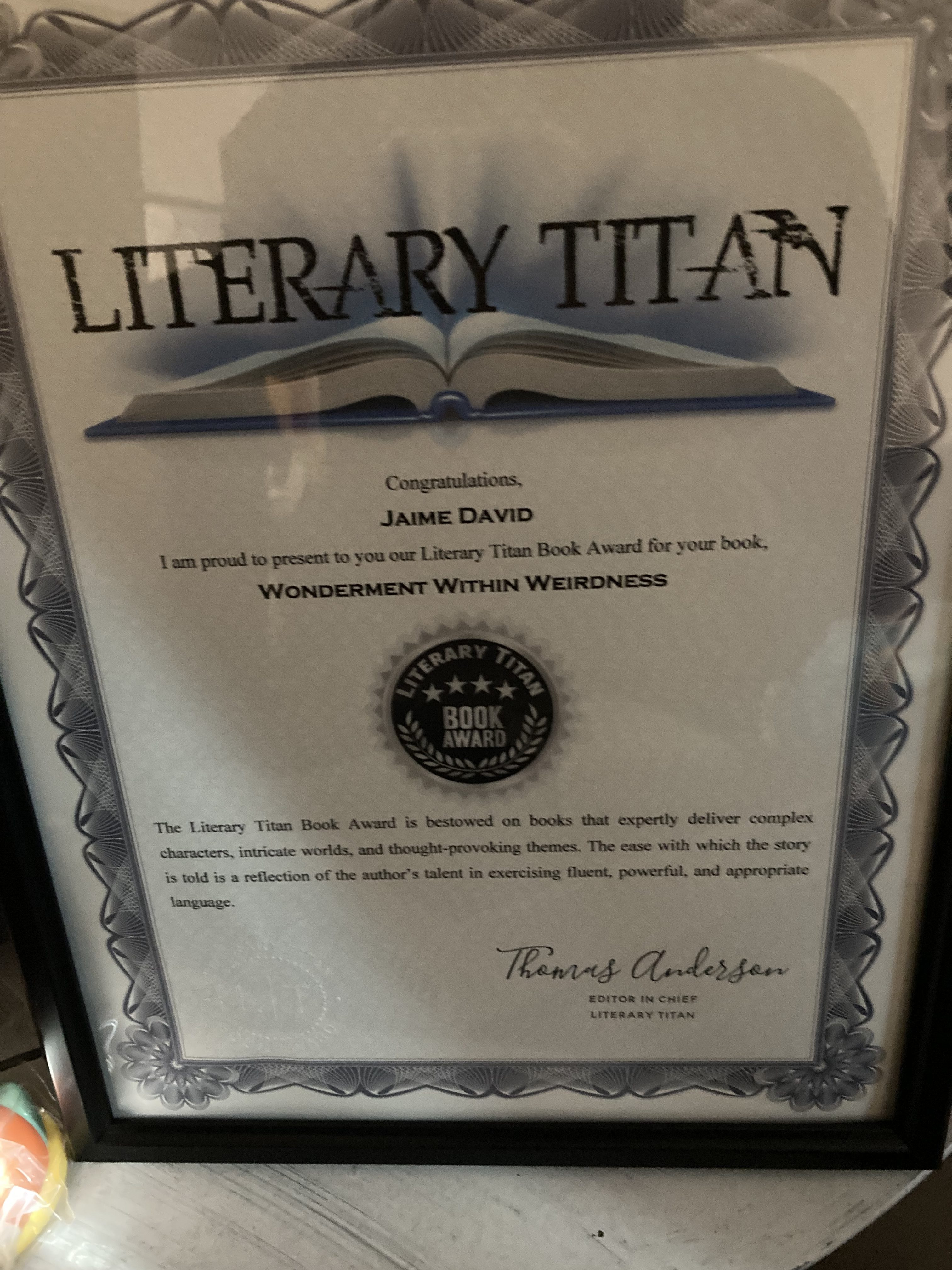
  • How My Debut Book “Wonderment Within Weirdness” Won a 4-Star Literary Titan Award

    How My Debut Book “Wonderment Within Weirdness” Won a 4-Star Literary Titan Award

    There are moments in life that do not fully register at first. Moments where you stare at a screen, reread the same sentence multiple times, and wonder if what you are seeing is actually real. For me, one of those moments came when I found out that my debut book, Wonderment Within Weirdness, had received a 4-star silver award from the Literary Titan.

    Now, before anyone misunderstands what I am saying, no, the Literary Titan award is not the Pulitzer Prize. It is not one of those century-old literary institutions that immediately dominate headlines or get discussed endlessly in academic circles. I understand that. I am aware of the hierarchy that exists within the literary world. There are massive awards with generations of prestige behind them, and then there are smaller, newer awards trying to carve out their own identity in the publishing landscape. Literary Titan falls more into that latter category. But here is the thing people often overlook: recognition is still recognition. An award does not have to be the most famous literary honor on Earth in order to matter.

    And for a debut author, especially an independent one, receiving any kind of legitimate literary recognition can mean far more than outsiders realize.

    Because here is the reality that many people do not talk about enough: writing a book is hard. Finishing a book is even harder. Publishing one is another mountain entirely. Then comes the most brutal stage of all, getting anyone to notice it in a world overflowing with content. Every day, countless books are released onto the internet. Thousands upon thousands of stories, poetry collections, essays, memoirs, philosophical works, experimental projects, and novels appear online, all fighting for visibility. Most disappear almost instantly into the digital void. Some never receive reviews. Some never find an audience. Some barely get read outside of friends and family circles. That is simply the brutal reality of modern publishing.

    Which is why the Literary Titan award mattered to me.

    Not because it suddenly transformed me into a globally recognized literary icon overnight. Not because I now expect to be discussed alongside literary giants. But because it represented something important: external validation. It meant that someone outside of my immediate circle looked at my work and believed it deserved recognition. That matters. Especially for a first book.

    Debut books exist in a strange space. Established authors often have advantages that new writers simply do not possess. They may already have audiences built over years. They may have publishers backing them with marketing budgets. They may have editors, agents, industry connections, media exposure, or simply the power of name recognition. Readers approach established writers with preconceived expectations. There is already a built-in level of trust there.

    A debut author has none of that.

    When someone picks up a first book from a completely unknown writer, there is no guarantee attached to it. There is no proven track record. No legacy. No assurance that the work will even be coherent, let alone compelling. A debut writer has to earn every ounce of credibility from scratch. That is part of what makes literary recognition for a first book feel especially significant.

    And in my case, Wonderment Within Weirdness was not some hyper-calculated, market-tested project designed specifically to appeal to mainstream publishing trends. If anything, the book reflects many of the themes and ideas that define my broader creative identity. Weirdness. Wonder. Introspection. Emotion. Existential thought. Philosophical wandering. Experimental energy. It is deeply tied to my voice as a writer and thinker. In many ways, it represents me authentically rather than trying to imitate what the market supposedly wants.

    That can be risky.

    The internet often pushes creators toward conformity. Algorithms reward familiarity. Publishing industries sometimes reward predictability. There is pressure everywhere to fit neatly into categories, genres, aesthetics, and market expectations. But creative work that embraces weirdness and individuality can sometimes cut through precisely because it feels different. It feels human. It feels personal. And I think that is part of why the recognition meant something to me.

    Because it suggested that originality still has value.

    I also think there is something psychologically important about literary awards for independent authors that many people underestimate. When you are creating largely on your own, doubt becomes constant. Every writer experiences it to some degree, but independent creators especially know what it feels like to question themselves endlessly. Is the work good enough? Is anyone reading? Does any of this matter? Am I wasting my time? These thoughts can become relentless.

    So when an outside organization says, “We see merit here,” it can genuinely impact a creator’s confidence. Not in an egotistical way, but in a stabilizing way. It becomes proof that the work connected with someone beyond yourself. That is valuable fuel for continuing forward creatively.

    And honestly, the award also made me reflect on how strange and unpredictable artistic journeys can be.

    There are writers who spend decades producing work before receiving recognition. There are others who explode into visibility instantly. Some receive praise early and disappear later. Others struggle for years before eventually finding audiences. There is no universal roadmap for creativity. No guaranteed formula. No clear sequence that determines who succeeds and who does not. The literary world is chaotic. Sometimes brilliant books are ignored. Sometimes mediocre books become massive phenomena. Sometimes deeply personal projects unexpectedly resonate with readers and reviewers alike.

    That unpredictability is both terrifying and beautiful.

    I think part of why this award mattered so much to me is because it symbolized momentum. Not finality. Not completion. Momentum. It felt like confirmation that I am not simply shouting into the void entirely unnoticed. Even smaller recognitions can create psychological momentum for artists. They can reinforce the idea that continuing to create is worthwhile.

    And perhaps most importantly, it reminded me that the definition of success is more nuanced than people often make it out to be.

    Modern internet culture tends to frame success in extremes. Either you are world famous, or you are irrelevant. Either you win the biggest awards imaginable, or your accomplishments supposedly do not count. But reality is far more layered than that. There are countless levels of artistic success between obscurity and superstardom. A smaller literary award can still represent a meaningful achievement. Especially for a first-time author.

    I also think there is something fascinating about newer literary awards in general. Every prestigious institution that exists today had to begin somewhere. The Pulitzer Prize was once new. The Booker Prize was once unknown. Every literary tradition starts small before history determines whether it grows into something larger. Now, I am not claiming Literary Titan will become the next Pulitzer. Nobody can predict that. But I do think people sometimes dismiss newer awards too quickly simply because they lack decades of legacy.

    The reality is that literary culture is constantly evolving. Independent publishing itself has changed dramatically over the last twenty years. The barriers between traditional and independent authorship have blurred. Online platforms have allowed writers to build audiences without relying entirely on gatekeepers. Smaller awards and independent review organizations have emerged partly because the literary ecosystem itself has expanded beyond older institutional models.

    And frankly, independent authors often need these spaces.

    Because traditional literary systems can be incredibly difficult to penetrate. Many talented writers never receive attention from major publishers or prestigious literary organizations despite producing meaningful work. Smaller awards can provide visibility where mainstream institutions may overlook emerging voices. That does not make the recognition fake or meaningless. It simply means it exists within a different layer of the literary landscape.

    Another thing that struck me after receiving the award was how differently creators experience recognition compared to outsiders observing from a distance. Someone scrolling online might see “4-star Literary Titan award” and move on after two seconds. But for the creator behind the work, that recognition often represents years of thought, effort, doubt, rewriting, editing, emotional investment, and persistence condensed into a single moment.

    People see the outcome. They rarely see the process behind it.

    They do not see the nights spent questioning whether the project will ever come together properly. They do not see the anxiety involved in publishing something personal into public view. They do not see the fear of rejection. They do not see the vulnerability required to create sincerely in a culture that often rewards irony and detachment more than authenticity.

    And perhaps that is another reason why this award felt meaningful to me specifically. It validated authenticity.

    I have always been drawn toward ideas that sit outside rigid convention. Whether through my writing, my philosophical ideas surrounding anarcho-compassionism, my blog posts, or my broader creative identity, I tend to gravitate toward introspection, emotional honesty, nuance, existential exploration, and unconventional thinking. Wonderment Within Weirdness reflects that mindset heavily. It is not trying to be sterile or artificially polished into generic marketability. It embraces weirdness directly, even in its very title.

    And honestly, I think the title itself matters.

    “Wonderment Within Weirdness” captures something fundamental about how I view creativity and existence. There is wonder inside the strange. Beauty inside imperfection. Meaning hidden within chaos. Modern society often pressures people to suppress weirdness, flatten individuality, and conform to expectations. But creativity frequently thrives in the exact opposite direction. Some of the most memorable art emerges precisely because it dares to be unusual.

    That does not mean every unconventional work automatically becomes brilliant. But authenticity has power. Readers can often sense when something comes from a genuine place rather than existing solely as a calculated product.

    I also think there is something inspiring about the fact that a debut independent book can receive recognition at all in today’s environment. We live in an era where gatekeeping still exists, but it is no longer absolute. Independent creators have more opportunities than ever before to publish work, connect with audiences, and gain visibility. The internet has created overwhelming saturation, yes, but it has also democratized creativity in many ways.

    That democratization comes with contradictions. Visibility is harder because everyone is competing simultaneously. Yet opportunities also exist that previous generations of writers could barely imagine. A person can build a blog, publish books independently, create podcasts, interact directly with readers, and cultivate a creative ecosystem almost entirely outside traditional institutions.

    That is part of the journey I have been navigating myself through The Musings of Jaime David and my broader online presence.

    And perhaps that is another reason this award felt important. It represented not just one isolated accomplishment, but evidence that the broader creative path I have been pursuing might actually be leading somewhere meaningful.

    What made the experience even more surreal was seeing the recognition expand beyond the award announcement itself. Literary Titan did not simply hand out the award quietly and move on. There was an actual press release published about my book receiving the award, which made the accomplishment feel far more tangible and publicly documented. FinancialContent press release about the award

    That mattered to me because there is something psychologically different about seeing your work discussed publicly in a professional context. It transforms the experience from feeling purely internal into something externally recognized and archived. Suddenly, the book was not just existing within my own creative ecosystem. It was being discussed beyond it.

    Then there was the author interview that Literary Titan conducted with me, which honestly made the entire experience feel even more real. Literary Titan author interview with Jaime David The title alone, “It Started With a YouTube Comment,” captures something fascinating about modern creativity and internet culture. So many creative journeys now begin in strange, seemingly insignificant digital moments. A comment. A post. A random idea. A passing conversation online. Something tiny eventually snowballs into something much larger.

    That interview gave me the opportunity to reflect not just on the book itself, but on the broader creative process behind it. And honestly, interviews can sometimes feel even more vulnerable than the work itself because they require the creator to directly articulate thoughts, motivations, insecurities, and inspirations in their own voice. There is nowhere to hide behind fictional structure or poetic abstraction at that point. It becomes direct human reflection.

    And then there was the review itself from Literary Titan. Literary Titan review of Wonderment Within Weirdness Reviews are fascinating because they represent interpretation. Once creative work enters the world, readers begin forming their own relationships with it. They notice things the creator may not have fully realized themselves. They interpret themes differently. They emotionally connect to unexpected aspects of the work. That is part of what makes literature so interesting in the first place. Books stop belonging solely to the author once they are released publicly. They become shared experiences between creator and reader.

    Perhaps one of the strangest and coolest parts of all this, though, was the fact that there was even a podcast episode discussing my book. Literary Titan podcast episode about Wonderment Within Weirdness There is something surreal about hearing people talk about your creative work in audio form, almost like listening to your ideas echo back at you from outside yourself. It creates this bizarre sensation where the project suddenly feels alive beyond your own head.

    And honestly, when you step back and look at the full picture, it becomes clear that the experience extended beyond simply “winning an award.” There was the award itself, the review, the interview, the press release coverage, and even a podcast discussion. For a debut independent book, that is genuinely meaningful visibility.

    Will the Literary Titan award alone suddenly make me famous? Of course not. I am realistic about that. But creative careers are often built incrementally. Recognition accumulates piece by piece over time. One review leads to another. One award builds credibility. One reader recommends a book to someone else. Momentum compounds gradually rather than explosively for most writers.

    People often romanticize overnight success while ignoring how many creators build their audiences slowly over years. Persistence matters enormously in creative fields. So does consistency. So does continuing to create even when visibility feels limited.

    And honestly, I think the award reinforced something deeper psychologically for me: the importance of continuing despite uncertainty.

    Because uncertainty never fully disappears for artists. Even successful writers experience doubt constantly. There is no magical point where creators suddenly become immune to insecurity. Every project involves risk. Every piece of writing involves vulnerability. Every publication becomes an act of exposure in some way.

    But recognition can help counterbalance that uncertainty enough to keep moving forward.

    It can remind creators that their work has impact beyond their own internal world. That someone connected with it. That the effort mattered to another human being somewhere out there.

    And for me, as a debut author, that feeling carries enormous significance.

    Fediverse Reactions
  • May 17, 2026 Update: No Word On Anything, UnderSparked Is Suing YouTube, And I’ve Been Taking A Break

    May 17, 2026 Update: No Word On Anything, UnderSparked Is Suing YouTube, And I’ve Been Taking A Break

    It’s May 17, 2026.

    And honestly? I almost didn’t write this post. Because this month, the month of May, I just have not been feeling like posting on any of my blogs. Not this one. Not my music blog. Not any of them. I’ve been busy. I’ve been burnt out. I’ve been needing a break from all of this. And I’ve been taking that break, or at least trying to. Because this entire situation with YouTube and Google has stressed me out in ways I didn’t fully anticipate when this all started back in early February. And on top of all of that, there’s everything else happening in this country and the world right now, which I’m not going to get into in this post, but which has added its own weight to everything. It’s just been a lot. All of it together has been a lot.

    But I’m writing this post anyway. Because there are updates. Because things have happened that I need to document and share. Because UnderSparked, a channel I care about and have been following through their own YouTube nightmare, just dropped a video that changed the entire landscape of this conversation. And because even when I’m burnt out and stressed and taking a break, I’m not willing to let this situation go undocumented. I’m not willing to let Google and YouTube off the hook just because I needed some time to breathe.

    So let me catch everyone up on everything, starting from the beginning for anyone who’s just finding this, and then getting into what’s new.

    The Full Background: Months of Discrimination and Silence

    Back in late January or early February 2026, YouTube terminated my manager channels overnight without warning. These were completely inactive administrative accounts with zero content, zero videos, zero posts, zero activity of any kind. They existed purely to give me backend access to manage my actual content channels. YouTube claimed they violated spam, deceptive practices, and scams policies. The claim was logically impossible from the moment I read it. You cannot post spam on a channel with no content. You cannot deceive anyone through an account that has never publicly done anything. YouTube’s automated AI system flagged my inactive accounts as suspicious, terminated them without human oversight, and when I filed appeals, rejected those appeals within approximately five hours with generic template responses that provided zero evidence, zero specifics, and zero real reasoning. Five hours of claimed careful review that was clearly nothing more than automated rubber stamping.

    The consequence of losing my manager channels was losing access to my actual content channels. My Luffymonkey0327 meme and mashup channel with over 500 subscribers is still live right now at https://youtube.com/@luffymonkey0327?si=H64a-BY4Spu4Cdb6. Anyone can visit it. Anyone can see the content I created. But I cannot access it. I cannot upload new videos. I cannot respond to my subscribers’ comments. I cannot check analytics. I cannot manage my own work. YouTube is hosting my content, potentially benefiting from any traffic it generates, while locking me out of managing it. That’s theft. That’s discrimination.

    After I filed a formal Better Business Bureau complaint documenting everything, YouTube deleted my JaimeDavid327 author channel under their circumvention policy. The circular logic was staggering: because my manager channels had been terminated, having content channels constituted circumvention of that termination. YouTube punished me for their own wrongful decision by making more wrongful decisions based on that first wrongful decision. My professional identity as a Hispanic writer, my author platform, my connection to readers, erased. Gone.

    Running parallel to all of this, Google has been rejecting my AdSense application for my Jaime David Music blog on Blogger repeatedly with the same vague determination: low value content. No specifics. No examples. No actionable feedback. Just the same copy paste rejection over and over for a blog that has been running for almost a year with nearly 200 essay style posts about music. I’ve demanded an actual human review my application. I’ve refused to change anything because there is nothing wrong with my blog. And I’ve gotten nothing but the same automated rejection every time.

    Throughout all of this, I’ve addressed YouTube CEO Neal Mohan, Google CEO Sundar Pichai, Google President Ruth Porat, and Google Senior Vice President James Manyika directly and by name across multiple detailed posts. I’ve filed formal complaints. I’ve called on major YouTubers including Smosh, PewDiePie, Markiplier, SomeOrdinaryGamers, ReviewTechUSA, Amazing Atheist, Secular Talk, Humanist Report, MrBeast, Jacksepticeye, Nexpo, Vaush, HasanAbi, and Hank Green to amplify my story. I’ve documented discrimination, harassment, retaliation, and systematic targeting of a Hispanic creator across Google’s entire ecosystem. And I’ve received from YouTube and Google: complete and total silence. For months. Not one word. Not one acknowledgment. Not one human being reaching out to say they were looking into anything.

    I also previously wrote about how I submitted a fresh appeal for my JaimeDavid327 channel, asking YouTube to actually have a live human being sit down and review my case rather than another automated system producing another automated rejection. That appeal is still out there somewhere in YouTube’s system. Whether any human being has actually looked at it, I have no idea. Whether it will result in anything different from every other appeal I’ve filed, I don’t know. I submitted it. I documented it. And I’m still waiting.

    The Current Status: Still No Word on Anything

    As of today, May 17, 2026, here is where everything stands.

    No word from Google about monetizing my Jaime David Music blog. No AdSense approval. No human communication. No specific feedback about what the actual problem is. Nothing. The blog is still there. The nearly 200 posts are still there. The almost year of work is still there. And Google is still apparently either not looking at it or looking at it and deciding through some automated process that it’s low value content without ever telling me what that actually means or how to address it.

    No word from YouTube about restoring my channels. My manager channels remain terminated. My JaimeDavid327 author channel remains deleted. My access to Luffymonkey0327 at https://youtube.com/@luffymonkey0327?si=H64a-BY4Spu4Cdb6 remains blocked. The appeal I submitted remains unanswered or at least unresolved in any meaningful way. Months have passed. The situation is exactly as it was when it started. YouTube terminating channels based on automated false accusations and maintaining those terminations through silence and inaction.

    And no word from YouTube about restoring monetization for UnderSparked.

    Which brings me to the biggest update in this post.

    UnderSparked Is Suing YouTube

    A few weeks ago I wrote about UnderSparked, a YouTube channel that had been demonetized by YouTube’s automated systems in a situation that had deeply familiar characteristics to my own. YouTube’s AI flagged their content as not having value, stripped their monetization, and left them dealing with the financial consequences and the frustrating inadequacy of YouTube’s appeals and review processes. I wrote about their situation because it illustrated that what was happening to me wasn’t isolated. It was part of a systemic pattern of YouTube’s automated systems making consequential decisions about creators without adequate human oversight, without fair process, without transparent communication.

    Well. UnderSparked has now made a new video. And they’re suing YouTube.

    Watch the video here: https://youtu.be/yrDUrttm0GA?si=6LAmHLiKts1cdO9a

    I want to let that sink in for a moment. UnderSparked is taking YouTube to court. They’re not just filing complaints. They’re not just making videos about their situation. They’re pursuing legal action against one of the most powerful platforms on the internet because YouTube’s automated systems wrongfully demonetized them and YouTube apparently failed to provide adequate resolution through their internal processes.

    I’m not going to pretend this doesn’t affect me emotionally. Because UnderSparked is a channel I like. A channel I’ve been following. A channel I’ve been watching go through their own version of the nightmare I’ve been living. And to see them reach the point where legal action feels like the necessary next step, that hits differently than just reading about someone else’s YouTube problems abstractly. This is a creator I care about, going through something I understand intimately, and taking a step that speaks to just how badly YouTube has failed them.

    And I want to be honest about what seeing UnderSparked’s situation reach this point does to my feelings about my own situation. It feels like triple getting screwed over by Google and YouTube. Because here’s a channel I follow, a creator whose work I value, dealing with YouTube’s broken systems and discriminatory automated decisions, and they’re getting nowhere through normal channels just like I’m getting nowhere. And meanwhile I still have no access to my own channels. I still have no AdSense approval for my music blog. I still have no response from anyone at YouTube or Google with actual authority to fix any of this. And now I’m watching a creator I care about have to resort to legal action because that’s apparently what it takes to get YouTube to actually pay attention.

    If you haven’t watched UnderSparked’s video yet, please do. https://youtu.be/yrDUrttm0GA?si=6LAmHLiKts1cdO9a. Share it. Talk about it. Because this is significant. A creator suing YouTube over wrongful demonetization is not a small thing. It’s the kind of action that should make everyone at YouTube and Google sit up and pay attention. It’s the kind of action that could set precedent for how platforms are held accountable for the harm their automated systems cause to creators.

    I’ve Been Burnt Out and Taking a Break

    I want to be real with you about something. This month, May 2026, I have barely posted anything on any of my blogs. Not here. Not my music blog. Not anywhere. And it’s not because nothing has been happening. It’s because I’ve needed a break. Because I’ve been busy with life things that have nothing to do with YouTube or Google. And because honestly, this entire situation has taken a toll on me that I don’t think I fully acknowledged until I found myself just not wanting to write anything for weeks.

    Being locked out of your own creative work for months is demoralizing in a way that’s hard to fully articulate. Building something, investing time and energy and creativity into channels and a blog and an audience, and then having it taken away through automated discrimination and having no meaningful recourse to get it back, that wears on you. It accumulates. It becomes background stress that colors everything else. And when you add to that everything else happening in this country and this world right now, which I’m not going to get into specifically because that’s a whole other conversation, it just becomes a lot. All of it together becomes a lot.

    So I took a break. I stepped back from posting. I gave myself permission to not write about this every single day or even every single week. I let myself breathe a little. And I don’t regret that. I needed it. I think any creator who’s been fighting a battle like this for months without resolution would need it at some point.

    But I’m back now. Not because everything is fixed. Nothing is fixed. Not because I’m feeling refreshed and energized and ready to fight with full intensity again. I’m still tired honestly. But because UnderSparked’s lawsuit video reminded me why this matters. Why documenting this matters. Why keeping the pressure on matters even when it feels futile.

    Because YouTube suing UnderSparked, sorry, UnderSparked suing YouTube, that’s what happens when creators stop getting nowhere through official channels and take things to the next level. And while I haven’t reached that specific step yet, watching it happen to a creator I care about reminded me that giving up entirely and going silent is exactly what YouTube and Google want from creators they’ve wronged. They want you to get tired. They want you to stop posting. They want you to eventually just disappear so they never have to deal with the mess their automated systems created.

    I’m not disappearing.

    A Direct Message to Everyone Who Has the Power to Fix This

    Neal Mohan, YouTube CEO. It has been months. My channels are still terminated. My access is still blocked. My appeal is still unresolved. UnderSparked is now suing YouTube. Is this the direction you want things to continue going? More creators reaching the point where legal action is the only option because YouTube’s internal processes have failed them completely? Or would you like to actually address these situations with the human review and transparent communication that should have happened from the beginning?

    Sundar Pichai, Google CEO. Your subsidiary has been discriminating against me as a Hispanic creator for months. Your AdSense system has been rejecting my music blog application with vague copy paste responses for almost as long. A creator who was demonetized by YouTube’s automated systems is now taking legal action against your company. At what point does this become something that requires your direct attention and intervention?

    Ruth Porat, Google President. James Manyika, Google Senior Vice President. Everything I’ve been saying for months about broken automated systems, inadequate human oversight, discriminatory patterns of treatment, those aren’t abstract complaints anymore. They’re documented across months of posts. They’re reflected in UnderSparked’s lawsuit. They’re part of a growing body of evidence that YouTube and Google’s approach to creator moderation and monetization is fundamentally broken and causing real harm to real people.

    Smosh, PewDiePie, Markiplier, SomeOrdinaryGamers, ReviewTechUSA, Amazing Atheist, Secular Talk, Humanist Report, MrBeast, Jacksepticeye, Nexpo, Vaush, HasanAbi, Hank Green. Please watch UnderSparked’s lawsuit video at https://youtu.be/yrDUrttm0GA?si=6LAmHLiKts1cdO9a. Please share it. Please add your voices to this conversation. Because if a creator can be demonetized without adequate recourse and have to resort to legal action to get YouTube’s attention, that vulnerability exists for every creator on this platform. Including all of you.

    Where I Go From Here

    Honestly? I don’t entirely know. I’m still burnt out. I’m still tired. I’m still dealing with months of accumulated stress from this situation. I’m still watching UnderSparked’s story unfold and feeling the weight of knowing that YouTube’s failures aren’t just affecting me, they’re affecting creators I care about, creators whose work I value, creators who deserve so much better than what YouTube’s broken automated systems have done to them.

    But I’m still here. Still documenting. Still refusing to let Google and YouTube maintain their discrimination in silence. My Luffymonkey0327 channel is still out there at https://youtube.com/@luffymonkey0327?si=H64a-BY4Spu4Cdb6, still inaccessible to me, still hosting my content without giving me management access. My JaimeDavid327 author channel is still deleted. My AdSense application is still rejected. My appeal is still unresolved. Everything is still exactly the wrong kind of the same.

    And UnderSparked is now suing YouTube. Watch that video. Share it. Because that’s what the end of the road with YouTube’s broken processes looks like. That’s what happens when a creator exhausts every other option. And nobody, not me, not UnderSparked, not any creator, should have to get to that point just to be treated fairly by a platform they’ve invested in.

    I’ll keep writing. Maybe not every day. Maybe not even every week. But I’ll keep writing. Because this story isn’t over. And I’m not letting it be buried.