The Musings of Jaime David
@jaimedavid.blog@jaimedavid.blog

The writings of some random dude on the internet

1,201 posts
1 follower

Tag: publishing

  • So, Who the Hell Is Jamie David? The Author of Johann Sebastian Humpbach

    So, Who the Hell Is Jamie David? The Author of Johann Sebastian Humpbach

    Okay.

    Screw it.

    We have officially reached the point where I might as well write the post.

    If you have followed my writing for any amount of time, you may have seen me mention a certain name.

    Jamie David.

    Notice the spelling.

    Jamie.

    J-A-M-I-E.

    Not Jaime.

    J-A-I-M-E.

    That one letter has become surprisingly important in my life.

    Because Jamie David is not me.

    She is a completely different person.

    She is an author.

    She is an artist.

    She is a former teacher.

    She lived in Hawaii.

    She wrote a children’s adventure novel about a singing whale.

    And, for reasons that I still find both hilarious and increasingly irritating, a bunch of spammers and random internet people keep apparently deciding that I am her.

    Yes.

    Me.

    The guy who writes under the name Jaime David.

    Apparently, one letter is sometimes the difference between knowing who you’re talking to and sending a wildly enthusiastic promotional email to the wrong author.

    So today, instead of simply saying, “Hey, I’m not Jamie David,” I thought:

    Why not actually find out who Jamie David is?

    Because here’s the thing.

    I have spent a fair amount of time talking about the confusion.

    I have joked about it.

    I have complained about it.

    I have written posts explaining it.

    I have told scammers that they have the wrong person.

    But somewhere underneath all of that is an actual human being who has her own story, her own career, her own creative work, and her own reason for writing the book that keeps getting me mistaken for her.

    And honestly?

    Her story is pretty interesting.

    First Things First: I Am Not Jamie David

    Let’s get this out of the way immediately.

    I am Jaime David.

    J-A-I-M-E.

    I write Wonderment Within Weirdness.

    I write My Powerful Poems.

    I write Some Small Short Stories.

    I run The Musings of Jaime David.

    I make music.

    I make podcasts.

    I write essays.

    I create a ridiculous number of things.

    I am not the author of Johann Sebastian Humpbach.

    I did not write a children’s adventure about a singing whale.

    I have never claimed that I did.

    I have no connection to that book.

    And I am not Jamie David.

    Jamie David is spelled J-A-M-I-E.

    She is the author of Johann Sebastian Humpbach, a book first published in 2009 by Chai Yo Maui Press. The book is 167 pages and follows a world-famous singing whale named Johann Sebastian Humpbach who disappears during his annual migration from Alaska to Hawaii.

    So if you came here because you are looking for the author of Johann Sebastian Humpbach:

    You have the wrong Jaime.

    Or, technically, the wrong Jamie.

    And that distinction is the entire reason this post exists.

    So Who Is Jamie David?

    The public information I can find about her paints a picture that is actually pretty fascinating.

    Jamie David is described as a writer, artist, and former teacher living on the island of Maui.

    She was born and raised in small-town Pennsylvania.

    After college, she moved west and eventually settled in San Francisco during what the author biography describes as an exciting period in the city’s history.

    Then, in 1986, she and her husband, Ralph, moved to Hawaii.

    That is already quite a life.

    Pennsylvania.

    California.

    Hawaii.

    Teacher.

    Artist.

    Writer.

    And eventually author of a children’s adventure story set around the Hawaiian islands.

    There is a pretty obvious geographic thread running through that story.

    Hawaii isn’t merely a backdrop in her writing.

    It appears to have been a major part of her life.

    And that makes Johann Sebastian Humpbach make a lot more sense.

    This wasn’t somebody sitting in some random office trying to manufacture an exotic setting.

    She actually lived there.

    She knew the environment she was writing about.

    She had spent decades in Hawaii.

    And eventually, she turned that experience into a children’s story.

    The Book Started With Her Students

    This might be my favorite part of the whole story.

    According to the author’s biography, during her years as a teacher, her middle-school English students frequently complained:

    Why can’t we read something fun?

    That complaint eventually became the spark for Johann Sebastian Humpbach.

    She wanted to create a story that would be entertaining for students while also being informative.

    She wanted something set in Hawaii.

    And when she couldn’t find the kind of book she was looking for, she decided to write one herself.

    That is actually something I can relate to.

    Not the whale part.

    Not the middle-school classroom part.

    Definitely not the Hawaii part.

    But the fundamental idea?

    Absolutely.

    You look around.

    You don’t find the thing you want.

    So eventually you think:

    Fine.

    I’ll make it myself.

    That is basically how a lot of creative projects begin.

    You have a problem.

    You have an idea.

    You have an itch that something isn’t quite right.

    And eventually you stop waiting for someone else to solve it.

    You create the thing.

    That’s how books happen.

    That’s how songs happen.

    That’s how blogs happen.

    That’s how podcasts happen.

    That’s how weird little creative projects happen.

    And apparently that’s how a singing whale ended up becoming a children’s novel.

    Enter Johann Sebastian Humpbach

    And what a title.

    Johann Sebastian Humpbach.

    I have to admit, the first time I saw that title, I immediately thought:

    What the hell is this?

    It is one of those titles that you cannot really ignore.

    Johann Sebastian Humpbach sounds simultaneously like a famous classical composer, a German philosopher, and a whale.

    And, as it turns out, he is the whale.

    The world’s most popular singing whale, apparently.

    Johann disappears during his annual migration from Alaska to Hawaii.

    Meanwhile, twelve-year-old twins Keoni and Leilani receive a birthday surprise from their Auntie Pua and Uncle Kalani.

    During a snorkeling trip, the twins discover a clue connected to Johann’s disappearance.

    And suddenly, they are pulled into an adventure involving a missing whale, mysterious circumstances, family, and villains.

    The book is essentially a middle-grade Hawaiian adventure story.

    And honestly?

    It sounds like a lot of fun.

    There Are Twins

    The protagonists are twelve-year-old twins named Keoni and Leilani.

    That is an important detail because the story isn’t simply about a whale.

    It’s about kids getting caught up in an adventure.

    They find a clue.

    They get involved.

    They become part of the search.

    And, according to the book description, they have to contend with Dr. Vile and his henchmen, who apparently want to silence the twins and prevent them from succeeding.

    It has all the classic ingredients of a children’s adventure.

    A mysterious disappearance.

    A pair of young protagonists.

    A beautiful setting.

    A strange mystery.

    Villains.

    Danger.

    Family.

    And a giant singing whale.

    It is a very different kind of book from anything I write.

    Which makes the mistaken identity even funnier.

    Imagine being a spammer who thinks they have found the author of a cheerful children’s Hawaiian whale adventure and instead emailing the guy who writes science-fiction weirdness and political essays.

    That’s not even the same ocean.

    And Apparently the Book Has an Environmental Message

    There is another interesting detail that shows up in descriptions and reviews of the book.

    One description of the book’s reception notes that it was written with middle-school students in mind and that the story includes a strong environmental message.

    That makes sense.

    If you’re writing a story about whales, Hawaii, migration, and the ocean, environmental themes are practically sitting there waiting for you.

    And it seems like the educational side of Jamie’s background mattered.

    She wasn’t simply trying to entertain.

    She wanted to make something that could be enjoyable while also teaching something.

    That’s a philosophy I respect.

    Because children’s literature can do both.

    It can be fun.

    It can be ridiculous.

    It can have singing whales.

    And it can still leave a kid thinking about the world around them.

    Jamie David Was a Teacher Before She Was an Author

    This is another part of her story that I find important.

    Her author biography identifies her as a former teacher.

    And the book itself appears to have grown directly out of that experience.

    Her students wanted something fun to read.

    She couldn’t find exactly what she wanted.

    So she created it.

    That means the book wasn’t simply an abstract creative exercise.

    It had a purpose.

    She had an audience in mind.

    She knew the age group.

    She knew what students were asking for.

    And she used that knowledge to build a story.

    There is something very practical about that.

    Sometimes creativity begins with a question:

    What do people actually want?

    In her case, the answer was apparently:

    Something fun.

    And so she wrote something fun.

    She Was Also an Artist

    And this is where the story gets even more interesting.

    Jamie wasn’t only a teacher and writer.

    Her author biography describes her as an artist as well.

    That means her creative identity extends beyond the book.

    She wasn’t simply somebody who happened to write one children’s novel.

    She had an artistic life.

    And perhaps that explains some of the visual and imaginative qualities of the project.

    A book like Johann Sebastian Humpbach isn’t only about words.

    It’s about creating a world.

    Hawaii.

    The ocean.

    Whales.

    Twins.

    Family.

    Villains.

    Adventure.

    Mystery.

    All of that requires imagination.

    And artists tend to think in worlds.

    That’s something I understand.

    I spend a lot of time doing the same thing, even though my medium is different.

    She Even Made a Companion Coloring Book

    One of the stranger things I discovered while researching her was that Jamie David apparently created a companion coloring book connected to Johann Sebastian Humpbach. A printing-industry article from 2017 specifically describes the book as a Hawaii-based early-reader novel and notes that she created a companion coloring book.

    And I love that.

    Because it shows that she wasn’t thinking about the story as just one object.

    She created something that could extend beyond the book itself.

    A story becomes a coloring book.

    A character becomes an image.

    A world becomes something children can interact with.

    That’s a pretty cool way to think about storytelling.

    And again, I find myself thinking about my own creative work.

    I don’t necessarily want everything I create to exist in isolation either.

    A poem can become a song.

    A podcast episode can become a transcript.

    A blog post can inspire another post.

    A book can become part of a series.

    An idea can mutate into something else.

    Creative work doesn’t always have to remain in the form in which it was born.

    Sometimes it evolves.

    And Apparently She Took the Book Into the Real World

    One of the things I found while researching her was a printing-industry article mentioning that Jamie David would set up a table at her town’s weekly street fair during the summer to sell Johann Sebastian Humpbach.

    That detail makes her feel much more real to me.

    Because it is easy to look at an author online and imagine some abstract person who simply exists as a name attached to a book.

    But this was apparently someone physically going out into her community with copies of her book.

    A table.

    A street fair.

    Copies of the book.

    Talking to people.

    Selling it.

    Connecting with readers.

    That’s what independent publishing looked like long before the current creator economy became a buzzword.

    And honestly, I respect the hell out of that.

    Because getting a book into the world is one thing.

    Getting people to actually pick it up is another.

    She Also Had a Very Different Publishing Journey From Mine

    Johann Sebastian Humpbach was published in 2009 by Chai Yo Maui Press. The book has a 2009 publication date and carries ISBN 9780615318400.

    That’s worth remembering.

    That was a very different internet.

    Social media looked different.

    Amazon looked different.

    Self-publishing looked different.

    Blogs looked different.

    Digital marketing looked different.

    The entire online publishing ecosystem was different.

    And yet, she still managed to put a book into the world.

    That’s something I can appreciate.

    Because regardless of what genre you write, there is a certain courage involved in publishing.

    You are taking something that existed inside your head and saying:

    Here.

    Other people can read this now.

    That’s terrifying.

    And exhilarating.

    And sometimes both at the same time.

    Then There Is the Part Where I Keep Getting Mistaken for Her

    Now we get to my favorite part.

    The stupid part.

    The ridiculous part.

    The part that caused this entire post to exist.

    Spammers keep confusing me with her.

    Not once.

    Not twice.

    Enough times that I have written about it publicly.

    The first major incident I remember involved an email that was very obviously meant for the author of Johann Sebastian Humpbach.

    It was an absurdly enthusiastic promotional pitch.

    The person writing it apparently believed they were talking to the author of the singing-whale adventure.

    Except they weren’t.

    They were talking to me.

    I was sitting there reading an email about Johann Sebastian Humpbach thinking:

    Who the hell are you talking to?

    Because I didn’t write that book.

    I don’t have a singing whale.

    I don’t have twins named Keoni and Leilani.

    I don’t have a Hawaiian children’s adventure series.

    I have absolutely no idea why you are talking to me about this.

    And then I realized:

    Oh.

    You think I’m her.

    And That’s When the Name Difference Became Really Funny

    Jamie.

    Jaime.

    One letter.

    That’s it.

    One letter.

    And apparently that is enough to confuse automated systems, spammers, scrapers, databases, and people who apparently don’t read very carefully.

    I have J-A-I-M-E.

    She has J-A-M-I-E.

    That’s the difference.

    And yet, online, a single letter can disappear remarkably easily.

    Someone searches for a name.

    Someone copies an email address.

    Someone scrapes an author database.

    Someone generates a marketing message.

    Someone looks at search results.

    Someone sees “Jamie David.”

    Someone sees “Jaime David.”

    And apparently the brain goes:

    Close enough.

    No.

    Not close enough.

    But I Don’t Blame Her

    This is important.

    I don’t blame Jamie David for any of this.

    At all.

    She didn’t send the spam emails.

    She didn’t tell anybody to confuse us.

    She didn’t create my identity.

    She didn’t create the internet.

    She didn’t invent automated scraping.

    She didn’t invent lazy marketing.

    She didn’t invent scammers.

    And she certainly didn’t ask to share a nearly identical name with me.

    She’s just another person who happens to have a name that looks extremely similar to mine.

    That’s it.

    If anything, I feel a strange sense of solidarity with her.

    Because I have to wonder whether she has ever been confused with me.

    Maybe she has.

    Maybe someone has contacted her about one of my books.

    Maybe someone has asked her about The Musings of Jaime David.

    Maybe someone has assumed she writes science fiction.

    Maybe somebody has looked at the name and never bothered to check the spelling.

    I have no idea.

    But it would be completely unsurprising.

    Because This Isn’t Really a Jamie Problem

    It’s an internet problem.

    It’s an attribution problem.

    It’s a metadata problem.

    It’s an algorithm problem.

    It’s a “people don’t read carefully” problem.

    And it is especially a problem when authors are involved.

    Because authorship matters.

    If you attribute the wrong book to the wrong person, you are not just making a funny mistake.

    You are attaching somebody else’s work to someone else’s identity.

    Imagine someone searching for me and seeing Johann Sebastian Humpbach listed under my name.

    Or someone searching for Jamie and finding Wonderment Within Weirdness.

    That’s not just confusing.

    It’s inaccurate.

    And eventually, inaccuracies become part of the digital record.

    Search engines index things.

    Databases copy things.

    Websites scrape things.

    People repeat things.

    And suddenly, a mistake that started with one lazy email can appear in five different places.

    Then twenty.

    Then fifty.

    Then somebody else assumes those fifty places must all be correct because they’re saying the same thing.

    That’s how misinformation spreads.

    Not necessarily through some grand conspiracy.

    Sometimes through repetition.

    And That’s Why I Keep Clarifying It

    I know it is funny.

    I know I have joked about it.

    I know that “No, I’m not the singing-whale author” is a pretty ridiculous sentence to have to say.

    But I also think there is value in being precise.

    So let’s do this one more time.

    Jamie David wrote Johann Sebastian Humpbach.

    Jaime David wrote Wonderment Within Weirdness.

    Jamie David is associated with Hawaii, children’s fiction, teaching, and art.

    Jaime David is associated with The Musings of Jaime David, books, music, podcasting, essays, and a completely different creative universe.

    Different people.

    Different spelling.

    Different books.

    Different lives.

    One extremely annoying letter.

    And Honestly, Her Book Sounds Pretty Damn Fun

    Now that I have actually researched Jamie David instead of simply knowing her as “the person scammers confuse me with,” I have to admit something.

    Johann Sebastian Humpbach actually sounds fun.

    A singing whale?

    Missing during migration?

    Two twelve-year-old twins?

    Hawaii?

    A mysterious clue?

    Villains?

    Adventure?

    Come on.

    That’s a pretty solid children’s adventure premise.

    And the fact that the book grew out of her experience as a teacher makes it even more interesting.

    She saw a gap.

    Her students wanted something fun.

    She couldn’t find the right thing.

    So she wrote it.

    That’s creativity.

    And I can respect that even if it is completely different from what I do.

    Maybe That’s the Funny Lesson in All of This

    When this whole thing first started, I mostly thought it was funny.

    Then it became annoying.

    Then it became something I felt I needed to clarify.

    But after actually digging into Jamie David’s story, I think I’ve landed somewhere else.

    It’s kind of fascinating.

    Because I keep finding people who share some variation of my name.

    And every single one of them has a completely different story.

    One Jaime David became a major Dominican political figure.

    Another Jaime M. David built a career in fashion and lifestyle communications.

    Another Jaime David became a BERNINA educator and textile artist.

    And Jamie David wrote about a singing whale and two adventurous Hawaiian twins.

    And then there is me.

    The sci-fi-writing, poetry-writing, blogging, podcasting, music-making, independent-creative-project-making Jaime David.

    That’s a pretty weird collection of people.

    And I love it.

    Names Don’t Own Us

    Maybe that’s the bigger lesson here.

    We spend a lot of time thinking about names as though they are unique identifiers.

    But they’re not.

    They are shared.

    They’re inherited.

    They’re sometimes changed.

    They’re sometimes chosen.

    And they’re constantly reused.

    What makes a person unique isn’t the name.

    It’s what they do with it.

    Jamie David took her name and wrote a children’s adventure.

    She taught.

    She created art.

    She lived in Hawaii.

    She made a book for young readers.

    She created a companion coloring book.

    She apparently brought her book into her community and sold it at street fairs.

    She built a creative life around her interests.

    I took my name and built something else.

    A blog.

    Books.

    A podcast.

    Music.

    Essays.

    Poetry.

    Whatever else I decide to make.

    And neither of us needs to be the “real” Jaime or Jamie David.

    We are both real.

    Our work is real.

    Our identities are real.

    Our stories are separate.

    So, To Jamie David

    If you ever happen to stumble across this:

    Hi.

    I’m the other one.

    The one with the A-I instead of the A-M-I.

    The one who keeps getting your spam.

    The one who apparently has had to explain to the internet that he did not write about a singing whale.

    I have never met you.

    I don’t know you personally.

    But after researching your story, I can say this:

    I think what you did is pretty cool.

    You saw something your students wanted.

    You couldn’t find it.

    So you wrote it.

    You turned your experience as a teacher into a children’s adventure.

    You created a Hawaiian setting.

    You made a singing whale the center of the story.

    You created a companion coloring book.

    You took the book into the real world.

    You built something.

    And ultimately, that’s what I respect.

    Because that’s what I’m doing too.

    Just differently.

    And To the Spammers

    Please.

    For the love of God.

    Look at the spelling.

    That’s all I’m asking.

    If the email says Jaime, maybe don’t assume you’re talking to Jamie.

    If the website says one thing, check the website.

    If the book you’re talking about doesn’t appear anywhere in the person’s bibliography, maybe reconsider before sending the pitch.

    And if you’re using some automated system that has decided Jamie and Jaime are interchangeable?

    Fix your damn database.

    I promise you, the world will survive.

    And maybe I’ll stop receiving emails about a whale I didn’t write about.

    Although, admittedly, there is something hilarious about the fact that this has become such a recurring theme in my life that I am now writing an entire essay about the woman who wrote Johann Sebastian Humpbach.

    Only on the internet.

    The Final Distinction

    So let’s leave this as the definitive version.

    Jamie David — spelled J-A-M-I-E — is the author of Johann Sebastian Humpbach, a 2009 children’s adventure novel about a missing singing whale, two Hawaiian twins, and an oceanic mystery. She is described as a writer, artist, and former teacher who lives on Maui and has a background rooted in Pennsylvania, California, Hawaii, education, and art.

    Jaime David — spelled J-A-I-M-E — is me.

    I write different books.

    I make different music.

    I run a different blog.

    I make a different podcast.

    I have a different life.

    And I am not responsible for Johann Sebastian Humpbach’s disappearance.

    If Johann is missing, please contact Jamie.

    Not Jaime.

    Please.

    I have enough going on.

    But seriously, I’m glad I finally wrote this.

    Because for a while, Jamie David was just “that other author whose name keeps getting attached to my email inbox.”

    Now I know a little more about her.

    And what I found was not some mysterious internet identity.

    It was a person who became a teacher, an artist, and an author; who saw something her students wanted and decided to create it; who turned Hawaii into the setting for an adventure; and who put a singing whale named Johann Sebastian Humpbach into the world.

    That’s actually a pretty damn good story.

    It just isn’t mine.

    And that’s okay.

    Because the whole point of having a name isn’t to be the only person who has it.

    It’s to live a life that gives the name meaning.

    Jamie David has hers.

    I have mine.

    And somewhere between Pennsylvania, San Francisco, Hawaii, New York, the internet, a missing whale, a bunch of scammers, and one annoyingly important letter, our stories accidentally collided.

    Honestly?

    I’m kind of glad they did.

    Because otherwise, I never would have discovered Johann Sebastian Humpbach.

    And apparently, I never would have had the opportunity to write a blog post explaining why I am not the person who wrote it.

    Life is weird.

    The internet is weird.

    Names are weird.

    And apparently, whales are weird too.

  • The Time I Sent a YouTuber Fan Mail

    The Time I Sent a YouTuber Fan Mail

    There are certain moments in life that feel almost impossible to predict. They are the kinds of moments that, years earlier, would have sounded like unrealistic daydreams. You imagine them happening to someone else, not to you. Then, one day, life surprises you.

    Recently, I experienced one of those moments.

    For the first time in my life, I sent fan mail to a YouTuber.

    Not only that, but the package contained something far more personal than a letter or a piece of merchandise. Instead, I sent three books that I wrote and published under my pen name, Jaime David. A short time later, I watched that same YouTuber open the package live on his show, flip through my books, read part of the dedication from my debut novel, discover that I had thanked him in the acknowledgements, and genuinely express his appreciation.

    Even now, it still feels surreal.

    This is the story of how that happened, why I decided to do it, and why this became such a meaningful full-circle moment in my journey as a writer.

    For years, I have watched Dusty Smith on YouTube. Whether you know him from his political commentary, livestreams, or his long-running online presence, he has been one of those creators whose content I have consistently followed.

    Like many people, I do not agree with every single opinion he has or every single thing he says. But beyond that, there has always been something about his content that kept me coming back. I have appreciated his humor, his personality, his ability to build a community, and his willingness to create content that feels different from many other channels online.

    And that is an important part of this story.

    Because when I decided to send my books to Dusty, it was not something I wanted to do with just anyone.

    I did not simply think, “I wrote books, so I should send them to every YouTuber I watch.”

    That was never the point.

    There are thousands upon thousands of creators online. But I specifically chose Dusty because he was someone whose work genuinely mattered to me over the years.

    He was one of my favorite YouTubers.

    That mattered.

    I wanted the books to go to someone whose content I had actually watched, someone whose work had been part of my life for years, and someone who had influenced me creatively.

    There was also another important reason.

    My debut novel, Wonderment Within Weirdness, contains an acknowledgements section where I thank people and creators who helped influence me throughout my writing journey.

    Dusty Smith was included in those acknowledgements.

    That was something personal.

    Writing a book does not happen in a vacuum. Every author has influences. Every creative person has moments, stories, and people who inspire them.

    And in Dusty’s case, there was something especially interesting.

    Dusty was not only a YouTuber.

    He was also an author.

    Years ago, before his current online presence became what many people know him for today, Dusty wrote and published a book called Seven Deadly Sins under the pen name Michael Bishop. This was not the famous science fiction author Michael Bishop, but rather a pen name Dusty used for his own writing.

    While Dusty himself has since been critical of that book and has expressed that he does not necessarily consider it his best work, the fact remains that he was an author.

    He went through the process of writing a book.

    He went through the process of publishing a book.

    He put a creative work into the world.

    And that is something that always stood out to me.

    Because as someone who eventually became an author myself, I understand the significance of taking an idea that exists only in your head and turning it into something physical that other people can hold.

    Even if an author later looks back at an earlier work and thinks, “I could have done that differently,” there is still something meaningful about having created it in the first place.

    That part of Dusty’s story resonated with me.

    I remember when I was in college watching Dusty talk about his book and showcase it on one of his shows.

    At the time, I found it fascinating.

    Here was someone I followed online who had actually written a book.

    Someone who had taken the leap from simply consuming stories to creating one.

    That did not single-handedly inspire me to become an author. My journey came from many different places: science fiction, movies, television, anime, video games, other writers, personal experiences, and my own imagination.

    But that moment was one small piece of the larger puzzle.

    Sometimes inspiration does not come from one huge event.

    Sometimes it comes from small moments that stay with you.

    A creator talking about writing.

    A person sharing their creative process.

    A reminder that ordinary people can create something meaningful.

    So when I eventually became an author myself, it felt fitting that Dusty would be someone I thanked.

    And once I realized he had a P.O. Box for fan mail, I thought about it.

    If I had already written his name in the acknowledgements of my book, why not give him the chance to actually see it?

    That was really the reason I decided to send the books.

    I wanted him to know his work had an impact.

    I wanted him to have the opportunity to read the acknowledgement himself.

    I wanted him to have the chance to check out the books if he wanted.

    Whether he ever opened them, read them, or talked about them was completely his choice.

    There were no expectations.

    It was simply gratitude.

    A way of saying, “Thank you for being part of my journey.”

    I had never sent fan mail to a YouTuber before.

    This was a first.

    And honestly, that made the decision feel even more meaningful.

    Since my books are self-published through Lulu, the process of getting copies to Dusty was not as simple as grabbing books from a shelf.

    My books are produced through print-on-demand.

    For people unfamiliar with self-publishing, print-on-demand is a system where books are created after an order is placed rather than being mass-produced ahead of time.

    Traditional publishing often involves printing large quantities of books, storing them, and distributing them through retailers.

    With print-on-demand, the book is printed specifically for the person who orders it.

    The files are submitted, the book enters production, it is printed, bound, inspected, packaged, and shipped.

    The advantage is that independent authors do not need to spend thousands of dollars upfront printing massive quantities of books.

    There is no need for warehouses.

    There is no need for storing hundreds of copies.

    The book exists whenever someone wants a copy.

    The tradeoff is time.

    Because each copy has to be produced, there is a waiting period before shipping.

    So after placing the order, I waited.

    The books went through production.

    Then they were shipped.

    A few weeks passed.

    Then a few more weeks passed as the package traveled.

    Eventually, the books arrived.

    Seeing your own writing become a physical object never stops being special.

    These were not just books.

    They represented years of ideas, drafts, revisions, editing, formatting, publishing decisions, and perseverance.

    Inside the package were:

    Wonderment Within Weirdness.

    My Powerful Poems.

    Some Small Short Stories.

    I carefully packaged everything and sent them to Dusty’s P.O. Box.

    Then I waited.

    At that point, there was nothing else I could do.

    Maybe he would open it.

    Maybe he would not.

    Maybe he would mention it.

    Maybe he would simply keep the books privately.

    And honestly, any of those outcomes would have been okay.

    The important thing was that I had sent them.

    Last week, I saw that the package had been delivered.

    That alone made me happy.

    The books had reached him.

    Then, during the week of July 6, 2026, Dusty picked up the mail.

    I still had no idea what would happen.

    Creators receive countless packages from viewers. Some things are opened privately. Some things appear on streams. Some things are saved for later.

    There was no guarantee.

    Then came July 8, 2026.

    During Dusty’s livestream, he opened my package.

    And suddenly, there they were.

    My books.

    Watching that moment was difficult to describe.

    These books had once existed only as ideas in my head.

    Now they were sitting in front of someone whose own creative journey had helped inspire mine.

    He picked up My Powerful Poems first.

    He reacted to the size of the book and complimented the printing quality.

    Then he looked through Some Small Short Stories.

    Finally, he reached Wonderment Within Weirdness.

    That was the moment that truly hit me.

    He opened my debut novel.

    He read from the dedication.

    Then he reached the acknowledgements.

    And he saw that I had thanked him.

    Watching that happen was incredibly special.

    Not because a YouTuber noticed my books.

    But because the reason I sent them was recognized.

    He understood that this was someone reaching out with appreciation.

    He thanked me for thinking of him.

    He complimented the quality of the books.

    And he gave my work a moment of recognition.

    After the stream ended, I kept thinking about why this moment meant so much.

    Eventually, I realized it was because of the connection between the past and the present.

    Years ago, I was watching an author who happened to be a YouTuber.

    Now, that same person was watching my own journey as an author.

    A person who once put his own book into the world was now holding mine.

    That is the part that feels like the ultimate full-circle moment.

    It is a reminder that creativity connects people in ways we do not always expect.

    An author can inspire another author.

    A viewer can eventually become a creator.

    A person watching someone else’s dream can eventually create a dream of their own.

    And sometimes, years later, those paths cross.

    Sending these books was not about seeking attention.

    It was not about demanding recognition.

    It was about gratitude.

    It was about saying thank you to someone who, even indirectly, was part of my creative journey.

    And the fact that he opened them, read them, and appreciated them made the experience even more memorable.

    This was my first time ever sending fan mail to a YouTuber.

    And I think it was the perfect reason to do it.

    Because sometimes fan mail is not really about receiving something back.

    Sometimes it is about finally getting the chance to give something.

    A thank you.

    A memory.

    A reminder that someone’s work mattered.

    Years after watching Dusty talk about his own book, I got to experience the incredible feeling of seeing him hold one of mine.

    That is something I will never forget.

    You can find the segment of Dusty unboxing my books starting at 26:33.

    Fediverse Reactions
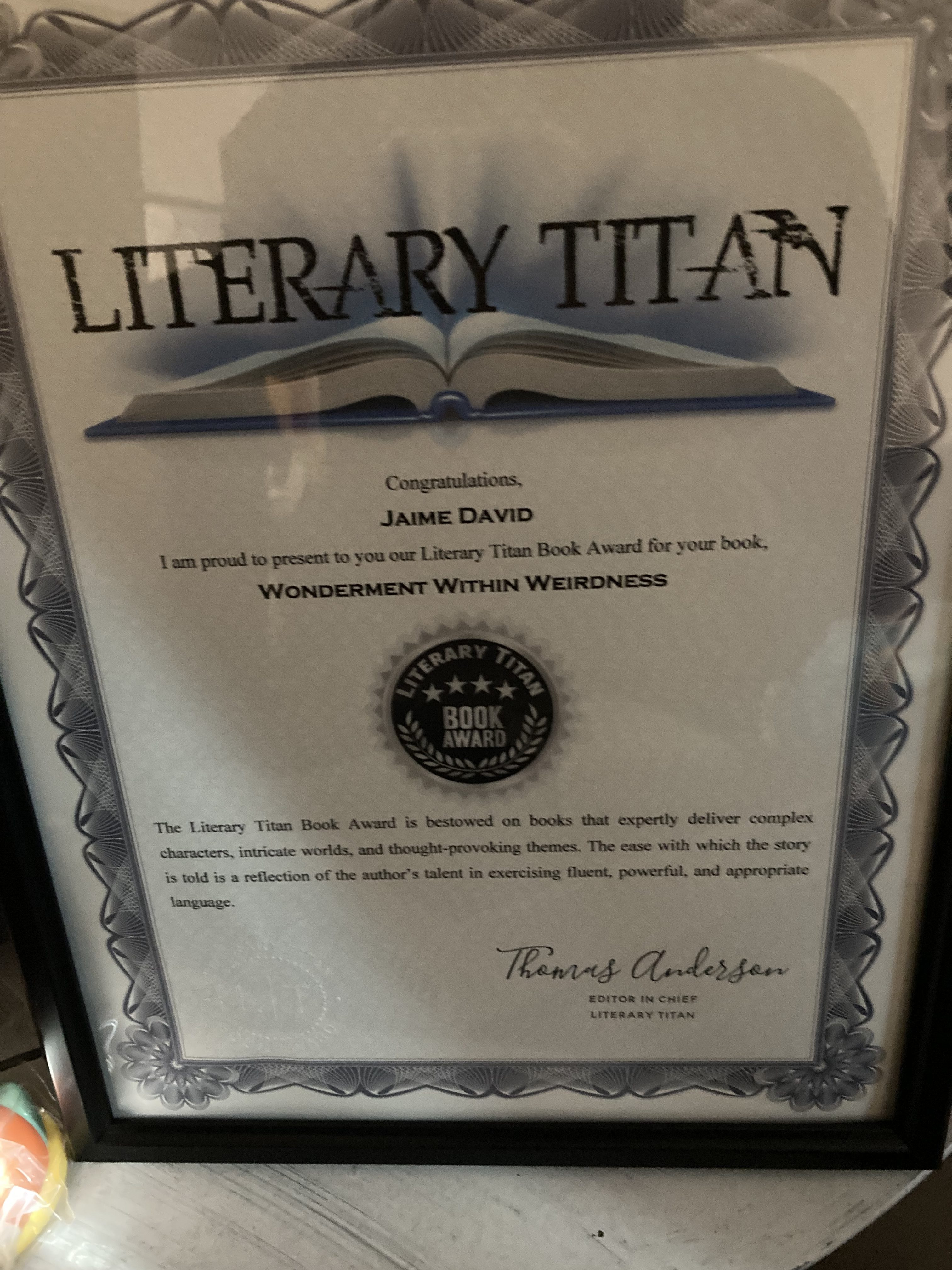
  • How My Debut Book “Wonderment Within Weirdness” Won a 4-Star Literary Titan Award

    How My Debut Book “Wonderment Within Weirdness” Won a 4-Star Literary Titan Award

    There are moments in life that do not fully register at first. Moments where you stare at a screen, reread the same sentence multiple times, and wonder if what you are seeing is actually real. For me, one of those moments came when I found out that my debut book, Wonderment Within Weirdness, had received a 4-star silver award from the Literary Titan.

    Now, before anyone misunderstands what I am saying, no, the Literary Titan award is not the Pulitzer Prize. It is not one of those century-old literary institutions that immediately dominate headlines or get discussed endlessly in academic circles. I understand that. I am aware of the hierarchy that exists within the literary world. There are massive awards with generations of prestige behind them, and then there are smaller, newer awards trying to carve out their own identity in the publishing landscape. Literary Titan falls more into that latter category. But here is the thing people often overlook: recognition is still recognition. An award does not have to be the most famous literary honor on Earth in order to matter.

    And for a debut author, especially an independent one, receiving any kind of legitimate literary recognition can mean far more than outsiders realize.

    Because here is the reality that many people do not talk about enough: writing a book is hard. Finishing a book is even harder. Publishing one is another mountain entirely. Then comes the most brutal stage of all, getting anyone to notice it in a world overflowing with content. Every day, countless books are released onto the internet. Thousands upon thousands of stories, poetry collections, essays, memoirs, philosophical works, experimental projects, and novels appear online, all fighting for visibility. Most disappear almost instantly into the digital void. Some never receive reviews. Some never find an audience. Some barely get read outside of friends and family circles. That is simply the brutal reality of modern publishing.

    Which is why the Literary Titan award mattered to me.

    Not because it suddenly transformed me into a globally recognized literary icon overnight. Not because I now expect to be discussed alongside literary giants. But because it represented something important: external validation. It meant that someone outside of my immediate circle looked at my work and believed it deserved recognition. That matters. Especially for a first book.

    Debut books exist in a strange space. Established authors often have advantages that new writers simply do not possess. They may already have audiences built over years. They may have publishers backing them with marketing budgets. They may have editors, agents, industry connections, media exposure, or simply the power of name recognition. Readers approach established writers with preconceived expectations. There is already a built-in level of trust there.

    A debut author has none of that.

    When someone picks up a first book from a completely unknown writer, there is no guarantee attached to it. There is no proven track record. No legacy. No assurance that the work will even be coherent, let alone compelling. A debut writer has to earn every ounce of credibility from scratch. That is part of what makes literary recognition for a first book feel especially significant.

    And in my case, Wonderment Within Weirdness was not some hyper-calculated, market-tested project designed specifically to appeal to mainstream publishing trends. If anything, the book reflects many of the themes and ideas that define my broader creative identity. Weirdness. Wonder. Introspection. Emotion. Existential thought. Philosophical wandering. Experimental energy. It is deeply tied to my voice as a writer and thinker. In many ways, it represents me authentically rather than trying to imitate what the market supposedly wants.

    That can be risky.

    The internet often pushes creators toward conformity. Algorithms reward familiarity. Publishing industries sometimes reward predictability. There is pressure everywhere to fit neatly into categories, genres, aesthetics, and market expectations. But creative work that embraces weirdness and individuality can sometimes cut through precisely because it feels different. It feels human. It feels personal. And I think that is part of why the recognition meant something to me.

    Because it suggested that originality still has value.

    I also think there is something psychologically important about literary awards for independent authors that many people underestimate. When you are creating largely on your own, doubt becomes constant. Every writer experiences it to some degree, but independent creators especially know what it feels like to question themselves endlessly. Is the work good enough? Is anyone reading? Does any of this matter? Am I wasting my time? These thoughts can become relentless.

    So when an outside organization says, “We see merit here,” it can genuinely impact a creator’s confidence. Not in an egotistical way, but in a stabilizing way. It becomes proof that the work connected with someone beyond yourself. That is valuable fuel for continuing forward creatively.

    And honestly, the award also made me reflect on how strange and unpredictable artistic journeys can be.

    There are writers who spend decades producing work before receiving recognition. There are others who explode into visibility instantly. Some receive praise early and disappear later. Others struggle for years before eventually finding audiences. There is no universal roadmap for creativity. No guaranteed formula. No clear sequence that determines who succeeds and who does not. The literary world is chaotic. Sometimes brilliant books are ignored. Sometimes mediocre books become massive phenomena. Sometimes deeply personal projects unexpectedly resonate with readers and reviewers alike.

    That unpredictability is both terrifying and beautiful.

    I think part of why this award mattered so much to me is because it symbolized momentum. Not finality. Not completion. Momentum. It felt like confirmation that I am not simply shouting into the void entirely unnoticed. Even smaller recognitions can create psychological momentum for artists. They can reinforce the idea that continuing to create is worthwhile.

    And perhaps most importantly, it reminded me that the definition of success is more nuanced than people often make it out to be.

    Modern internet culture tends to frame success in extremes. Either you are world famous, or you are irrelevant. Either you win the biggest awards imaginable, or your accomplishments supposedly do not count. But reality is far more layered than that. There are countless levels of artistic success between obscurity and superstardom. A smaller literary award can still represent a meaningful achievement. Especially for a first-time author.

    I also think there is something fascinating about newer literary awards in general. Every prestigious institution that exists today had to begin somewhere. The Pulitzer Prize was once new. The Booker Prize was once unknown. Every literary tradition starts small before history determines whether it grows into something larger. Now, I am not claiming Literary Titan will become the next Pulitzer. Nobody can predict that. But I do think people sometimes dismiss newer awards too quickly simply because they lack decades of legacy.

    The reality is that literary culture is constantly evolving. Independent publishing itself has changed dramatically over the last twenty years. The barriers between traditional and independent authorship have blurred. Online platforms have allowed writers to build audiences without relying entirely on gatekeepers. Smaller awards and independent review organizations have emerged partly because the literary ecosystem itself has expanded beyond older institutional models.

    And frankly, independent authors often need these spaces.

    Because traditional literary systems can be incredibly difficult to penetrate. Many talented writers never receive attention from major publishers or prestigious literary organizations despite producing meaningful work. Smaller awards can provide visibility where mainstream institutions may overlook emerging voices. That does not make the recognition fake or meaningless. It simply means it exists within a different layer of the literary landscape.

    Another thing that struck me after receiving the award was how differently creators experience recognition compared to outsiders observing from a distance. Someone scrolling online might see “4-star Literary Titan award” and move on after two seconds. But for the creator behind the work, that recognition often represents years of thought, effort, doubt, rewriting, editing, emotional investment, and persistence condensed into a single moment.

    People see the outcome. They rarely see the process behind it.

    They do not see the nights spent questioning whether the project will ever come together properly. They do not see the anxiety involved in publishing something personal into public view. They do not see the fear of rejection. They do not see the vulnerability required to create sincerely in a culture that often rewards irony and detachment more than authenticity.

    And perhaps that is another reason why this award felt meaningful to me specifically. It validated authenticity.

    I have always been drawn toward ideas that sit outside rigid convention. Whether through my writing, my philosophical ideas surrounding anarcho-compassionism, my blog posts, or my broader creative identity, I tend to gravitate toward introspection, emotional honesty, nuance, existential exploration, and unconventional thinking. Wonderment Within Weirdness reflects that mindset heavily. It is not trying to be sterile or artificially polished into generic marketability. It embraces weirdness directly, even in its very title.

    And honestly, I think the title itself matters.

    “Wonderment Within Weirdness” captures something fundamental about how I view creativity and existence. There is wonder inside the strange. Beauty inside imperfection. Meaning hidden within chaos. Modern society often pressures people to suppress weirdness, flatten individuality, and conform to expectations. But creativity frequently thrives in the exact opposite direction. Some of the most memorable art emerges precisely because it dares to be unusual.

    That does not mean every unconventional work automatically becomes brilliant. But authenticity has power. Readers can often sense when something comes from a genuine place rather than existing solely as a calculated product.

    I also think there is something inspiring about the fact that a debut independent book can receive recognition at all in today’s environment. We live in an era where gatekeeping still exists, but it is no longer absolute. Independent creators have more opportunities than ever before to publish work, connect with audiences, and gain visibility. The internet has created overwhelming saturation, yes, but it has also democratized creativity in many ways.

    That democratization comes with contradictions. Visibility is harder because everyone is competing simultaneously. Yet opportunities also exist that previous generations of writers could barely imagine. A person can build a blog, publish books independently, create podcasts, interact directly with readers, and cultivate a creative ecosystem almost entirely outside traditional institutions.

    That is part of the journey I have been navigating myself through The Musings of Jaime David and my broader online presence.

    And perhaps that is another reason this award felt important. It represented not just one isolated accomplishment, but evidence that the broader creative path I have been pursuing might actually be leading somewhere meaningful.

    What made the experience even more surreal was seeing the recognition expand beyond the award announcement itself. Literary Titan did not simply hand out the award quietly and move on. There was an actual press release published about my book receiving the award, which made the accomplishment feel far more tangible and publicly documented. FinancialContent press release about the award

    That mattered to me because there is something psychologically different about seeing your work discussed publicly in a professional context. It transforms the experience from feeling purely internal into something externally recognized and archived. Suddenly, the book was not just existing within my own creative ecosystem. It was being discussed beyond it.

    Then there was the author interview that Literary Titan conducted with me, which honestly made the entire experience feel even more real. Literary Titan author interview with Jaime David The title alone, “It Started With a YouTube Comment,” captures something fascinating about modern creativity and internet culture. So many creative journeys now begin in strange, seemingly insignificant digital moments. A comment. A post. A random idea. A passing conversation online. Something tiny eventually snowballs into something much larger.

    That interview gave me the opportunity to reflect not just on the book itself, but on the broader creative process behind it. And honestly, interviews can sometimes feel even more vulnerable than the work itself because they require the creator to directly articulate thoughts, motivations, insecurities, and inspirations in their own voice. There is nowhere to hide behind fictional structure or poetic abstraction at that point. It becomes direct human reflection.

    And then there was the review itself from Literary Titan. Literary Titan review of Wonderment Within Weirdness Reviews are fascinating because they represent interpretation. Once creative work enters the world, readers begin forming their own relationships with it. They notice things the creator may not have fully realized themselves. They interpret themes differently. They emotionally connect to unexpected aspects of the work. That is part of what makes literature so interesting in the first place. Books stop belonging solely to the author once they are released publicly. They become shared experiences between creator and reader.

    Perhaps one of the strangest and coolest parts of all this, though, was the fact that there was even a podcast episode discussing my book. Literary Titan podcast episode about Wonderment Within Weirdness There is something surreal about hearing people talk about your creative work in audio form, almost like listening to your ideas echo back at you from outside yourself. It creates this bizarre sensation where the project suddenly feels alive beyond your own head.

    And honestly, when you step back and look at the full picture, it becomes clear that the experience extended beyond simply “winning an award.” There was the award itself, the review, the interview, the press release coverage, and even a podcast discussion. For a debut independent book, that is genuinely meaningful visibility.

    Will the Literary Titan award alone suddenly make me famous? Of course not. I am realistic about that. But creative careers are often built incrementally. Recognition accumulates piece by piece over time. One review leads to another. One award builds credibility. One reader recommends a book to someone else. Momentum compounds gradually rather than explosively for most writers.

    People often romanticize overnight success while ignoring how many creators build their audiences slowly over years. Persistence matters enormously in creative fields. So does consistency. So does continuing to create even when visibility feels limited.

    And honestly, I think the award reinforced something deeper psychologically for me: the importance of continuing despite uncertainty.

    Because uncertainty never fully disappears for artists. Even successful writers experience doubt constantly. There is no magical point where creators suddenly become immune to insecurity. Every project involves risk. Every piece of writing involves vulnerability. Every publication becomes an act of exposure in some way.

    But recognition can help counterbalance that uncertainty enough to keep moving forward.

    It can remind creators that their work has impact beyond their own internal world. That someone connected with it. That the effort mattered to another human being somewhere out there.

    And for me, as a debut author, that feeling carries enormous significance.

    Fediverse Reactions
  • One Year as a Published Author: Reflecting on an Unexpected Journey

    One Year as a Published Author: Reflecting on an Unexpected Journey

    February 15, 2026 marks a milestone I never quite imagined I would reach, at least not in the way it has unfolded. One year ago today, I officially became a published author when my debut novel “Wonderment Within Weirdness” was released into the world. As I sit here reflecting on the past twelve months, I find myself almost disbelieving that not only did I publish that first book, but I somehow managed to release two additional books during the summer of 2025, my poetry compilation “My Powerful Poems” and my short story collection “Some Small Short Stories.” Three books in one year. The thought still catches me off guard, fills me with a strange mixture of pride and bewilderment, as if I’m looking at someone else’s accomplishments rather than my own.

    There’s something profoundly transformative about becoming a published author. The moment “Wonderment Within Weirdness” went live, something shifted in how I saw myself and my relationship with writing. For years before that, writing had been something I did, a passion I pursued in the margins of my life, but it wasn’t necessarily who I was in any official capacity. I was someone who wrote, sure, but calling myself a writer felt presumptuous, like claiming a title I hadn’t quite earned. Publishing that debut novel changed everything. Suddenly, the identity wasn’t aspirational anymore, it was actual. I had created something tangible that existed beyond my own computer files and notebooks, something that other people could hold, read, and experience. That transition from private creator to public author felt both terrifying and exhilarating, like stepping off a cliff and discovering I could fly.

    “Wonderment Within Weirdness” was a labor of love that took far longer to complete than I ever anticipated. Like many debut novels, it went through countless revisions, moments of self-doubt, periods where I was convinced it was brilliant followed immediately by periods where I was certain it was irredeemable garbage. The writing process taught me patience with myself, taught me that creation is rarely linear, that sometimes you have to write yourself into corners just to discover new doors. When I finally decided it was ready, when I finally took that leap and actually published it, I remember feeling this overwhelming sense of vulnerability. Putting your work out there for public consumption is an act of courage that non-writers sometimes don’t fully appreciate. You’re not just sharing words on a page, you’re sharing pieces of your imagination, your perspective, your soul in some fundamental way.

    What I didn’t anticipate on that February day in 2025 was how publishing that first book would unleash something within me. It was as if releasing “Wonderment Within Weirdness” into the world opened a creative floodgate I didn’t even know existed. Throughout the spring of 2025, I found myself writing with a fervor and consistency that surprised me. The poetry that had been accumulating in various notebooks and digital files for years suddenly felt like it deserved to be compiled, organized, given its own home. The short stories I had written sporadically, often as experiments or exercises or just bursts of inspiration, began to look like they could form a cohesive collection. Where publishing my debut novel had once seemed like the culmination of years of work, it now felt more like a beginning, a doorway opening onto a path I hadn’t fully considered walking.

    By summer 2025, I had made the decision to publish not one but two additional books. “My Powerful Poems” became my second published work, a collection that felt intensely personal in a different way than the novel had. Poetry strips away so much of the protective narrative distance that fiction provides. Each poem was a distilled moment of emotion, observation, or insight, laid bare without the comfortable camouflage of characters and plot. Compiling that collection meant revisiting different versions of myself, the person I was when I wrote each piece, the moments of joy or pain or wonder that had inspired the words. It meant curating an emotional landscape and inviting readers to walk through it with me. The vulnerability of publishing poetry felt even more acute than publishing fiction, yet there was also something deeply satisfying about it, about saying these are my truths, these are my observations of the world, take them or leave them.

    Following closely on the heels of the poetry collection came “Some Small Short Stories,” which gathered together the narrative fragments and complete miniature worlds I had created over time. Short stories are a unique form, requiring precision and economy in a way that novels don’t. Each story in that collection represented a different experiment in voice, perspective, genre, or style. Some were realistic, some ventured into the strange and surreal, some were humorous, others melancholic. Putting them together into one collection felt like creating a gallery of different moments and moods, a showcase of range rather than a single sustained vision. I loved the freedom that collection represented, the way it didn’t have to be any one thing but could contain multitudes.

    Looking back at the publishing journey of those three books across 2025, I’m struck by how much I learned in such a compressed timeframe. Each book taught me different lessons about the craft of writing, the business of publishing, and the experience of being an author. “Wonderment Within Weirdness” taught me about sustained narrative, about character development, about weaving together plot threads and themes across hundreds of pages. It taught me about the marathon of novel writing, the endurance required to stay committed to a single project through all its ups and downs. “My Powerful Poems” taught me about distillation, about finding the exact right word, about the music of language and the power of white space on a page. It taught me to trust emotion, to not overexplain, to let readers bring their own experiences to the work. “Some Small Short Stories” taught me about versatility, about the sprint of short fiction versus the marathon of novel writing, about beginnings and endings and making every word count.

    Beyond the craft lessons, publishing three books in one year taught me practical things about the publishing process itself, especially as someone navigating the world of independent publishing. I learned about formatting and cover design, about metadata and keywords, about the strange alchemy of trying to find readers in an oversaturated marketplace. I learned about the importance of patience, about how building an audience is a slow process that can’t be rushed. I learned that publishing a book is just the beginning of its journey, not the end, and that the work of being an author extends far beyond the writing itself into promotion, engagement, and community building. These weren’t lessons I necessarily wanted to learn, they felt less romantic than the pure act of creation, but they were necessary ones, grounding my artistic aspirations in practical reality.

    What strikes me most profoundly as I mark this one-year anniversary is the sheer unexpectedness of it all. A year ago, if someone had told me I would publish three books in twelve months, I would have laughed at the impossibility of it. My aspirations were much more modest, I just wanted to get that debut novel out there and see what happened. I didn’t have a master plan for multiple releases, I wasn’t following some strategic publishing roadmap. Instead, each book emerged organically from the momentum created by the one before it. Publishing “Wonderment Within Weirdness” didn’t exhaust my creative energy, it multiplied it. It gave me confidence I hadn’t possessed before, a belief that my work was worth sharing, that I had more to say and people might want to listen.

    This anniversary also prompts reflection on what it means to call something an accomplishment. We live in a culture that often measures success in quantifiable external metrics, sales numbers, bestseller lists, awards, recognition. By those standards, I can’t claim massive success. My books haven’t topped any charts, I haven’t quit my day job to write full-time, I’m not fielding offers from major publishers or Hollywood producers. But accomplishment, I’ve learned, can be measured in different ways. The fact that I wrote three books, that I brought them from conception to completion to publication, that I overcame all the internal resistance and self-doubt and fear that plagues every writer, that alone feels monumental. The fact that even one person I don’t personally know has read my work and connected with it, that’s meaningful in a way that transcends commercial metrics.

    There’s also something to be said for the accomplishment of consistency, of showing up to the work again and again across a full year. Writing requires discipline, especially when inspiration wanes, when life gets busy, when the initial excitement of a new project fades into the hard middle where you’re not sure if what you’re creating has any value. Publishing three books meant showing up consistently to the page, trusting the process even when I couldn’t see the endpoint, pushing through the resistance that tried to convince me I had nothing worthwhile to say. It meant honoring the commitment I made to myself to be a writer not just in identity but in practice, day after day, word after word, until those words accumulated into complete works.

    As I think about the year ahead, I find myself in an interesting position. The urgency that drove me through 2025, that led to three publications in rapid succession, has settled into something different. I don’t feel the same pressure to prove anything, either to myself or to others. I’ve done the thing, I’ve published books, I’ve earned the title of author in a concrete way. Now the question becomes what kind of author I want to be moving forward, what stories and ideas deserve my attention and energy, how I want to balance the creation of new work with the cultivation of what I’ve already released. There’s a freedom in having accomplished something you once thought impossible, it gives you permission to be more intentional, more selective, more patient with yourself and the creative process.

    Part of me wonders if I’ll publish anything in 2026, or if this will be a year of rest and renewal, of filling the creative well rather than drawing from it. I’ve learned that sustainable creativity requires cycles of output and input, of speaking and listening, of sharing your vision and absorbing the visions of others. After the intense productivity of 2025, perhaps what I need most is spaciousness, room to experiment without the pressure of publication, permission to write things that might never see the light of day simply because they help me grow and explore. Or perhaps I’ll surprise myself again, perhaps there’s another book waiting to emerge that I haven’t yet recognized. The beauty of having made it through this first year is that I now trust the process more, trust that the work will make itself known when it’s ready.

    What I do know is that I’m grateful for this year, for everything it taught me, for the ways it challenged and changed me. February 15, 2026 isn’t just an anniversary of publication, it’s an anniversary of transformation, of becoming something I always hoped I could be but wasn’t sure I actually would. It’s a marker of courage, of the decision to stop waiting for permission or perfect circumstances and to simply begin, to put my work into the world despite all the reasons not to. Every writer I admire had to start somewhere, had to publish that first book, had to push through the fear and uncertainty and just do the thing. I did that. I’m doing that. And that’s worth celebrating.

    Looking at those three books, “Wonderment Within Weirdness,” “My Powerful Poems,” and “Some Small Short Stories,” I see a year of my life crystallized into words. I see the person I was when I wrote each piece, the hopes and fears and observations that shaped the work. I see evidence of growth, of experimentation, of a willingness to try different forms and voices. They’re imperfect, of course, all creative work is imperfect because we ourselves are imperfect. There are things I would change if I could go back, passages I would rewrite, choices I would reconsider. But they also represent something complete, something finished, something that exists independently in the world now. They’re no longer just mine, they belong to whoever reads them, interpreted through the lens of each reader’s unique experience and perspective.

    This anniversary makes me think about all the aspiring writers out there who are where I was two years ago, sitting on completed manuscripts or half-finished projects, wanting to publish but not quite ready to take the leap. If I could offer any wisdom from my year as a published author, it would be this: just start. Don’t wait for everything to be perfect, because it never will be. Don’t wait until you feel completely ready, because that feeling might never come. Don’t wait for someone to give you permission or validate your work, because you are the only permission you need. The difference between an unpublished writer and a published author is simply the decision to share your work, to take that terrifying step from private creation to public offering. Everything else is just details.

    As I close out these reflections on my first year as a published author, I’m filled with a quiet sense of pride that feels hard-earned and genuine. Three books. One year. It’s an accomplishment not because of any external validation, but because I set out to do something difficult and I did it. I faced every obstacle, internal and external, that tried to stop me, and I persisted. I honored my creative voice enough to believe it deserved to be heard. I trusted myself enough to put imperfect work into the world rather than keeping it hidden in pursuit of an impossible perfection. That’s what I’m celebrating on this February 15, 2026, not just the books themselves, but the growth they represent, the courage they required, the transformation they catalyzed.

    Here’s to one year as a published author, to “Wonderment Within Weirdness” and “My Powerful Poems” and “Some Small Short Stories,” to unexpected journeys and surprising productivity, to creative risks and vulnerable sharing, to the terror and joy of putting your work into the world. Here’s to whatever comes next, whether it’s more books or fallow periods, new experiments or deeper dives into familiar territory. Here’s to the ongoing adventure of being a writer, with all its challenges and rewards, its frustrations and fulfillments. And here’s to anyone reading this who has their own creative dreams waiting to be realized: may you find the courage to begin, the persistence to continue, and the satisfaction of looking back one day and marveling at how far you’ve come.

    Fediverse Reactions
  • Texas SB20 and the Risk to Books, Graphic Novels, and Manga

    Texas SB20 and the Risk to Books, Graphic Novels, and Manga

    Books have always been a battleground for free expression. From novels banned in schools to graphic novels challenged in libraries, literature is often where society tests the limits of what should be read, shared, and celebrated. Now, with Texas Senate Bill 20 (SB20) in effect, those limits may become narrower than ever.

    SB20 criminalizes the possession or promotion of “obscene visual material” that appears to depict minors. While its stated intent is to stop child exploitation, the language is so vague and sweeping that it does not stop at harmful real-world depictions. Instead, it extends to animation, AI-generated images, comics, graphic novels, and manga—works of pure fiction. For writers, artists, publishers, and readers, that is a deeply troubling development.

    Graphic Novels in the Crosshairs

    Graphic novels and manga rely on stylized art to tell stories. Characters may look younger than their canon ages due to artistic conventions. Themes of growth, identity, and coming-of-age often involve youth characters in dramatic, sometimes challenging contexts. Under SB20, such depictions could be misread as “obscene” depending on how an individual judge, prosecutor, or even police officer interprets them.

    That interpretation doesn’t require malicious intent. A librarian stocking Made in Abyss, a bookstore selling Bleach or Dragon Ball, or a fan who owns a volume of Attack on Titan could all suddenly be viewed through a criminal lens. The issue isn’t that these books exploit anyone—they don’t. The issue is that the law makes no room for artistic conventions, fictional storytelling, or cultural nuance.

    The Slippery Slope of Censorship

    SB20 continues a long tradition of book censorship in America, but with a dangerous new twist. Traditionally, challenges to books like Maus or Gender Queer have come through school boards or library systems, where community debates determine availability. SB20 escalates the stakes by attaching criminal penalties to certain kinds of art. Instead of arguing about what’s appropriate for libraries, the law risks criminalizing the very act of creating, publishing, or owning certain works.

    That is a chilling precedent. Writers and illustrators may censor themselves before putting pen to paper, worried that their work could be misconstrued. Publishers may avoid certain genres altogether, especially those like manga that play with youthful aesthetics. Libraries may quietly pull entire categories of books rather than risk controversy. Readers, meanwhile, may hesitate to buy, collect, or even publicly discuss their favorite titles.

    The Cultural Significance of Manga

    Manga in particular is vulnerable because of its global popularity and unique style. Characters with large eyes, youthful faces, and slim frames are staples of the medium—even when those characters are canonically adults. Many stories also explore school settings or fantastical worlds where age and appearance are intentionally ambiguous.

    That ambiguity is part of manga’s charm. It allows creators to tell universal stories about courage, friendship, trauma, and growth in ways that resonate across cultures. But under SB20, that same ambiguity could be weaponized against fans. The very traits that make manga beloved—the art style, the themes, the imaginative freedom—are the same traits that could now trigger suspicion in Texas.

    Libraries and Readers at Risk

    Beyond creators and publishers, SB20 affects the everyday experience of readers. Libraries may face pressure to remove manga or graphic novels that could be misinterpreted. Independent bookstores could find themselves in legal jeopardy for stocking titles that someone deems questionable.

    And for fans, especially young readers, the message is clear: your hobbies and passions might make you a criminal. Imagine a teenager in Texas who checks out a volume of Naruto or buys a graphic novel adaptation of a YA fantasy. Under SB20’s broad language, their simple act of enjoying fiction could become entangled in legal suspicion. That is not child protection—it is paranoia.

    Creativity Under Pressure

    Writers and illustrators often turn to graphic novels and manga because the medium allows for freedom. Visual storytelling can explore ideas too raw, surreal, or fantastical for prose alone. But when the law criminalizes ambiguous depictions, that freedom shrinks.

    An author writing a coming-of-age graphic novel may hesitate to depict adolescent characters realistically for fear of accusations. An artist may avoid drawing in a manga-inspired style altogether. Over time, this leads not just to fewer books but to a narrower imagination, where creators stick to “safe” ideas rather than risk legal scrutiny.

    A Broader Trend

    Texas is not acting in isolation. Mississippi has floated similar proposals, and the United Kingdom has already passed its Online Safety Act, which imposes strict rules on digital content. The trend is clear: governments are equating fictional, artistic works with real-world harm, and in the process, they are reshaping the boundaries of free expression.

    Books are a prime target because they are accessible, visual, and influential. Graphic novels and manga in particular are easy scapegoats for lawmakers who do not understand the art form but want to appear tough on crime. If SB20 stands unchallenged, it could encourage other states or countries to follow suit, eroding creative freedom on a global scale.

    Defending Literature’s Role

    Books have always been lightning rods for controversy because they matter. They shape culture, inspire readers, and push conversations forward. Graphic novels and manga are no different—they are simply the modern form of an age-old tradition of storytelling.

    If we care about literature as a space for imagination, we must resist laws like SB20 that blur the line between fiction and crime. Protecting children is essential, but that protection cannot come at the cost of criminalizing art. Otherwise, we risk not only silencing creators but also depriving future generations of the books that could inspire them most.

    SB20 may have started as a law against exploitation, but in practice, it threatens the freedom of books, graphic novels, and manga alike. For writers, publishers, libraries, and readers, the message is clear: vigilance is necessary. Because if we allow vague laws to dictate what stories can be told, the bookshelf itself becomes a battleground—and every page is at risk.