The Musings of Jaime David
@jaimedavid.blog@jaimedavid.blog

The writings of some random dude on the internet

1,161 posts
1 follower

Tag: book review

  • When Literary Titan Put My Book on Their Podcast

    When Literary Titan Put My Book on Their Podcast

    There are certain moments in an author’s journey that stand out forever.

    Publishing a book is already a surreal experience. For years, a story exists only in your imagination. It lives inside your head. Then, eventually, you take that idea and turn it into something physical. You write the words, edit the manuscript, format the pages, create the cover, and finally release it into the world.

    But once a book is released, something else happens.

    You have to let go.

    The story that was once completely yours now belongs to readers. It belongs to reviewers. It belongs to anyone who decides to pick it up and experience it for themselves.

    As an independent author, those moments can feel especially meaningful because every milestone represents something you built yourself.

    Recently, I experienced another one of those moments.

    My debut novel, Wonderment Within Weirdness, was featured on the Literary Titan podcast, and that podcast episode was recently uploaded to YouTube.

    Seeing that happen was incredibly exciting because Literary Titan was already an important milestone in my journey as an author.

    They were one of the first major literary organizations to recognize my work.

    They reviewed my book.

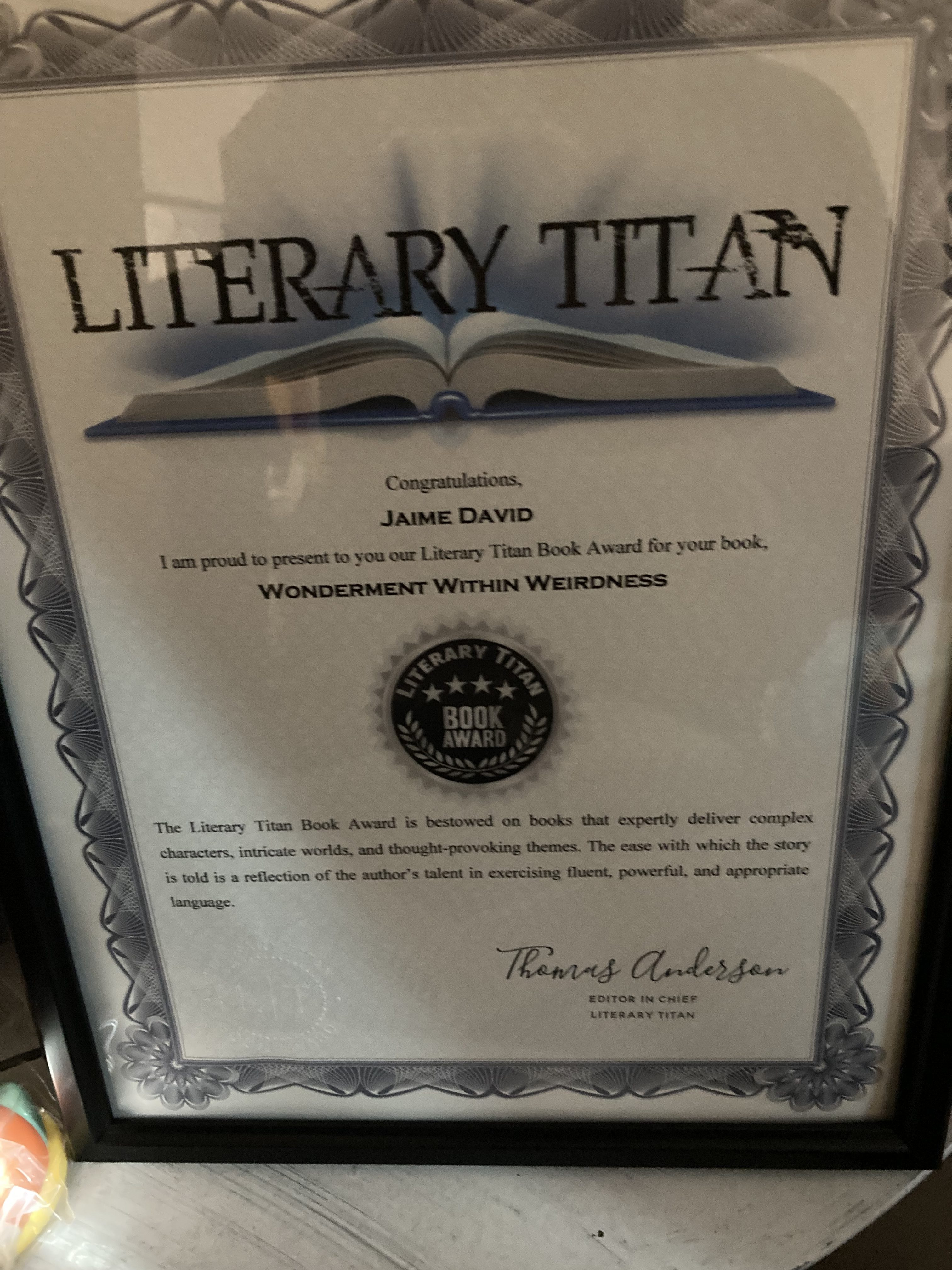
    They awarded it the Literary Titan Silver Book Award.

    And now, their discussion of my novel has reached an even wider audience through YouTube.

    For an indie author, moments like this are incredibly meaningful.

    When I first published Wonderment Within Weirdness, I knew I was creating something unusual.

    I knew it was not a typical science fiction story.

    I knew it was not going to fit neatly into one category.

    The book was a combination of science fiction, fantasy, satire, adventure, cosmic speculation, and my own personal ideas about life, existence, morality, and the universe.

    It was a story that I wanted to be big.

    I wanted it to feel like an epic journey.

    I wanted it to explore massive ideas while still being driven by personal emotions.

    And when Literary Titan reviewed it, they recognized many of those elements.

    Their podcast discussion focused on exactly what makes Wonderment Within Weirdness the type of story it is.

    The review begins with the basic premise.

    The story follows Matthew Tiberius, who dies and awakens in a strange and unexpected version of heaven.

    Instead of finding a simple, peaceful afterlife, Matthew discovers a bizarre world filled with politics, conflicts, strange systems, and mysteries.

    The heaven of Wonderment Within Weirdness is not just a place of eternal peace.

    It is a fully developed world.

    It has neighborhoods.

    It has organizations.

    It has conflicts.

    It has power struggles.

    It has systems that reflect many of the issues found in human society.

    That was one of the things Literary Titan highlighted.

    The idea of taking something traditionally viewed as perfect and exploring what happens when that environment becomes complicated.

    Because one of the biggest themes behind Wonderment Within Weirdness is questioning systems.

    Questioning authority.

    Questioning judgment.

    Questioning whether even supposedly perfect worlds can contain flaws.

    The podcast also highlighted the scale of the story.

    One thing I always wanted with this series was to create something massive.

    The first book is not just about one character discovering a strange afterlife.

    It expands into larger conflicts involving cosmic forces, different realities, and multiverse-level stakes.

    The goal was to create a feeling of exploration.

    A feeling that the universe was much bigger than the characters initially understood.

    That sense of wonder is something that has always attracted me to science fiction and fantasy.

    The idea that there are endless possibilities beyond what we know.

    The idea that existence itself can be questioned and explored.

    Literary Titan also discussed the tone of the novel.

    And this was something I found especially interesting.

    They described the writing style as bold, loud, messy, and intentionally excessive.

    And honestly, that description fits.

    Wonderment Within Weirdness was never meant to be a quiet story.

    It was never meant to be a small, simple adventure.

    The title itself says a lot.

    There is wonder.

    There is weirdness.

    There is imagination.

    There is chaos.

    The story embraces being unconventional.

    And that is something I have always valued as a creator.

    Not every story has to follow the same formula.

    Not every book has to feel like everything else already published.

    Sometimes the most interesting stories are the ones that take risks.

    Of course, a bold style is not going to appeal to every reader.

    Every creative choice has people who love it and people who do not connect with it.

    But as an author, I would rather create something that has a strong identity than something that feels like it was designed to be completely safe.

    Literary Titan also discussed the world-building.

    One of the biggest ideas behind the novel was imagining heaven as an actual functioning society.

    What would happen if the afterlife had infrastructure?

    What would happen if it had communities?

    What would happen if beings with immense power still had disagreements, conflicts, and different interpretations of existence?

    Those questions helped shape the world of Wonderment Within Weirdness.

    The afterlife in the story is not simply a destination.

    It is a place with history.

    A place with politics.

    A place with mysteries.

    A place where characters still have to confront questions about morality, identity, and purpose.

    Another major point from the review was the exploration of themes.

    At its core, Wonderment Within Weirdness is not just about action and adventure.

    It is also about bigger questions.

    What does it mean to be judged?

    Who gets to decide what is right and wrong?

    What happens when systems designed to create order become complicated?

    How do individuals find meaning in a universe that is larger than themselves?

    These are questions that have fascinated humanity for centuries.

    Science fiction and fantasy have always been powerful genres because they allow creators to explore those ideas through impossible scenarios.

    A spaceship.

    A magical world.

    An alternate reality.

    A strange version of heaven.

    The setting may be fictional, but the questions are often very real.

    That is what I have always loved about speculative fiction.

    It allows us to explore reality by imagining something beyond reality.

    The Literary Titan podcast also emphasized who might enjoy this type of story.

    They highlighted readers who enjoy unconventional indie science fiction and fantasy.

    Readers who enjoy mythological reinterpretations.

    Readers who enjoy stories that are not afraid to experiment.

    Readers who enjoy big ideas and unusual concepts.

    And that means a lot to me because that is exactly the audience I hoped would connect with the book.

    I never wanted Wonderment Within Weirdness to simply be another generic science fiction story.

    I wanted it to feel like something that could only come from my imagination.

    Something unique.

    Something strange.

    Something different.

    The fact that Literary Titan recognized those qualities is incredibly meaningful.

    Especially because independent authors often face a unique challenge.

    When you publish traditionally, there is usually an established system behind you.

    Editors.

    Publishers.

    Marketing teams.

    Distribution networks.

    When you publish independently, you are responsible for much more.

    You are the writer.

    You are the editor.

    You are the marketer.

    You are the person trying to convince the world that your story is worth discovering.

    So when an organization like Literary Titan recognizes your work, it feels like validation that all those hours mattered.

    Receiving the Literary Titan Silver Book Award was already an incredible honor.

    Having them discuss the book on their podcast was another amazing step.

    And now seeing that discussion uploaded to YouTube creates another opportunity.

    It means more people can discover the story.

    More people can learn what Wonderment Within Weirdness is about.

    More people can see what kind of journey I created.

    Looking back, it is still amazing to think about how far this book has traveled.

    It started as an idea.

    Then it became a manuscript.

    Then a published novel.

    Then an award-winning book.

    Then a podcast discussion.

    Then a YouTube video.

    Every step represents another person encountering something that began in my imagination.

    That is one of the most rewarding parts of being an author.

    Stories have a life beyond their creators.

    Once they are released, they can travel places the author never expected.

    They can reach people the author never meets.

    They can create conversations.

    They can inspire thoughts.

    They can become part of someone else’s experience.

    That is the dream every writer has.

    Not necessarily fame.

    Not necessarily becoming the biggest author in the world.

    But simply knowing that something you created reached another person.

    For me, Literary Titan’s recognition of Wonderment Within Weirdness represents exactly that.

    It represents someone else seeing the creativity, ambition, and imagination that went into the book.

    It represents a reminder that taking a chance on yourself can lead to unexpected opportunities.

    And it represents another chapter in my journey as Jaime David.

    When I first wrote Wonderment Within Weirdness, I did not know where it would go.

    I just knew I had a story I wanted to tell.

    Now, years later, that story has been recognized, reviewed, awarded, and discussed by others.

    And that is something I will always appreciate.

    Because every book has a journey.

    Every author has a journey.

    And this has been one of the most incredible parts of mine.

    Fediverse Reactions
  • How My Debut Book “Wonderment Within Weirdness” Won a 4-Star Literary Titan Award

    How My Debut Book “Wonderment Within Weirdness” Won a 4-Star Literary Titan Award

    There are moments in life that do not fully register at first. Moments where you stare at a screen, reread the same sentence multiple times, and wonder if what you are seeing is actually real. For me, one of those moments came when I found out that my debut book, Wonderment Within Weirdness, had received a 4-star silver award from the Literary Titan.

    Now, before anyone misunderstands what I am saying, no, the Literary Titan award is not the Pulitzer Prize. It is not one of those century-old literary institutions that immediately dominate headlines or get discussed endlessly in academic circles. I understand that. I am aware of the hierarchy that exists within the literary world. There are massive awards with generations of prestige behind them, and then there are smaller, newer awards trying to carve out their own identity in the publishing landscape. Literary Titan falls more into that latter category. But here is the thing people often overlook: recognition is still recognition. An award does not have to be the most famous literary honor on Earth in order to matter.

    And for a debut author, especially an independent one, receiving any kind of legitimate literary recognition can mean far more than outsiders realize.

    Because here is the reality that many people do not talk about enough: writing a book is hard. Finishing a book is even harder. Publishing one is another mountain entirely. Then comes the most brutal stage of all, getting anyone to notice it in a world overflowing with content. Every day, countless books are released onto the internet. Thousands upon thousands of stories, poetry collections, essays, memoirs, philosophical works, experimental projects, and novels appear online, all fighting for visibility. Most disappear almost instantly into the digital void. Some never receive reviews. Some never find an audience. Some barely get read outside of friends and family circles. That is simply the brutal reality of modern publishing.

    Which is why the Literary Titan award mattered to me.

    Not because it suddenly transformed me into a globally recognized literary icon overnight. Not because I now expect to be discussed alongside literary giants. But because it represented something important: external validation. It meant that someone outside of my immediate circle looked at my work and believed it deserved recognition. That matters. Especially for a first book.

    Debut books exist in a strange space. Established authors often have advantages that new writers simply do not possess. They may already have audiences built over years. They may have publishers backing them with marketing budgets. They may have editors, agents, industry connections, media exposure, or simply the power of name recognition. Readers approach established writers with preconceived expectations. There is already a built-in level of trust there.

    A debut author has none of that.

    When someone picks up a first book from a completely unknown writer, there is no guarantee attached to it. There is no proven track record. No legacy. No assurance that the work will even be coherent, let alone compelling. A debut writer has to earn every ounce of credibility from scratch. That is part of what makes literary recognition for a first book feel especially significant.

    And in my case, Wonderment Within Weirdness was not some hyper-calculated, market-tested project designed specifically to appeal to mainstream publishing trends. If anything, the book reflects many of the themes and ideas that define my broader creative identity. Weirdness. Wonder. Introspection. Emotion. Existential thought. Philosophical wandering. Experimental energy. It is deeply tied to my voice as a writer and thinker. In many ways, it represents me authentically rather than trying to imitate what the market supposedly wants.

    That can be risky.

    The internet often pushes creators toward conformity. Algorithms reward familiarity. Publishing industries sometimes reward predictability. There is pressure everywhere to fit neatly into categories, genres, aesthetics, and market expectations. But creative work that embraces weirdness and individuality can sometimes cut through precisely because it feels different. It feels human. It feels personal. And I think that is part of why the recognition meant something to me.

    Because it suggested that originality still has value.

    I also think there is something psychologically important about literary awards for independent authors that many people underestimate. When you are creating largely on your own, doubt becomes constant. Every writer experiences it to some degree, but independent creators especially know what it feels like to question themselves endlessly. Is the work good enough? Is anyone reading? Does any of this matter? Am I wasting my time? These thoughts can become relentless.

    So when an outside organization says, “We see merit here,” it can genuinely impact a creator’s confidence. Not in an egotistical way, but in a stabilizing way. It becomes proof that the work connected with someone beyond yourself. That is valuable fuel for continuing forward creatively.

    And honestly, the award also made me reflect on how strange and unpredictable artistic journeys can be.

    There are writers who spend decades producing work before receiving recognition. There are others who explode into visibility instantly. Some receive praise early and disappear later. Others struggle for years before eventually finding audiences. There is no universal roadmap for creativity. No guaranteed formula. No clear sequence that determines who succeeds and who does not. The literary world is chaotic. Sometimes brilliant books are ignored. Sometimes mediocre books become massive phenomena. Sometimes deeply personal projects unexpectedly resonate with readers and reviewers alike.

    That unpredictability is both terrifying and beautiful.

    I think part of why this award mattered so much to me is because it symbolized momentum. Not finality. Not completion. Momentum. It felt like confirmation that I am not simply shouting into the void entirely unnoticed. Even smaller recognitions can create psychological momentum for artists. They can reinforce the idea that continuing to create is worthwhile.

    And perhaps most importantly, it reminded me that the definition of success is more nuanced than people often make it out to be.

    Modern internet culture tends to frame success in extremes. Either you are world famous, or you are irrelevant. Either you win the biggest awards imaginable, or your accomplishments supposedly do not count. But reality is far more layered than that. There are countless levels of artistic success between obscurity and superstardom. A smaller literary award can still represent a meaningful achievement. Especially for a first-time author.

    I also think there is something fascinating about newer literary awards in general. Every prestigious institution that exists today had to begin somewhere. The Pulitzer Prize was once new. The Booker Prize was once unknown. Every literary tradition starts small before history determines whether it grows into something larger. Now, I am not claiming Literary Titan will become the next Pulitzer. Nobody can predict that. But I do think people sometimes dismiss newer awards too quickly simply because they lack decades of legacy.

    The reality is that literary culture is constantly evolving. Independent publishing itself has changed dramatically over the last twenty years. The barriers between traditional and independent authorship have blurred. Online platforms have allowed writers to build audiences without relying entirely on gatekeepers. Smaller awards and independent review organizations have emerged partly because the literary ecosystem itself has expanded beyond older institutional models.

    And frankly, independent authors often need these spaces.

    Because traditional literary systems can be incredibly difficult to penetrate. Many talented writers never receive attention from major publishers or prestigious literary organizations despite producing meaningful work. Smaller awards can provide visibility where mainstream institutions may overlook emerging voices. That does not make the recognition fake or meaningless. It simply means it exists within a different layer of the literary landscape.

    Another thing that struck me after receiving the award was how differently creators experience recognition compared to outsiders observing from a distance. Someone scrolling online might see “4-star Literary Titan award” and move on after two seconds. But for the creator behind the work, that recognition often represents years of thought, effort, doubt, rewriting, editing, emotional investment, and persistence condensed into a single moment.

    People see the outcome. They rarely see the process behind it.

    They do not see the nights spent questioning whether the project will ever come together properly. They do not see the anxiety involved in publishing something personal into public view. They do not see the fear of rejection. They do not see the vulnerability required to create sincerely in a culture that often rewards irony and detachment more than authenticity.

    And perhaps that is another reason why this award felt meaningful to me specifically. It validated authenticity.

    I have always been drawn toward ideas that sit outside rigid convention. Whether through my writing, my philosophical ideas surrounding anarcho-compassionism, my blog posts, or my broader creative identity, I tend to gravitate toward introspection, emotional honesty, nuance, existential exploration, and unconventional thinking. Wonderment Within Weirdness reflects that mindset heavily. It is not trying to be sterile or artificially polished into generic marketability. It embraces weirdness directly, even in its very title.

    And honestly, I think the title itself matters.

    “Wonderment Within Weirdness” captures something fundamental about how I view creativity and existence. There is wonder inside the strange. Beauty inside imperfection. Meaning hidden within chaos. Modern society often pressures people to suppress weirdness, flatten individuality, and conform to expectations. But creativity frequently thrives in the exact opposite direction. Some of the most memorable art emerges precisely because it dares to be unusual.

    That does not mean every unconventional work automatically becomes brilliant. But authenticity has power. Readers can often sense when something comes from a genuine place rather than existing solely as a calculated product.

    I also think there is something inspiring about the fact that a debut independent book can receive recognition at all in today’s environment. We live in an era where gatekeeping still exists, but it is no longer absolute. Independent creators have more opportunities than ever before to publish work, connect with audiences, and gain visibility. The internet has created overwhelming saturation, yes, but it has also democratized creativity in many ways.

    That democratization comes with contradictions. Visibility is harder because everyone is competing simultaneously. Yet opportunities also exist that previous generations of writers could barely imagine. A person can build a blog, publish books independently, create podcasts, interact directly with readers, and cultivate a creative ecosystem almost entirely outside traditional institutions.

    That is part of the journey I have been navigating myself through The Musings of Jaime David and my broader online presence.

    And perhaps that is another reason this award felt important. It represented not just one isolated accomplishment, but evidence that the broader creative path I have been pursuing might actually be leading somewhere meaningful.

    What made the experience even more surreal was seeing the recognition expand beyond the award announcement itself. Literary Titan did not simply hand out the award quietly and move on. There was an actual press release published about my book receiving the award, which made the accomplishment feel far more tangible and publicly documented. FinancialContent press release about the award

    That mattered to me because there is something psychologically different about seeing your work discussed publicly in a professional context. It transforms the experience from feeling purely internal into something externally recognized and archived. Suddenly, the book was not just existing within my own creative ecosystem. It was being discussed beyond it.

    Then there was the author interview that Literary Titan conducted with me, which honestly made the entire experience feel even more real. Literary Titan author interview with Jaime David The title alone, “It Started With a YouTube Comment,” captures something fascinating about modern creativity and internet culture. So many creative journeys now begin in strange, seemingly insignificant digital moments. A comment. A post. A random idea. A passing conversation online. Something tiny eventually snowballs into something much larger.

    That interview gave me the opportunity to reflect not just on the book itself, but on the broader creative process behind it. And honestly, interviews can sometimes feel even more vulnerable than the work itself because they require the creator to directly articulate thoughts, motivations, insecurities, and inspirations in their own voice. There is nowhere to hide behind fictional structure or poetic abstraction at that point. It becomes direct human reflection.

    And then there was the review itself from Literary Titan. Literary Titan review of Wonderment Within Weirdness Reviews are fascinating because they represent interpretation. Once creative work enters the world, readers begin forming their own relationships with it. They notice things the creator may not have fully realized themselves. They interpret themes differently. They emotionally connect to unexpected aspects of the work. That is part of what makes literature so interesting in the first place. Books stop belonging solely to the author once they are released publicly. They become shared experiences between creator and reader.

    Perhaps one of the strangest and coolest parts of all this, though, was the fact that there was even a podcast episode discussing my book. Literary Titan podcast episode about Wonderment Within Weirdness There is something surreal about hearing people talk about your creative work in audio form, almost like listening to your ideas echo back at you from outside yourself. It creates this bizarre sensation where the project suddenly feels alive beyond your own head.

    And honestly, when you step back and look at the full picture, it becomes clear that the experience extended beyond simply “winning an award.” There was the award itself, the review, the interview, the press release coverage, and even a podcast discussion. For a debut independent book, that is genuinely meaningful visibility.

    Will the Literary Titan award alone suddenly make me famous? Of course not. I am realistic about that. But creative careers are often built incrementally. Recognition accumulates piece by piece over time. One review leads to another. One award builds credibility. One reader recommends a book to someone else. Momentum compounds gradually rather than explosively for most writers.

    People often romanticize overnight success while ignoring how many creators build their audiences slowly over years. Persistence matters enormously in creative fields. So does consistency. So does continuing to create even when visibility feels limited.

    And honestly, I think the award reinforced something deeper psychologically for me: the importance of continuing despite uncertainty.

    Because uncertainty never fully disappears for artists. Even successful writers experience doubt constantly. There is no magical point where creators suddenly become immune to insecurity. Every project involves risk. Every piece of writing involves vulnerability. Every publication becomes an act of exposure in some way.

    But recognition can help counterbalance that uncertainty enough to keep moving forward.

    It can remind creators that their work has impact beyond their own internal world. That someone connected with it. That the effort mattered to another human being somewhere out there.

    And for me, as a debut author, that feeling carries enormous significance.

    Fediverse Reactions
  • Songbird: My Psalms — A Book I Stumbled Upon and Can’t Stop Thinking About

    Songbird: My Psalms — A Book I Stumbled Upon and Can’t Stop Thinking About

    There is something uniquely disorienting about being an author. You spend so much time on the production side of literature, so focused on your own writing, your own releases, your own creative goals, that you sometimes forget you are also a reader. You forget that books are being born every day without your awareness, that entire collections of poems are floating out into the world while you are busy wrestling with your own sentences. That is exactly what happened when I stumbled upon Songbird: My Psalms. I didn’t go looking for it. It found me the way a lot of interesting things find me, through a moment of aimless discovery, a rabbit hole of clicking around and wandering through titles and descriptions until something stopped me cold and said, wait, look at this.

    I want to be upfront about something before I go any further, because I think honesty is important when it comes to talking about books. I have not read Songbird: My Psalms yet. I have not cracked the cover, I have not sat with the poems, I have not let the language move through me the way poetry is supposed to. So this is not a review. It cannot be, because I have not done the work of actually reading it. What this is, instead, is something I find almost more interesting to write, which is the story of encountering a book before you have read it, of what a title and a description and a premise can do to your brain before a single poem has reached you personally. It is the anticipation, the curiosity, the specific sensation of a book lodging itself into your awareness and refusing to leave. And Songbird: My Psalms has absolutely done that to me.

    So let me tell you about it. The collection is written by two authors, Danielle Emily and Emile Ignatius, and from everything I have been able to gather about it, the book is built around an intersection of themes that I find genuinely compelling. On the surface, the title tells you a lot. Songbird, a creature defined by its voice, by its instinct to sing regardless of whether anyone is listening. My Psalms, a deeply personal claiming of a form that is ancient and sacred and loaded with meaning. The Psalms, in the Biblical sense, are songs of the human soul directed outward toward something larger than the self. They are expressions of grief and gratitude, of despair and praise, of questioning and ultimate surrender. To call a poetry collection your psalms is to signal something important about how the poets are approaching their own inner lives, treating their words not as casual observations but as genuine spiritual offerings, as cries and declarations that carry the weight of something sacred.

    The thematic territory of the collection is what really got me. From what I have come to understand about it, Songbird: My Psalms moves through themes of nature, healing, resilience, and a deep desire for peace and renewal. There is something in the book about the restorative power of the natural world, about how the landscapes around us can become mirrors for the landscapes inside us. There is also a significant thread running through it about neurodivergence, about the experience of feeling disconnected from a so-called consensus reality, about navigating a world that was not quite built for the way your mind works. The poets explore what it feels like to be misunderstood, to live with an interior life that does not map cleanly onto the expectations of the world around you, and to find within faith and within nature and within poetry itself a kind of dignity and validation that the outside world does not always offer.

    That is a lot of ground for a poetry collection to cover, and yet it does not strike me as a collection that is trying too hard or overreaching. What draws me to it, even from a distance, is the sense that these are poems rooted in lived experience, in the specific textures of real emotional and spiritual struggle rather than abstraction. When poets write about healing, there is always a risk of the work becoming vague, of reaching for universality so aggressively that the poems lose all specificity and end up saying everything and nothing simultaneously. But the framing of Songbird: My Psalms suggests something more grounded than that. The psalms of the Bible were always specific even when they were universal. David crying out from the caves, from the wilderness, from the throne, was always writing from a particular body in a particular moment, and that particularity is what made the universality land so hard. A good poem about pain is always about one specific pain, and then, mysteriously, it is about everyone’s pain at once.

    Now here is where I have to situate myself a bit, because I think my perspective on this book is shaped considerably by who I am and where I am in my life as a writer. My name is Jaime David, and over the past couple of years I have been on my own unexpected publishing journey. My debut novel, Wonderment Within Weirdness, was released on February 15th, 2025, a date that still feels surreal to me when I say it out loud. In the months that followed, I somehow also released a poetry compilation called My Powerful Poems and a short story collection called Some Small Short Stories, giving me three books out in a single year in a way that still occasionally makes me stop and stare at the wall in mild disbelief. Three books. One year. Me, a person who spent years writing without knowing if any of it would ever reach a reader.

    The reason I bring my own story up is not to make this about me in any reductive sense. It is because I think where you stand as a writer shapes what you see when you encounter other writers’ work. When I stumbled upon Songbird: My Psalms, I was not just a random reader browsing a title. I was someone who had recently put his own poetry out into the world, someone who had recently grappled with the question of what his own poems were trying to say and to whom. My Powerful Poems is exactly what it sounds like, a collection of things I had been writing for years across notebooks and documents and blog posts, pulled together and given a spine and a cover and a chance to breathe as a single thing. Writing and assembling that collection taught me a great deal about what poetry actually is, or at least what it is for me. It is not performance. It is not decoration. It is the attempt to say the unsayable, to compress a feeling or a moment or a question into a shape that someone else can hold.

    So when I encountered the description of Songbird: My Psalms, particularly the idea of poems exploring disconnection and resilience and spiritual healing through the lens of neurodivergence and nature and faith, it touched something specific. The subtitle alone, My Psalms, resonates with me on a level that I did not entirely expect. There is something honest and brave about that word my in that context. Not the psalms, not a collection of psalms, not psalms, but my psalms. Claiming an ancient sacred form as your own, insisting that your particular grief and your particular joy and your particular complicated relationship with the divine deserve to be spoken in that register. That kind of confidence, that kind of insistence on the validity of one’s own inner life, is something I deeply respect in any writer.

    And the songbird imagery itself has been sitting with me since I first came across the title. A songbird does not sing because it has been trained to perform. It sings because singing is the expression of its nature, because silence would be a kind of death. There is something in that which cuts right to the heart of why any of us write, certainly why I write. Not for acclaim, not for success in any conventional sense, not because writing is professionally strategic or financially wise, but because something in the composition of my interior life requires the act of turning experience into language. If I do not write, something backs up inside me and goes sour. The songbird does not choose to sing. The singing is what it is. That is a true thing about poetry, and a title that captures that truth before you have even opened the first page is doing something right.

    I want to talk about the timing of this book a little, because context matters when you discover a work. Songbird: My Psalms is a relatively recent collection, and the fact that it exists in this particular cultural moment feels significant to me. We are living through a period of intense and ongoing reckoning with mental health, with neurodivergence, with the question of how people who experience the world differently are seen and valued and heard. The conversation around things like being a highly sensitive person, around the experience of empaths, around the many ways a mind can diverge from the statistical norm and still carry profound insight and beauty, that conversation has become louder and more widespread than it perhaps ever has been. A poetry collection that plants itself right in the middle of that conversation and speaks from the inside of that experience rather than looking at it from the outside is exactly the kind of book this moment calls for.

    There is also something about the pairing of nature and spirituality in this collection that feels important to name. The natural world has always been one of the primary languages through which human beings have tried to articulate the ineffable. The Psalms themselves are filled with landscape, with trees and rivers and mountains and the birds of the air. When the poets of Songbird: My Psalms turn to nature as a source of healing and as a vehicle for spiritual expression, they are participating in a lineage that goes back thousands of years, one that refuses to sever the connection between the outer world and the inner world, between the physical and the sacred. That refusal feels radical in a good way, in an era when technology and speed and abstraction have made it genuinely difficult for many people to access the natural world as a restorative force. A book that says slow down, look at this, let the light through these poems change something in you, is performing a kind of service that goes beyond entertainment or even art.

    The fact that this is a collaborative work, written by two authors, also interests me. Poetry is such an intimate form, so deeply tied to the singular voice and singular consciousness of the writer, that collaboration introduces a fascinating complexity. How do two writers merge into something coherent enough to feel like one book, one collection, one vision? How do the seams hold? I am genuinely curious about how Danielle Emily and Emile Ignatius navigate that question throughout the collection, whether the poems feel unified or whether there is a pleasing tension between two distinct sensibilities sharing the same pages. These are questions I will only be able to answer once I actually sit down and read the thing, which brings me back to the central admission of this whole post.

    I have not read it yet. I want to. That want is strong and specific and not going anywhere. There is a particular kind of book that gets into your mind before you have read it, that builds anticipation not through hype or marketing but through the sheer quality of the idea behind it, through the sense that whoever made this thing was working from a real place and trying to say something true. Songbird: My Psalms is one of those books for me. The title is good, the premise is good, the thematic territory is rich and relevant and alive, and the psalms framing suggests a depth of intention that I want to meet properly, with my full attention and an open reading mind, rather than skimming or rushing through it. Some books deserve to be read slowly. I suspect this is one of them.

    What I can say with confidence, even before I have turned a single page, is that this book feels like it matters. It feels like it was made with care, by people who had something genuine to say and who chose the hardest, most compressed, most demanding form available to say it. Poetry is not the easy road. Any poet will tell you that. It is the form that accepts no filler, no padding, no hiding behind plot or character development or the forward momentum of story. Every word is load-bearing. Every line break is a choice that either works or it does not. To write an entire collection of poems about healing and neurodivergence and faith and nature and to title it after your psalms, your personal sacred songs, is to put your whole interior life on the table and say, here, this is what I found when I went looking inside myself, and I believe it is worth your time.

    I believe it is worth my time too, and soon enough I plan to sit down and find out exactly how right my instincts are. Until then, the title sits in my mind like a piece of music I cannot quite remember but cannot stop trying to hear.