The Musings of Jaime David
@jaimedavid.blog@jaimedavid.blog

The writings of some random dude on the internet

1,089 posts
1 follower

Tag: creative writing

  • One Year as a Published Author: Reflecting on an Unexpected Journey

    One Year as a Published Author: Reflecting on an Unexpected Journey

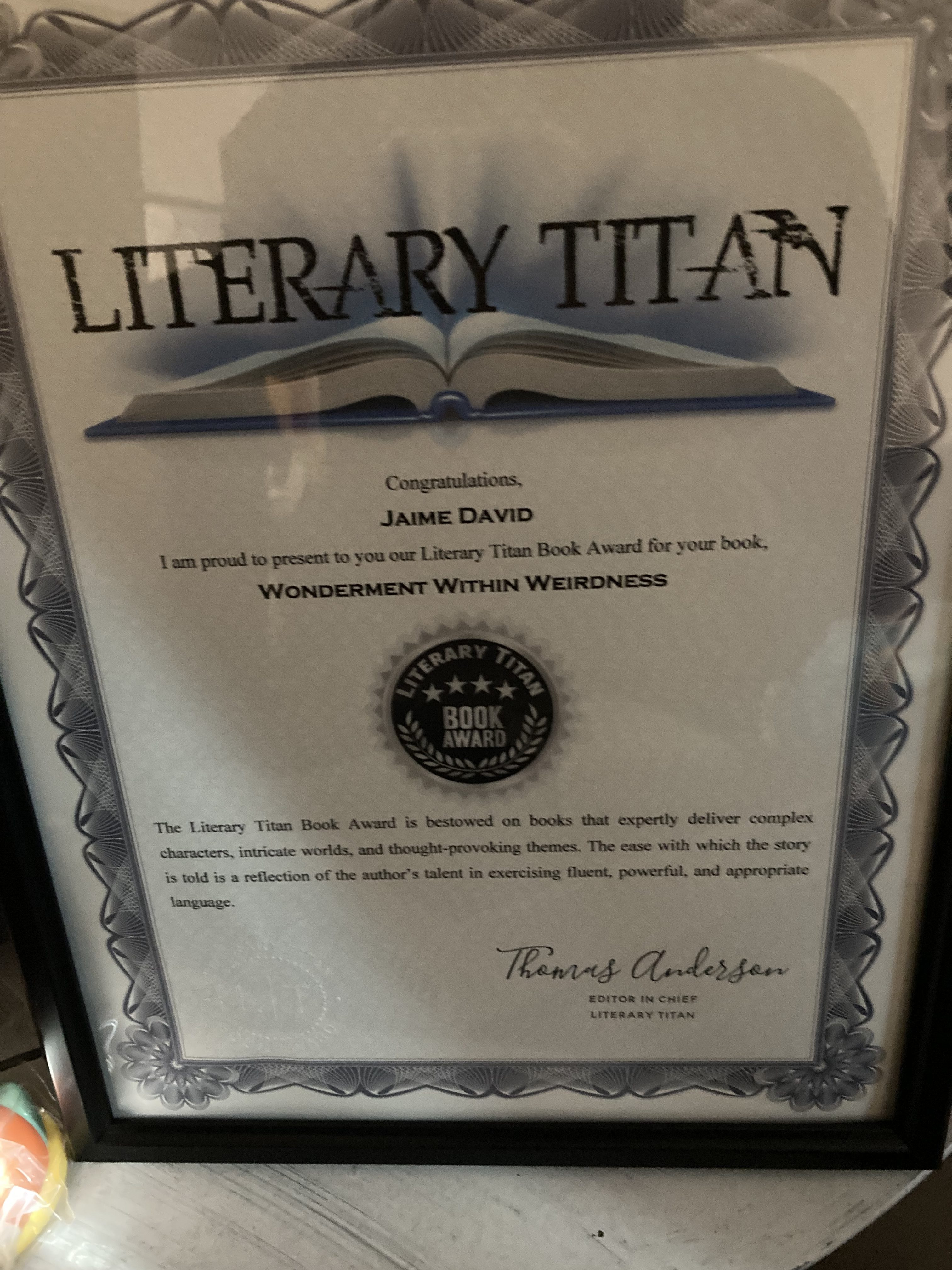
    February 15, 2026 marks a milestone I never quite imagined I would reach, at least not in the way it has unfolded. One year ago today, I officially became a published author when my debut novel “Wonderment Within Weirdness” was released into the world. As I sit here reflecting on the past twelve months, I find myself almost disbelieving that not only did I publish that first book, but I somehow managed to release two additional books during the summer of 2025, my poetry compilation “My Powerful Poems” and my short story collection “Some Small Short Stories.” Three books in one year. The thought still catches me off guard, fills me with a strange mixture of pride and bewilderment, as if I’m looking at someone else’s accomplishments rather than my own.

    There’s something profoundly transformative about becoming a published author. The moment “Wonderment Within Weirdness” went live, something shifted in how I saw myself and my relationship with writing. For years before that, writing had been something I did, a passion I pursued in the margins of my life, but it wasn’t necessarily who I was in any official capacity. I was someone who wrote, sure, but calling myself a writer felt presumptuous, like claiming a title I hadn’t quite earned. Publishing that debut novel changed everything. Suddenly, the identity wasn’t aspirational anymore, it was actual. I had created something tangible that existed beyond my own computer files and notebooks, something that other people could hold, read, and experience. That transition from private creator to public author felt both terrifying and exhilarating, like stepping off a cliff and discovering I could fly.

    “Wonderment Within Weirdness” was a labor of love that took far longer to complete than I ever anticipated. Like many debut novels, it went through countless revisions, moments of self-doubt, periods where I was convinced it was brilliant followed immediately by periods where I was certain it was irredeemable garbage. The writing process taught me patience with myself, taught me that creation is rarely linear, that sometimes you have to write yourself into corners just to discover new doors. When I finally decided it was ready, when I finally took that leap and actually published it, I remember feeling this overwhelming sense of vulnerability. Putting your work out there for public consumption is an act of courage that non-writers sometimes don’t fully appreciate. You’re not just sharing words on a page, you’re sharing pieces of your imagination, your perspective, your soul in some fundamental way.

    What I didn’t anticipate on that February day in 2025 was how publishing that first book would unleash something within me. It was as if releasing “Wonderment Within Weirdness” into the world opened a creative floodgate I didn’t even know existed. Throughout the spring of 2025, I found myself writing with a fervor and consistency that surprised me. The poetry that had been accumulating in various notebooks and digital files for years suddenly felt like it deserved to be compiled, organized, given its own home. The short stories I had written sporadically, often as experiments or exercises or just bursts of inspiration, began to look like they could form a cohesive collection. Where publishing my debut novel had once seemed like the culmination of years of work, it now felt more like a beginning, a doorway opening onto a path I hadn’t fully considered walking.

    By summer 2025, I had made the decision to publish not one but two additional books. “My Powerful Poems” became my second published work, a collection that felt intensely personal in a different way than the novel had. Poetry strips away so much of the protective narrative distance that fiction provides. Each poem was a distilled moment of emotion, observation, or insight, laid bare without the comfortable camouflage of characters and plot. Compiling that collection meant revisiting different versions of myself, the person I was when I wrote each piece, the moments of joy or pain or wonder that had inspired the words. It meant curating an emotional landscape and inviting readers to walk through it with me. The vulnerability of publishing poetry felt even more acute than publishing fiction, yet there was also something deeply satisfying about it, about saying these are my truths, these are my observations of the world, take them or leave them.

    Following closely on the heels of the poetry collection came “Some Small Short Stories,” which gathered together the narrative fragments and complete miniature worlds I had created over time. Short stories are a unique form, requiring precision and economy in a way that novels don’t. Each story in that collection represented a different experiment in voice, perspective, genre, or style. Some were realistic, some ventured into the strange and surreal, some were humorous, others melancholic. Putting them together into one collection felt like creating a gallery of different moments and moods, a showcase of range rather than a single sustained vision. I loved the freedom that collection represented, the way it didn’t have to be any one thing but could contain multitudes.

    Looking back at the publishing journey of those three books across 2025, I’m struck by how much I learned in such a compressed timeframe. Each book taught me different lessons about the craft of writing, the business of publishing, and the experience of being an author. “Wonderment Within Weirdness” taught me about sustained narrative, about character development, about weaving together plot threads and themes across hundreds of pages. It taught me about the marathon of novel writing, the endurance required to stay committed to a single project through all its ups and downs. “My Powerful Poems” taught me about distillation, about finding the exact right word, about the music of language and the power of white space on a page. It taught me to trust emotion, to not overexplain, to let readers bring their own experiences to the work. “Some Small Short Stories” taught me about versatility, about the sprint of short fiction versus the marathon of novel writing, about beginnings and endings and making every word count.

    Beyond the craft lessons, publishing three books in one year taught me practical things about the publishing process itself, especially as someone navigating the world of independent publishing. I learned about formatting and cover design, about metadata and keywords, about the strange alchemy of trying to find readers in an oversaturated marketplace. I learned about the importance of patience, about how building an audience is a slow process that can’t be rushed. I learned that publishing a book is just the beginning of its journey, not the end, and that the work of being an author extends far beyond the writing itself into promotion, engagement, and community building. These weren’t lessons I necessarily wanted to learn, they felt less romantic than the pure act of creation, but they were necessary ones, grounding my artistic aspirations in practical reality.

    What strikes me most profoundly as I mark this one-year anniversary is the sheer unexpectedness of it all. A year ago, if someone had told me I would publish three books in twelve months, I would have laughed at the impossibility of it. My aspirations were much more modest, I just wanted to get that debut novel out there and see what happened. I didn’t have a master plan for multiple releases, I wasn’t following some strategic publishing roadmap. Instead, each book emerged organically from the momentum created by the one before it. Publishing “Wonderment Within Weirdness” didn’t exhaust my creative energy, it multiplied it. It gave me confidence I hadn’t possessed before, a belief that my work was worth sharing, that I had more to say and people might want to listen.

    This anniversary also prompts reflection on what it means to call something an accomplishment. We live in a culture that often measures success in quantifiable external metrics, sales numbers, bestseller lists, awards, recognition. By those standards, I can’t claim massive success. My books haven’t topped any charts, I haven’t quit my day job to write full-time, I’m not fielding offers from major publishers or Hollywood producers. But accomplishment, I’ve learned, can be measured in different ways. The fact that I wrote three books, that I brought them from conception to completion to publication, that I overcame all the internal resistance and self-doubt and fear that plagues every writer, that alone feels monumental. The fact that even one person I don’t personally know has read my work and connected with it, that’s meaningful in a way that transcends commercial metrics.

    There’s also something to be said for the accomplishment of consistency, of showing up to the work again and again across a full year. Writing requires discipline, especially when inspiration wanes, when life gets busy, when the initial excitement of a new project fades into the hard middle where you’re not sure if what you’re creating has any value. Publishing three books meant showing up consistently to the page, trusting the process even when I couldn’t see the endpoint, pushing through the resistance that tried to convince me I had nothing worthwhile to say. It meant honoring the commitment I made to myself to be a writer not just in identity but in practice, day after day, word after word, until those words accumulated into complete works.

    As I think about the year ahead, I find myself in an interesting position. The urgency that drove me through 2025, that led to three publications in rapid succession, has settled into something different. I don’t feel the same pressure to prove anything, either to myself or to others. I’ve done the thing, I’ve published books, I’ve earned the title of author in a concrete way. Now the question becomes what kind of author I want to be moving forward, what stories and ideas deserve my attention and energy, how I want to balance the creation of new work with the cultivation of what I’ve already released. There’s a freedom in having accomplished something you once thought impossible, it gives you permission to be more intentional, more selective, more patient with yourself and the creative process.

    Part of me wonders if I’ll publish anything in 2026, or if this will be a year of rest and renewal, of filling the creative well rather than drawing from it. I’ve learned that sustainable creativity requires cycles of output and input, of speaking and listening, of sharing your vision and absorbing the visions of others. After the intense productivity of 2025, perhaps what I need most is spaciousness, room to experiment without the pressure of publication, permission to write things that might never see the light of day simply because they help me grow and explore. Or perhaps I’ll surprise myself again, perhaps there’s another book waiting to emerge that I haven’t yet recognized. The beauty of having made it through this first year is that I now trust the process more, trust that the work will make itself known when it’s ready.

    What I do know is that I’m grateful for this year, for everything it taught me, for the ways it challenged and changed me. February 15, 2026 isn’t just an anniversary of publication, it’s an anniversary of transformation, of becoming something I always hoped I could be but wasn’t sure I actually would. It’s a marker of courage, of the decision to stop waiting for permission or perfect circumstances and to simply begin, to put my work into the world despite all the reasons not to. Every writer I admire had to start somewhere, had to publish that first book, had to push through the fear and uncertainty and just do the thing. I did that. I’m doing that. And that’s worth celebrating.

    Looking at those three books, “Wonderment Within Weirdness,” “My Powerful Poems,” and “Some Small Short Stories,” I see a year of my life crystallized into words. I see the person I was when I wrote each piece, the hopes and fears and observations that shaped the work. I see evidence of growth, of experimentation, of a willingness to try different forms and voices. They’re imperfect, of course, all creative work is imperfect because we ourselves are imperfect. There are things I would change if I could go back, passages I would rewrite, choices I would reconsider. But they also represent something complete, something finished, something that exists independently in the world now. They’re no longer just mine, they belong to whoever reads them, interpreted through the lens of each reader’s unique experience and perspective.

    This anniversary makes me think about all the aspiring writers out there who are where I was two years ago, sitting on completed manuscripts or half-finished projects, wanting to publish but not quite ready to take the leap. If I could offer any wisdom from my year as a published author, it would be this: just start. Don’t wait for everything to be perfect, because it never will be. Don’t wait until you feel completely ready, because that feeling might never come. Don’t wait for someone to give you permission or validate your work, because you are the only permission you need. The difference between an unpublished writer and a published author is simply the decision to share your work, to take that terrifying step from private creation to public offering. Everything else is just details.

    As I close out these reflections on my first year as a published author, I’m filled with a quiet sense of pride that feels hard-earned and genuine. Three books. One year. It’s an accomplishment not because of any external validation, but because I set out to do something difficult and I did it. I faced every obstacle, internal and external, that tried to stop me, and I persisted. I honored my creative voice enough to believe it deserved to be heard. I trusted myself enough to put imperfect work into the world rather than keeping it hidden in pursuit of an impossible perfection. That’s what I’m celebrating on this February 15, 2026, not just the books themselves, but the growth they represent, the courage they required, the transformation they catalyzed.

    Here’s to one year as a published author, to “Wonderment Within Weirdness” and “My Powerful Poems” and “Some Small Short Stories,” to unexpected journeys and surprising productivity, to creative risks and vulnerable sharing, to the terror and joy of putting your work into the world. Here’s to whatever comes next, whether it’s more books or fallow periods, new experiments or deeper dives into familiar territory. Here’s to the ongoing adventure of being a writer, with all its challenges and rewards, its frustrations and fulfillments. And here’s to anyone reading this who has their own creative dreams waiting to be realized: may you find the courage to begin, the persistence to continue, and the satisfaction of looking back one day and marveling at how far you’ve come.

    Fediverse Reactions
  • How to Write a Poem: A Modern, Free-Flowing Approach to Poetry

    How to Write a Poem: A Modern, Free-Flowing Approach to Poetry

    Writing a poem is one of the most personal forms of expression you can engage in. Poetry is freedom. It’s about what comes from your heart, your soul, your mind — not about following a prescribed structure or set of rules. And the best part? Anyone can write a poem. If you have emotions, thoughts, or a story to tell, you have the ingredients to write poetry. Whether you’re a seasoned writer or someone just starting out, there are no wrong ways to do it.

    So, if you’ve been wondering, “How do I start writing poetry?” I’m here to tell you: Just start writing. Poetry is your voice, and your voice doesn’t need permission.


    1. Embrace the Freedom of Poetry — There Are No Rules

    Poetry doesn’t have to rhyme, and it doesn’t have to follow any specific format. If you feel something deep inside and you can express it, then it’s poetry. Some poems rhyme; some don’t. Some follow specific structures like a sonnet or a haiku; others are completely free-flowing.

    The beauty of poetry is that it’s an art form meant to express your innermost thoughts and emotions. If that means your poem is just a few lines, or it’s a longer, sprawling piece — that’s fine. Poetry can be anything you want it to be. It doesn’t need to follow tradition to be powerful.


    2. Poetry Is About Expression — Not Structure

    While traditional components of poetry include imagery, rhythm, and emotion, don’t feel bound by them. Poetry is personal, and it’s meant to convey what you’re feeling. Here’s how to think about it:

    • Imagery: Poetry uses vivid imagery to evoke feelings. You don’t have to overdo it with metaphors or similes, but try to describe things in a way that resonates with your emotions. For instance, you might say, “My heart is a fragile glass,” or “My thoughts are like scattered leaves in the wind.” Let your imagery come naturally — what does your emotion feel like?
    • Rhythm: Not every poem needs a strict rhythm, but the sound of words is important. Play with how your words flow when read aloud. Does the poem sound smooth? Jarring? Rhythmic? If it does, then you’ve got rhythm.
    • Emotion: Above all, poetry is about feeling. How do you feel about the world, life, or love? Poetry allows you to explore these feelings in a way that no other writing can.

    3. Don’t Overthink — Just Write

    It’s easy to get stuck in your own head and think, “Is this poem good enough?” But remember, perfection isn’t the goal. The key is to keep writing and allow yourself to evolve.

    • Freewriting: Try setting a timer for 10 minutes and just write. Don’t worry about whether or not it’s a poem yet. Just let your thoughts flow and see what emerges. Afterward, you can go back and find the parts that speak to you.
    • Sensory Writing: Take a walk outside and use your senses. What do you see, hear, smell, or feel? Write it down. Sensory details bring a poem to life in ways nothing else can.
    • Use Prompts: If you’re stuck, use a word or image as a prompt. For example, “rain” could prompt a poem about sadness or renewal. Start with something simple, and see where it takes you.

    4. Experiment — Play With Form and Language

    Don’t worry about having to “get it right.” Start small, and allow your poem to evolve naturally. Free verse poems, for instance, don’t follow any specific rules, and you can break all the rules if it suits your poem.

    • Free Verse: Start by just writing words or sentences that describe how you feel. When you have enough, break it into lines or stanzas to give it shape.
    • Concrete Poetry: This form is fun — you shape your poem into an image. Maybe you write about a flower, and your words form the shape of a flower on the page.
    • Short Form: You don’t need to write long poems. A short, impactful poem can be just as powerful. Don’t let length define your success.

    5. Where to Find Inspiration and Learn More

    To really get into the groove of poetry, reading other poets can help spark your creativity. Here are some poets who bring fresh voices to the art:

    • Billy Collins: Known for his accessible yet profound poetry, Collins’ work is full of wit and wisdom.
    • Rupi Kaur: Famous for her short and powerful poetry, Kaur’s work speaks directly to the emotions we all experience.
    • Warsan Shire: Her poetry delves deep into themes of identity, migration, and trauma.
    • Langston Hughes: His work often captures the struggles of Black Americans in poetic yet accessible ways.

    There are also amazing resources like “The Poetry Handbook” by Mary Oliver and “A Poetry Handbook” by John Lennard that help guide you in the craft of writing poetry.


    6. Don’t Forget — Music Can Be Poetry

    A powerful way to see poetry is through music. Songs are poetry with a rhythm and melody to back them up. The lyrics of your favorite songs? That’s poetry! Whether it’s the rebellious spirit of punk rock, the emotional depth of ballads, or the lyrical beauty of a love song, lyrics have the same power as poetry.

    In fact, when you break down song lyrics, you’ll see that they often follow the same structure as poetry: imagery, rhythm, and emotion. Think about iconic lyrics like Bob Dylan’s “Blowing in the Wind” or Kendrick Lamar’s “Alright”. These are powerful poems wrapped in music.

    Consider listening to song lyrics as part of your poetry practice. Break down your favorite lyrics and study how they evoke emotion. See how they use rhythm, repetition, and metaphor, and then incorporate those tools into your own poems.


    7. Keep Going, Keep Experimenting — Your Voice Matters

    Above all else, remember: there is no right or wrong way to write poetry. The more you write, the more you will discover your own voice. Each poem you write will teach you something new, and each new discovery will help you grow as a poet.

    At the end of the day, poetry is yours to define. So don’t stress about getting it “right” — just express yourself.


    Final Thoughts: Just Write

    The most important piece of advice I can give you is this: just write. Your first poem doesn’t have to be perfect. Your second one doesn’t either. Just keep experimenting, keep playing with words, and allow yourself to be messy. You’ll discover your own voice over time.

    Poetry isn’t about following rules; it’s about creating something meaningful to you. So pick up your pen and start writing today. Your poem is waiting to be written.

  • Literal Titles and Names: What Words Really Tell Us About Stories, Brands, and Beyond

    Literal Titles and Names: What Words Really Tell Us About Stories, Brands, and Beyond

    Titles are strange creatures. They serve as the very first handshake between a work or product and its audience, setting expectations and emotions in motion even before we engage with the content. Often, titles are crafted to spark curiosity, convey mood, or hint at themes without revealing everything upfront. They can be poetic, symbolic, playful, or mysterious — all tools to catch our attention.

    But what if we peel back that layer? What if we ignore metaphor, branding gloss, or emotional subtext and instead take every title or name at its purest face value — literally? How often does the literal meaning line up with the actual content or purpose? How often are we misled, teased, or left puzzled? This is the fascinating terrain this post explores.

    Literalness in naming sits at the crossroads of communication, marketing, and creativity. Names and titles are our earliest points of contact, shaping our first impression and sometimes our entire experience. Yet, depending on the medium — whether books, movies, music, brands, or tech — the function and effect of literalness can change dramatically.

    Why do some creators choose brutally honest, straightforward titles, while others go for invented words or abstract concepts? When does literal clarity serve better than intrigue, and vice versa? To answer these questions, we’ll dive deeply into titles and names across several categories: movies, TV shows, video games, music, brands and products, and technology. Along the way, we’ll unpack examples and reflect on what literalness reveals about how we name and perceive things.


    Movies, TV Shows, and Video Games: Mostly Literal, Sometimes Mystifying

    In the world of visual storytelling and interactive media, titles often have a very pragmatic job: they need to signal genre, tone, and core themes quickly. Audiences browse through countless options, and a clear, direct title helps them make split-second decisions.

    Take Star Wars. Instantly recognizable and loaded with imagery, it’s a straightforward title that telegraphs a cosmic conflict involving stars, space, and war. No surprise: the franchise delivers precisely on that promise. Its simplicity is part of its power.

    Similarly, The Walking Dead leaves no room for guessing. This title is literal to the core — the “walking dead” are zombies, and the show’s plot revolves around surviving a zombie apocalypse. Here, literal clarity creates immediate emotional impact and sets the tone for horror and survival drama.

    Contrast that with Breaking Bad. The phrase means turning toward a life of crime or moral decay but doesn’t describe specific events in the plot. It’s more thematic than literal, inviting viewers to reflect on the transformation of Walter White. The title’s ambiguity adds depth and invites curiosity.

    Better Call Saul ups the literalness — it’s a direct call to action and identifies the show’s focus on a lawyer named Saul Goodman. The title is conversational, humorous, and clear, setting expectations for a legal drama with comedic elements.

    Video games often mirror this practical naming. Grand Theft Auto spells out its core gameplay: stealing cars and engaging in crime. Call of Duty is equally straightforward, indicating military combat action. Assassin’s Creed names a secret assassin order central to the plot, grounding players in the game’s world.

    However, more niche or experimental games buck this trend. The Stanley Parable is enigmatic; the title itself doesn’t hint at gameplay or theme without context. Gintama — a Japanese anime and game franchise — uses a portmanteau that means “Silver Soul,” which resonates with fans but tells newcomers little.

    Classic movies provide more varied examples. Nightmare on Elm Street clearly signals horror and sets a specific place, invoking fear and supernatural terror. Inception means “beginning,” but the movie focuses on planting ideas in dreams — a less literal connection that’s more conceptual.

    Titles like Predator and Alien name antagonists outright, creating a simple but effective hook for fans of those genres. The clarity draws in viewers who know what kind of threats they will face.

    Many titles in this space hover between literal and metaphorical, walking a fine line. Literal names help audiences quickly understand what to expect; metaphorical ones deepen intrigue. The most memorable titles often do both — offering just enough literal clarity to entice, and enough mystery to linger in the mind.


    Music: A Dance Between Title and Theme

    Music lives in a world of emotion, mood, and atmosphere more than narrative clarity. Songs are often short, poetic bursts of feeling rather than stories with defined plots. Because of this, song and album titles tend to function differently than in storytelling media.

    Take Keane’s You Are Young and Everybody’s Changing. Both titles appear repeatedly in lyrics, grounding the listener in themes of youth, transition, and loss. The titles give literal clues to the song’s emotional core and thematic focus, creating a tight link between title and content.

    Coldplay’s Fix You and The Scientist also fold their titles directly into the lyrics, using them as anchors for the song’s emotional narrative. “Fix you” offers hope and support, while “The Scientist” reflects regret and introspection.

    But the relationship between title and song is often more nuanced. Guster’s Happier is an excellent example. The word “happier” repeats, but the song is deeply melancholic and explores loss and pain. The title’s literal meaning contrasts with the song’s emotional reality, creating tension that invites reflection on the nature of happiness and regret.

    Breaking Benjamin’s Diary of Jane literally references a diary, and the song’s story centers on it, making the title straightforward. Conversely, Linkin Park’s Numb evokes a feeling of emotional detachment and pain. The title expresses the theme but leaves room for listeners to interpret their own emotional experience.

    Album titles also play this dance of literal and abstract. Coldplay’s Viva la Vida (“live the life”) suggests celebration but the songs tell stories of downfall and loss, complicating the title’s message. Slipknot’s Psychosocial blends psychology and social commentary, creating a complex concept rather than a straightforward label.

    Songs often invite poetic ambiguity, making strict literalism less effective. Titles become mood-setters and thematic signposts, opening up space for listeners to bring their own emotions and stories.

    Music’s fluid relationship between title and content reflects its fundamental nature: expression over explanation.


    Brands and Products: Names as Clues or Mysteries

    Brand names operate in a highly competitive, noisy marketplace, so naming is a high-stakes game. Names must be catchy, memorable, and ideally give some hint about the product or service — or at least evoke a feeling or idea that helps position the brand.

    Some brands nail this with literal clarity. Burger King clearly indicates a burger-focused fast-food restaurant with a royal claim. Home Depot immediately signals a home improvement store. Panera Bread tells customers bread and bakery items are central. Panda Express invokes Asian cuisine through its panda mascot and “express” suggests quick service.

    Others are more opaque. Subway, literally an underground train system, doesn’t suggest sandwiches to an uninformed person. It’s a case where branding and familiarity have replaced literal meaning.

    Coca-Cola and Pepsi are iconic brands where the literal meaning is limited. “Cola” is a general descriptor of flavor but doesn’t convey the actual taste or cultural meaning. The words themselves are invented or historical references that don’t immediately communicate their products.

    Some brands use abstract or invented names that build identity rather than description. Pandora references mythology and suggests mystery, but gives no hint about streaming music service. The Facebook rebrand to Meta moves from a descriptive social “face book” to a vague, futuristic “beyond,” which can confuse audiences about what the company does.

    Twitter’s rebrand to X is even more opaque and complicated by adult-content associations with “X,” which dilutes clarity and can alienate some users.

    Retail brands like 7-Eleven hint at operating hours, and Speedway suggests speed or mobility, but neither is self-explanatory about the business’s actual nature. Telecom brands like T-Mobile, Verizon, and AT&T blend clarity about communication with branding flair.

    Overall, brand names span from literal and descriptive to evocative and mysterious, often reflecting a tension between clarity and marketing impact.


    Software and Tech: Abstract or Descriptive?

    Technology and software names inhabit a unique realm where branding, functionality, and community identity collide.

    Programming languages such as Python, Ruby, Go, and Java don’t tell you about coding or computers if you’re unfamiliar. Python’s name comes from a comedy troupe, not snakes or programming, giving it a playful, abstract identity rather than a literal one.

    Operating systems like Ubuntu (meaning “humanity”) and Fedora (a type of hat) sound like exotic or abstract nouns, with little indication they are software platforms. This abstraction supports community values and uniqueness but at the cost of immediate clarity.

    Some software, though, opts for straightforward names. Microsoft’s Paint is exactly what it sounds like: a digital drawing tool. Notepad is self-explanatory as a note-taking application. Adobe’s Photoshop directly indicates photo editing capabilities. Business software like Salesforce (a force in sales) and QuickBooks (fast bookkeeping) uses literal naming to convey function clearly.

    Other software brands choose abstract names that evoke culture or emotion, like Slack (suggesting informality and ease) or Asana (a yoga pose), trading literal clarity for brand identity.

    Logistics companies such as FedEx (Federal Express), UPS (United Parcel Service), and DHL (named after founders) use acronyms that require familiarity but have become shorthand for reliable delivery worldwide.

    Tech naming balances clarity and branding, often valuing community and differentiation over literal description.


    What We Learn from Literalism Across Mediums

    Exploring literalness across diverse titles and names reveals rich insights about communication, marketing, and creativity.

    Literal titles work best where clarity helps quick understanding: fast food brands, software tools, and action games benefit from straightforward names. When consumers want to know immediately what they’re getting, literalness is a major advantage.

    In storytelling — whether books, movies, or TV shows — literal titles often feel too blunt or limiting. Poetic, symbolic, or metaphorical titles offer richer invitations and layered meanings, inviting exploration beyond surface expectations. Titles like The Catcher in the Rye or To Kill a Mockingbird captivate through metaphor rather than description.

    Music is the most abstract medium. Song titles often evoke mood, theme, or emotional tone rather than plot or content. This ambiguity enriches listener experience and invites personal connection.

    Brands walk a fine line. Too literal, and names risk blandness or forgettability. Too abstract, and they risk confusion or alienation. Names like Burger King and Home Depot balance memorability with clarity; Meta and Pandora opt for identity and mystery, sometimes at a cost.

    Tech names range from purely functional (Paint, Photoshop) to highly abstract (Python, Ubuntu), reflecting a diversity of priorities — clarity, community, uniqueness.

    Across all these, literalness is a tool, not a rule. Its power depends on context, audience, and purpose.


    Final Thoughts

    Taking titles and names literally opens a window into how language and marketing adapt to the medium, message, and audience.

    Some names tell you exactly what to expect — a fast food restaurant named Burger King, a game called Call of Duty, or a drawing tool called Paint offer clarity and comfort.

    Others lure you into mystery — the movie Inception, the music platform Pandora, or the rebranded Meta beckon you into unknown territory, inviting curiosity and exploration.

    Many do a bit of both, blending directness with intrigue, balancing function with art. This delicate dance makes naming an essential and fascinating part of creative expression and commerce.

    Whether it’s Breaking Bad, Star Wars, Diary of Jane, Burger King, Paint, or Meta, the title or name is often our first step into a broader story, product, or idea — a promise, a puzzle, or an invitation. And that’s the wonderful magic of naming.

  • Summer of Imagination: The Sun-Soaked Dreamscape

    Summer of Imagination: The Sun-Soaked Dreamscape

    Summer is a season of boundless potential. The sun, more generous than any other time of the year, casts its golden light on everything it touches. There’s a unique magic in summer, where the ordinary becomes extraordinary. A walk down a quiet street becomes a journey into a different world, where the sounds of birds and the rustling of leaves speak of adventure.

    This is the time when our minds are free to wander without the constraints of winter’s cold grip. We allow ourselves to daydream about the places we could go, the lives we could live, and the adventures we might take. Summer invites us to shed the heavy layers of thought and simply exist in the moment, basking in the sun’s warmth and letting our imaginations take flight.

    There’s a certain kind of beauty in the simplicity of summer days—the feeling of warm sand between your toes, the sound of ice cubes clinking in a glass, and the way the sky stretches endlessly above us. But it’s more than just the weather. Summer is about embracing a slower pace, where we allow ourselves to dream and wonder, to live in the present and to imagine what could be.

    In this post, I invite you to remember those moments of pure summer bliss, where the world felt like it was at your fingertips. To revel in the boundless energy the season offers and to tap into that childlike wonder that summer brings..