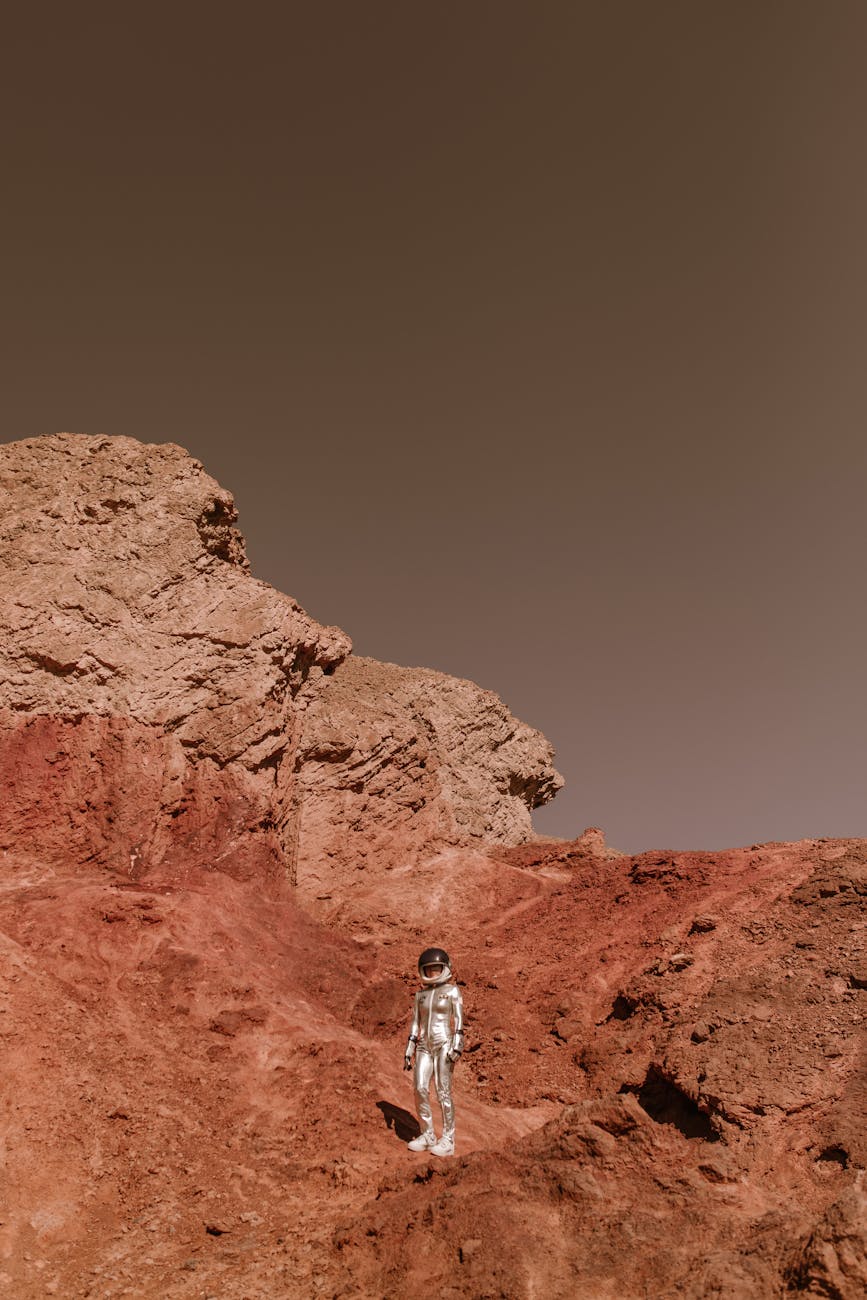
When we watch The Martian (2015), it’s easy to see Mark Watney’s story as a thrilling tale of survival on a distant planet. He battles isolation, resource scarcity, and, most pressingly, Mars’ massive dust storms. Meanwhile, Interstellar (2014) portrays a dying Earth, ravaged by relentless dust storms and agricultural collapse. On the surface, the films seem unrelated — different worlds, different crises, different stakes. But a fascinating fan theory suggests that the Mars mission in The Martian might have been humanity’s trial run for surviving exactly the kind of environmental catastrophe that we see in Interstellar.
Mars as a Dust Storm Laboratory
In The Martian, the storm that forces Watney’s crew to evacuate is the inciting incident for his ordeal. The dust isn’t just a dramatic backdrop — it’s a relentless hazard that shapes every aspect of his survival strategy. He must seal habitats, engineer oxygen production, conserve water, and grow crops in harsh, wind-driven conditions. Every improvised solution is a test of human ingenuity under environmental pressure.
Now imagine if NASA designed the Mars mission with a dual purpose: exploration and environmental research. The goal would be to see how humans could survive and adapt in extreme, dusty conditions — essentially using Mars as a laboratory for techniques that could later be applied to Earth’s declining ecosystems. Every rover drive, every habitat seal, every nutrient calculation becomes a rehearsal for surviving future dust storms on our own planet.
From Mars Lessons to Earth Survival
Fast forward to the timeline of Interstellar: Earth is experiencing massive dust storms that devastate crops and threaten global food security. While NASA operates in secrecy, the lessons learned from Watney’s Mars mission — life support, resource rationing, habitat resilience, and psychological endurance — could have informed their plans for humanity’s long-term survival.
If we accept the headcanon that Watney eventually becomes Dr. Mann, the connection deepens. Mann’s expertise in extreme survival would be informed by firsthand experience on Mars. His ability to assess planetary environments, manage life support systems, and react under intense pressure stems not only from his natural skill but from a “dress rehearsal” on the red planet.
Psychological Preparation
Dealing with dust storms on Mars doesn’t just test physical survival — it tests mental resilience. Watney faces isolation, frustration, and the constant threat of failure. This psychological endurance is directly applicable to the high-stakes missions in Interstellar, where astronauts must confront vast distances, near-impossible odds, and the crushing loneliness of space. Watney’s experience shows that surviving the elements is as much about mental fortitude as it is about engineering prowess.
A Hidden Continuity
By framing the Mars mission as an environmental experiment, the subtle connections between the two films become compelling. The dust storms in The Martian aren’t just a plot device; they’re a precursor to the challenges in Interstellar. The narrative link suggests a shared universe where human ingenuity and resilience are tested repeatedly — first on Mars, then on a dying Earth, and finally in the uncharted expanse of space.
Watney’s journey thus becomes more than a thrilling survival story; it’s a blueprint for the survival of humanity itself. Every improvised solution, every adaptation to dust, is a step toward preparing humanity for the world we see in Interstellar.
Conclusion
While The Martian and Interstellar were made independently and have distinct stories, imagining the Mars mission as a survival experiment for Earth’s environmental collapse provides a fascinating lens for analysis. It transforms Watney’s adventures into a precursor for Mann’s mission, links the dust storms of two worlds, and adds a layer of thematic continuity to both films. In this light, humanity’s struggle against the elements — whether on Mars or Earth — is a continuous story of adaptation, ingenuity, and resilience.