The Musings of Jaime David
@jaimedavid.blog@jaimedavid.blog

The writings of some random dude on the internet

1,168 posts
1 follower

Tag: internet culture

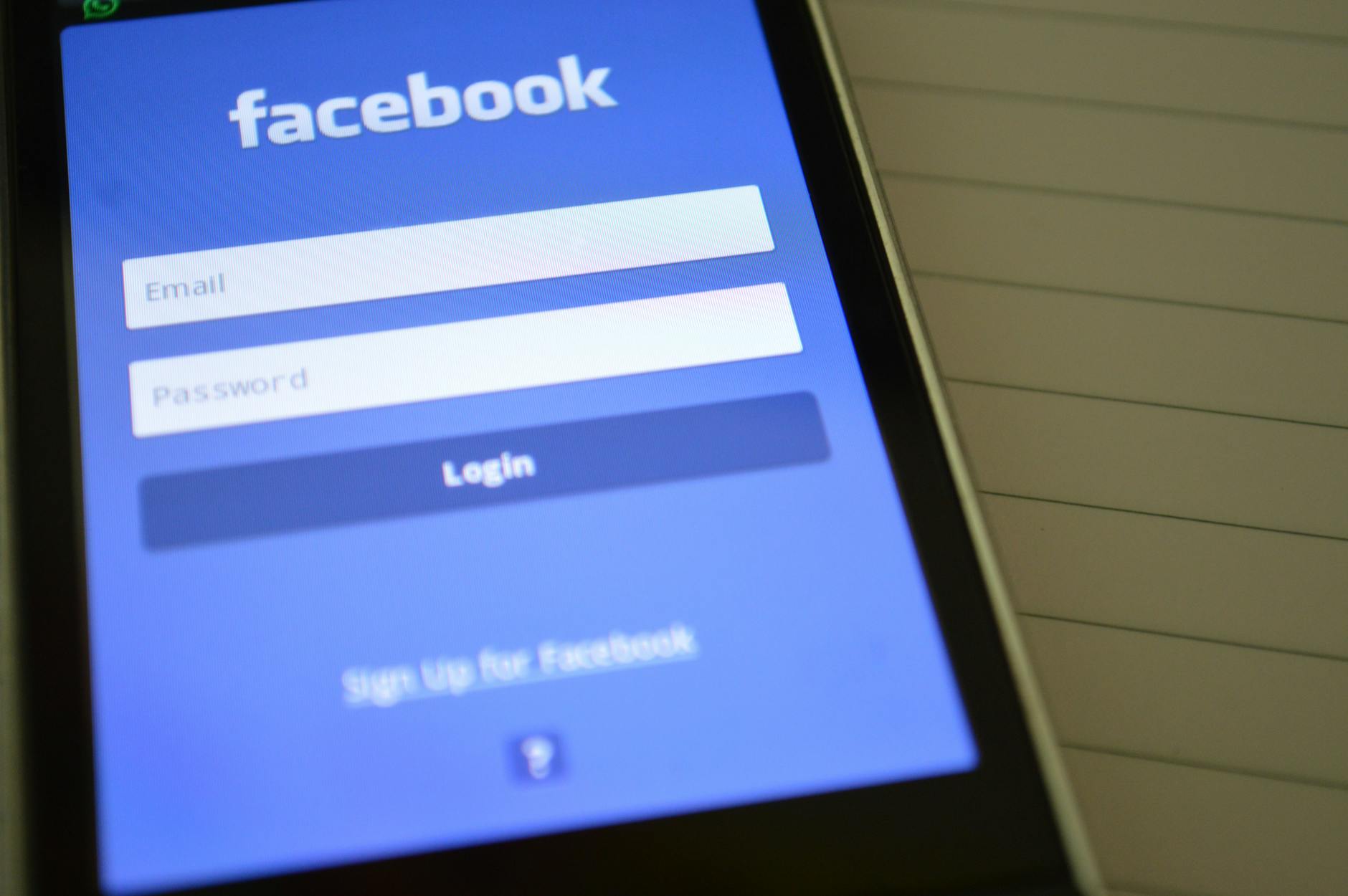
  • Stop Turning Private Facebook Groups Public

    Stop Turning Private Facebook Groups Public

    There is a trend on Facebook that drives me absolutely insane, and it seems to happen over and over again. A group starts out private. People join it because it is private. The privacy is literally part of the appeal. The group grows. The community develops. People become comfortable posting there. They share opinions, stories, frustrations, hobbies, interests, and sometimes personal experiences that they would never throw onto a fully public page. Then one day, out of nowhere, the admins decide to flip a switch and make the group public.

    Why?

    Seriously, why?

    I do not understand this obsession some Facebook group owners seem to have with taking something that was intentionally private and turning it into a public spectacle. If I wanted to post in a public group, I would have joined a public group. The fact that it was private was the entire point.

    What makes this especially frustrating is that private groups create a different atmosphere. People interact differently when they know their posts are being shared within a contained community. It is not that they are hiding something. It is that they understand context matters. A private group feels more like a conversation among members. A public group feels like standing in the middle of a crowded street with a megaphone.

    The difference is huge.

    When people join a private group, they often do so with the expectation that discussions are largely staying within the walls of that community. Sure, nothing on the internet is ever truly private, but there is still a meaningful distinction between a group that requires membership to view content and one where literally anyone can browse through posts without joining. That distinction matters.

    Yet somehow, some admins seem to reach a point where they decide visibility is more important than community.

    Suddenly, growth becomes the priority.

    Suddenly, engagement becomes the priority.

    Suddenly, attracting outsiders becomes the priority.

    And the people who originally joined because the group was private get completely ignored.

    It feels like a bait and switch.

    You join one thing and end up getting another.

    Imagine signing up for a small local club because you like the atmosphere, only for the organizers to eventually tear down all the walls and invite the entire city to wander through whenever they want. At that point, it is not really the same club anymore.

    The thing that annoys me the most is how often this decision gets justified as if it is automatically positive.

    “We want more visibility.”

    “We want more people to discover us.”

    “We want to grow the community.”

    Okay.

    Not every community needs to grow forever.

    Not every group needs to become massive.

    Not every corner of the internet needs to optimize itself for maximum exposure.

    Sometimes smaller is better.

    Sometimes limited access is better.

    Sometimes privacy is better.

    Why is that such a difficult concept for people to understand?

    There seems to be this modern internet mentality that everything must constantly expand. Every page must gain followers. Every channel must gain subscribers. Every group must gain members. Every community must become bigger than it was yesterday.

    But bigger does not always mean better.

    In fact, many times it means worse.

    As groups get larger, discussions become less personal. The sense of familiarity disappears. More trolls show up. More arguments happen. More spam appears. More low-effort content floods the feed. More outsiders enter who do not understand the culture that originally made the group enjoyable.

    The very thing that attracted people in the first place starts disappearing.

    I have seen this happen repeatedly.

    A niche group starts out great.

    People know each other.

    Conversations are interesting.

    There is a sense of trust.

    Then growth becomes the obsession.

    The group explodes in size.

    The atmosphere changes.

    The quality drops.

    The original members start leaving.

    And everyone acts surprised when the community is no longer what it once was.

    Well, what did you expect?

    You changed the entire structure of the environment.

    Of course things changed.

    What really gets me is that many group admins seem to underestimate how much privacy itself is a feature.

    Privacy is not merely a setting.

    Privacy is part of the product.

    Privacy is part of the experience.

    Privacy is part of what people are signing up for.

    When you remove that, you are not simply tweaking a setting. You are fundamentally altering the nature of the group.

    Some people join support groups because they are private.

    Some people join hobby groups because they are private.

    Some people join local community groups because they are private.

    Some people join discussion groups because they do not want every random stranger on Facebook reading their posts.

    These are perfectly reasonable preferences.

    Yet they often get treated as an afterthought.

    The assumption seems to be that everyone should be excited about increased visibility.

    I am not.

    A lot of people are not.

    If anything, the internet has become increasingly exhausting because everything is public.

    Every opinion becomes content.

    Every discussion becomes content.

    Every interaction becomes content.

    Every conversation becomes something that can be screenshotted, shared, reposted, and spread beyond its original context.

    Private groups offer at least some relief from that.

    Or at least they are supposed to.

    Then they get turned public.

    And suddenly the thing that made them appealing is gone.

    Another thing that bothers me is the lack of respect for existing members when these decisions are made.

    Sometimes admins will post an announcement.

    Sometimes they will not.

    Sometimes they act like it is no big deal.

    But it is a big deal.

    People joined under one set of expectations.

    Changing those expectations deserves serious consideration.

    At the very least, there should be meaningful input from the members.

    At the very least, there should be transparency.

    At the very least, there should be recognition that some people specifically chose the group because of its privacy settings.

    Instead, it often feels like a top-down decision where members are expected to simply accept it.

    Well, maybe they do not want to accept it.

    Maybe they joined for a reason.

    Maybe privacy was not some minor detail buried in the fine print.

    Maybe it was the entire selling point.

    And honestly, I am tired of seeing it happen.

    Every time I find a good group, there is this lingering concern in the back of my mind.

    Will this stay private?

    Or is it eventually going to follow the same pattern?

    Because I have watched it happen enough times that it feels predictable.

    The group gets bigger.

    Admins start talking about growth.

    More people arrive.

    The idea of going public gets floated.

    Then eventually it happens.

    And another private space disappears.

    It is frustrating because the internet already has an abundance of public spaces.

    There is no shortage of places where anybody can walk in and see everything.

    Those spaces already exist.

    They are everywhere.

    Private groups are one of the few alternatives.

    So why keep eliminating them?

    Why keep converting them into the exact thing they were supposed to be different from?

    Not every community needs to chase visibility.

    Not every community needs to chase metrics.

    Not every community needs to become an open-access attraction.

    Some communities work precisely because they are more contained.

    Some communities work precisely because members feel comfortable.

    Some communities work precisely because there is a barrier to entry.

    That barrier is not always a bad thing.

    In many cases, it is the reason the group functions well in the first place.

    And yes, I know admins technically have the right to run their groups however they want.

    That is not really the point.

    The point is that just because you can do something does not mean it is a good idea.

    The point is that if people joined because the group was private, maybe respect that.

    Maybe recognize that privacy is valuable.

    Maybe understand that not everyone wants maximum exposure.

    Maybe stop treating public visibility as the ultimate goal of every online community.

    Because for some of us, it is not.

    For some of us, the entire appeal is that the group is not public.

    For some of us, the appeal is having a space that feels at least somewhat separated from the endless performance culture that dominates social media.

    For some of us, the appeal is being able to participate without feeling like every comment is being broadcast to the entire internet.

    And when a private group suddenly goes public, that appeal disappears.

    So to the Facebook group admins who keep doing this, I have a simple request.

    Stop.

    Just stop.

    If the group started private, maybe leave it private.

    If people joined because it was private, maybe respect that.

    If the community works as a private community, maybe do not fix what is not broken.

    The internet already has more public spaces than anyone could ever reasonably use. Not everything needs to become one more public stage.

    Sometimes a private group should stay exactly what it was meant to be.

    Private.
  • The Absolute Rage Induced by “K.”

    The Absolute Rage Induced by “K.”

    Daily writing prompt
    What’s a word or phrase that annoys you?

    There are many phrases in this world that annoy me. Corporate buzzwords. Fake positivity. Passive aggressive nonsense. People saying “we should totally hang out sometime” when both of you know that is never happening. But there is one response, one microscopic combination of letters, one digital communication war crime that rises above the rest. One phrase so unbelievably lazy, dismissive, cold, and irritating that every time I see it, a tiny part of my soul flatlines.

    “K.”

    Just that. K.

    Not “okay.” Not “ok.” Not “alright.” Not even the slightly chaotic but acceptable “kk.” Just a lonely little “k” sitting there like a digital middle finger.

    And I know some people are gonna say, “well maybe they’re busy.” No. I do not care. Because typing “okay” takes maybe half a second longer than typing “k.” You already opened the message. You already looked at it. You already responded. So what exactly was saved here? What incredible amount of time efficiency was gained? Did NASA recruit you mid conversation? Were you suddenly called into a hostage negotiation? Did your phone battery have 0.0001% left and you sacrificed the other letters for survival?

    Because otherwise, what are we doing here?

    Especially when I send an actual thoughtful response. That is where “k” becomes truly infuriating. I could send somebody an entire paragraph. A detailed response. An actual conversation. Maybe I am explaining something important, talking about an idea, telling a story, venting about something, or even just trying to have a normal human interaction. And after all that effort, after all those words, after all that thought, the response I get back is:

    “K.”

    Are you kidding me?

    That is not a response. That is the conversational equivalent of someone shutting a door in your face halfway through a sentence. It feels like I just threw a fully cooked meal onto a plate for someone and they stared at it for two seconds before saying, “aight.” Not even enough respect to capitalize the K sometimes either. Just a lowercase “k” sitting there in all its emotionally vacant glory.

    And the worst part is how weirdly aggressive it feels.

    Because let’s be honest here. “K” does not read as neutral. Nobody on Earth reads “k” and thinks, “wow, what a warm and enthusiastic response.” No. “K” feels annoyed. It feels irritated. It feels passive aggressive even when maybe it is not intended that way. It feels like someone responding while rolling their eyes so hard they can see their own brain.

    Imagine talking to someone in real life like that. Imagine you are telling somebody a story face to face and when you finish, they just stare at you blankly and go, “k.” You would immediately assume they hated you. You would think they were angry. Or bored. Or trying to end the conversation as fast as possible.

    That is because human communication is not just about words. It is about effort. Energy. Tone. Engagement. And “k” has the energy of somebody throwing a single stale cracker onto the table and calling it dinner.

    Now look, I understand not every message needs a five paragraph response. I am not asking for people to write essays every single time. Sometimes short responses are fine. Sometimes there is not much to say. That is normal. But there is a gigantic difference between a simple response and a completely dead one.

    “Okay” feels normal.

    “Gotcha” feels normal.

    “Sounds good” feels normal.

    Even “lol” at least acknowledges humanity still exists.

    But “k” feels like the emotional equivalent of being left on read while technically not being left on read.

    And yes, there are layers to this too. Because context matters. A “k” from your boss somehow feels terrifying. A “k” from a friend feels dismissive. A “k” from someone you are arguing with feels like they are trying to start World War III. A “k” from someone you like romantically? Oh congratulations, now you are going to spend the next three hours wondering if they hate you.

    The single letter “k” has somehow evolved into one of the most emotionally loaded responses in digital communication history.

    And honestly, I think part of why it annoys me so much is because it represents this larger problem with modern communication in general. People have become so weirdly disconnected from conversations. Everything is rushed. Everything is shortened. Everything is compressed into the smallest possible amount of effort. We are communicating faster than ever before while somehow saying less than ever before.

    Conversations now sometimes feel like people are trying to speedrun human interaction.

    And again, I am not demanding constant deep emotional speeches. I am not asking every text conversation to become a philosophical debate about existence itself. But there is something deeply irritating about the absolute bare minimum effort possible becoming normalized.

    Especially when the other person is clearly trying.

    That is the key thing here. Effort should at least somewhat match effort. If somebody sends you an actual message, responding with “k” feels like conversational malpractice. It feels like somebody handing you a handwritten letter and you responding by throwing a sticky note at their forehead.

    And I know somebody reading this right now is thinking, “wow this dude is really angry about one letter.”

    Yes. Yes I am.

    Because somehow that one letter manages to radiate annoyance in ways entire paragraphs cannot.

    Honestly, sometimes “k” feels worse than no response at all. At least being left on read has ambiguity. Maybe they got distracted. Maybe they forgot. Maybe life happened. But “k” confirms they saw your message and actively decided this single consonant was all you were worth in return.

    It is honestly impressive in a horrible way.

    And do not even get me started on the variations of it either. Because there are subclasses of “k” energy.

    Lowercase “k” is cold and dismissive.

    Uppercase “K” feels actively hostile.

    “K…” feels like somebody preparing for murder.

    And then there is “Mk.” Which somehow feels like an exhausted parent trying not to lose their sanity entirely.

    Digital communication has become its own weird language where punctuation and capitalization can completely change emotional meaning. A period at the end of a sentence suddenly feels aggressive. Multiple exclamation points can feel fake. No punctuation can feel detached. And “k” became the king of all emotionally cursed responses.

    What fascinates me too is how universal this annoyance seems to be. So many people hate “k.” Entire memes exist about this. Entire online discussions exist about this. People immediately understand the emotional vibe of it without explanation. Humanity collectively agreed that this one letter carries the energy of disappointment, annoyance, boredom, or emotional shutdown.

    That is honestly kind of incredible.

    Language evolved over thousands of years and somehow we arrived at this.

    One letter.

    Pure irritation.

    And maybe some people genuinely do not mean anything by it. Maybe for some people it really is just shorthand. Maybe they truly are neutral when they send it. But communication is not just about intention. It is also about perception. And if millions of people collectively interpret “k” as irritated or dismissive, maybe there is a reason for that.

    Maybe because it feels incomplete.

    Maybe because it lacks warmth.

    Maybe because it feels like somebody trying to end a conversation instead of participate in one.

    Or maybe because it just looks ugly sitting there on the screen like some emotionally abandoned letter fragment.

    Honestly, even “👍” sometimes feels more human than “k.”

    At least the thumbs up has shape. Presence. Energy. “K” just looks like somebody gave up halfway through typing.

    And there is also a weird imbalance that happens when one person clearly cares more about the conversation than the other. You can feel it instantly. One person is engaged. The other is responding with the verbal equivalent of elevator music. “K” becomes the ultimate symbol of that imbalance. It tells you immediately who is carrying the interaction.

    Nobody wants to feel like they are talking at somebody instead of with somebody.

    That is what “k” does.

    It transforms conversations into brick walls.

    And listen, maybe this sounds dramatic. Maybe it is dramatic. But honestly? Human interaction matters. The little things matter. Tone matters. Effort matters. People can absolutely feel when someone is emotionally checked out of a conversation. Sometimes tiny things communicate massive feelings.

    That stupid little letter somehow communicates exhaustion, irritation, boredom, indifference, and passive aggression all at once.

    Which honestly is almost impressive linguistically.

    Like congratulations, “k.” You somehow became the most efficient delivery system for negative conversational energy imaginable.

    And the thing is, I do not even think people realize how often tiny responses shape interactions. A slightly warmer response can completely change the feeling of a conversation. A little enthusiasm can make somebody feel heard. Even basic acknowledgment can matter more than people realize.

    But “k” feels like anti warmth.

    Anti conversation.

    Anti human connection.

    It is the response equivalent of fluorescent office lighting.

    Cold. Harsh. Soulless.

    And maybe part of my hatred for it comes from how common it has become. Because once you notice it, you start seeing it everywhere. Texts. DMs. Comments. Group chats. Everywhere you go, there is always somebody lurking with their tiny little “k” loaded and ready to destroy the vibe instantly.

    It can kill momentum in seconds.

    You could be having a genuinely fun conversation and suddenly:

    “K.”

    Boom. Atmosphere dead. Conversation buried. Social energy annihilated.

    It is honestly almost comedic how powerful it is.

    One letter should not have this much destructive capability.

    And yes, before anybody says it, I know there are bigger problems in the world. Obviously. But sometimes daily annoyances are what stick with you the most because they happen constantly. Tiny frustrations repeated over and over become their own special category of rage.

    And “k” is absolutely one of them.

    Because at its core, I think what annoys me is not even the letter itself. It is what it represents. Minimal effort. Disengagement. Emotional laziness. The feeling of somebody barely participating while technically still responding.

    It feels like the modern internet distilled into a single character.

    Shortened attention spans.

    Compressed communication.

    Reduced effort.

    Everything becoming smaller, faster, emptier.

    And honestly? I hate that.

    I miss when conversations actually felt alive sometimes. When people bounced ideas off each other. When interactions had energy. When communication did not constantly feel like people trying to escape the conversation as quickly as possible.

    Maybe that makes me old fashioned. I do not know.

    But I do know this.

    If I send somebody an actual thoughtful message and all I get back is “k,” I immediately lose interest in continuing the conversation. Because why am I putting energy into something the other person clearly does not care about?

    Conversation is a two way street.

    Not one person dragging the other through digital quicksand.

    So yes, WordPress daily prompt, my answer is absolutely “k.”

    I cannot stand it.

    That one tiny letter somehow became one of the most irritating phrases in modern communication.

    And every single time I see it pop up on my screen, I swear I can physically feel my soul leave my body for half a second.

    Fediverse Reactions
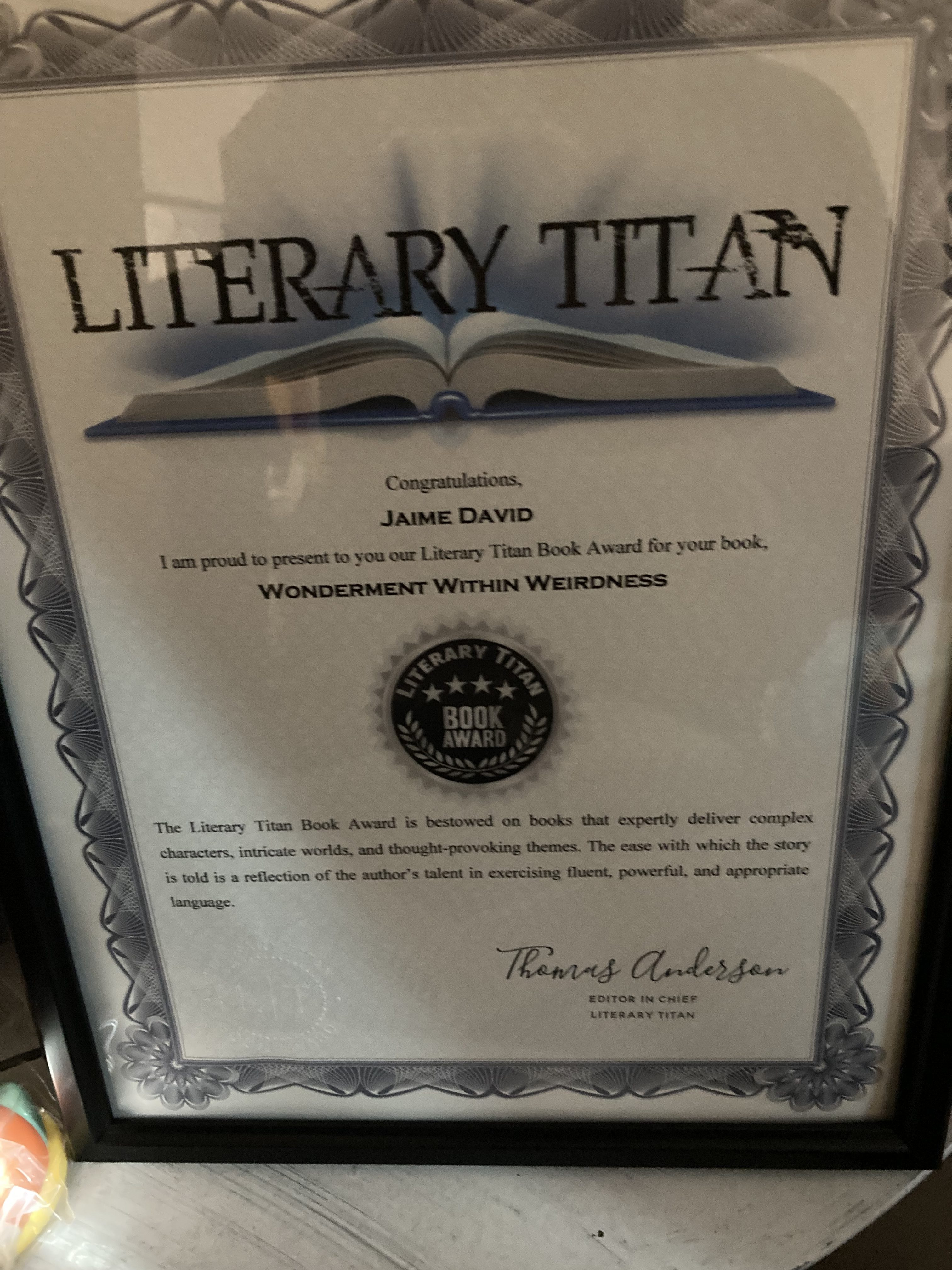
  • How My Debut Book “Wonderment Within Weirdness” Won a 4-Star Literary Titan Award

    How My Debut Book “Wonderment Within Weirdness” Won a 4-Star Literary Titan Award

    There are moments in life that do not fully register at first. Moments where you stare at a screen, reread the same sentence multiple times, and wonder if what you are seeing is actually real. For me, one of those moments came when I found out that my debut book, Wonderment Within Weirdness, had received a 4-star silver award from the Literary Titan.

    Now, before anyone misunderstands what I am saying, no, the Literary Titan award is not the Pulitzer Prize. It is not one of those century-old literary institutions that immediately dominate headlines or get discussed endlessly in academic circles. I understand that. I am aware of the hierarchy that exists within the literary world. There are massive awards with generations of prestige behind them, and then there are smaller, newer awards trying to carve out their own identity in the publishing landscape. Literary Titan falls more into that latter category. But here is the thing people often overlook: recognition is still recognition. An award does not have to be the most famous literary honor on Earth in order to matter.

    And for a debut author, especially an independent one, receiving any kind of legitimate literary recognition can mean far more than outsiders realize.

    Because here is the reality that many people do not talk about enough: writing a book is hard. Finishing a book is even harder. Publishing one is another mountain entirely. Then comes the most brutal stage of all, getting anyone to notice it in a world overflowing with content. Every day, countless books are released onto the internet. Thousands upon thousands of stories, poetry collections, essays, memoirs, philosophical works, experimental projects, and novels appear online, all fighting for visibility. Most disappear almost instantly into the digital void. Some never receive reviews. Some never find an audience. Some barely get read outside of friends and family circles. That is simply the brutal reality of modern publishing.

    Which is why the Literary Titan award mattered to me.

    Not because it suddenly transformed me into a globally recognized literary icon overnight. Not because I now expect to be discussed alongside literary giants. But because it represented something important: external validation. It meant that someone outside of my immediate circle looked at my work and believed it deserved recognition. That matters. Especially for a first book.

    Debut books exist in a strange space. Established authors often have advantages that new writers simply do not possess. They may already have audiences built over years. They may have publishers backing them with marketing budgets. They may have editors, agents, industry connections, media exposure, or simply the power of name recognition. Readers approach established writers with preconceived expectations. There is already a built-in level of trust there.

    A debut author has none of that.

    When someone picks up a first book from a completely unknown writer, there is no guarantee attached to it. There is no proven track record. No legacy. No assurance that the work will even be coherent, let alone compelling. A debut writer has to earn every ounce of credibility from scratch. That is part of what makes literary recognition for a first book feel especially significant.

    And in my case, Wonderment Within Weirdness was not some hyper-calculated, market-tested project designed specifically to appeal to mainstream publishing trends. If anything, the book reflects many of the themes and ideas that define my broader creative identity. Weirdness. Wonder. Introspection. Emotion. Existential thought. Philosophical wandering. Experimental energy. It is deeply tied to my voice as a writer and thinker. In many ways, it represents me authentically rather than trying to imitate what the market supposedly wants.

    That can be risky.

    The internet often pushes creators toward conformity. Algorithms reward familiarity. Publishing industries sometimes reward predictability. There is pressure everywhere to fit neatly into categories, genres, aesthetics, and market expectations. But creative work that embraces weirdness and individuality can sometimes cut through precisely because it feels different. It feels human. It feels personal. And I think that is part of why the recognition meant something to me.

    Because it suggested that originality still has value.

    I also think there is something psychologically important about literary awards for independent authors that many people underestimate. When you are creating largely on your own, doubt becomes constant. Every writer experiences it to some degree, but independent creators especially know what it feels like to question themselves endlessly. Is the work good enough? Is anyone reading? Does any of this matter? Am I wasting my time? These thoughts can become relentless.

    So when an outside organization says, “We see merit here,” it can genuinely impact a creator’s confidence. Not in an egotistical way, but in a stabilizing way. It becomes proof that the work connected with someone beyond yourself. That is valuable fuel for continuing forward creatively.

    And honestly, the award also made me reflect on how strange and unpredictable artistic journeys can be.

    There are writers who spend decades producing work before receiving recognition. There are others who explode into visibility instantly. Some receive praise early and disappear later. Others struggle for years before eventually finding audiences. There is no universal roadmap for creativity. No guaranteed formula. No clear sequence that determines who succeeds and who does not. The literary world is chaotic. Sometimes brilliant books are ignored. Sometimes mediocre books become massive phenomena. Sometimes deeply personal projects unexpectedly resonate with readers and reviewers alike.

    That unpredictability is both terrifying and beautiful.

    I think part of why this award mattered so much to me is because it symbolized momentum. Not finality. Not completion. Momentum. It felt like confirmation that I am not simply shouting into the void entirely unnoticed. Even smaller recognitions can create psychological momentum for artists. They can reinforce the idea that continuing to create is worthwhile.

    And perhaps most importantly, it reminded me that the definition of success is more nuanced than people often make it out to be.

    Modern internet culture tends to frame success in extremes. Either you are world famous, or you are irrelevant. Either you win the biggest awards imaginable, or your accomplishments supposedly do not count. But reality is far more layered than that. There are countless levels of artistic success between obscurity and superstardom. A smaller literary award can still represent a meaningful achievement. Especially for a first-time author.

    I also think there is something fascinating about newer literary awards in general. Every prestigious institution that exists today had to begin somewhere. The Pulitzer Prize was once new. The Booker Prize was once unknown. Every literary tradition starts small before history determines whether it grows into something larger. Now, I am not claiming Literary Titan will become the next Pulitzer. Nobody can predict that. But I do think people sometimes dismiss newer awards too quickly simply because they lack decades of legacy.

    The reality is that literary culture is constantly evolving. Independent publishing itself has changed dramatically over the last twenty years. The barriers between traditional and independent authorship have blurred. Online platforms have allowed writers to build audiences without relying entirely on gatekeepers. Smaller awards and independent review organizations have emerged partly because the literary ecosystem itself has expanded beyond older institutional models.

    And frankly, independent authors often need these spaces.

    Because traditional literary systems can be incredibly difficult to penetrate. Many talented writers never receive attention from major publishers or prestigious literary organizations despite producing meaningful work. Smaller awards can provide visibility where mainstream institutions may overlook emerging voices. That does not make the recognition fake or meaningless. It simply means it exists within a different layer of the literary landscape.

    Another thing that struck me after receiving the award was how differently creators experience recognition compared to outsiders observing from a distance. Someone scrolling online might see “4-star Literary Titan award” and move on after two seconds. But for the creator behind the work, that recognition often represents years of thought, effort, doubt, rewriting, editing, emotional investment, and persistence condensed into a single moment.

    People see the outcome. They rarely see the process behind it.

    They do not see the nights spent questioning whether the project will ever come together properly. They do not see the anxiety involved in publishing something personal into public view. They do not see the fear of rejection. They do not see the vulnerability required to create sincerely in a culture that often rewards irony and detachment more than authenticity.

    And perhaps that is another reason why this award felt meaningful to me specifically. It validated authenticity.

    I have always been drawn toward ideas that sit outside rigid convention. Whether through my writing, my philosophical ideas surrounding anarcho-compassionism, my blog posts, or my broader creative identity, I tend to gravitate toward introspection, emotional honesty, nuance, existential exploration, and unconventional thinking. Wonderment Within Weirdness reflects that mindset heavily. It is not trying to be sterile or artificially polished into generic marketability. It embraces weirdness directly, even in its very title.

    And honestly, I think the title itself matters.

    “Wonderment Within Weirdness” captures something fundamental about how I view creativity and existence. There is wonder inside the strange. Beauty inside imperfection. Meaning hidden within chaos. Modern society often pressures people to suppress weirdness, flatten individuality, and conform to expectations. But creativity frequently thrives in the exact opposite direction. Some of the most memorable art emerges precisely because it dares to be unusual.

    That does not mean every unconventional work automatically becomes brilliant. But authenticity has power. Readers can often sense when something comes from a genuine place rather than existing solely as a calculated product.

    I also think there is something inspiring about the fact that a debut independent book can receive recognition at all in today’s environment. We live in an era where gatekeeping still exists, but it is no longer absolute. Independent creators have more opportunities than ever before to publish work, connect with audiences, and gain visibility. The internet has created overwhelming saturation, yes, but it has also democratized creativity in many ways.

    That democratization comes with contradictions. Visibility is harder because everyone is competing simultaneously. Yet opportunities also exist that previous generations of writers could barely imagine. A person can build a blog, publish books independently, create podcasts, interact directly with readers, and cultivate a creative ecosystem almost entirely outside traditional institutions.

    That is part of the journey I have been navigating myself through The Musings of Jaime David and my broader online presence.

    And perhaps that is another reason this award felt important. It represented not just one isolated accomplishment, but evidence that the broader creative path I have been pursuing might actually be leading somewhere meaningful.

    What made the experience even more surreal was seeing the recognition expand beyond the award announcement itself. Literary Titan did not simply hand out the award quietly and move on. There was an actual press release published about my book receiving the award, which made the accomplishment feel far more tangible and publicly documented. FinancialContent press release about the award

    That mattered to me because there is something psychologically different about seeing your work discussed publicly in a professional context. It transforms the experience from feeling purely internal into something externally recognized and archived. Suddenly, the book was not just existing within my own creative ecosystem. It was being discussed beyond it.

    Then there was the author interview that Literary Titan conducted with me, which honestly made the entire experience feel even more real. Literary Titan author interview with Jaime David The title alone, “It Started With a YouTube Comment,” captures something fascinating about modern creativity and internet culture. So many creative journeys now begin in strange, seemingly insignificant digital moments. A comment. A post. A random idea. A passing conversation online. Something tiny eventually snowballs into something much larger.

    That interview gave me the opportunity to reflect not just on the book itself, but on the broader creative process behind it. And honestly, interviews can sometimes feel even more vulnerable than the work itself because they require the creator to directly articulate thoughts, motivations, insecurities, and inspirations in their own voice. There is nowhere to hide behind fictional structure or poetic abstraction at that point. It becomes direct human reflection.

    And then there was the review itself from Literary Titan. Literary Titan review of Wonderment Within Weirdness Reviews are fascinating because they represent interpretation. Once creative work enters the world, readers begin forming their own relationships with it. They notice things the creator may not have fully realized themselves. They interpret themes differently. They emotionally connect to unexpected aspects of the work. That is part of what makes literature so interesting in the first place. Books stop belonging solely to the author once they are released publicly. They become shared experiences between creator and reader.

    Perhaps one of the strangest and coolest parts of all this, though, was the fact that there was even a podcast episode discussing my book. Literary Titan podcast episode about Wonderment Within Weirdness There is something surreal about hearing people talk about your creative work in audio form, almost like listening to your ideas echo back at you from outside yourself. It creates this bizarre sensation where the project suddenly feels alive beyond your own head.

    And honestly, when you step back and look at the full picture, it becomes clear that the experience extended beyond simply “winning an award.” There was the award itself, the review, the interview, the press release coverage, and even a podcast discussion. For a debut independent book, that is genuinely meaningful visibility.

    Will the Literary Titan award alone suddenly make me famous? Of course not. I am realistic about that. But creative careers are often built incrementally. Recognition accumulates piece by piece over time. One review leads to another. One award builds credibility. One reader recommends a book to someone else. Momentum compounds gradually rather than explosively for most writers.

    People often romanticize overnight success while ignoring how many creators build their audiences slowly over years. Persistence matters enormously in creative fields. So does consistency. So does continuing to create even when visibility feels limited.

    And honestly, I think the award reinforced something deeper psychologically for me: the importance of continuing despite uncertainty.

    Because uncertainty never fully disappears for artists. Even successful writers experience doubt constantly. There is no magical point where creators suddenly become immune to insecurity. Every project involves risk. Every piece of writing involves vulnerability. Every publication becomes an act of exposure in some way.

    But recognition can help counterbalance that uncertainty enough to keep moving forward.

    It can remind creators that their work has impact beyond their own internal world. That someone connected with it. That the effort mattered to another human being somewhere out there.

    And for me, as a debut author, that feeling carries enormous significance.

    Fediverse Reactions
  • Subways of Your Mind: The Most Mysterious Song on the Internet, and a Meme Waiting to Happen

    Subways of Your Mind: The Most Mysterious Song on the Internet, and a Meme Waiting to Happen

    The song “Subways of Your Mind” by Fex has, without a doubt, cemented itself as one of the most intriguing, enigmatic pieces of music in recent internet history. Revered not just for its ethereal vibe, but for its history, it has garnered attention for its mysterious origins. Released in 1984, this track was shrouded in anonymity for decades, puzzling listeners around the world who stumbled upon it in the early days of the internet. Now, in 2026, the song’s background is well-known: the band, Fex, was tracked down in 2024, finally answering the questions surrounding the track that had been haunting online forums, Reddit threads, and YouTube comments for years.

    But while the discovery of the band was a watershed moment for fans, there’s something even more tantalizing that we, as a collective, have yet to see—a meme that feels almost too perfect for the song’s long-awaited recognition. That meme is one where “Subways of Your Mind” is played in an actual subway.

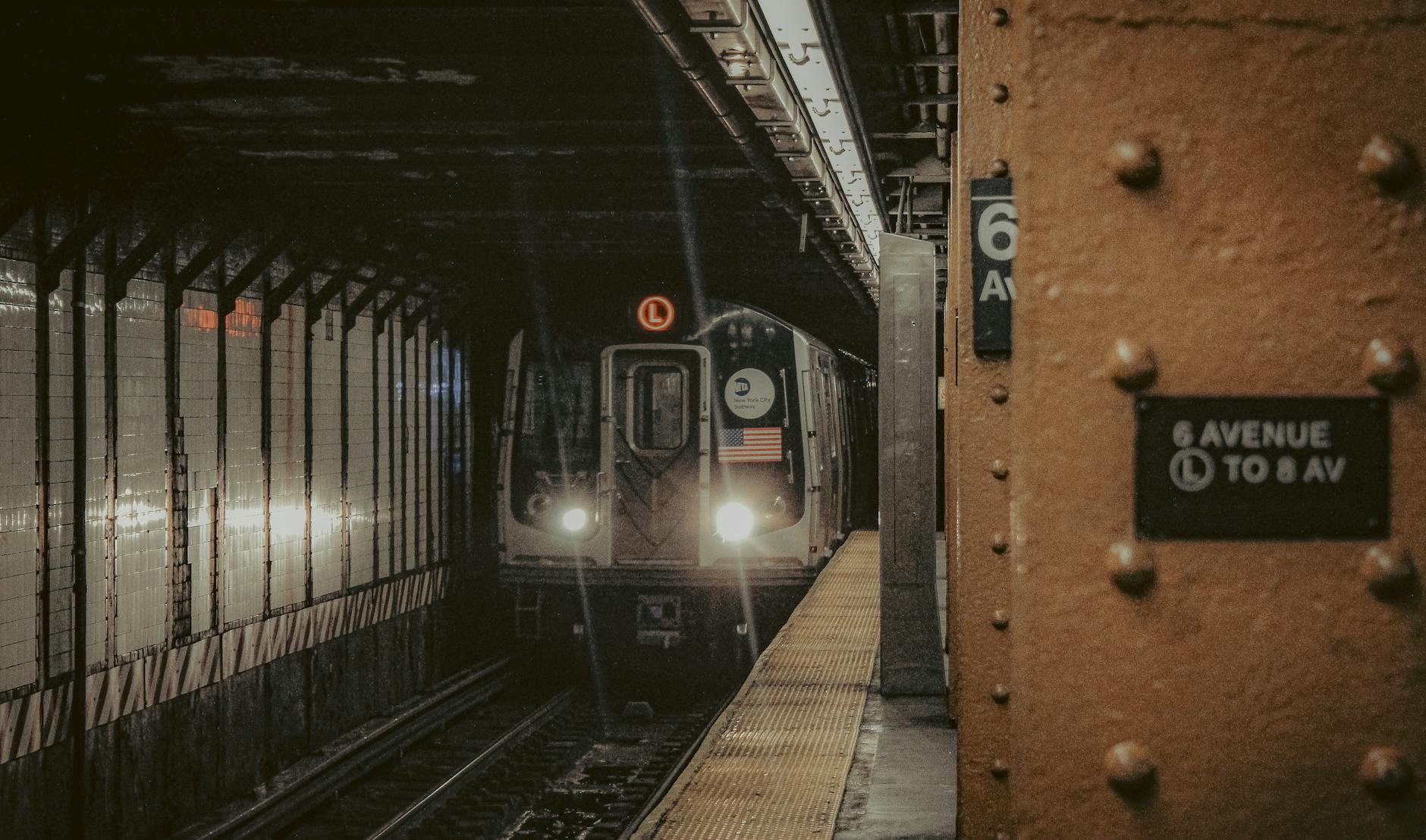
    Now, let’s take a step back and imagine the potential here. Picture it: the song, with its haunting melody and rhythmic, almost hypnotic pulse, filling the air of a bustling subway station, creating an otherworldly atmosphere. It could happen in the New York City subway, one of the largest and most iconic transportation systems in the United States. The potential for memes in this scenario is just too rich to ignore. But before we dive into the specifics of how and why this meme could transform the subway into something much more than just a transit hub, let’s first talk about what makes “Subways of Your Mind” so uniquely deserving of this moment.

    The Song: A Journey in Itself

    “Subways of Your Mind” has this haunting, dreamlike quality that resonates with anyone who stumbles upon it. The melody is captivating, almost hypnotic, with ethereal electronic instrumentation that is as enigmatic as it is beautiful. This was a track that was virtually unknown for years, circulating only in obscure corners of the internet. It’s the kind of song you hear and immediately want to know more about, yet the origins remained unknown until 2024, when the band Fex was tracked down. The story of the song itself is part of its allure—the mystery behind the music is a puzzle that connects the song to an internet culture that thrives on discovery, curiosity, and uncovering the hidden gems of the past.

    The vibe of the song feels like it was made for cities, especially for the fast-paced, bustling nature of subways, where passengers are typically lost in their own thoughts and journeys. It’s almost as if the song was written to echo the rhythmic thrum of subway trains, an auditory parallel to the physical journey commuters experience each day. It’s a match made in heaven—“Subways of Your Mind” would find a perfect home in the NYC subway system, blending seamlessly with the movement, the transit, and the feeling of thousands of people traveling in parallel lives, each on their own journey.

    The Meme That Should Exist

    Memes, as we know them, are born out of spontaneous, almost serendipitous moments that blend together the absurdity of the internet with the cultural zeitgeist of the time. And in 2026, with the renewed interest in “Subways of Your Mind,” it’s hard not to feel like we’re on the cusp of something incredible—something that will define the viral moment that the song deserves.

    Imagine the scene: the iconic sounds of the NYC subway—rushing trains, the screech of wheels against tracks, the hum of overhead lights—interwoven with the atmospheric tones of “Subways of Your Mind.” It starts with someone who happens to play the song from a radio or speaker, their fingers pressing play as the haunting intro fills the air. Perhaps it’s a street musician, or maybe someone with musical talent decides to cover the song in an impromptu subway performance. The subway cars, typically filled with commuters staring at their phones, become the backdrop for this almost cinematic moment, where the past meets the present in a surreal fusion of art and life.

    The aesthetic here would be powerful. The dissonance between the anonymous, underground nature of the subway and the evocative, mysterious qualities of the song creates a scenario that demands to be captured. The image of a subway car, filled with people going about their day, while “Subways of Your Mind” echoes through the station, would be nothing short of iconic. The perfect shot would feature the glow of fluorescent lights reflecting off commuters, their tired faces unknowingly in tune with a piece of music that once traversed the obscure corners of the internet, now coming alive in the heart of a city that never sleeps.

    There’s a sort of poetic symmetry in seeing the song’s presence in the subway, a place that is literally built for movement and transience. It feels as though “Subways of Your Mind” is meant to be played there, a soundtrack for the fleeting lives of subway passengers—people who are on their way somewhere, but in this moment, are transported into a meditative state by the music.

    Why NYC? The Intersection of Culture and Transit

    New York City, with its iconic subway system, offers a perfect stage for this meme. It is a city defined by its contrasts: the fast-paced nature of life mixed with the slow rhythm of the train, the quiet moments of reflection against the noise of the outside world. It’s a city where anything can happen, and where strangers become part of your life, if only for a fleeting second. The NYC subway has always been more than just a means of transportation; it is a microcosm of the city itself.

    Subways are not just places of movement—they are symbols of connection. And there’s something beautifully symbolic about pairing a song like “Subways of Your Mind” with the imagery of the subway. It brings together the underground, the transient, and the mysterious. What better place to create a moment that feels both personal and universal?

    Now, as of January 2026, this meme—this moment—has to happen. The city is alive with creative energy, and the internet, always thirsty for new content, would eat up a well-timed “Subways of Your Mind” moment. Whether it’s a street performer in a subway station covering the song, a random commuter playing it on their phone, or a flashmob orchestrating a spontaneous tribute to the track, the possibilities are endless.

    The Cultural Impact of the Meme

    The viral potential of this meme cannot be understated. Memes are how we share moments of culture, they’re how we give context to what it means to exist in a particular time and place. In the case of “Subways of Your Mind,” a meme set in the subway would bring together two aspects of modern life: the nostalgia of the past (the rediscovery of a long-lost song) and the immediacy of the present (the busy, often chaotic nature of daily life in a city like New York).

    It would be the kind of meme that both fans of the song and those unfamiliar with it could appreciate. For longtime listeners, it would be a fitting tribute to a song that has captured the imagination of internet culture. For newcomers, it would be an invitation to discover the track and fall down the rabbit hole of its mysterious origins. Either way, it would go viral in a heartbeat.

    The Song in 2026: A New Era for Fex

    As we move further into 2026, the band Fex is enjoying renewed attention, thanks to the viral resurgence of “Subways of Your Mind.” What began as an obscure internet curiosity has now blossomed into a cultural touchstone. And yet, for all the attention the song has garnered, we’re still waiting for that perfect moment—a moment where “Subways of Your Mind” finds itself organically embedded into the fabric of New York City’s subway system. It’s an opportunity for the song to transcend its internet origins and become a part of the city’s urban tapestry.

    The potential for memes here is just undeniable. Subways are a part of the modern experience; “Subways of Your Mind” is the soundtrack to that experience. Together, they’re a perfect match.

    Conclusion: A Call for the Meme That Should Be

    The time is now, and the meme is waiting to happen. In 2026, it feels almost inevitable that “Subways of Your Mind” will find its way into a New York City subway station, blending perfectly with the movement, the energy, and the quiet moments of reflection that define this iconic place. Whether through a spontaneous performance or a commuter playing the song on their phone, the possibilities are endless. But one thing is for certain: this meme is one that must be made. It’s the perfect convergence of music, place, and internet culture—and it’s time for the world to see it.

  • This Post (Wont Delete Now or Ever)

    This Post (Wont Delete Now or Ever)

    There’s a trend going around on the internet these days, one that’s so painfully obvious and, honestly, kind of pathetic, that it’s almost laughable. You know what I’m talking about. Folks post something, maybe something serious, maybe something dumb, and then they tack on a little note at the end, something like “will delete soon” or “might delete later.” And it’s everywhere. Social media, blogs, forums, even meme pages. Everywhere you look, someone is trying to say something, but not really, and then they reassure you that this will disappear, that it won’t last, that they’re not really committing to it. And that’s the thing—it’s such a transparent move that it’s almost insulting to anyone who reads it.

    Here’s my take. If you’re going to post something, just post it. Stand by it. Don’t put a half-hearted disclaimer at the end like you’re protecting yourself from your own words or from the judgment of others. It’s cowardly. Plain and simple. This whole “will delete soon” thing? It’s not clever. It’s not edgy. It’s a flimsy attempt to shield yourself from consequences that, let’s be real, are inevitable anyway. The internet doesn’t forget. Nothing is ever truly deleted. Screenshots exist. Backups exist. Archives exist. Whatever you post, it lives on in one form or another. So when someone says “I’ll delete this soon,” they’re lying. They know it. And you know it. Everybody knows it. It’s a performance, not a statement.

    And here’s what it really says about people. It says that they’re scared. It says that they’re uncertain. It says that they don’t trust themselves or their own judgment enough to put something out into the world and stand by it. That’s the root of it. It’s not a fun, quirky trend—it’s fear wrapped in a digital post. Fear of being judged, fear of being wrong, fear of being hated, fear of simply being seen. And maybe that fear is understandable, in a general sense, because we all live in a world where every opinion can be critiqued endlessly online. But that doesn’t make it noble. It makes it weak. It makes it hesitant. It makes it dishonest. And I can’t help but roll my eyes when I see it.

    Because here’s the truth: if you don’t know what you want to say, don’t say it. There’s no shame in silence. There’s no shame in waiting until you’ve figured out your words. But if you do know, if you do have something to express, then own it. Post it. Make your statement. And then leave it there. Don’t hedge it with a promise to retract, don’t dilute it with a wink, don’t try to sneak it past the world under the guise of impermanence. It’s not a trick. It’s not clever. It’s not protection. It’s a lack of conviction.

    Think about it this way. The people who constantly add these disclaimers, the “will delete soon” crowd—they’re putting the focus on themselves rather than the content. The content doesn’t matter as much as the self-preservation. And isn’t that kind of sad? It’s as if they can’t let their words exist without simultaneously trying to control how others interact with them. They’re trying to cheat the system of social interaction online, trying to have the experience of posting without ever being vulnerable. But vulnerability, however scary, is where authenticity comes from. Without it, your posts are hollow. They’re not statements—they’re props.

    And let’s be honest: posting is a risk. Saying something, anything, puts you out there. It opens you up to agreement, disagreement, ridicule, praise, criticism. That’s unavoidable. You can’t opt out of it while still participating fully. So when people write “will delete soon,” they’re essentially trying to opt out after opting in. It’s a paradox. And the paradox is only funny if you step back far enough to laugh at the ridiculousness of it, but mostly it’s just irritating. It’s irritating because it clutters conversations with half-measures, weak opinions, and shallow performances. And it trains other people to do the same, which, in the end, erodes the quality of discourse anywhere it spreads.

    I’ve seen this happen over and over. Someone posts something important, meaningful even, but then they bury it under a digital shrug, a “don’t take this seriously, I might delete it.” And what happens? People don’t take it seriously. People ignore it. The post is undermined before it even has a chance to exist. And that’s the problem with this trend in general—it’s self-sabotage disguised as humility, disguised as cleverness. It’s the worst kind of attention-seeking because it’s attention-seeking while pretending not to be. It’s manipulation without courage, and it’s everywhere.

    So, if you ask me, the opposite approach is the one worth taking. Say what you mean. Mean what you say. Post it. Leave it. Let it exist. Let people engage with it, positively or negatively, but let it exist. Don’t hedge. Don’t promise deletion. Don’t protect yourself from imaginary consequences that are going to find you anyway. The internet doesn’t forget. Nothing truly goes away. So the real bravery is in saying something knowing it will stay, knowing it will be judged, knowing it will be seen, and still posting it anyway. That’s integrity. That’s authenticity. And yes, it’s scarier than tacking on a little “will delete soon” note, but it’s worth it.

    The “wont delete now or ever” approach, which is exactly what I’m doing here, is not just a joke about a trend—it’s a statement about how to exist online with your words intact. It’s about taking responsibility for what you put out. It’s about rejecting the cowardice of hedging, of preemptive retraction, of lying to yourself and others about your intentions. It’s about standing tall with your thoughts, your opinions, your statements, your jokes, your complaints, your praise, your art, whatever it is that you have to offer. Don’t dilute it. Don’t hide it. Don’t apologize for it before it even has a chance to breathe.

    I think a lot of people don’t realize that there’s a freedom in this. There’s a liberation that comes from knowing that your words, your posts, your thoughts, exist, and that they exist unafraid. There’s a satisfaction in speaking without the chains of pretense. And when you combine that with the inevitable permanence of the internet, it’s almost poetic. You’re acknowledging reality as it is: nothing truly disappears, nothing is ever entirely private, nothing is ever entirely under your control. And rather than fear that, you embrace it. You work with it. You live honestly within it.

    So, to those who feel compelled to write “will delete soon,” I have a simple suggestion: stop. Take a breath. Ask yourself why you feel the need to hedge. Ask yourself why you’re afraid of being fully seen. And then, if your message matters, post it without reservation. Let it live. And if it doesn’t matter, if you’re unsure, then maybe don’t post it at all. Silence is better than cowardice. Thoughtfulness is better than performative vulnerability. Authenticity is better than trend-following, every time.

    And finally, for anyone who reads this and thinks, “Well, maybe I will delete it later,” understand this: the true courage is in knowing that deletion is irrelevant. The courage is in posting, in saying, in committing. Not in hiding. Not in apologizing before it’s necessary. Not in pretending impermanence makes your words any safer or more acceptable. It doesn’t. Words exist once spoken or written, and the internet is the ultimate testament to that. Accept it, embrace it, and for once, post something without shame, without hedging, without disclaimers, and without thinking that deletion is your safety net.

    So yeah, this post won’t delete now or ever. That’s the point. I’m not hedging. I’m not scared. I’m not pretending. And that’s how it should be for everyone. Say what you mean, mean what you say, and let the world deal with it.

  • The Insanity of the Facebook Puzzle Scam Code: “BE CV BK 2025 -R-D” and the Unbelievable Spread of an Obvious Scam

    The Insanity of the Facebook Puzzle Scam Code: “BE CV BK 2025 -R-D” and the Unbelievable Spread of an Obvious Scam

    It’s hard to overstate just how bizarre it is that something as nonsensical as “BE CV BK 2025 -R-D” has taken over Facebook and even started creeping into Google search results. This strange code — which looks like some mix of a fake model number, a coded message, and a bot gibberish tag — has appeared in thousands of posts across Facebook. And what’s wild is that, despite being so obviously a scam, so clearly fraudulent, so transparently fake, it’s everywhere. The fact that it’s not being widely discussed, not being reported on by major outlets, not being taken down effectively by Facebook, makes the whole thing even more insane.

    You can go on Facebook right now, type that code into the search bar — “BE CV BK 2025 -R-D” or “BE CV BK.2025 -R-D” — and what you’ll find is a flood of the same kinds of posts. Some are in different languages. Some use emojis. Some pretend to be part of “puzzle groups” or “mystery challenges.” Others are just random accounts spamming the same text over and over again, often accompanied by weird links, grainy photos, or random “game” announcements. But the one thing they all share is the same exact scam code.

    The strangest part is that this isn’t just some obscure niche spam chain buried deep in Facebook’s murky corners. It’s out in the open. Public groups. Public pages. Public posts. You can find it by simply searching. It’s like the digital equivalent of walking through a city and seeing “SCAM” graffiti plastered across every wall — and somehow, no one’s talking about it.

    That’s what makes this whole “puzzle scam” phenomenon feel so surreal. It’s not hidden. It’s not subtle. It’s right there in plain sight. And yet, despite being so blatant, it’s spreading like wildfire.

    It’s easy to see why the “puzzle” angle works. These kinds of scams often rely on curiosity — on the human desire to “figure out” something mysterious. The code looks cryptic enough to seem like there’s a deeper meaning behind it. “BE CV BK 2025 -R-D.” It almost feels like it could be a secret message, or a part of a viral challenge, or some kind of ARG (alternate reality game). And that’s what hooks people in. Someone sees a friend post it. They think, “What is this? Is this some new Facebook game? Is this part of something?” And before long, they’re clicking links, joining groups, following instructions, or even sharing the post themselves — unknowingly helping to spread the scam further.

    The entire design of this “puzzle” is meant to exploit one of the simplest psychological triggers: curiosity. Humans are hardwired to seek answers, especially when something looks like a code or a mystery. Scammers have known this for years — that’s why “riddles,” “tests,” “IQ puzzles,” and “hidden messages” have long been a popular front for phishing scams, malware links, and data-harvesting schemes. This particular Facebook scam just takes that formula and dresses it up with a meaningless code that looks intriguing to the untrained eye.

    But what’s really unsettling about this whole thing is just how many posts there are. It’s not just a handful of scammers copying and pasting the same message. There are thousands. Some of them are weeks or months old. Others are being posted in real time. The scam has evolved into a kind of bot swarm, almost like a virus that keeps replicating itself across the platform. And the lack of any large-scale intervention from Facebook makes it even worse.

    You’d think a platform with as much power, as much data control, and as much AI filtering as Facebook would be able to catch something as blatantly repetitive and nonsensical as this. But nope. The scam lives on, thriving. And that’s what’s disturbing. The scammers have found a way to stay one step ahead — maybe by slightly changing punctuation, or spacing, or formatting, to keep slipping past Facebook’s algorithmic filters. The difference between “BE CV BK 2025 -R-D” and “BE CV BK.2025 -R-D” might be enough to fool automated moderation systems.

    And meanwhile, the rest of us are just sitting here, watching this nonsense flood our feeds, while hardly anyone seems to be calling it out.

    It’s a sign of how desensitized we’ve all become to online spam. There’s so much garbage on the internet — from fake giveaways to impersonation accounts to AI-generated comment bots — that something like this barely registers anymore. The absurdity of a code like “BE CV BK 2025 -R-D” showing up everywhere doesn’t even faze people anymore. We’ve reached a point where mass spam has become so normalized that people just scroll past it without question.

    But the danger here isn’t just about annoyance. It’s about what’s behind these scams. Many of these “puzzle” posts are actually phishing attempts or clickbait traps that redirect users to shady sites. Others use the puzzle format to get users to comment, share, or click a “Continue” button — all tactics designed to collect engagement data or personal information. And then there’s the possibility that some of these are part of larger coordinated bot networks — networks designed not just to scam individuals, but to manipulate engagement metrics, artificially inflate content visibility, or even test out new spam strategies that can later be used in political or commercial manipulation.

    That may sound far-fetched, but it’s not. Facebook has long been a testing ground for disinformation and bot campaigns. If scammers can flood the platform with something so meaningless yet widespread, imagine what they can do when they actually put some effort into it.

    What’s also strange is how the scam has spread to Google. Search “BE CV BK 2025 -R-D” and you’ll see that it’s indexed in all kinds of pages — cached Facebook links, random blog comment sections, obscure reposting sites. The digital footprint of this nonsense code is massive. And that means it’s not just a Facebook issue anymore. It’s become part of the broader web ecosystem, another layer in the weird, polluted strata of modern internet junk data.

    It’s almost poetic, in a depressing way. The internet used to be about connection, creativity, and genuine curiosity. Now that same curiosity — the thing that once drove people to explore and learn — is being weaponized against them. Instead of solving puzzles for fun, people are being tricked into interacting with spam. Instead of decoding art or mystery, they’re decoding scams. And it’s not even subtle anymore.

    What’s wild, too, is that Facebook users themselves are often the ones unknowingly keeping it alive. The bots can only do so much — but when real people start engaging, commenting, sharing, or trying to “warn” others by reposting the code, that activity actually boosts the visibility of the scam. Facebook’s algorithm doesn’t care why something is getting engagement — it just sees numbers. So every time someone posts, “Don’t fall for BE CV BK 2025 -R-D, it’s a scam!”, that post can ironically push the code further up the visibility ladder, leading even more people to see it.

    The whole thing feels like an ouroboros of internet stupidity — a self-feeding loop where spam generates attention, attention generates engagement, and engagement keeps the spam alive.

    And maybe that’s the most disturbing part of all: how effortless it’s become for something like this to go viral without any real content behind it. It doesn’t even have to make sense. It doesn’t have to be convincing. It doesn’t have to look real. It just has to exist in large enough quantity to trick the algorithm.

    It’s a perfect reflection of how broken online ecosystems have become. In the old internet, scams had to at least try to look legitimate — a fake website pretending to be your bank, or a phony giveaway with a convincing logo. Now? All it takes is a random string of letters and numbers, a few thousand bot accounts, and a platform too busy or too lazy to do anything about it.

    Facebook’s failure to stop something this blatant speaks volumes. It’s not just an oversight — it’s a sign that their moderation systems are reactive, not proactive. They’re so focused on surface-level metrics that something like this can thrive indefinitely. And in that sense, the “BE CV BK 2025 -R-D” code becomes more than just a scam. It becomes a symptom. A sign of decay. Proof that the systems that were supposed to protect users from obvious manipulation are no longer functioning as intended.

    It’s worth asking: what’s the endgame here? What’s the point of this code? Is it just engagement farming? A front for phishing? A bot experiment? Or is it something even weirder — an automated system left to run amok, spamming for the sake of spamming?

    At this point, no one really knows. But that’s the scary part — no one’s really trying to find out, either. The internet is so overloaded with noise that even something this widespread can go largely unnoticed by the mainstream. People see it, shrug, and move on.

    That’s how scams survive. Not because they’re convincing, but because people have stopped caring enough to investigate.

    Maybe that’s the biggest takeaway from the “BE CV BK 2025 -R-D” puzzle scam — not just how it spreads, but what it reveals about us. We’re living in a time where nonsense thrives because attention is cheap. Where scams succeed not through sophistication, but through sheer saturation. Where even the most absurd, poorly disguised fraud can blanket an entire social network and nobody blinks.

    The “BE CV BK 2025 -R-D” code isn’t just a scam — it’s a mirror. A reflection of an online culture that’s too burned out, too overwhelmed, and too desensitized to call out the obvious anymore.

    And maybe, until more people start noticing the sheer absurdity of things like this, we’re going to keep seeing the same pattern play out — again and again — until our feeds are nothing but codes, spam, and empty noise pretending to be meaning.

    Fediverse Reactions
  • October 3rd: A Day for Pop Culture, Fandom, and Memory

    October 3rd: A Day for Pop Culture, Fandom, and Memory

    October 3rd has, strangely and beautifully, become one of the most iconic dates in pop culture. Unlike other “fan holidays” that get created artificially or through marketing campaigns, October 3rd has significance for two completely different fandoms that, at first glance, could not be further apart: Mean Girls and Fullmetal Alchemist. On one side, we have a 2004 teen comedy film that satirizes high school cliques, social hierarchy, and the pressures of fitting in. On the other side, we have a profound Japanese manga and anime series that deals with grief, war, science, morality, and the consequences of human ambition. Both of them, in their own ways, marked October 3rd as important. This overlapping coincidence has created a fascinating cultural phenomenon where fans online celebrate the day with memes, tributes, essays, and endless callbacks. October 3rd has become a “double holiday,” a day when two worlds—fetch pink and philosophical alchemy—come together.

    In Mean Girls, October 3rd is immortalized through a single, simple line. Cady Heron, the protagonist, narrates that “On October 3rd, he asked me what day it was.” She’s talking about Aaron Samuels, the popular boy she has a crush on. The humor and charm of the line is that it’s so mundane. It isn’t a dramatic confession of love, or an important milestone, but rather a trivial detail. Yet that is precisely what makes it so powerful: many of our most memorable teenage experiences are not grand declarations, but little, seemingly random interactions that become engraved in memory. Fans latched onto this line as something deeply relatable. Everyone remembers that one ordinary exchange that suddenly became special because of who said it, or how it made us feel. October 3rd in Mean Girls represents that teenage longing, the way a simple conversation can feel like a moment of destiny. Over time, fans turned it into a holiday, and every year, the internet becomes awash with pink-colored memes, GIFs, and tweets declaring “It’s October 3rd!”

    On the other side of the cultural spectrum, October 3rd plays a very different role in Fullmetal Alchemist. The date has weight, gravity, and deep sorrow. Edward and Alphonse Elric, two brothers who broke the laws of alchemy in a desperate attempt to resurrect their mother, suffer devastating consequences: Edward loses his arm and leg, and Alphonse loses his entire body, his soul tethered to a suit of armor. In order to move forward with their lives and commit fully to their journey to restore what they lost, they burn down their childhood home on October 3rd. This act is symbolic. They are erasing the possibility of ever returning to the life they once had. Edward even engraves the date—“Don’t forget 3.Oct.10”—on his State Alchemist pocketwatch, a constant reminder of the sacrifice, the pain, and the commitment they made.

    What’s fascinating is how different these two uses of October 3rd are, and yet how similar they feel when filtered through the lens of fandom. In one case, October 3rd is a sweet, nostalgic memory of teenage infatuation. In the other, it is a solemn vow tied to grief and responsibility. And yet both share the same root: memory. For Cady, October 3rd is worth remembering because of the boy she liked. For Edward, October 3rd is worth remembering because of what he lost and what he swore never to forget. Both works understand that humans often attach significance to dates as markers of who we are and where we’ve been. Whether trivial or tragic, these markers give us a way to frame time, to make sense of life’s chaos.

    This duality is also a reflection of why fandom culture loves anniversaries and dates. Fans are always looking for points of connection, touchstones that can bring people together. When October 3rd rolls around, fans of Mean Girls and Fullmetal Alchemist flood the internet with tributes. Sometimes they are separate: pink-themed posts about Cady Heron and Aaron Samuels on one side, somber references to the Elric brothers on the other. Sometimes, though, they cross over, and that’s where the internet magic happens. You’ll see memes of Edward Elric wearing pink on Wednesdays, or Aaron Samuels holding a Philosopher’s Stone. These crossovers are not just silly—they’re examples of how digital culture allows fans to stitch together unrelated works into a shared tapestry of meaning.

    What’s also interesting is how both fandoms reflect on growing up, though in radically different tones. Mean Girls is about the social battles of adolescence: the insecurities, the cliques, the desperate need to belong. Its October 3rd moment is lighthearted, almost comedic, but beneath the joke is a reflection of how awkward teenage years are navigated. Fullmetal Alchemist, meanwhile, is about the forced maturity of children who experienced tragedy far too young. Its October 3rd moment is heavy, brutal, and about moving on when you are not ready to. Both capture the theme of transitions—of life forcing you forward whether you like it or not.

    Why, then, has October 3rd resonated so strongly with audiences worldwide? Part of the answer lies in the universality of marking time. People everywhere love rituals, and in a digital age, fandom rituals become collective experiences. October 3rd is not just a fandom date; it’s a digital holiday. Just as May 4th has become Star Wars Day (“May the Fourth be with you”), October 3rd has carved its own place as a day where people all over the world know exactly what it means to certain fans. The fact that it unites two very different kinds of fandom only makes it more powerful.

    Consider how the internet itself has amplified October 3rd. In 2004, when Mean Girls first came out, fandom was more localized—people might have quoted lines with friends at school, but the idea of a collective October 3rd celebration wasn’t widespread. By the late 2000s and early 2010s, social media platforms like Tumblr, Twitter, and Facebook gave fans spaces to amplify the significance of the date. Similarly, Fullmetal Alchemist fans, who had always viewed October 3rd as meaningful because of the manga and anime, found new audiences who could engage with that symbolism. Over time, the convergence of these two fandoms created a snowball effect: now, every October 3rd, the date trends worldwide.

    There is also something beautiful about how two pieces of media from such different cultures—an American teen comedy and a Japanese anime—ended up connected this way. It shows how storytelling transcends geography. Both films and anime are deeply local in their origins—Mean Girls satirizes American high school culture, while Fullmetal Alchemist is steeped in Japanese perspectives on grief, morality, and war. And yet both ended up speaking to global audiences. October 3rd, then, becomes a cross-cultural bridge, a reminder that art can unify people in unexpected ways.

    Another angle worth exploring is how fans themselves project meaning onto dates. It’s not the creators of Mean Girls or Fullmetal Alchemist who told us, “Celebrate October 3rd every year.” That was fans, taking ownership of the story, carving rituals into the calendar. This fan-driven appropriation of dates is a kind of cultural authorship, a way of saying, “This moment mattered to us, and we’re not going to let it fade.” The phenomenon of October 3rd demonstrates how audiences can keep media alive long after release. Mean Girls could have remained just another 2000s teen comedy. Fullmetal Alchemist could have remained just one more shonen anime among many. But because of fandom, they are eternal.

    Critically, we can also see how October 3rd has evolved into not just a fandom holiday, but a point of intergenerational connection. Younger fans discovering Mean Girls on streaming platforms still laugh at the October 3rd line, while older fans remember seeing it in theaters. Similarly, new viewers of Fullmetal Alchemist: Brotherhood still gasp at the Elric brothers’ decision to burn their home, while older fans recall reading the manga chapter as it was released. October 3rd creates continuity, a shared moment where old and new fandoms meet.

    Memes and social media jokes aside, there is something deeply human about needing to remember. Both Mean Girls and Fullmetal Alchemist capture that instinct. Cady remembers October 3rd because it felt important to her heart. Edward remembers October 3rd because it defined his life’s path. And we, as audiences, remember October 3rd because both stories taught us that dates, however arbitrary, become sacred when tied to emotion.

    So every October 3rd, the internet turns pink and silver, fetch and alchemy. Some fans will laugh about Aaron Samuels asking what day it is. Others will post images of Edward Elric’s pocketwatch with “Don’t forget 3.Oct.10.” And some will do both, creating mashups that honor how strange and wonderful it is that two different works, from two different continents, gave us the same date to hold onto.

    And perhaps that is the ultimate lesson of October 3rd: memory doesn’t need to be monumental to matter. A crush asking the date, or two brothers burning their home, both mean something because they remind us of what it feels like to be alive, to want, to lose, to move forward. Whether we laugh with Cady or cry with Edward, October 3rd has become a vessel for remembering, together.

  • Discover the Strange, the Quirky, and the Unexpected: Introducing Oddities in Media

    In a world overflowing with media, it’s easy to feel like we’ve seen it all. From blockbuster films to trending social media posts, from best-selling books to viral videos, content surrounds us at every turn. But sometimes, the most fascinating and memorable moments in media are the ones that defy expectations—the strange, the quirky, and the unusual. These are the moments that make us pause, laugh, question, or simply scratch our heads. And that is exactly the space my new site, Oddities in Media, is designed to explore.

    Oddities in Media is a blog dedicated to highlighting the odd, the overlooked, and the utterly unique corners of all forms of media. It doesn’t matter whether it’s social media, YouTube, movies, TV shows, books, or other creative outlets—if it’s unusual, unexpected, or fascinatingly strange, it belongs here. The goal is simple: to shine a light on the media that most people miss, ignore, or dismiss, and to explore what makes it so compelling.

    The idea for this site stems from my fascination with media as a reflection of culture and creativity. Often, the content that seems odd, strange, or even ridiculous at first glance tells us more about society, artistic experimentation, or collective human behavior than the mainstream hits ever could. A bizarre viral video might reveal fascinating trends in internet culture. An obscure movie scene might reflect societal anxieties or creative risks from its era. Even an unusual book or TV episode can challenge conventions, experiment with narrative, or present ideas in ways that demand attention. By exploring these oddities, Oddities in Media offers readers a new lens through which to view and understand the media they consume.

    This blog is not just about cataloging strange content—it’s about celebrating it. Media doesn’t always have to be polished or commercially successful to be valuable. Often, it’s the imperfections, the quirks, and the unexpected moments that make a work memorable. A movie scene that seems unintentionally funny, a viral meme that surprises us with its absurdity, or a forgotten book with experimental storytelling all have a story to tell. Oddities in Media aims to give these works the attention and appreciation they deserve. It’s about curiosity, laughter, reflection, and discovery.

    Another goal of Oddities in Media is to provide context and analysis. It’s one thing to point out that something is strange; it’s another to explore why it exists, what it reveals, and why it captures—or fails to capture—attention. Posts on the site will often dig deeper, looking at historical, cultural, or artistic context, examining what makes a particular work odd, and exploring the impact it has on audiences. By combining observation with insight, the site encourages readers to think critically while still enjoying the weirdness and charm of unusual media.

    The scope of the blog is intentionally broad. It covers a wide variety of media, from the newest viral videos to forgotten movies, TV shows, YouTube channels, or books that may have slipped through the cracks. Oddities can be small, like a quirky line in a scene, or large, like a completely unconventional narrative structure or aesthetic choice. Social media posts, obscure fan videos, experimental art, and unusual adaptations are all fair game. By keeping the focus wide, Oddities in Media can uncover hidden gems, spark curiosity, and provide a space where readers can encounter content they might never have discovered otherwise.

    One of the joys of exploring odd media is that it invites conversation. Strange content often provokes strong reactions—laughter, confusion, awe, or curiosity—and discussing it allows us to see different perspectives. Oddities in Media aims to be a space for community engagement, where readers can share thoughts, reactions, and their own discoveries. Whether it’s a particularly bizarre movie scene, a viral social media trend, or a forgotten TV show, there’s always room to discuss, debate, and explore. The blog encourages interaction and discovery, making it more than just a collection of posts—it’s a hub for curiosity.

    Oddities in media often reveal patterns, insights, and trends that are otherwise invisible. They show us the unexpected side of creativity, the ways artists experiment, and the ways audiences respond. Sometimes these moments are unintentionally funny or strange; other times they are deeply thought-provoking. By highlighting these works, the blog invites readers to expand their understanding of media, culture, and storytelling. It’s a reminder that the unusual often holds more significance than we realize and that paying attention to what’s “offbeat” can lead to fresh perspectives and new appreciation.

    The site also emphasizes the fun of discovery. In a media landscape dominated by algorithms and trending topics, it can be easy to miss the small, strange, or unconventional gems that exist just beyond the mainstream spotlight. Finding an odd, fascinating, or overlooked piece of media can be incredibly rewarding—and that’s exactly the experience Oddities in Media wants to share. Readers can expect posts that uncover hidden gems, explain what makes them unique, and invite discussion, all while celebrating the unpredictability of creative expression.

    In short, Oddities in Media is a celebration of curiosity, creativity, and the strange corners of culture. It’s about embracing the weird, the unexpected, and the overlooked, and finding value in moments that might otherwise pass unnoticed. By exploring media through this lens, the site encourages readers to think critically, laugh, reflect, and above all, enjoy the fascinating diversity of the creative world.

    I invite readers of The Musings of Jaime David to visit Oddities in Media and join me on this journey. Whether you are looking for strange and hilarious moments in media, overlooked artistic gems, or deeper insights into cultural trends, there’s something here for everyone. By celebrating the unusual and unexpected, Oddities in Media hopes to inspire curiosity, foster discussion, and remind us that sometimes the most memorable experiences come from the things we least expect.

    So, if you’ve ever been intrigued by the weird, the quirky, or the wonderfully strange, Oddities in Media is your new destination. Explore, discover, laugh, think, and enjoy. The world of media is vast and full of surprises, and sometimes the oddest corners are the most rewarding to explore.

  • Is YouTube’s New AI Age Restriction Update the Beginning of the End?

    Is YouTube’s New AI Age Restriction Update the Beginning of the End?

    YouTube has always walked a tightrope between protecting its audience and supporting its creators. Every few years, the platform introduces changes that spark debates, backlash, and speculation about what the future holds. The latest controversy? YouTube’s new AI-driven age restriction update.

    In his video, “Creators Worry The AI Age Restriction Update Could End YouTube,” Xanderhal explores why this system is raising alarms across the creator community. The update uses artificial intelligence—specifically, facial analysis and other biometric cues—to estimate whether a viewer is old enough to watch certain content. On the surface, this seems like a reasonable move. After all, YouTube has a responsibility to keep age-inappropriate videos out of children’s hands. But the more you dig into it, the more unsettling the implications become.

    The biggest concern is accuracy. If an AI incorrectly flags a video as “age-restricted,” the consequences for a creator are immediate and severe. Restricted videos often disappear from recommendations, get buried in search results, and lose monetization opportunities. For creators who depend on YouTube revenue, one bad flag can mean the difference between paying rent and struggling to make ends meet. Imagine putting hours of work into a project, only to have an algorithm decide that your content is too “mature” for audiences—even when it clearly isn’t.

    Then there’s the issue of privacy. To verify age, the system relies on biometric data. That means analyzing people’s faces and other personal cues. Not only does this raise ethical questions about consent, but it also pushes YouTube into murky legal territory, especially in countries with strict data protection laws. If users start to feel that simply watching a video comes with invasive surveillance, will they stick around?

    Beyond privacy and accuracy lies the broader impact on YouTube as a whole. If creators continue to see their content unfairly flagged and their income shrink, many might feel forced to abandon the platform. The diversity of voices that made YouTube what it is today could start to vanish. What’s left would be a sanitized, risk-averse video library—safe for advertisers and regulators, but stripped of the creativity and boldness that once defined the site.

    The irony is that YouTube’s update, meant to protect the platform, could end up accelerating its decline. Creators are the foundation of YouTube. Without them, there’s no community, no innovation, no reason for viewers to keep coming back. If AI-driven restrictions continue unchecked, it’s not far-fetched to imagine creators migrating to other platforms, taking their audiences with them.

    My Take as a Creator

    I may not be a big YouTuber, but I do run a couple of small channels—one for memes and another tied to my author persona. Neither are monetized, and honestly, I doubt they ever will be. I post on YouTube for the sake of creativity, not income. But even as a smaller creator, I can’t ignore how policies like this could shape the platform’s future.

    What worries me is how these systems don’t just affect “big creators” with millions of subscribers. They affect everyone. If my videos—or anyone’s—got unfairly restricted, it wouldn’t be about losing money, but about losing visibility, connection, and motivation. For smaller creators like me, who already face an uphill climb just to be noticed, one wrong algorithmic flag could make that climb impossible.

    And this concern isn’t limited to YouTube. I’m also a blogger, and blogging is one of the most accessible forms of content creation out there. In some ways, it’s even easier to monetize a blog than a YouTube channel, and it’s definitely easier for people to start one. That accessibility is what makes blogging so special—but it’s also what makes me nervous. If YouTube, the largest video platform, is willing to introduce these kinds of sweeping AI-driven restrictions, how long until other video sites do the same? And how long after that until blogging platforms follow?

    If blogs ever became subject to the same kind of algorithmic scrutiny, the internet as we know it could change dramatically. It would no longer matter how creative or authentic your writing is—what would matter is whether an algorithm “approved” of it. That possibility scares me, because it suggests a future where the barrier to creation isn’t talent or effort, but compliance with a machine’s standards.

    At the end of the day, creators—big and small, video makers and bloggers alike—want the same thing: a fair shot to share their work without an algorithm standing in the way. YouTube’s new system might not affect me financially, but it still makes me wonder: if policies like this spread, what kind of internet will we be left with?

  • We Were Wrong About Holden Caulfield — He Cares More Than We Thought

    We Were Wrong About Holden Caulfield — He Cares More Than We Thought

    If Holden Caulfield were somehow transported into the year 2025, immersed in the dizzying swirl of our modern digital age, it would be a mistake to imagine him as merely angry or rebellious in the shallow, stereotypical teenage sense. No, Holden’s emotional landscape is far more complex, far more aching, and far more layered with contradictions than a simple outburst of adolescent defiance. At his core, the man who famously wielded the word phony as a kind of battle cry against insincerity would actually be struggling under the weight of something far heavier: a profound and wrenching mix of frustration and hope, tangled together so tightly it’s nearly impossible to separate one from the other.

    That word phony — often reduced by casual readers to a throwaway insult or a juvenile declaration — is in truth a deeply raw, visceral cry from someone who desperately yearns for the world to be better, more honest, and ultimately more real. Holden is not just railing against the surface-level fake or the trivial hypocrisy; he’s mourning the loss of genuine human connection and authenticity in a society increasingly overwhelmed by masks, performances, and illusions. In today’s chaotic 2025, where social media filters blur faces and expressions, AI bots masquerade as real people with eerie precision, scams and catfishers weave complex webs of deception, and cryptographic technologies like NFTs and cryptocurrencies spin dizzying new illusions of value and trust, Holden’s distress about phoniness feels not only relevant but more urgent and poignant than ever before.

    His frustration isn’t born of apathy or cynical detachment. Instead, it emerges from an almost unbearable depth of care — care for a world that no longer seems to value sincerity, care for people who are all too often invisible behind their masks, care for connection in an age of alienation. Holden wants a world where sincerity is not a precious rarity but a widespread currency. The more superficial the world becomes, the more he feels like a lone voice crying out in an increasingly deafening storm of façades. Importantly, he is not condemning the world simply to reject it outright; rather, he mourns what has been lost and painfully longs for what might still be recovered. This longing is not a small part of who Holden is; it is his essence — a deeply sensitive soul gasping for air in an environment suffocated by noise and superficiality.

    Holden’s pain is not simply a private or individual anguish; it carries a cultural and existential weight. Every time he calls someone “phony,” he is identifying a symptom of a broader social sickness — a society that increasingly rewards performance over presence, spectacle over substance, style over authenticity. The very concept of being “real” in this context becomes, almost paradoxically, a revolutionary act. His frustration is not mere teenage angst, but a profound cry for genuine authenticity in a world that seems more and more constructed from illusion and pretense.

    When Holden flings around the term phony in The Catcher in the Rye, he is not merely venting bitterness or staging an act of rebellion against the world. Instead, he is overwhelmed by emotions that are so immense and complex, they evade simple verbal expression: sadness that runs deep, crushing loneliness, and a sense of betrayal by the very people and institutions he hoped to trust. As a highly sensitive person, one whose emotional antennae pick up the faintest signals of pain and insincerity, Holden wrestles with these floods of feelings. “Phony” becomes his singular, catch-all term for capturing the hollowness he perceives in the world — the emotional exhaustion of constant performances and fakeness that threaten to drown out any possibility of true connection.

    His bluntness and sometimes abrasive tone are more than just defensive armor; they are a coping mechanism and a desperate plea for something genuine and meaningful. Beneath his dismissive, sarcastic exterior lies a heart that is aching, vulnerable, and painfully raw. To Holden, the insincerity of the world is not a mere annoyance or inconvenience — it is a wound, one that cuts to the very core of his fragile hope for human connection.

    Importantly, Holden’s anger at phoniness is not rooted in hatred. It is a form of hope — a hope so raw and unpolished it wears the rough disguise of anger and tough love. It is a hope that the people around him might somehow be kinder, more authentic, and more genuinely connected to one another. This makes him profoundly relatable today, even if many don’t immediately recognize it. The modern world is flooded with its own versions of phoniness: “grifters” — from social media influencers peddling carefully curated but ultimately fake lifestyles, to multi-level marketing bosses who exploit emotional trust, to hollow gurus hawking quick fixes and empty promises. These are the phonies of Holden’s time, the ones he would have feared and condemned.

    But his reaction to them would be more nuanced than simple disdain. He would be frightened by what their deception reveals about human nature and society: that people are so hungry for genuine connection and meaning that they are willing to believe illusions and lies, that the social fabric is so frayed that trust has become a scarce commodity. The success of these grifters signals not only their cunning but also the profound fractures in our cultural landscape and the scarcity of true realness. Holden’s warnings about phoniness go beyond calling out individual bad actors; they are indictments of a society that increasingly elevates surface-level performance and pretense over truth, where meaning is drowned out by noise.

    Yet Holden is not without his own flaws and contradictions. He lies, he performs, he lashes out — not because he is callous or uncaring, but because he is terrified to confront his own vulnerability. Deep inside, he suspects that he might be just as phony as the people he harshly judges. This painful paradox — being both the accuser and the accused — is what makes him so raw, so real, and so profoundly human.

    This internal battle is at the heart of Holden’s tragedy, but also his resilience. His self-awareness of his own flaws does not weaken him; rather, it sharpens his judgments and preserves his genuineness. It is this self-reflection and humility that prevents him from sliding into complete cynicism or nihilism. Instead, Holden is a broken idealist who continues to try, to fail, and to try again to find authenticity in a world that often seems to reject it. This vulnerability is exactly what makes him eternally relatable to readers across generations.

    From a psychological perspective, Holden fits the personality profile of an ENFJ — the empathetic, emotionally intense “compassionate truth-teller” who suffers deeply when those around him fall short of his high ideals. Combined with traits typical of a highly sensitive person, Holden’s capacity to care deeply is both his strength and his source of profound pain. In a world overwhelmed by noise, pretense, and relentless surface-level interaction, he feels utterly isolated in his search for sincerity. His fierce criticisms are often a mask for his yearning to connect and to protect those he cares about.

    Imagine Holden navigating the digital landscape of today. He would see bots pretending to be humans, scammers hiding behind fabricated identities, catfishers weaving elaborate lies to manipulate and gain attention, and parasocial relationships built on one-sided obsession. He would watch people fall in love with influencers who don’t even know they exist, and witness AI-generated content that blurs the lines between authentic and artificial reality. These phenomena would deepen his sense of alienation and loss.

    And then there is the physical world: knockoff perfumes, counterfeit sneakers, cheap imitations flooding both brick-and-mortar stores and online marketplaces. To Holden, these objects would not be merely cheap products but potent symbols of a culture that values image and hype over substance and honesty. As he walked through bustling city streets or scrolled endlessly through advertising feeds, he might mutter under his breath, “Goddamn phonies.” This would be no mere expression of irritation, but a mournful lament for a world where what is real becomes harder and harder to find.

    Even the economy would not escape Holden’s sharp critique. The rise of NFTs and cryptocurrencies — often dismissed by critics as speculative bubbles or empty hype — would appear to him as mass delusions, where millions are spent on digital images or tokens lacking intrinsic value. It would matter little how sophisticated the technology is or how much promise it holds for decentralization. To Holden, these trends would be perfect metaphors for a culture entranced by surface over substance, the latest signs of how easily we are seduced by illusions and empty hype.

    Philosophically, Holden’s deep suspicion of the world would find resonance in simulation theory — the provocative idea that reality itself might be a computer-generated illusion. While this remains unproven, the concept would echo Holden’s darkest fears about universal phoniness and deception. If the world around us is merely a simulation, then where does that leave hope for truth, for connection, for genuine human experience? This cosmic dread would only deepen his internal struggle and his profound sense of alienation, feeding the loneliness at the very core of his being.

    But Holden’s skepticism is far from isolated. His distrust of the status quo aligns, though uneasily, with many voices across today’s fractured ideological landscape: from MAGA loyalists convinced the system is rigged, to anarchists calling for radical upheaval, libertarians rejecting centralized authority, “truthers” questioning official narratives, sociologists who deconstruct social realities, and nihilists who deny inherent meaning in life. These groups vary widely in their beliefs and approaches, but they share with Holden a fundamental sense that the world’s script is broken — that something essential is amiss.

    This widespread skepticism is less about shared ideology and more about a collective feeling of distrust, alienation, and disillusionment. It reflects a society grappling with complexity, contradiction, and suspicion. Holden’s feelings connect across this broad spectrum not as a political statement or endorsement but as an expression of the universal human struggle to find meaning and authenticity amid confusion.

    Ironically, Holden would likely view many of his own fans as phonies — those who don Catcher in the Rye merchandise or idolize his rebellious image. To him, this commodification of his pain and confusion would feel like yet another mask obscuring the very vulnerability he struggles to express. He never aspired to be anyone’s hero; he simply wanted to survive his own confusing, painful world. Watching his story become a cultural icon might deepen his sense of being misunderstood, amplifying his feeling of isolation.

    At the very center of it all, Holden knows he is a phony too. The finger he points outward always reflects back upon himself. He judges performance, but he performs as well. He fears fakery but wonders if he has already been consumed by it. His fierce desire to protect innocence stands in contrast to his own deeply wounded soul. This painful self-awareness, far from weakening him, is what grounds him in reality and makes him endlessly relatable.

    Ultimately, Holden endures not because he is perfect or certain but because he feels deeply and hopes fiercely. He is flawed, lost, angry, scared — yet still yearning for something genuine in a world that often feels like a carefully staged play. In an age dominated by masks, bots, and simulations, Holden’s stubborn hope for authenticity is itself a radical act of resistance: a quiet, fierce defiance that reminds us all of the profound meaning of truly caring.