The Musings of Jaime David
@jaimedavid.blog@jaimedavid.blog

The writings of some random dude on the internet

1,089 posts
1 follower

Tag: Literature

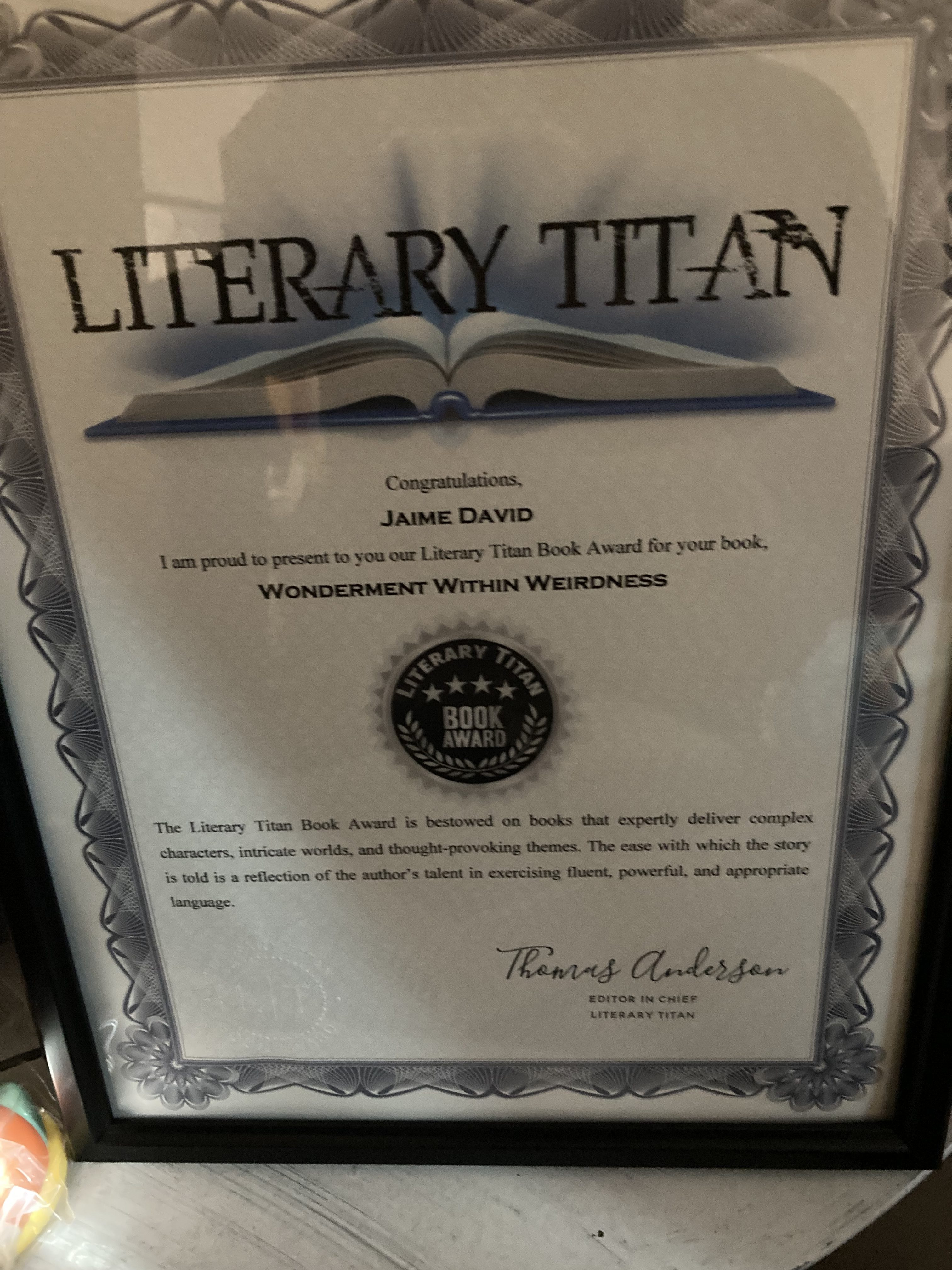
  • Wonderment Within Weirdness Is Weirdly an Anti-War Novel

    Wonderment Within Weirdness Is Weirdly an Anti-War Novel

    Sometimes you write a book and only later realize what it was actually about. That might sound strange, but it happens more often than people think. Stories have a way of revealing their deeper meanings after the fact, sometimes months or even years after they are written. When I first wrote my debut novel, Wonderment Within Weirdness, I was not sitting there thinking, “I am going to write an anti-war novel.” That was not the plan. The goal was much simpler and honestly much more chaotic. I wanted to write something weird, something big, something ambitious, something cosmic and philosophical and absurd all at the same time. I wanted a story that mixed strange ideas, big stakes, casual narration, and characters who reacted like actual human beings. What I ended up with was a story about a random guy who ends up teaming up with others to stop a multiversal conflict. At first glance that sounds like the setup for a giant sci-fi or fantasy action adventure. And in many ways it absolutely is. But the more I think about it, the more I realize that beneath the weirdness and the cosmic scale, the story is actually deeply anti-war. I did not even fully realize that until much later.

    Right now the world feels tense in a way that makes stories about conflict feel especially relevant. The ongoing tensions involving the United States, Israel, and Iran have created an atmosphere where talk about war has returned to everyday conversation. People are watching the news more closely. Political rhetoric is heating up. There is anxiety in the air about where things might go next. Whenever global tensions rise like this, the idea of war stops feeling abstract and starts feeling frighteningly real again. It becomes something people worry about in their daily lives rather than something distant in history books. In moments like this, fiction sometimes becomes more important than we realize. Stories can act as mirrors for the anxieties we are feeling. They can also provide a kind of escape, a place where we can process complicated ideas about conflict without being overwhelmed by the constant flood of real-world headlines.

    When I look back at Wonderment Within Weirdness through that lens, I start to see the story differently. On the surface, the premise sounds like the kind of thing that might glorify conflict. A random guy rises up and becomes involved in a multiversal struggle. Cosmic forces clash. Massive stakes are introduced. Entire realities are threatened. But when you look more closely, the story does not actually celebrate war or conflict in the way a lot of action stories do. Instead, it highlights how absurd and overwhelming conflict becomes when it escalates beyond control. The characters are not warriors who were born for battle. They are people who get thrown into a situation they never asked for. They react with confusion, frustration, fear, and determination all at once. They do not treat the conflict like a glorious adventure. They treat it like a crisis that needs to be stopped before it spirals into something even worse.

    One of the most important aspects of the book that reinforces this idea is the perspective through which the story is told. The narrative uses a casual, first-person voice where characters think and speak the way real people do. When a character notices something like a tree, they are not going to launch into a poetic essay about the intricate structure of the branches or the philosophical meaning of nature. They are going to think something simple and direct, something like, “Oh look, a tree. It’s big. It’s green.” That casual tone might seem like a small stylistic choice, but it actually changes how the reader experiences the entire story. It keeps the characters grounded in human perception even when the events around them are massive and surreal. The multiverse may be at stake, but the characters still notice ordinary things. They still react like normal people would if they suddenly found themselves trapped in an incomprehensible situation.

    That grounded perspective makes the conflict feel less glamorous and more chaotic. In many stories about war, the narrative tone elevates the conflict into something heroic or mythological. Battles are described with grand language and dramatic speeches. Characters speak like legendary figures who exist solely for the purpose of fighting. But in Wonderment Within Weirdness, the casual voice constantly reminds the reader that the characters involved in the conflict are not legendary warriors. They are ordinary individuals trying to figure out what is happening and how to stop it. That shift in tone subtly undermines the romanticized image of war that appears in so many stories.

    Another element that gives the book its accidental anti-war energy is the sheer scale of the conflict itself. The story is not about a small territorial dispute or a battle between neighboring kingdoms. It is about a multiversal crisis where the consequences extend across countless realities. At that level of scale, the idea of winning or losing starts to look strange. If entire universes are threatened, what does victory even mean? What does survival look like when reality itself is unstable? By pushing the stakes to such an absurdly large level, the story indirectly questions the logic of escalation that often drives real-world conflicts. When every side tries to outdo the other with bigger weapons, bigger alliances, and bigger threats, the situation can spiral into something catastrophic. In the world of the book, that escalation becomes literal. The conflict expands until it threatens everything.

    What makes the story interesting is that the characters are not trying to dominate the conflict. They are trying to stop it. Their goal is not conquest. It is stabilization. They want the chaos to end. That distinction matters because it shifts the emotional center of the story. Instead of celebrating power or victory, the narrative focuses on the effort to prevent disaster. The characters are motivated by the desire to protect what exists rather than the desire to destroy an enemy.

    Looking back at the book now, I also realize that the protagonist’s role in the story reinforces this anti-war feeling. James is not introduced as a heroic war leader or a tactical genius. He is just a random person who ends up in the middle of something huge. His reactions often mirror what the reader might feel in the same situation. Confusion, disbelief, determination, fear, curiosity, frustration. That emotional realism makes the story feel less like a traditional war narrative and more like a survival story set against a cosmic backdrop. The focus is not on the glory of conflict but on the experience of navigating chaos.

    There is also something interesting about the way the story balances weirdness with seriousness. The book is intentionally strange. The title itself, Wonderment Within Weirdness, signals that the reader is stepping into a world where unusual ideas and bizarre situations are part of the experience. But that weirdness actually helps the anti-war themes stand out. By exaggerating the scale and strangeness of the conflict, the story makes the destructive logic of escalation easier to see. It turns the concept of war into something almost surreal, forcing the reader to step back and question it rather than simply accepting it as a normal part of the narrative.

    Lately, the ongoing situation in Iran has weighed heavily on my mind, forcing me to confront not only the realities of global conflict but also the responsibilities of being a writer, a storyteller, and a human being in a world that feels increasingly volatile. When tensions between nations escalate, when headlines are filled with talk of military action, sanctions, and the threat of open warfare, it is difficult not to feel a profound sense of urgency. I have been documenting my thoughts and concerns on my blogs, calling out what I see as dangerous rhetoric, and highlighting the human costs of political escalation. I have written about it in a direct, critical manner, but I have also realized that there is another, subtler way to engage with these issues: through fiction. This reflection has led me to examine my own work, and particularly my debut novel, Wonderment Within Weirdness, in a new light. What initially seemed like a story about a strange, multiversal adventure has revealed itself to me as, at its core, an anti-war narrative—a realization I did not fully grasp when I first wrote it.

    The connection between fiction and reality is a complicated one, especially when discussing global conflicts. When people hear the term “anti-war novel,” they often imagine literature that is overtly political, stories that depict the horrors of battle, the futility of military ambition, or the moral decay caused by violence. Those narratives certainly have their place, and they have historically influenced the ways people think about war. Yet fiction can also approach the topic more indirectly, more imaginatively, and sometimes with even more impact precisely because it is not bound by real-world constraints. Wonderment Within Weirdness, at first glance, is a story about a seemingly ordinary person, James, who is thrust into circumstances that are literally cosmic. He ends up confronting a conflict that spans universes, and the choices he makes, alongside those he teams up with, have consequences that ripple through the multiverse. On the surface, it might look like an action-adventure story or a high-concept science fiction epic, but beneath the spectacle is a deeply anti-war message: the chaos of conflict, regardless of scale, is never glorified, and the real heroism lies in preventing escalation rather than perpetuating it.

    As I reflect on the Iran situation, the parallels between real-world conflict and the conflicts in my novel become even more striking. Escalation, in both reality and fiction, is often portrayed as inevitable. One side acts, the other retaliates, and before long, the cycle grows out of control. In my novel, the stakes are exaggerated to cosmic proportions: entire realities are threatened, consequences are almost unimaginable, and the characters themselves are ordinary people trying to survive. That exaggeration is deliberate, but it also mirrors the logic of human conflicts. When geopolitical actors pursue escalation without fully considering the outcomes, when rhetoric about “showing strength” or “defending interests” dominates, the results can become catastrophic. Fiction allows us to explore these ideas in a way that is both removed and immediate. Readers can see the absurdity of escalation without being caught in the real-world panic that headlines provoke. They can witness the human cost of conflict on a scale so extreme it becomes a metaphor for any war or confrontation in our world.

    Writing about the ongoing Iran tensions has also forced me to confront my own role as a commentator and storyteller. I have used my blogs to call out the rhetoric I see as dangerous, to highlight the ways in which escalation threatens innocent lives, and to provide context or reflection where mainstream narratives often fail to do so. Yet I have realized that commentary alone is not enough. Words on a blog, while important, do not reach the emotional core in the same way that fiction can. Fiction allows readers to inhabit the world of characters, to experience the consequences of decisions through empathy and imagination. In Wonderment Within Weirdness, the anti-war sentiment is woven into the very premise: James is not fighting for conquest, glory, or domination. He is intervening to stop a multiversal conflict precisely because the stakes are too great, because escalation threatens the collapse of realities. That is a theme that resonates profoundly with how I feel about the real-world situation. Intervention, when necessary, should always aim to prevent disaster rather than to perpetuate cycles of violence.

    Beyond Wonderment Within Weirdness, I have noticed that this anti-war theme subtly permeates my other works as well. In my poetry collection, My Powerful Poems, and my short story compilation, Some Small Short Stories, there are recurring motifs of struggle, resistance, and reflection on the human tendency toward conflict. In the poems, the focus is often internal, exploring the psychological effects of violence, injustice, and oppression, but it mirrors the external consequences of war in the real world. In the short stories, characters confront both literal and figurative battles, often discovering that understanding, dialogue, and empathy are more effective solutions than brute force. These recurring motifs are not always the central theme of every piece, but they reflect a worldview that values prevention of harm, empathy, and conscious intervention—values that become extremely relevant when considering ongoing global tensions like those with Iran. However, while my other works contain anti-war elements, my debut novel crystallizes this theme in a way that is both central and unavoidable: the entire story revolves around stopping a massive, almost incomprehensible conflict, and the journey emphasizes the human, emotional, and moral stakes of doing so.

    Focusing on my debut novel in particular, it is striking how much of its power comes from framing anti-war sentiment through the lens of ordinary people confronted with extraordinary circumstances. James is not a superhero, he is not a trained soldier, he is not some legendary figure destined to save the multiverse. He is a regular person who becomes involved in events that dwarf anything he could have imagined. That choice is deliberate. It forces the reader to consider that anyone, at any moment, might be placed in a situation where the consequences of inaction are catastrophic. That is the essence of anti-war thinking: understanding that the stakes of conflict extend beyond abstract political or military victories, and that the real cost is often measured in human suffering, disrupted lives, and destabilized communities.

    The casual tone and first-person perspective in Wonderment Within Weirdness further reinforce this message. Characters think and speak as ordinary people do, noticing small details, reacting emotionally, and struggling to make sense of events around them. This style emphasizes the human element of conflict, even when the conflict is multiversal in scale. Readers are reminded constantly that the people involved are not faceless entities or archetypes—they are individuals with fears, doubts, and moral concerns. This grounded approach makes the anti-war message more effective because it frames cosmic stakes in human terms, making the consequences of conflict tangible and relatable.

    I have also reflected on the importance of openly acknowledging the anti-war elements in my work. Fiction often speaks for itself, but if no one talks about the deeper themes, they may go unnoticed. The current tensions in Iran have highlighted this for me: the world is full of urgent discussions, debates, and warnings, yet the quieter messages—those embedded in art and literature—can be overlooked. That is why I feel compelled to talk about it. Calling attention to the anti-war aspects of Wonderment Within Weirdness is not just a marketing move or a way to tie the book to current events. It is a deliberate effort to highlight a theme that is profoundly important to me personally. The novel, at its core, is about preventing chaos, stopping escalation, and confronting overwhelming circumstances with courage and cooperation rather than violence. That message is relevant in fiction, in poetry, in short stories, and in real life.

    The timing of these reflections has also deepened my appreciation for how fiction can interact with contemporary issues. While my book was not written as a direct response to any current conflict, the story has become unexpectedly relevant. Readers navigating the anxiety of news about Iran may find that engaging with a story about a regular person stopping a multiversal conflict provides both escapism and reflection. They can inhabit the tension of stakes far beyond their own lives while also recognizing the underlying anti-war commentary. This dual effect—entertainment and reflection—is one of the reasons I believe fiction remains a vital medium for understanding human concerns, especially during times of heightened geopolitical tension.

    It is important to note that the anti-war theme in Wonderment Within Weirdness is not presented as moralizing or didactic. The story does not preach or deliver explicit lessons in the way some literature might. Instead, it emerges organically from the premise and the characters’ experiences. The narrative shows the consequences of escalation, highlights the courage required to intervene, and portrays the human costs of widespread conflict, all without turning into a lecture on morality. That subtlety makes the message more compelling, because readers arrive at the conclusion themselves: unchecked conflict is destructive, and preventing it requires empathy, cooperation, and courage.

    In many ways, the novel’s multiversal conflict acts as a metaphor for the real-world consequences of war. When conflicts expand beyond control, the results are unpredictable, and the scale of suffering can become incomprehensible. By exaggerating the stakes, the story makes the logic of escalation visible. Readers can see how one action leads to another, how decisions made in haste or anger can spiral into catastrophe. The fantastical elements—portals, cosmic stakes, multiversal consequences—serve as a magnifying lens for examining the same dynamics that occur in the real world, albeit in a more extreme and imaginative way.

    My commitment to highlighting these themes is reinforced by my broader body of work. In My Powerful Poems and Some Small Short Stories, I explore human experience, moral reflection, and the consequences of actions, often touching on themes related to conflict and resolution. The anti-war element is more explicit in my debut novel because it is embedded in the central premise, but the underlying philosophy of valuing empathy, foresight, and nonviolent intervention permeates all of my creative work. This coherence across mediums is intentional, even if it is subtle: I want my writing to consistently remind readers of the human cost of conflict and the importance of considering consequences beyond immediate goals.

    Reflecting on this, I also recognize the responsibility that comes with creating work that resonates with these themes. Fiction is not just a personal exercise; it can influence readers’ perspectives and prompt reflection. By highlighting the anti-war aspects of Wonderment Within Weirdness, I hope to offer readers an opportunity to think critically about conflict, escalation, and the value of intervention that prioritizes protection over destruction. While the story operates on a fantastical scale, its emotional and philosophical resonance is universal: whether in a multiverse or in our own world, the stakes of conflict are deeply human.

    Acknowledging the anti-war themes in my debut novel is profoundly important to me because it reflects both my values and my perception of the world. Current events, like the ongoing situation in Iran, make these reflections urgent. When violence and the threat of violence loom in reality, it is natural to look for ways to understand, critique, and respond to them. Fiction allows that exploration in a unique way: it combines imagination with ethical reflection, humor with gravity, and spectacle with introspection. Wonderment Within Weirdness achieves this balance, providing readers with both a compelling story and an underlying meditation on the nature of conflict and the human capacity to confront it responsibly.

    Ultimately, the anti-war theme in Wonderment Within Weirdness is not a secondary consideration—it is central to the story. The very premise, of a regular person stepping up to prevent a multiversal conflict, embodies resistance to escalation, recognition of the human cost of conflict, and the potential for agency in the face of chaos. It is a narrative that reflects both the absurdity of unchecked escalation and the profound importance of intervention aimed at preservation rather than conquest. By calling attention to this theme, especially now when global tensions feel so high, I hope to engage readers in thinking about these ideas, both within the context of the story and in the real world. That engagement is why I feel compelled to speak openly about it. It is not just a theme; it is a lens through which the story can resonate meaningfully with readers, and perhaps even inspire reflection about the consequences of conflict, the importance of empathy, and the power of ordinary people to intervene in extraordinary circumstances. The anti-war element is literally built into the foundation of the book, and acknowledging it is essential to understanding what the story ultimately seeks to convey.

    One of the most striking things I have realized about Wonderment Within Weirdness is that the anti-war themes, while not consciously planned at first, are central to the story. When I wrote the book, my focus was on creating something absurd, expansive, and cosmic, something that would push the boundaries of conventional storytelling and blend weirdness with wonder. It was only later, as I reflected on the narrative, that I began to see how deeply it resonates with ideas about conflict, escalation, and human responsibility. That realization made me feel that it is important to discuss these themes openly. Even though the story is exaggerated—multiversal stakes, cosmic consequences, strange physics, absurd adventures—it mirrors real-life feelings in a way that is meaningful. The sense of chaos, the sense of being overwhelmed, the feeling that everything is bigger than you and impossible to control, these are exactly what so many people feel when faced with uncertainty in the real world, whether it is geopolitical conflict, social upheaval, or personal crises.

    In particular, the story speaks to the sense of confusion and powerlessness that many people experience. In a world where global tensions rise, where the news is filled with discussions of war, threats, and political brinkmanship, it is easy to feel small and helpless. How can a single person possibly make a difference when entire nations or multiverses are at stake? This is a question that James, the protagonist of Wonderment Within Weirdness, faces throughout the story. He is just a regular person, thrown into a situation far beyond his control, and yet he must act. The absurdity of the narrative—the cosmic scope, the multiversal chaos, the strange events—serves to highlight how extraordinary it is when someone decides to take a stand despite fear, uncertainty, and overwhelming odds. In this way, the book becomes a reflection of real-life courage: sometimes the act of standing up, even when no one else will, is the most radical, essential, and meaningful form of resistance.

    The connection between fiction and reality becomes even more poignant when considering how many people feel lost or paralyzed in the face of global conflict. Watching the news, reading headlines, or simply trying to understand the stakes of international tensions can create a sense of dread. There is an emotional weight in feeling powerless, in feeling like there is nothing you can do to change the trajectory of events that affect millions, or billions, of people. That weight is mirrored in the experiences of the characters in my novel. Despite the exaggerated and fantastical setting, the emotional truths are grounded: fear, doubt, confusion, and the temptation to do nothing are all real. And yet, the story insists that action matters. It insists that intervention—careful, conscientious, determined action—is worthwhile, even when it seems small against the enormity of the problem.

    This is why I feel compelled to discuss the anti-war themes in my debut novel. Fiction allows us to process and explore ideas that might feel too abstract or overwhelming in reality. Wonderment Within Weirdness exaggerates the stakes to make a point: even when events feel absurdly large, even when the situation seems impossible, the choice to act is what matters. James may be one person in a multiverse-spanning conflict, but the book emphasizes that one person’s courage and decisiveness can make a difference. That is the essence of the anti-war message, and it is deeply relevant now. In a world where so many feel powerless in the face of political or military escalation, the story offers a reminder: taking a stand, even when no one else will, is vital. If you do not act, who will? That is the central moral of the book, and it is a message that applies as much to our own reality as it does to the multiversal chaos of the narrative.

    The fact that the story is absurd, exaggerated, and cosmic does not diminish this message; if anything, it amplifies it. By creating a setting where stakes are literally universal, the story shows how overwhelming conflict can be, how confusing it is to navigate moral and practical decisions, and how critical it is to confront problems head-on. The scale of the narrative mirrors the scale of the anxiety and helplessness that many people feel today. And yet, even in this hyperbolic context, the characters’ choices are grounded in human values: empathy, courage, perseverance, and the recognition that inaction allows destruction to flourish. The anti-war themes are not abstract lessons; they are woven into the very fabric of the story. The multiversal conflict, the bizarre events, the challenges James faces—they all converge to illustrate that conflict, no matter how absurd or inevitable it seems, can and must be resisted by those willing to take responsibility.

    Another reason this theme is worth discussing is that it is counterintuitive to many readers at first glance. A story about a cosmic multiversal conflict, full of strange phenomena and high-stakes action, does not immediately read as “anti-war.” In fact, some might assume it celebrates conflict or glorifies violence. That is why reflection is important. By highlighting the anti-war elements, we can show that even stories that appear absurd, fantastical, or over-the-top can carry profound moral insights. The casual tone, the first-person narration, the ordinary perspective of James—all of these choices reinforce the anti-war message subtly. The characters are not epic warriors who relish combat; they are people confronting chaos and making decisions to prevent destruction. That makes the anti-war sentiment both organic and deeply resonant.

    Ultimately, the central lesson of Wonderment Within Weirdness—even when wrapped in absurdity, cosmic stakes, and weird narrative structure—is that courage and responsibility matter, even when they seem small or futile. Taking a stand is not easy, and it often comes with personal risk, fear, and uncertainty. But that is precisely why it is essential. In the context of the ongoing tensions in Iran, and in many other situations where ordinary people feel powerless, this message carries real weight. Fiction can act as both mirror and guide, helping us process the complexities of our world while inspiring reflection and action. The story may be exaggerated, it may be surreal, but it teaches a truth that is very real: when no one else will act, you must. If you do not, who will? That simple, profound principle underlies the anti-war message of the book and is why it remains a deeply important theme to me, one that I feel deserves to be acknowledged, discussed, and shared.

    The idea of ordinary individuals stepping into conflict not for glory, not for conquest, but for the sake of preventing devastation, is an idea that resonates far beyond the pages of a book. It mirrors the hope, responsibility, and courage that we as humans must summon when facing threats that seem larger than life. In Wonderment Within Weirdness, this concept is magnified to a multiversal scale, but the emotional core remains entirely human. Fear, confusion, vulnerability, doubt, and hesitation are all present—but so is the opportunity to rise, to take responsibility, and to act decisively when the world needs it most. That is the anti-war message at the heart of the story: it is not the absence of conflict that matters, but the presence of courageous action to prevent unnecessary destruction. And recognizing that theme, acknowledging it, and talking about it openly is essential. Especially now, when so many feel lost, scared, or powerless, stories like this remind us that action, even against overwhelming odds, is possible—and it is essential.

    Some folks might wonder why I am spending so much time analyzing my own work. They might think, “You wrote the book. Shouldn’t you already know the themes? Shouldn’t you already understand what it’s about?” And yes, I do know some of them. When I was writing Wonderment Within Weirdness, I was focused on creating a story that was absurd, multiversal, weird, and full of wonder. I knew I wanted James to be a regular person thrown into situations far beyond what anyone could imagine, and I knew I wanted Lucifer and other characters to serve as constants across a universe-spanning narrative. I knew the stakes would be cosmic, the action would be extreme, and the plot would twist and turn in ways that felt unpredictable. I knew I was experimenting with narrative style, multiple POVs, casual thought processes, and a tone that reflected how people actually perceive the world, rather than forcing everything into “literary essay” levels of description.

    But here’s the thing: I wasn’t thinking about all of the themes in every possible light. I wasn’t reflecting on how the story might speak to the fears, anxieties, and moral dilemmas of readers experiencing a world in crisis. I wasn’t fully considering how the absurdity of the multiverse, the bizarre conflicts, and the cosmic stakes could serve as a lens through which to examine human tendencies toward violence, escalation, and the consequences of war. I was focused on creating a story that was fun, immersive, and expansive, that could exist on its own and set the stage for a much larger saga. I knew I was writing something ambitious, but I didn’t immediately see how deeply it also functioned as a meditation on conflict, responsibility, and moral action.

    That changed when I started thinking seriously about the ongoing conflict in Iran. Seeing the headlines, watching how the tensions escalated, reading the analyses, and thinking about the real-world consequences—it all hit me in a way that reframed my understanding of my own work. Suddenly, I saw the anti-war sentiment that had always been present in my novel in a new, more urgent light. The Iran conflict, with all its complexity, danger, and human cost, became a mirror that reflected the stakes of my story back at me. In a way I hadn’t fully realized while writing, Wonderment Within Weirdness is about preventing escalation, about acting responsibly in the face of overwhelming odds, and about standing up when no one else will. It is, at its heart, an anti-war story, even though the “war” in the book is exaggerated, absurd, and cosmic in scale. That realization compelled me to analyze my own work more critically and more intentionally, because I wanted to understand and articulate the depth of the message that was already embedded in it.

    It’s worth reflecting on why analyzing one’s own work can even be valuable. Some might see it as self-indulgent or unnecessary, assuming that authors always understand the full scope of their own creations. But the truth is, writing is a process of discovery. When you sit down to write a story, you are exploring characters, events, and ideas, but you are not always consciously aware of how all of the themes will emerge or interconnect. Stories have a way of surprising even their creators, revealing meanings, resonances, and patterns that were not planned in advance. In my case, the Iran conflict acted as a catalyst for that discovery. It pushed me to ask new questions about my work, to consider how the narrative speaks to human concerns about conflict, responsibility, and moral courage, and to reflect on what readers might take away from the story beyond its multiversal spectacle.

    What struck me most is how relevant the anti-war theme is in a world where so many people feel lost, confused, scared, or powerless. It’s a strange combination of emotions: on the one hand, there’s fear and anxiety about events that seem entirely out of one’s control; on the other hand, there’s a desire to act, to make a difference, and to resist destructive forces. This tension mirrors the experience of James in my novel. He is a regular person, not a superhero, not a god, not someone preordained to save the multiverse. He is ordinary, which makes his actions and choices all the more meaningful. The story emphasizes that ordinary people, even when overwhelmed, have the capacity to act and to influence outcomes in ways that matter. That is the essence of the anti-war message: when faced with conflict or potential catastrophe, choosing to act responsibly, ethically, and courageously is essential—even if it feels impossible, even if no one else will act, and even if the stakes are incomprehensible.

    The absurdity of the narrative—the cosmic scope, the multiversal chaos, and the strange events—serves an important purpose in conveying this message. By exaggerating the stakes, I highlight the scale of the human consequences of conflict. In the real world, wars and conflicts can feel distant, abstract, or impersonal. We hear numbers, statistics, and geopolitical analysis, but it is often difficult to feel the emotional weight of what is happening. Fiction, particularly a story as outlandish and expansive as Wonderment Within Weirdness, creates a magnifying lens. It amplifies the stakes, the tension, and the consequences, making readers experience, in a visceral way, the chaos and destruction that escalation brings. And yet, even in this exaggerated context, the story remains fundamentally human. The characters’ emotions, doubts, and moral deliberations are relatable. Readers can see themselves in James, in Lucifer, in the choices being made—even when those choices are taking place in absurd, cosmic circumstances.

    Analyzing my own work has also made me appreciate how subtle the anti-war sentiment is embedded in the story. It is not didactic. The narrative does not lecture or preach about morality, politics, or global conflicts. Instead, it demonstrates the consequences of inaction, the value of empathy, and the importance of courageous intervention. James and the other protagonists do not pursue conflict for glory, conquest, or personal gain. They act because escalation threatens life, because chaos endangers the innocent, and because moral responsibility demands engagement. That distinction is critical. It makes the anti-war message resonate without feeling heavy-handed. The story doesn’t just tell readers that violence is bad; it shows, through plot, character, and consequence, why unchecked conflict is destructive and why intervention is necessary, even when the odds seem insurmountable.

    Reflecting further, I recognize that this process of analyzing my work is not merely about understanding the story itself—it is also about connecting the story to the real world. The Iran conflict, like many other geopolitical crises, presents a situation where individuals can feel powerless. Decisions are made far away, with consequences that ripple across populations and nations. Many people are left wondering what they can do, if anything, to make a difference. In that sense, the story of Wonderment Within Weirdness offers a form of guidance, or at least reflection: ordinary people have agency, courage matters, and standing up, even when no one else will, is vital. James may be fictional, and the multiverse may be absurdly exaggerated, but the emotional and moral truths carry over to reality. Choosing action over inaction, empathy over apathy, and responsibility over resignation is a message that transcends genre, scale, or setting.

    Part of why this analysis is so important to me is that I truly believe many readers will resonate with it, even if they initially approach the story as a fantastical adventure. The narrative can be enjoyed on multiple levels: as an absurd, multiversal action story; as a character-driven exploration of courage, fear, and responsibility; and as a meditation on conflict, escalation, and moral choice. Recognizing these layers allows me to speak more directly about why the story matters, why it is relevant, and why it deserves reflection. That is why I take the time to analyze my own work. Not because I didn’t know what I wrote, but because I didn’t fully see all the ways it can connect to human experience, all the ways it can speak to readers grappling with fear, uncertainty, or moral responsibility in their own lives.

    There is also a personal dimension to this analysis. As someone who has been actively commenting on the Iran conflict, calling out rhetoric, and reflecting on the human cost of escalation, I feel a responsibility to acknowledge how my work intersects with these concerns. The anti-war themes in Wonderment Within Weirdness are not accidental—they are part of a worldview that values empathy, foresight, and moral courage. But it took the lens of real-world conflict to make me fully aware of how strongly these ideas are embedded in the narrative. That awareness, in turn, strengthens my ability to discuss the book openly, to highlight its relevance, and to encourage readers to consider the broader implications of the story. By analyzing my work, I am not elevating my own importance; I am clarifying a message that I believe can resonate meaningfully with others.

    Ultimately, analyzing my own book is an act of reflection and responsibility. Writing is not just about creating stories—it is about engaging with the ideas, emotions, and moral questions those stories raise. When a global conflict like the situation in Iran brings issues of violence, escalation, and responsibility into sharp focus, it is natural to revisit one’s own work and ask how it speaks to these themes. Wonderment Within Weirdness is a story about chaos, about ordinary people confronting overwhelming challenges, and about taking a stand when no one else will. Recognizing, articulating, and reflecting on these themes is not self-indulgent—it is necessary. It ensures that the story is fully understood, that its message reaches those who might need it most, and that the work serves not only as entertainment but also as a source of reflection and inspiration in a world where so many feel lost, powerless, or overwhelmed.

    In the end, this deep dive into my own work has reinforced something I have always believed: fiction matters, and the choices we make, both in stories and in real life, carry weight. The anti-war themes in Wonderment Within Weirdness are now clearer to me than ever before, and that clarity makes me want to share it, discuss it, and encourage others to consider what it means to act responsibly, courageously, and empathetically—even when no one else will. That is why I analyze my own book, why I reflect on its relevance, and why I am committed to discussing it openly: because these themes are too important to leave unspoken, and because stories, even absurd, cosmic, and fantastical ones, have the power to illuminate human truths and inspire action in a way that nothing else can.

    In times of global tension, stories like this can serve an important purpose. They remind us that conflict does not have to be treated as inevitable or heroic. Fiction allows us to explore different ways of thinking about the world, different ways of imagining solutions to problems that seem overwhelming in reality. Even when a story involves cosmic stakes and multiversal chaos, it can still carry a message about the value of preventing destruction rather than embracing it.

    Of course, talking about the anti-war themes of my book right now might look like a marketing move. Some people might roll their eyes and say that this is just an attempt to tie the story to current events in order to promote it. And honestly, maybe there is some truth to that. Independent writers do not have massive marketing teams or giant advertising budgets. Sometimes the only way to share your work with people is to talk about it directly and hope that the conversation reaches someone who might find the story interesting.

    But there is another side to it as well. The more I thought about the themes of Wonderment Within Weirdness, the more I realized that the anti-war element was not something I was inventing after the fact. It was already there. The story is literally about a random person rising up and teaming up with others to stop a multiversal conflict before it destroys everything. That premise alone carries an implicit critique of endless escalation. The goal is not domination or conquest. The goal is preventing catastrophe.

    And maybe that is why stories like this matter right now. When the world feels tense and uncertain, people often turn to fiction for a combination of escape and reflection. Escapist stories allow readers to step away from the constant stress of the real world, even if only for a little while. At the same time, those stories can still engage with important ideas about power, responsibility, and the consequences of conflict.

    In that sense, Wonderment Within Weirdness ended up being something I did not initially plan but am glad it became. It is a weird book. It is a cosmic book. It is a philosophical book in places and a casual, strange adventure in others. But underneath all of that, it is also a story about stopping a war before it destroys everything. And if that message resonates with readers during a time when the world feels increasingly tense, then maybe that weird little accident of storytelling turned out to be exactly what the book needed to be.

    Fediverse Reactions
  • Exploring My Creative Universe: Blogs, Books, Podcast, and More

    Exploring My Creative Universe: Blogs, Books, Podcast, and More

    Over the years, I’ve poured myself into countless creative projects—blogs, podcasts, books, and beyond. Each one reflects a part of my passions, curiosity, and perspectives. I want to take a moment to invite you in. I know how easy it is to scroll past content online, but these works are meaningful to me—and I hope they’ll spark something for you too.

    While many know my original blog, The Musings of Jaime David, I’ve created other spaces that dive into specific interests, explore new ideas, and offer perspectives you might not find elsewhere.

    Blogs
    Each blog started from curiosity, a desire to explore, and the need to share.

    • Anime, Comics, and Manga – A space for the storytelling and visual artistry that captivated me since childhood. Here, I explore both mainstream and obscure works, examining character development, themes, cultural impact, and how stories resonate globally.
    • Jaime David Music – More than reviews or playlists, this blog dives into how music shapes emotion, culture, and identity.
    • Jaime David Science – A playground for curiosity about the natural world, technology, and the strange wonders of discovery. Science is approachable, engaging, and sometimes delightfully odd here.
    • Jaime David Gaming – From video games to board games, I explore storytelling, strategy, and the human experience through play.
    • Oddities in Media – A space for the overlooked, the weird, and the culturally fascinating in movies, music, games, and more.
    • Let’s Be Different Together – For mental health, individuality, and social reflection. A space for those who have ever felt different or misunderstood.
    • The Interfaith Intrepid – Exploring spirituality, culture, and philosophy with nuance and empathy, fostering dialogue in a divided world.

    Of course, The Musings of Jaime David remains my most personal and experimental space, where essays, reflections, and philosophical musings flow freely. But I want each of my other projects to shine—they offer unique flavors, perspectives, and insights.

    Podcast
    The Jaime David Podcast lets me share ideas in real-time. I revisit old writings, explore creative processes, and dive into cultural phenomena. It’s a chance to experience my thoughts in a personal, engaging way.

    Books

    • Wonderment Within Weirdness – My debut novel, exploring the extraordinary and unexpected.
    • My Powerful Poems – Reflections and emotions distilled into lyrical moments.
    • Some Small Short Stories – Brief narratives revealing larger truths through small moments.

    Each book is a window into a different facet of my imagination and curiosity.

    Newsletter
    The Jaime David Newsletter connects you directly to my work—blogs, podcast episodes, book updates, and insights not always shared elsewhere. It’s the most direct way to stay engaged and explore the full breadth of my creative universe.

    These projects exist not only for my expression but as invitations to explore, reflect, and discover. While separate, they share a common thread: curiosity, creativity, and connection. Your engagement—reading, listening, subscribing, or sharing—helps these projects thrive. It allows me to keep creating, experimenting, and reaching more people.

    So if something here sparks your interest, I hope you’ll dive into my blogs, listen to the podcast, explore my books, and subscribe to the newsletter. There’s a universe of ideas, creativity, and discovery waiting, and I hope you find something that surprises, inspires, or delights you.

  • The Unfilmable Film: Why The Catcher in the Rye Absolutely Can—and Should—Be Adapted

    The Unfilmable Film: Why The Catcher in the Rye Absolutely Can—and Should—Be Adapted

    So I saw this video the other day. One of those “why The Catcher in the Rye can never be adapted” kind of videos. You know the type. Someone with a soothing voice explaining why Holden Caulfield is too complex, why the book is too introspective, why the magic of the novel lives in its inner monologue, why Hollywood would ruin it. And I couldn’t even finish it. Not because the person was wrong per se, but because the argument felt, to me, like a cop-out. Like an excuse to not even try. Because I think—no, I know—that The Catcher in the Rye can be adapted. It can be done. It just requires a shift in mindset, a creative leap that filmmakers today are more capable of than ever before.


    Holden Caulfield Is Not the Problem

    Let’s start with Holden himself. The eternal teenager, the perpetual cynic, the broken boy who can’t quite find peace in the world around him. People say Holden is too unlikable to carry a movie. That audiences would get tired of his whining, his contradictions, his self-sabotage. But have these same people seen the protagonists of modern cinema? We’ve had antiheroes, villains, narcissists, and self-destructive lunatics as main characters—people like Travis Bickle, Arthur Fleck, Bo Burnham’s character in Eighth Grade, or Barry in Barry. Holden is practically tame compared to some of them.

    The reason Holden “works” in the novel isn’t because we love him. It’s because we recognize him. We’ve all had a Holden phase, or known someone who lived in one. He’s that moment in youth when you realize the world isn’t as pure as you thought it was, but you’re not yet old enough to do anything about it. You’re angry, cynical, hurt, lost. A good actor—someone who can capture both raw arrogance and fragile sincerity—could make Holden come alive on screen. Not as a symbol. Not as a hero. But as a kid barely holding on.

    The right filmmaker would know not to make him “likable.” He doesn’t have to be. He just has to be real.


    The Myth of the “Unfilmable” Book

    People love to call certain books “unfilmable.” It sounds smart. It gives a sense of reverence, like the story is too sacred, too special to be touched by the messy, collaborative medium of cinema. But I think that’s nonsense. Every so-called unfilmable book has eventually been adapted, and many have been done brilliantly. Dune was once called unfilmable. The Lord of the Rings, too. Watchmen. Cloud Atlas. Even Life of Pi. Each one required someone to step outside the norm, to think cinematically rather than literally.

    That’s the key—The Catcher in the Rye doesn’t need to be adapted literally. You don’t need every scene, every line, every inner thought. You just need to capture its spirit. The feeling of alienation, confusion, melancholy, and fleeting innocence.

    People say, “But the book is all internal!” Well, so was Taxi Driver. So was Joker. So was American Psycho. Those are films built on monologues, on isolation, on unreliable narrators. Holden could easily join their ranks. If anything, it’s surprising no one’s gone all-in on that yet.


    The Aesthetic of Madness and Melancholy

    Here’s the thing: if someone’s going to adapt Catcher in the Rye in 2025, they shouldn’t make it neat. They shouldn’t make it polished, or even traditionally coherent. They should make it wild.

    Picture this: a movie shot in a fragmented, dreamlike style. A world that shifts around Holden’s mood. One minute everything’s bright and bustling, the next it’s gray and alienating. People’s faces distort, voices echo too long, time skips forward and backward. You never quite know what’s real and what’s imagined. It’s not about the literal plot—it’s about the experience of being Holden Caulfield.

    A filmmaker like Ari Aster (Hereditary, Beau Is Afraid), Greta Gerwig (Lady Bird), or the Safdie Brothers (Uncut Gems) could absolutely nail that kind of energy. Or even someone like Charlie Kaufman (I’m Thinking of Ending Things), who knows how to externalize the internal chaos of the human mind.

    Holden’s New York isn’t just a setting—it’s a psychological maze. It’s a purgatory of phonies and false smiles, of flashing lights and empty noise. A smart director could make it feel alive, unstable, constantly shifting in tone.


    Voiceover Isn’t the Enemy

    A lot of people roll their eyes at the idea of adapting Catcher in the Rye because it relies so heavily on Holden’s voice. His narration is the backbone of the book. Take that away, and what’s left?

    But here’s the thing—voiceover isn’t the enemy of good filmmaking. When done right, it enhances it. Think about Fight Club, Goodfellas, American Beauty, or Adaptation. All those films use voiceover not just as exposition but as part of the rhythm, the texture, the music of the story. Holden’s voice could work the same way.

    The tone of his narration—sarcastic, meandering, self-aware—could be a tool. It could even contradict what we see visually, creating this tension between how Holden perceives the world and what’s actually happening. Imagine a moment where Holden says he doesn’t care about something, but the visuals betray that he’s devastated. That’s cinema. That’s emotion.


    Embrace the Chaos

    To make The Catcher in the Rye work, a filmmaker has to lean into the chaos. Not shy away from it. Not sand down the rough edges. The story isn’t about events—it’s about a breakdown. A slow, wandering unraveling. So why not make it cinematic?

    You could frame the movie like a fever dream, or a series of fractured memories. Holden’s conversations could feel slightly off, like he’s not fully there. Some moments could loop, repeat, distort. Time could be inconsistent. Maybe even the setting doesn’t stay the same—maybe his world keeps subtly changing as his mental state does.

    Make it a movie about alienation in form as well as content. Make the audience feel what Holden feels—disoriented, frustrated, trapped in an uncaring world. The camera itself could reflect his instability, swinging between clarity and blur, intimacy and distance.

    Think of it as a surreal psychological drama, not a straight literary adaptation.


    Everything Everywhere All at Once—Proof of Concept

    And here’s the perfect example that proves The Catcher in the Rye could work: Everything Everywhere All at Once.

    That movie was absolute chaos—in the best possible way. It was over the top, emotional, existential, absurd, sincere, silly, and devastating—all at once. It juggled dozens of tones and realities without ever collapsing under its own weight. And yet, somehow, it worked. It hit audiences right in the heart.

    That movie showed us that chaos and meaning can coexist. That a film can be fragmented, bizarre, self-aware, and still profoundly human. It made the multiverse feel like a metaphor for identity, regret, love, and everything that makes life painful and beautiful.

    Now imagine Catcher in the Rye treated with that same energy—not in literal multiverse fashion, but in emotional fragmentation. Imagine Holden’s breakdown depicted like Evelyn’s journey in Everything Everywhere. Moments overlapping, reality bending, emotion swelling beyond logic. The absurdity of life, the longing for innocence, the fight against the emptiness—all visually alive.

    That’s what I mean when I say: don’t be afraid to go all in. If you’re adapting a book like Catcher, don’t try to tone it down. Go full absurdist. Go full surrealist. Let the film break its own frame, shift genres, veer into hallucination, laugh and cry within seconds.

    Movies like Everything Everywhere All at Once proved that audiences are ready for that. We can handle complex, nonlinear storytelling. We can handle characters that aren’t easy to love. We can handle movies that ask us to feel deeply and think weirdly.

    Holden’s world is chaotic enough to handle that kind of filmmaking. The emotional truth of his story—the confusion, the heartbreak, the desperate longing for something pure—isn’t all that different from what Everything Everywhere explored. Both stories deal with characters drowning in a world that feels fake, lost, and loud, trying to cling to something real. For Evelyn, it was family. For Holden, it’s childhood innocence. For both, it’s that fight to still feel.

    So if Everything Everywhere All at Once could make a multiverse of tax receipts and bagels feel like poetry, then someone can make The Catcher in the Rye sing too.


    Modern Context Matters

    And here’s something important: The Catcher in the Rye doesn’t have to stay in the 1950s. In fact, it probably shouldn’t. Its core themes—alienation, disillusionment, the loss of innocence—are timeless. You could easily transplant Holden into 2025, scrolling through social media, disgusted with influencer culture, corporate phoniness, online hypocrisy.

    Imagine Holden trying to navigate a world of TikTok therapy, self-diagnosis, performative activism, and digital loneliness. He’d probably hate all of it—and that’s exactly why it’d work.

    Because Holden’s disdain isn’t just for people. It’s for falseness. And what’s more false than the age of filters and algorithms? A 2025 Catcher in the Rye could be a biting social commentary, showing how phoniness has evolved—but never really gone away.


    Casting the Right Holden

    Casting would make or break the movie. The actor has to be able to carry the whole thing—not through charisma, but through authenticity. Someone like Lucas Hedges, Timothée Chalamet (in his earlier years), or an unknown breakout talent could work. It has to be someone who can make Holden feel alive, not like a caricature of angst.

    Holden isn’t supposed to be cool. He’s awkward, defensive, confused, tender. A good performance would balance arrogance and vulnerability. That’s what makes him human.


    Direction and Tone

    Tone is everything. The movie shouldn’t try to romanticize Holden’s worldview, nor should it judge him too harshly. It should sit in that uncomfortable middle—where Holden is both right and wrong, sympathetic and irritating, lovable and detestable.

    The tone should be melancholic, absurd, funny, tragic—all at once. Think of something like Eternal Sunshine of the Spotless Mind, where surreal humor and heartbreak coexist in the same breath.

    The music, too, could play a huge role. A moody, eclectic soundtrack—some jazz, some ambient noise, maybe even distorted indie tracks—could capture the dissonance in Holden’s head.


    Why Now?

    We live in an age of oversharing, overanalyzing, and underfeeling. Holden’s voice—raw, messy, contradictory—might be exactly what we need to hear again. He’s not perfect. But he’s honest. He calls out the world’s phoniness, not because he’s better, but because he’s scared he’s becoming part of it.

    That’s universal. That’s timeless. And that’s what makes The Catcher in the Rye still relevant.

    Modern cinema has caught up to Salinger’s vision. We now have the tools—visually, narratively, emotionally—to bring Holden’s chaos to life. We can capture the noise in his head, the blurry space between youth and adulthood, the quiet ache of wanting something pure in a world that feels fake.


    The Ending: Keep It Ambiguous

    If there’s one thing the movie shouldn’t do, it’s try to explain Holden. Don’t spell out his trauma. Don’t overanalyze him. Keep it mysterious, like the book does. Let the audience feel like they’ve spent a few days inside the mind of a lost kid—and now they’re being dropped back into reality, changed, confused, thoughtful.

    The final shot shouldn’t be closure. It should be a sigh. A quiet, uncertain exhale. Something that lingers.


    Conclusion: The Time Is Now

    To say The Catcher in the Rye is unfilmable is to underestimate what film can do. Cinema has evolved past traditional storytelling. It can now do abstraction, subjectivity, chaos, and emotion all at once.

    We’ve seen movies about madness (Joker), loneliness (Her), alienation (Lost in Translation), rebellion (Fight Club), and now even multiversal absurdity (Everything Everywhere All at Once). Holden Caulfield fits right in.

    If anything, a Catcher in the Rye movie would be the ultimate reflection of our times—messy, self-aware, unfiltered, human. The key is not to tame it, not to make it neat, not to make it polite. You have to go all the way in.

    Make it strange. Make it haunting. Make it alive.

    Because Holden deserves that. And so does Salinger’s vision.


    If they’re going to make it, they should make it like Holden himself: bold, flawed, and unapologetically real.

    Fediverse Reactions
  • Texas SB20 and the Risk to Books, Graphic Novels, and Manga

    Texas SB20 and the Risk to Books, Graphic Novels, and Manga

    Books have always been a battleground for free expression. From novels banned in schools to graphic novels challenged in libraries, literature is often where society tests the limits of what should be read, shared, and celebrated. Now, with Texas Senate Bill 20 (SB20) in effect, those limits may become narrower than ever.

    SB20 criminalizes the possession or promotion of “obscene visual material” that appears to depict minors. While its stated intent is to stop child exploitation, the language is so vague and sweeping that it does not stop at harmful real-world depictions. Instead, it extends to animation, AI-generated images, comics, graphic novels, and manga—works of pure fiction. For writers, artists, publishers, and readers, that is a deeply troubling development.

    Graphic Novels in the Crosshairs

    Graphic novels and manga rely on stylized art to tell stories. Characters may look younger than their canon ages due to artistic conventions. Themes of growth, identity, and coming-of-age often involve youth characters in dramatic, sometimes challenging contexts. Under SB20, such depictions could be misread as “obscene” depending on how an individual judge, prosecutor, or even police officer interprets them.

    That interpretation doesn’t require malicious intent. A librarian stocking Made in Abyss, a bookstore selling Bleach or Dragon Ball, or a fan who owns a volume of Attack on Titan could all suddenly be viewed through a criminal lens. The issue isn’t that these books exploit anyone—they don’t. The issue is that the law makes no room for artistic conventions, fictional storytelling, or cultural nuance.

    The Slippery Slope of Censorship

    SB20 continues a long tradition of book censorship in America, but with a dangerous new twist. Traditionally, challenges to books like Maus or Gender Queer have come through school boards or library systems, where community debates determine availability. SB20 escalates the stakes by attaching criminal penalties to certain kinds of art. Instead of arguing about what’s appropriate for libraries, the law risks criminalizing the very act of creating, publishing, or owning certain works.

    That is a chilling precedent. Writers and illustrators may censor themselves before putting pen to paper, worried that their work could be misconstrued. Publishers may avoid certain genres altogether, especially those like manga that play with youthful aesthetics. Libraries may quietly pull entire categories of books rather than risk controversy. Readers, meanwhile, may hesitate to buy, collect, or even publicly discuss their favorite titles.

    The Cultural Significance of Manga

    Manga in particular is vulnerable because of its global popularity and unique style. Characters with large eyes, youthful faces, and slim frames are staples of the medium—even when those characters are canonically adults. Many stories also explore school settings or fantastical worlds where age and appearance are intentionally ambiguous.

    That ambiguity is part of manga’s charm. It allows creators to tell universal stories about courage, friendship, trauma, and growth in ways that resonate across cultures. But under SB20, that same ambiguity could be weaponized against fans. The very traits that make manga beloved—the art style, the themes, the imaginative freedom—are the same traits that could now trigger suspicion in Texas.

    Libraries and Readers at Risk

    Beyond creators and publishers, SB20 affects the everyday experience of readers. Libraries may face pressure to remove manga or graphic novels that could be misinterpreted. Independent bookstores could find themselves in legal jeopardy for stocking titles that someone deems questionable.

    And for fans, especially young readers, the message is clear: your hobbies and passions might make you a criminal. Imagine a teenager in Texas who checks out a volume of Naruto or buys a graphic novel adaptation of a YA fantasy. Under SB20’s broad language, their simple act of enjoying fiction could become entangled in legal suspicion. That is not child protection—it is paranoia.

    Creativity Under Pressure

    Writers and illustrators often turn to graphic novels and manga because the medium allows for freedom. Visual storytelling can explore ideas too raw, surreal, or fantastical for prose alone. But when the law criminalizes ambiguous depictions, that freedom shrinks.

    An author writing a coming-of-age graphic novel may hesitate to depict adolescent characters realistically for fear of accusations. An artist may avoid drawing in a manga-inspired style altogether. Over time, this leads not just to fewer books but to a narrower imagination, where creators stick to “safe” ideas rather than risk legal scrutiny.

    A Broader Trend

    Texas is not acting in isolation. Mississippi has floated similar proposals, and the United Kingdom has already passed its Online Safety Act, which imposes strict rules on digital content. The trend is clear: governments are equating fictional, artistic works with real-world harm, and in the process, they are reshaping the boundaries of free expression.

    Books are a prime target because they are accessible, visual, and influential. Graphic novels and manga in particular are easy scapegoats for lawmakers who do not understand the art form but want to appear tough on crime. If SB20 stands unchallenged, it could encourage other states or countries to follow suit, eroding creative freedom on a global scale.

    Defending Literature’s Role

    Books have always been lightning rods for controversy because they matter. They shape culture, inspire readers, and push conversations forward. Graphic novels and manga are no different—they are simply the modern form of an age-old tradition of storytelling.

    If we care about literature as a space for imagination, we must resist laws like SB20 that blur the line between fiction and crime. Protecting children is essential, but that protection cannot come at the cost of criminalizing art. Otherwise, we risk not only silencing creators but also depriving future generations of the books that could inspire them most.

    SB20 may have started as a law against exploitation, but in practice, it threatens the freedom of books, graphic novels, and manga alike. For writers, publishers, libraries, and readers, the message is clear: vigilance is necessary. Because if we allow vague laws to dictate what stories can be told, the bookshelf itself becomes a battleground—and every page is at risk.

  • Literal Lies and Honest Titles: What Book Names Really Say About the Story

    Literal Lies and Honest Titles: What Book Names Really Say About the Story

    There’s a strange joy in taking something seriously that was never meant to be. Book titles, for instance, are usually crafted to stir emotion, spark curiosity, or signal a theme. They’re tools of marketing and metaphor. But what happens when we ignore all that and take the title at face value? No metaphors, no symbolism, no themes—just cold, literal interpretation. It becomes a strange literary litmus test: how much does the book actually deliver on the words printed on the cover?

    Let’s start with the classics. To Kill a Mockingbird may be revered as a masterpiece of American literature, but if you take the title literally, it’s a fraud. No one kills a mockingbird in this book. No scene where Atticus Finch solemnly raises a rifle and ends the life of a chirping bird mid-song. Instead, it’s a metaphor—representing innocence, goodness, and the senseless destruction of both. Powerful, yes. But literal? Not in the slightest.

    Meanwhile, The Hunger Games is a rare case where metaphor and literal truth converge. The title promises a game centered on hunger—and that’s exactly what it is. Kids are forced to fight to the death in a dystopian arena, where starvation and scarcity are as lethal as weapons. It’s one of the few titles that, when taken literally, still lines up perfectly with the plot. You could summarize the entire premise in those three words.

    Then we have The Catcher in the Rye, which sets up an expectation that never materializes. There’s no rye field, no catching, and certainly no job title of “catcher.” What we get instead is Holden Caulfield fantasizing about saving children from metaphorical cliffs—an idea that exists entirely in his imagination. So while the title is rich in symbolism, it fails the literal test entirely. Rye remains untrampled.

    There are books that sound metaphorical and turn out to be shockingly literal. Jennette McCurdy’s I’m Glad My Mom Died is confrontational, darkly humorous, and absolutely direct. And it’s not just for shock value. The book outlines the emotional abuse McCurdy endured under her mother’s control and the complicated relief she felt when that control died with her. This title might sound exaggerated, but it’s not. It’s literal. Brutally so.

    Similarly, Trevor Noah’s Born a Crime feels like a metaphor until you realize it’s not. Under apartheid law in South Africa, Noah’s birth—resulting from an illegal interracial relationship—was literally considered a crime. The title is not poetic; it’s legal documentation. It’s a fact dressed as drama.

    In contrast, A Clockwork Orange is an outright con if taken literally. There are no oranges, clockwork or otherwise, anywhere in the novel. The phrase is a surreal British idiom referring to something natural turned mechanical—meant to describe the main character’s forced psychological conditioning. Clever and unsettling, yes. But literal? Not even close. If you came for sentient citrus, prepare to be disappointed.

    Literalism thrives in books like The Maze Runner, which gives you exactly what it promises: a guy runs through a maze. That’s the whole deal. The same goes for Holes by Louis Sachar. It’s about a kid digging holes. Hundreds of them. The holes are eventually revealed to be symbolic of justice and fate, sure, but none of that undermines the fact that they are also very real, round, dusty holes. These books don’t hide behind metaphor—they deliver.

    Some titles start vague but earn their literal meaning through context. Scar Tissue, Anthony Kiedis’s memoir, sounds metaphorical until you read about the self-inflicted damage and drug abuse that left the Red Hot Chili Peppers frontman physically and emotionally shredded. The title works because it is both a metaphor and a literal reference to his pain. Blue October’s Crazy Making, a memoir about toxic relationships and mental unraveling, likewise sounds vague until you experience the full descent chronicled inside. Then the title feels uncomfortably accurate—like a warning label disguised as a name.

    Meanwhile, The Big Bang Theory: The Definitive, Inside Story of the Epic Hit Series is so literal it’s almost boring. The full title rescues what initially sounds like a physics book. There’s no confusion once you read it in context. It’s about a sitcom, not the origin of the universe. It doesn’t pretend to be anything it’s not. In this case, the subtitle does all the work.

    And then there’s T.J. Kirk’s The Douchebag Bible, which seems like a joke until you open it. While it’s obviously not sacred scripture, it functions exactly like one might imagine a holy book for obnoxious narcissists would. It’s filled with rants, rules, diatribes, and the kind of worldview that feels designed to offend. In tone and structure, it’s not far off from a dystopian gospel. So while the title is satirical, it’s also weirdly appropriate. If there were ever a scripture for proud misanthropes, this might be it.

    Simple, single-word titles sometimes offer the most honest agreements with the reader. Divergent delivers a character who is, well, divergent—someone who doesn’t fit into a rigid social system. Educated tells the story of Tara Westover’s transformation from an uneducated survivalist upbringing into a Cambridge PhD. Both titles cut straight to the truth. They don’t try to sound deep. They just are.

    And then there’s The Curious Incident of the Dog in the Night-Time. At first, it sounds like some cutesy mystery. But take the title literally, and it’s almost a plot spoiler. A dog dies mysteriously at night, and the protagonist—a teenage boy with a neurodivergent perspective—investigates it. The incident with the dog is both the hook and the core event that sets the narrative in motion. It’s a curious incident. It happens at night. It involves a dog. It’s the title turned into chapter one.

    This whole exercise reveals something surprisingly profound: even in literature, where metaphor is king, literalism is an underrated diagnostic tool. When a title lines up exactly with the content, it often signals clarity, confidence, and intention. When it doesn’t, it might suggest mystery, metaphor, or sometimes just marketing sleight-of-hand. Literal titles aren’t always better—but they are honest in a way that many titles aren’t.

    Sometimes the title lies to you. Sometimes it tells you exactly what’s coming. And sometimes, it hands you a shovel, points to a hole, and says: this is exactly what it looks like.

  • Applying Occam’s Razor to Unsolved Problems Across Fields

    Applying Occam’s Razor to Unsolved Problems Across Fields

    Occam’s Razor is a principle that suggests the simplest explanation is often the best one. When dealing with complex and unsolved problems in various fields, it’s easy to get lost in the intricacies of theories, conjectures, and debates. But what if the simplest approach, rather than the most complicated, is the answer? Let’s take Occam’s Razor and apply it to some of the most challenging unsolved problems across disciplines like mathematics, chemistry, physics, biology, literature, and philosophy. By stripping away the excess and focusing on what is most likely and practical, we may uncover fresh perspectives on long-standing conundrums.


    Mathematics:

    1. Riemann Hypothesis
    The Riemann Hypothesis delves into prime number distribution and is essential for understanding the behavior of primes. The complex versions of this problem require intricate mathematical theory and advanced analysis. But applying Occam’s Razor, we can simplify it by focusing on the basics: prime numbers follow a pattern, and the hypothesis suggests they do so in a predictable way. If the hypothesis is true, we don’t need to dive deep into convoluted reasoning. Just let primes be what they are — mysterious but real, without needing an elaborate framework.

    2. Collatz Conjecture
    The Collatz Conjecture involves recursive operations that, for most numbers, eventually reach 1. The process is simple but leads to complex possibilities. Rather than complicating the matter with infinite pathways or advanced mathematical operations, Occam’s Razor suggests that the simplest way to view it is: some numbers will eventually loop or reduce to 1. If we don’t need a universal proof, we can focus on whether the conjecture holds true across numbers without getting caught up in its infinite possibilities.

    3. Goldbach Conjecture
    Goldbach’s conjecture proposes that every even number greater than 2 can be written as the sum of two primes. While the conjecture has yet to be proven, we can apply Occam’s Razor by trusting the pattern we’ve observed so far. If the conjecture holds true for every even number tested, perhaps the answer lies in the simplest approach — testing more numbers and assuming the pattern holds.


    Chemistry:

    1. Origin of Life (Abiogenesis)
    The question of how life emerged from non-living matter is one of chemistry’s greatest unsolved problems. Theories often dive into complicated biochemical processes and molecular evolution. But applying Occam’s Razor, we might simplify it by proposing that life arose when the right ingredients mixed under the right conditions. There’s no need for elaborate or fantastical hypotheses when the simplest explanation might be that life is just a product of basic chemistry, evolving in a primordial soup.

    2. Dark Matter and Dark Energy
    Dark matter and dark energy remain theoretical concepts that attempt to explain the behavior of the universe. We’ve yet to observe these forces directly, and physicists continue to speculate about their exact nature. Instead of postulating exotic particles or forces, we can apply Occam’s Razor and assume that the universe behaves as it does because we simply don’t yet fully understand gravity and its role. Sometimes, the absence of an explanation is itself an explanation.

    3. Protein Folding
    Proteins fold into specific shapes that are critical for their function. The mechanism behind protein folding remains an unsolved problem in biology. Rather than complicating it with speculative models, Occam’s Razor would suggest that the folding process might be governed by simple physical laws we don’t yet fully understand. The solution likely lies in uncovering the fundamental forces behind folding, rather than imagining wildly complex biological processes.


    Physics:

    1. Quantum Gravity
    Quantum gravity seeks to reconcile quantum mechanics with general relativity. Theories like string theory and loop quantum gravity propose complex and abstract models. However, Occam’s Razor suggests that we should consider the possibility that these two frameworks are just approximations for a deeper, unified law that we have yet to discover. Instead of relying on highly complex models, we might want to strip down the problem and simply ask: is gravity fundamentally quantum, or is it an emergent property of something else?

    2. The Uncertainty Principle
    The uncertainty principle introduces limits to our ability to measure certain pairs of physical properties, like position and momentum. Rather than complicating things with the philosophical implications of this principle, we can apply Occam’s Razor by accepting that the uncertainty principle is simply the reality of the universe at small scales. It’s not a deep paradox; it’s just how things work at a microscopic level.

    3. The Measurement Problem (Wave Function Collapse)
    The measurement problem in quantum mechanics, where the wave function collapses upon observation, leads to various interpretations. The debate between the Copenhagen interpretation and many-worlds is full of intricate philosophical and theoretical complexities. But the simplest solution might just be that the wave function is a tool for predicting probabilities, and measurement results in a definite outcome. No need for metaphysical baggage; it’s simply the way quantum mechanics works.


    Biology:

    1. The Nature vs. Nurture Debate
    The nature vs. nurture debate has been ongoing for decades, with genetic and environmental factors both contributing to who we are. Instead of taking an all-or-nothing approach, Occam’s Razor suggests the simplest explanation: it’s both. Traits arise from a combination of genetic predispositions and environmental influences. There’s no need to choose one over the other — the truth lies in the balance.

    2. The Aging Process
    Aging is often viewed as a complex biological process involving telomeres, mitochondrial dysfunction, and genetic expression. However, applying Occam’s Razor, we might simplify aging to the basic concept of accumulated damage over time. Aging doesn’t require a mysterious, grand explanation; it’s just the result of cells, systems, and environments interacting and deteriorating over time.

    3. Consciousness
    The problem of consciousness remains one of the greatest unsolved mysteries in biology. Rather than overcomplicating it with metaphysical theories, Occam’s Razor suggests that consciousness is a product of neural patterns in the brain. The simplest approach is to accept that the brain produces thoughts, and those thoughts produce consciousness, without invoking layers of unnecessary complexity.


    English/Literature:

    1. The Meaning of Metaphor
    Metaphors are central to human communication, yet their full cognitive and psychological nature remains elusive. Applying Occam’s Razor, we can reduce metaphors to their simplest form: tools for linking familiar concepts with unfamiliar ones. They don’t need to be anything more than that. The simplest explanation is that metaphors enrich language by facilitating understanding and connection.

    2. Authorship of Shakespeare’s Works
    The authorship of Shakespeare’s works has long been debated, with some questioning whether Shakespeare wrote all of his plays. Instead of entertaining complex theories about alternative authors, we can apply Occam’s Razor and trust the historical records. Shakespeare likely wrote the plays, and the simplest solution is to accept that historical facts, even if imperfect, are our best guide.

    3. The “Untranslatable” Word
    Some argue that certain words can’t be translated into other languages without losing their essence. Occam’s Razor would suggest that the apparent untranslatability lies in cultural differences, not inherent linguistic limitations. The simplest explanation is that any word can be explained through context or analogies, and that’s enough.


    Philosophy:

    1. The Problem of Other Minds
    Philosophers often debate how we can be certain that other people have minds similar to our own. Occam’s Razor suggests that the simplest explanation is to assume that other people are conscious and sentient, based on their behavior and interactions. We don’t need to overthink the problem; just assume that other minds exist, and proceed as if they do.

    2. Free Will vs. Determinism
    The debate over free will versus determinism often leads to philosophical and metaphysical entanglements. Occam’s Razor cuts through this by suggesting that we probably have some degree of free will, but it’s influenced by a mix of biological, environmental, and random factors. The issue isn’t all or nothing; it’s a balance of influences.

    3. The Nature of Reality
    Debates about whether reality is subjective, objective, or an illusion have persisted for centuries. Occam’s Razor suggests that the simplest explanation is to treat reality as something we can observe and interact with. Whether it’s an illusion or objective truth is beside the point — reality exists as we experience it, and that’s enough to live by.


    Conclusion

    Occam’s Razor offers a valuable tool for tackling unsolved problems across various fields. By simplifying complex issues and removing unnecessary assumptions, we often find that the answer lies not in convoluted theories but in a more direct and intuitive approach. In a world full of uncertainties and complexities, sometimes the simplest answer is the most insightful, and it’s often hidden in plain sight.

  • One Piece: The Modern-Day Odyssey

    One Piece: The Modern-Day Odyssey

    Introduction

    So, I don’t know if I’m the only one who thinks this, but One Piece is a modern-day Odyssey. Nani (for those of you who don’t know, “nani” is the Japanese word for “what”)???? Yes, you heard it right! The anime/manga series “One Piece” is a modern-day version of “The Odyssey!” You know; that epic from ancient Greece that you learn about in high school and whatnot (at least, I assume people learn about it in high school. I don’t know what the curriculum is like in other high schools. I went to a private school, and I know that I learned about “The Odyssey” in my school)? The one that’s written by a guy named Homer who’s last name is not Simpson (and who, as far as I’m aware, doesn’t even have a last name, because it was written during a period of time when last names weren’t a thing, or at the very least, weren’t very common)? Yes; that “Odyssey!” How so? Well, One Piece has a lot of similar themes, and a similar story structure, to The Odyssey! Let me show you what I mean! Now, before I begin, I’m going to point out that there are A LOT of themes in both The Odyssey and One Piece that I could make numerous blog posts about and whatnot, but I’ll save those for another time! For now, I just want to highlight some major themes and story structures that are similar in both works. Oh, and spoiler alert for those who haven’t read the Odyssey nor read/watched One Piece! With that out of the way, let’s begin!

    Synopses

    As with all comparative essays, one must start with synopses of the works that are being compared. I will do the same for this blog post!

    The Odyssey:

    “The Odyssey” focuses on Odysseus’ 10-year journey home to Ithaca after the Trojan War. Along the way, he sails the sea, explores different islands, faces many powerful enemies (such as gods and monsters), and meets many different people!

    One Piece:

    “One Piece” is about a boy named Luffy who sets off to sea at 17 to find the elusive treasure named “The One Piece.” Along the way, he gets together a crew, explores different islands, faces many powerful enemies (some with superhuman abilities, thanks to these fruits called “Devil Fruits,” and some without), and makes many new friends!

    Similarities

    Now that I’ve summarized the premises of “One Piece” and “The Odyssey,” I will now present to you the various similarities in both works!

    Epic-style storytelling:

    Right off the bat, one should note that both works have an epic-style storytelling. What is an epic? According to Merriam-Webster dictionary, an epic is defined as “a long narrative poem in elevated style recounting the deeds of a legendary or historical hero” (https://www.merriam-webster.com/dictionary/epic). Now, obviously “The Odyssey” fits this definition exactly. It was a long poem, written during ancient Greece, that narrates the journey of Odysseus as he makes his way home to Greece. Along the way, he accomplishes many feats that seem “legendary” and “heroic.” Odysseus embarks on the hero’s journey, and we see him grow and evolve as the narrative goes on. “The Odyssey” definitely fits the definition of what constitutes an epic. Does “One Piece” fit the definition, as well? I would say yes.

    How does “One Piece” fit the definition of what it means to be an epic? Of course, it isn’t a poem. It is an anime/manga series! However, it is focused mainly on the journey of a central character (Luffy) as he travels the world in search of the mysterious “One Piece” and become Pirate King! Throughout the series, Luffy and his crew are seen accomplishing many feats that other characters thought were impossible to achieve! We (the audience) see Luffy and his crew grow and develop throughout the course of the series! Sure, “One Piece” may not be the standard form of an epic tale, however, it is still an epic tale, in my opinion! Luffy embarks on the hero’s journey at the very start of the series, and from there, we witness Luffy’s quest to reach “The One Piece!” Similarly, in “The Odyssey,” we (the audience) witness Odysseus’s quest to get back home!

    Importance of the sea:

    The sea plays a pivotal role in both “The Odyssey” and “One Piece.” In both works, the sea is used as a mode of transport to get from one destination to another. The characters use sea-faring ships to traverse the sea and go from island to island.

    The sea is also a means of escape for the characters in both works. Odysseus uses the sea to escape Calypso’s island, and the Straw Hats use the sea to escape many perilous situations, such as escaping from Enies Lobby after their battle with CP9. The sea also evokes a sense of uncertainty and danger in both “The Odyssey” and “One Piece.” In “The Odyssey,” once Odysseus sets out to see after escaping the island of Calypso, he doesn’t know what lies ahead of him. All he does know is that for him to reach Greece, he has to traverse straight through the uncertainty that lies ahead. In “One Piece,” the end goal of the Straw Hats from the very beginning of the series is to reach Raftel and find the One Piece. To get there, they have to travel along the Grand Line, which has it’s own perils and dangers that many pirates may not expect.

     The sea is also used as a means to world-build and character-build. Many interesting characters are met on the sea, many unique places are discovered while traveling on the sea, and many pivotal moments for the characters in both works take place on the sea!

    Significance of the number “10”:

    The number “10” is prevalent throughout both works. In “The Odyssey,” the number “10” is used to denote how many years have passed since the end of the Trojan War. The Trojan War itself had lasted for 10 years, which parallels how long it’s been since Odysseus has not returned home.

    In “One Piece,” the number “10” is the number of crew members Luffy wants to gather before the end of the series (so far, he has nine, which leads fans to speculate who is, or will be, the 10th member of the Straw Hats). The number “10” is also the number of members are on Blackbeard’s crew (excluding Blackbeard himself, and excluding Doc Q’s horse). The 10 crew members on Blackbeard’s crew are nicknamed “The Ten Titanic Captains,” for they are captains of smaller divisions of the Blackbeard crew. Blackbeard and his crew are foreshadowed to be the antitheses for Luffy and his crew, for the are the opposite in almost every single way in terms of personality, but similar in every single way in terms of their capabilities and roles on their respective crews. The number “10” is also the number of years it was between Luffy meeting Shanks for the first time and receiving the Straw Hat at 7 years old to Luffy setting out to sea and beginning his adventure at 17. The number “10” is also the number of years it was between Shanks lost his arm to save Luffy from drowning and getting eaten from the giant Sea King and Luffy defeating the Sea King with one punch, which was a pivotal moment for Luffy and his character. When Luffy was 7, he was weak. He had just eaten the Gum-Gum fruit and received his rubber abilities, so he was not used to his powers and weaknesses (such as losing the ability to swim for the rest of his life). Because Luffy was weak, he could not defend himself from the bandits that kidnapped him, he could not swim to safety, and he could not fight against the Sea King that tried to eat him. Thus, he relied on Shanks, his hero, to save Luffy during those critical moments in his life. At the end of all of that, when Shanks and his crew were about to leave Foosha Village, Luffy tells Shanks that he wants to be just like him when he grows up, and that he’ll gather his own crew and become a pirate just like him. As a symbol of their bond, Luffy’s dreams, and the promise that Luffy makes to Shanks, Shanks gives Luffy the straw hat he was wearing, and tells Luffy to give it back to him when they meet again! Ten-years was also how old Luffy’s brother Sabo had set out to sea and “died.” It was after Sabo’s “death” that Luffy and his brother Ace made a promise to always protect each other, that they’d set out to sea at 17, and that no matter what crew they were on, they’d always be brothers at heart!

     As you all can see, the number “10” is a significant number in both works! There are probably even more examples I could list about the significance of the number “10,” but I won’t because I don’t want to sound like a bore. However, it is something interesting to think about!

    Larger-than-life villains:

     Both works are filled TO THE BRIM with larger-than-life villains, both literally and figuratively! In “The Odyssey,” Odysseus fights against gods, giants, monsters, and creatures. In “One Piece,” Luffy and crew face off against giants, creatures, really big enemies that aren’t considered giants, and characters that are very powerful. In both works, these enemies are represented as larger-than-life, either physically (i.e. size) or figuratively (i.e. power). Significant size differences can make someone seem small. Luffy’s and Odysseus’s sizes are closest to the sizes of a real human, and seeing them face off against gigantic enemies can create a feeling of tension, and it can be very cathartic to see them overcome the enemies that are larger than them.

    Obstacles:

    In both works, there are TONS of obstacles throughout the worlds! In “The Odyssey,” Odysseus face monsters, giants, gods, and creatures, prevails through storms, whirlpools, and wreckage, treks through different islands, and deals with the wrath of numerous gods in order to get back home.

     In One Piece, Luffy and crew come across various obstacles while traveling the seas, from pirate crews attacking them to Marines ambushing them. They also need to brave through storms, fight past sea monsters, and find their way past rocks, cliffs, and mountains that get in their way.

    Theme of freedom:

    Both works have a running theme of freedom. Odysseus and Luffy both long freedom. For Odysseus, he longs to be free of the curse that the gods put on him so he can get back home. When he is trapped on numerous islands, he wants to be free from his prison so he can get back home. Once Odysseus is home, he defeats all of the suitors so he can be free to be with his wife in private and live the rest of his life in peace and tranquility.

    In One Piece, Luffy and crew desire freedom in their own way. They all want to be free to roam the seas without any Marines or pirates attacking them, and they want to be able to freely accomplish the dreams and goals that they have. When Luffy and crew are trapped by enemies, they long to return to the sea, because for them, the sea represents freedom. It is at the sea that they are truly free. On the sea, they can sail away to anywhere. When Luffy sees other people getting hurt, he wants to do everything that he can so that they can be free of the pain and suffering that they are enduring.

    Theme of rebellion:

    There is a lot of rebellion in both works. In “The Odyssey,” Odysseus rebels against the will of the gods. The gods want him to die, but Odysseus defies what they want. When he returns to Ithaca, he finds that suitors want his wife. Odysseus defies what the suitors want by slaying all of them.

    In One Piece, Luffy and crew rebel against antagonistic forces on numerous occasions. When they face Crocodile on Alabasta, they rebel against him and his entire organization in order to save the people living in the kingdom. When they face Doflamingo on Dressrosa, they rebel against him and his crew, and create an uprising of pirates, Marines, citizens, and enslaved denizens so that they can save the island from the evil tyrant. There are so many more examples that I can list, but I won’t. I only listed notable examples from the series.

    Theme of loyalty:

    In both works, loyalty is a major theme. Both Odysseus and Luffy care about their respective crews and families. Odysseus cares about his crew and his wife a lot. He does all he can to try to bring his crew home, and he does all he can to try to get back to Ithaca to see his wife.

    In One Piece, Luffy cares a lot about his crew, his friends, his brothers, his grandpa, anyone he meets along his journey whom he finds really nice, and anyone who is in suffering or is in pain. He does all he can to help people in need, and will go at great lengths for people he cares about, regardless of how long he’s known them. He’s even willing to go so far as to sacrifice himself for his crew. Luffy’s crew is also very loyal to him and one another. Whenever they are faced with difficult situations, they are willing to put themselves on the front line in order to save each other.

    Theme of resilience:

    The main protagonists in both works are very resilient. Odysseus faces so many foes, obstacles, and hardships to get back home, and even when he’s home, he faces so many enemies to get to his wife. For many, witnessing one’s own crew perish right in front of their own eyes would cause them to break, but not Odysseus. Instead, he stands tall and braves through it all. He braves through every obstacle that the gods throw at him so he can make it back home, even if he winds up returning home alone. It is his resilience, willpower, and bravery that allows him to get back home.

    In One Piece, Luffy and crew are very resilient. No matter how tough the enemies may be, they use all of their strength, skills, and wit in order to defeat them. Even if they are almost on the verge of defeat, they manage to pull through and come out victorious.

    Differences

    Some vs none:

     In “The Odyssey,” Odysseus starts out with a crew. Towards the end, he loses his crew, as well as all of the people that helped him get back home. In “One Piece,” Luffy starts his journey by himself. Over the course of the series, he gathered a crew and made allies along the way. Luffy’s journey is the reverse of Odysseus’s in terms of how it starts out. Luffy starts out with no one and eventually ends up with a crew and allies, while Odysseus starts out with a crew and allies, but ends up coming back home without them.

    Individualism vs collectivism:

     In both works, there are many examples of Odysseus and Luffy holding their own, as well as many examples of them relying on others. When comparing the two characters, however, Odysseus tends to rely on his crew and others a lot, while Luffy relies on himself most of the time. There are some cases, however, where Odysseus is forced to rely on himself (i.e. when his crew members perish in front of his eyes). As for Luffy, there are cases where he needs to rely on his crew (i.e. when there is an enemy that is too strong for any of them to handle individually).

    Brains vs brawn:

     When it comes to Luffy and Odysseus, there is a stark contrast when it comes to how they deal with enemies. For Odysseus, he is strategic. He plans his every move, and relies on his brains and wit in order to overcome difficult situations. For Luffy, on the other hand, he relies on strength and emotion. He uses his brawn to fight his way through most of his problems. This mentality has gotten Luffy and his crew into trouble on more than one occasion.

    Maturity vs immaturity:

    To build upon the previous point, relying on brains can be seen as an example of maturity, while relying on strength can be seen as an example of immaturity. When challenges arise in life, one needs to be logical and strategic. Relying on pure emotion gets one nowhere, because it clouds one’s judgment and prevents them from seeing other perspectives, outcomes, and solutions. This is especially true in survival situations. In order to have the best chances of success and making it out alive, one needs to be logical and strategic, for one mistake or mishap could prove fatal.

     During the Punk Hazard arc, there is one scene where Zoro scolds Luffy for being too reckless, and that he needs to take things more seriously, otherwise he’d put him and the rest of the crew in serious danger.

    Conclusion

    So, as you can see, there are a lot of interesting similarities and parallels between “The Odyssey” and “One Piece.” There is a lot more comparisons and contrasts I could probably make, but I think I’ve said enough for now. If you want, check out this blog post from another One Piece fan who had also found interesting similarities between “One Piece” and “The Odyssey.” Give it a read!

    https://omisyth.wordpress.com/2009/01/03/one-piece-a-modern-day-epic-in-every-sense-of-the-word/

  • Thematic Discussion of Daniela Elana’s “Volatile”

    Thematic Discussion of Daniela Elana’s “Volatile”

    This post is going to be something different. I’ve had the idea in my mind for a while. I’d like to discuss some the themes and symbols in my friend Daniela Elana’s book “Volatile,” and share my thoughts. Hope you enjoy. Oh and spoiler alert, if you have not read the book “Volatile,” there will be plot spoilers in this post, so be forewarned! Without further ado, let’s begin.

    Theme of Betrayal

    Betrayal is a pertinent theme that appears throughout Volatile. Maricel first gets betrayed by the guy she meets on the bus who turned out to be a creep. Later on, she feels betrayed by celebrities that she idolized and looked up to when one of them assaults her and later insults her. Later on in the novel, Maricel gets betrayed by her deadbeat dad who comes into her life out of the blue. The two start to develop a connection, until it was later revealed to Maricel that her dad only wanted to connect for her money. She felt betrayed by that. Towards the climax of the novel, Marciel gets betrayed by her lover Claudius, who was revealed to have lied about everything regarding who he was, including his name. Maricel is forced to work together with a few of the enslaved denizens in the secret society of Lemuria, only to be betrayed yet again by one of the allies that she had previously worked with once all of them were out of the fray. Betrayal is a prevalent theme in Volatile, and the lessons that can be learned can be applied to the real world. Sometimes, you don’t know who you can trust, because people whom you could know really well could have the worst of intentions. The only person you can trust is yourself, but even then, not fully, which was the case when Maricel took possession of the crystal skull. She had lost control of herself and became someone she was not; something she was not. Similarly, strong emotions, whether they are positive or negative, can make us act in ways that we wouldn’t normally act. Same thing with substances. We have the potential to act in ways we wouldn’t normally act. If one is not careful, it is possible to lose one’s self. It is possible to act irrational and become someone you’re not. It is possible to do things you would normally not do. In short, you have to be skeptical of people, and try not to act in ways that can hurt yourself or others. Don’t be too skeptical, though. By acting too skeptical of things, it is possible to turn away the people who care about the most, causing them to feel betrayed. This was the case when Maricel pushed her friends and family away after they warned her about who Claudius really was. By the time she found out for herself who he really was, it was too late. So, to summarize, be skeptical, but not too skeptical, be cautious, but not too cautious, be open to listen to people’s concerns, even if you may not believe it 100 percent, try to act in ways that don’t hurt yourself or others, and lastly, try not to push people away, because you might wind up pushing away the people who care about you the most.

    Theme of Change

    Throughout the novel, Maricel evolves as a character. She starts out as a country gal that no one really knew. As time goes on, she becomes a famous actress who everybody knows. By the end of the novel, she loses all of that fame and becomes a nobody once again. Not only that, but her character also changes in the way she acts. At the start of the novel, she’s passive about a lot of things. By the end of the novel, she becomes a strong and independent character who doesn’t take crap from anyone else. In a way, she goes from being a follower to becoming a leader.

    Similarly, her relationship with Claudius changes. In the beginning, he starts off as an elusive character with a mysterious backstory. As Maricel finds out more about Claudius, their relationship changes. It goes from joyful to annoying to abusive to a full-blown nightmare. In the end, she is able to escape him, but at the cost of losing everything and everyone she loved.

    Individualism vs Conformity

    Throughout the novel, the themes of individuality and conformity clash in dynamic and ironic ways. Maricel’s character is the embodiment of individuality. She constantly makes her own choices, which a lot of the time go against what others expect of her. When her friends and family warned her of Claudius, she decided to stay with him despite what they said to her. When she was brought to Lemuria, she was expected to act like a queen, but she didn’t. She did what she wanted to do. Eventually, she turned on the order itself and found a way to escape. She had help, but ultimately, she made it out alone. From the beginning of the novel all the way to the end, Maricel did things her way.

    Claudius embodies both conformity and individuality. He was imprisoned by God, but eventually made his way out. Once he did, he and a group of other angels turned on God and formed their own society. In this sense, they were individualists because they did things their own way. They didn’t go along with what God and the other angels expected of them. That is how Claudius embodies individuality. On the flipside, he also embodies conformity. Sometime after forming a secret society, Claudius became a tyrant and ruled over the society with an iron fist. He oppressed the citizens of Lemuria and forced them to conform with his vision. If they didn’t, there’d be dire consequences for them.

    Symbolism of Fire

    Fire is a major symbol for “Volatile,” and the rest of the “Through the Fire” series. The relationship of Claudius and Maricel is described as “volatile.” In chemistry, volatility relates to vapor pressures and boiling points for liquids or solids. If the vapor pressure is high, volatility is high. If the boiling point, volatility is low. This is because gases are the most unstable form of matter. Usually, a substance’s volatility is recorded at room temperature. If a substance evaporates (for liquids) or sublimates (for solids) at room temperature, that means that for that specific substance, room temperature was a very high temperature for it. In layman’s terms, room temperature is considered “hot” for volatile substances that evaporate or sublimate at room temperature.

    Fire itself burns at high temperatures. It is a very destructive force. It can end lives, burn homes, and destroy ecosystems. If fire is not contained and controlled, it can quickly go out of control and burn everything in its path.

    Love is usually compared to fire or flames. This is because love, just like fire, can burn uncontrollably if it is not contained or controlled. Similarly, other emotions, especially anger, are like fire as well. If they are not controlled or contained, they can go out of control like a wildfire.

    Fire, for the most part, is bad. It is bad if it goes out of control. However, there are some good qualities about fire. Firstly, fire can be a light source. It can light up the darkness that surrounds. A person with a strong, positive personality can have a similar effect, as well. If there is sadness and negativity in a person’s life, a positive person could sometimes brighten up that person’s life, even if it is in a small or brief way. Positive people can also find a way to bring joy into the lives of those they meet, whether it’s friends, family, lovers, or even strangers. Just by being who they are as people, they are able to make people’s lives better.

    Fire can also provide warmth for people. In the frigid, cold months, or in environments with extreme cold, fire can help provide some warmth for people. Heat is able to radiate out of the flames and can warm a person’s external and internal body temperature. Similarly, someone who is a loving individual can give people feelings of warmth and comfort in the ways they speak and act. They can show uplifting emotional support when needed, and are caring and affectionate individuals.

    Lastly, fire has a rejuvenating effect. Once it destroys an ecosystem, it has the potential to allow new ecosystems to thrive. It provides new organisms with homes and shelter, it allows plants and seedlings to grow and thrive, and it enriches the soil by providing it with nutrients! Similarly, when love fails, it makes way for something new. It allows people to find out who they truly are, and it allows people to better themselves as individuals, and it gives them a chance to find a way to tame the flame that they have within them. It allows one to grow, learn, and thrive! It allows one to enrich their lives with whatever it is they enjoy the most and it allows people to figure out what it is they want from love. It allows people to figure out what they want and how they want to be. The ending of love is not an ending; it’s a beginning. It’s the beginning of something new; something better. It’s the beginning of something that is better than anything that came before! That is what love is, and that is how love can make us grow, even when it ends! Sure, love may be volatile, but it’s volatility can bring about change that is needed for people to grow!

    Closing Thoughts

    There are many more themes and symbols in “Volatile” that I could discuss, but for now, I think I’ve written enough. I don’t want this post to get too long, after all! I just wanted to highlight some themes and symbols that I found interesting! I hope you all enjoyed! While you’re at it, feel free to check out my friend Daniela Elana’s blog. It has a lot of great work on there! Take care, everyone! I plan on making more literary discussions like this, not only of my friend’s other books, but also other works that I find interesting, as well, whether it’s movies, TV shows, video games, books from other authors, YouTube videos, music, art, poems, short stories, etc. Anyways, that’s all for now!

    https://danielaelana.wordpress.com/