
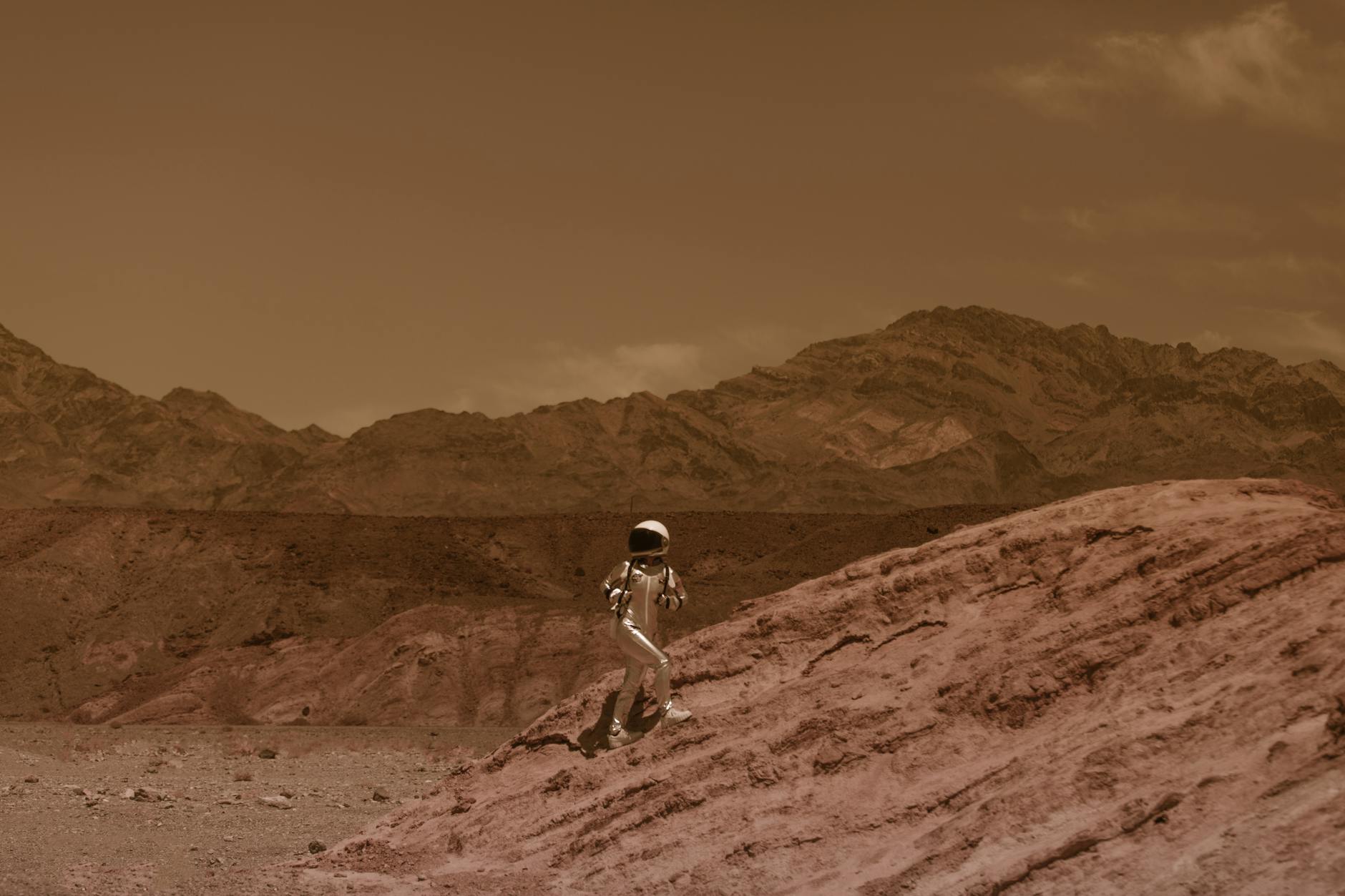
After sitting through Mission to Mars and bouncing off it hard, it becomes a lot easier to understand why some space movies stick with people for years while others quietly fade into the background of cable reruns and forgotten DVD bins. It is not just about budget, cast, or even ambition. It is about execution, pacing, emotional grounding, and whether a film actually makes you feel like you are part of the journey instead of just observing a slideshow of space concepts.
And when you line it up next to films like Interstellar and The Martian, the contrast becomes almost unfair. Because those two films do something Mission to Mars never managed to do, at least in my experience: they make space feel alive, urgent, and emotionally anchored in human stakes that actually matter.
It is interesting because all three films are trying to operate in the same general space (no pun intended). They are all about Mars or space exploration, human survival, mystery, and the unknown. On paper, they share DNA. But in execution, they feel like completely different species of storytelling.
With Mission to Mars, my experience was immediate detachment. Within thirty minutes, I felt like I was watching a film that was happening at me rather than with me. Scenes existed, but they did not pull me forward. Dialogue happened, but it did not spark curiosity. Even the premise, which should naturally be engaging, felt strangely flat in motion. That lack of momentum is what ultimately killed it for me.
Now compare that to The Martian. From the very beginning, The Martian understands something crucial: survival is inherently interesting when it is personal. It is not just “a mission on Mars.” It is one man alone, stranded, forced to problem-solve in real time with limited resources and growing stakes. That immediately creates tension because the audience understands consequences in a grounded way. Every small decision matters. Every setback is measurable. Every win feels earned.
That is something Mission to Mars never quite achieved in my viewing experience. It had the ingredients of space exploration, but it did not translate them into gripping, character-driven urgency. The Martian takes the same environment and turns it into a constant chain of problem-solving, where even quiet moments are filled with intellectual tension. You are not just watching events unfold; you are actively invested in whether the next solution works.
Then there is Interstellar, which takes a different but equally effective approach. Instead of focusing only on survival mechanics, it builds emotional gravity first. The entire film is anchored in relationships, especially the connection between Cooper and his daughter. That emotional thread becomes the backbone of everything else. Even the most abstract or scientifically heavy parts of the film are grounded by something human.
That is what gives Interstellar its power. It is not just space exploration. It is space exploration filtered through love, time, sacrifice, and loss. The science fiction elements are massive in scope, but they never feel detached because the emotional core is always pulling you back in.
That is where Mission to Mars felt weakest to me. There was no strong emotional anchor pulling me forward early on. Without that grounding, the pacing feels heavier, slower, and less meaningful. Even when things are happening on screen, they do not feel like they are building toward something emotionally resonant. And when that happens, even interesting concepts can start to feel empty.
Another key difference is momentum.
The Martian and Interstellar both understand how to structure progression in a way that constantly renews interest. In The Martian, every new obstacle introduces a new layer of problem-solving. In Interstellar, every shift in location or time expands the stakes and recontextualizes what came before. There is always forward motion, even in quieter scenes.
With Mission to Mars, at least in my viewing experience, that sense of escalating momentum was missing. It felt more like scenes existed in sequence rather than building into each other in a way that deepens engagement. And that is where viewer attention starts to slip. When progression feels flat, attention follows.
There is also the issue of tone control.
Interstellar manages to balance awe, tension, and emotional weight without collapsing into monotony. It knows when to slow down and when to escalate. It knows when to be silent and when to overwhelm you. It uses its pacing as part of the storytelling language rather than just a default rhythm.
The Martian similarly balances humor, intelligence, and tension. It never feels like it is stuck in one emotional gear for too long. Even when things get serious, it allows moments of personality and levity to keep the human side of the story alive.
That balance is critical. Because without it, space movies can easily become emotionally flat or overly mechanical.
And that is where Mission to Mars felt uneven. It leaned into a tone that, to me, came across as overly subdued without enough emotional contrast to keep things engaging. When everything is serious all the time but not emotionally charged, it creates a kind of narrative stagnation.
Another big difference is clarity of purpose.
In The Martian, the goal is crystal clear: survive and get home. In Interstellar, the goal evolves, but there is always a strong emotional and existential direction guiding the story forward. Even when things get complicated, the audience understands what is at stake and why it matters.
With Mission to Mars, I never fully felt that clarity in the first portion I watched. It felt more like events were unfolding without a strong emotional throughline tying them together. And when that happens, it becomes harder for the viewer to invest.
But the biggest difference, and honestly the one that stood out the most to me, is this: space itself.
In Mission to Mars, space did not feel like space.
It felt like a continuation of Earth.
That is the best way I can describe it. It did not feel like stepping into something alien, vast, dangerous, or fundamentally different. It felt like the same environments, the same emotional texture, just with a different backdrop. Like Earth scenes with a space filter applied over them. There was no sense of isolation that actually landed, no feeling of cosmic scale that reshaped how you perceive the characters’ situation. Even when the setting changed, the emotional experience did not feel like it changed with it.
And that is a major problem for a space movie.
Because space is supposed to feel like space.
It is supposed to feel distant. Silent. Hostile. Beautiful in a way that does not care about you. It should feel like a place where human assumptions stop working. Where every small action carries weight because you are operating in an environment that is fundamentally not built for you.
Interstellar nails this constantly. Space feels immense. Time behaves differently. Distance becomes emotional. Even silence has weight. You feel the scale of it in a way that is almost uncomfortable at times.
The Martian does it in a different way. Mars feels like an actual alien surface. Not Earth with a tint, but a real hostile environment where everything is slightly wrong for human survival. The isolation is tangible. The landscape feels indifferent. The science becomes a lifeline because the environment is actively trying to kill you.
Both films understand that space is not just a backdrop. It is a character in itself.
Mission to Mars, at least in my experience, never fully reaches that level of immersion. It never makes space feel like a separate reality with its own rules and emotional consequences. And when that happens, the entire premise loses some of its power. Because if space does not feel like space, then the journey stops feeling extraordinary. It just feels like movement from one scene to another.
And when combined with the pacing issues and lack of emotional pull, the result is a film that feels distant in all the wrong ways.
That is ultimately why I bounced off it.
I shut it off.
No dramatic exit. No hate-watch finish. Just the realization that I was not being pulled into the experience, and there was no reason to force it.
Meanwhile, Interstellar and The Martian succeed because they understand that space is not enough on its own. You need emotional gravity, narrative momentum, and environmental immersion working together at the same time. When those elements align, you do not just watch a space movie. You experience it.
And that is the difference.