The Musings of Jaime David
@jaimedavid.blog@jaimedavid.blog

The writings of some random dude on the internet

1,120 posts
1 follower

Tag: self publishing

  • Brian Griffin, Me, and the Difference Between Calling Yourself a Writer and Actually Becoming One

    Brian Griffin, Me, and the Difference Between Calling Yourself a Writer and Actually Becoming One

    There is something strangely fascinating about Family Guy and the way it portrays ambition. Beneath all the absurdity, cutaway gags, offensive jokes, and chaotic humor, the show often presents characters who are deeply stagnant. They dream big, they talk big, they imagine themselves as important, talented, intelligent, or special, but they rarely change. In many ways, that is part of the joke. The characters are trapped in a comedic loop where development resets because the show itself depends on maintaining a status quo. And among all those characters, perhaps none embodies that contradiction more than Brian Griffin.

    Brian Griffin is, supposedly, a writer.

    Or at least, that is what he calls himself.

    Throughout the series, Brian constantly presents himself as intellectual, artistic, cultured, and sophisticated. He drinks wine, quotes literature, criticizes others, talks about philosophy, politics, and culture, and positions himself as the most enlightened member of the Griffin family. But when you actually examine his actions throughout the duration of the show, a very different image emerges. Brian talks about writing far more than he actually writes. He talks about ambition more than he acts on ambition. He talks about becoming successful more than he genuinely works toward success. And while there are episodes where he technically becomes an author or experiences temporary recognition, those moments almost always disappear afterward, resetting him back to square one.

    That matters more than people realize.

    Because in a strange way, Brian represents a very real phenomenon within creative communities. He represents the person who loves the aesthetic of being a writer more than the actual process of writing itself.

    And that is where I compare him to myself.

    Now, on the surface, comparing a real person to a fictional cartoon dog might sound ridiculous. And honestly, it kind of is. But sometimes fictional characters become symbols larger than themselves. Sometimes they reflect archetypes that exist in reality. Brian Griffin is one of those characters. Whether people like it or not, he represents a certain type of writer. The writer who constantly speaks about their future greatness while rarely putting in the sustained work required to actually build something meaningful.

    And when I look at my own life as a writer, I see the exact opposite trajectory.

    I did not just sit around talking about writing.

    I wrote.

    I built.

    I created.

    I spent years constructing something from absolutely nothing.

    My debut novel, Wonderment Within Weirdness, took seven years to write. Seven years. That is not a weekend hobby. That is not pretending to be a writer. That is not casually fantasizing about creativity while doing nothing. That is years of dedication, persistence, rewriting, self reflection, frustration, experimentation, growth, and discipline. A project does not survive for seven years unless someone genuinely believes in it enough to keep going through periods of doubt, exhaustion, and uncertainty.

    And then in 2025, I published not one book, but three.

    That alone separates fantasy from action.

    Because the truth is, writing is easy to romanticize. Society romanticizes writers constantly. People love the image of the writer. The lonely intellectual sitting in cafés. The misunderstood artist. The deep thinker staring out rainy windows while typing profound sentences. Popular culture has turned “being a writer” into an identity aesthetic. But the actual reality of writing is much uglier and much harder than people imagine.

    Real writing is repetition.

    Real writing is discipline.

    Real writing is continuing when nobody cares yet.

    Real writing is building platforms from scratch while feeling invisible.

    Real writing is editing the same paragraph twenty times.

    Real writing is spending years on projects with no guarantee of success.

    Brian Griffin rarely does any of that.

    Instead, Brian often acts entitled to recognition before truly earning it. He wants validation immediately. He wants people to acknowledge his intelligence. He wants to be seen as talented. But he lacks consistency. And consistency is the single most important thing in creative work.

    The uncomfortable truth is that many people who identify as writers never actually commit themselves to writing seriously. They love discussing ideas. They love announcing projects. They love imagining future success. But they do not endure the long, painful process of building something over time.

    I did.

    And that matters.

    Especially in the modern era where attention spans are collapsing and creative burnout happens constantly.

    What makes this comparison even more interesting is that Brian Griffin exists inside a world where excuses are easy. He lives comfortably enough. He has a support system. He has free time. He has opportunities. Yet despite all that, he rarely fully commits himself. He drifts. He procrastinates. He self sabotages. He intellectualizes instead of acting. And honestly, that is one of the most realistic aspects of his character. A lot of people fail not because they lack talent, but because they lack sustained application.

    Talent without consistency becomes meaningless.

    Ideas without execution become meaningless.

    Dreams without action become meaningless.

    And this is why I think Brian is such an important character to analyze, even beyond comedy. He unintentionally exposes a very real issue within artistic culture. There are people who become so attached to the identity of being creative that they never actually create enough.

    Meanwhile, I approached writing differently.

    I built blogs.

    I built podcasts.

    I expanded my online presence across multiple platforms.

    I kept creating.

    And I did it from the ground up.

    Nobody handed me an audience.

    Nobody magically gave me visibility.

    Nobody dropped success into my lap.

    I worked for it.

    That distinction is important because independent creative work in the modern age is brutal. People underestimate how difficult it is to maintain motivation while building something independently. Especially online. The internet creates the illusion that success happens instantly, but behind almost every successful creator is years of invisible labor that nobody saw.

    Seven years spent writing a debut novel is invisible labor.

    Years of blogging is invisible labor.

    Building podcasts is invisible labor.

    Maintaining consistency is invisible labor.

    And unlike Brian Griffin, I did not simply stop at the idea stage.

    I followed through.

    One of the biggest differences between Brian and myself is that I understand creativity as work, not just identity. Brian often treats writing as an extension of his ego. He wants writing to prove he is sophisticated. He wants recognition attached to the title of “writer.” But genuine creative work humbles you very quickly. The process itself destroys ego. Writing forces you to confront your weaknesses repeatedly. It forces you to revise, rethink, fail, and improve. If you genuinely dedicate yourself to writing long term, you eventually stop caring about looking like a writer and start caring about becoming better at writing.

    That shift changes everything.

    Because once creativity becomes practice rather than performance, progress begins happening.

    And honestly, I think that is why Brian remains stagnant throughout most of the show. He rarely transforms because he rarely commits himself fully enough to transformation. He prefers the fantasy version of himself over the difficult process required to actually become the person he imagines he already is.

    Again, I understand why the show does this. Seth MacFarlane and the writers designed Brian this way intentionally. Brian is meant to be hypocritical. He is meant to embody contradiction. The humor comes from the gap between how intelligent he thinks he is and how flawed he actually is. But despite being fictional satire, there is truth embedded in that characterization.

    A lot of people become trapped inside self perception.

    They think talking equals doing.

    They think intentions equal accomplishments.

    They think potential equals achievement.

    It does not.

    Potential means nothing without application.

    That is something I learned firsthand through writing.

    Especially with a project like Wonderment Within Weirdness. Spending seven years on a debut novel changes your perspective entirely. Most people abandon long projects. Many writers never finish their first book. Some spend decades talking about novels they never complete. So to not only finish a novel, but publish it, alongside multiple other books in the same year, represents sustained commitment over fantasy.

    And honestly, I think there is something symbolic about comparing myself to Brian Griffin specifically because he is such a recognizable cultural figure. Millions of people know Brian. Millions of people recognize the archetype he represents. The pseudo intellectual creative who endlessly talks about greatness while rarely manifesting it into consistent output.

    But I think there is another reason this comparison matters.

    Brian reflects fear.

    Underneath his arrogance and intellectualism, there is insecurity. He fears failure. He fears irrelevance. He fears inadequacy. And ironically, those fears contribute to his stagnation. Because the more someone fears failure, the easier it becomes to avoid fully trying. If you never genuinely commit, you never have to fully confront whether you could succeed or fail.

    But when you spend seven years writing a novel, you confront that fear directly.

    When you publish books publicly, you confront that fear directly.

    When you build podcasts and blogs publicly, you confront that fear directly.

    You expose yourself to criticism, rejection, indifference, misunderstanding, and uncertainty.

    That vulnerability is real.

    And it is something Brian often avoids.

    This is why I fundamentally disagree with the version of creativity Brian represents. Writers should not merely identify as writers. They should write. They should create consistently. They should push themselves. They should build something tangible, even if the process is slow and difficult.

    And yes, not everyone needs to publish books or build giant platforms. Success looks different for different people. But there is still a difference between someone who genuinely practices their craft and someone who endlessly talks about doing so without sustained effort.

    The modern internet era makes this issue even more complicated because performance has become deeply intertwined with creativity. Social media encourages people to brand themselves instantly. People introduce themselves as writers, artists, philosophers, creators, entrepreneurs, influencers, visionaries, often before they have actually built much of anything. Identity becomes detached from output.

    Brian Griffin predicted that dynamic before social media fully exploded.

    He is essentially the prototype of performative intellectualism.

    And honestly, that is part of why he remains such an effective character.

    Because despite being a cartoon dog in an absurd comedy series, he reflects something deeply human.

    People want recognition.

    People want meaning.

    People want validation.

    But wanting those things is not enough.

    You have to build.

    You have to persist.

    You have to continue even when progress feels invisible.

    That is what separates fantasy from reality.

    And I think my own journey reflects that distinction clearly. I did not wait for permission to become a writer. I became one through action. Through years of effort. Through long term commitment. Through creation itself.

    There is also another irony here.

    Brian Griffin desperately wants authenticity and depth, yet he often lacks both because he rarely commits himself fully enough to anything. Meanwhile, real authenticity emerges through process. Through persistence. Through long term engagement with your craft. You cannot fake seven years spent writing a novel. You cannot fake maintaining blogs and podcasts over time. You cannot fake sustained creative output forever. Eventually, real work reveals itself.

    And honestly, that is something many aspiring writers need to hear.

    Writing is not about appearing intellectual.

    Writing is not about aesthetics.

    Writing is not about fantasy identities.

    Writing is about writing.

    That sounds obvious, but many people forget it.

    The actual work matters more than the performance surrounding the work.

    Brian often reverses that equation.

    He prioritizes appearance over sustained effort.

    And to be fair, that flaw makes him compelling as a character. Perfect characters are boring. Brian’s contradictions are precisely what make him memorable. But outside fiction, those contradictions become dangerous if people emulate them too closely.

    Because creative stagnation becomes easy.

    Endless planning becomes easy.

    Endless talking becomes easy.

    Endless dreaming becomes easy.

    Finishing things is hard.

    Building platforms is hard.

    Publishing books is hard.

    Remaining consistent for years is hard.

    And yet, that is exactly what I did.

    I think there is also a broader lesson here about self belief. Brian often oscillates between arrogance and insecurity. He wants to believe he is exceptional, but deep down he often doubts himself. That contradiction traps him in cycles of inaction. Meanwhile, real creative growth requires a strange balance between humility and confidence. Enough confidence to continue creating despite uncertainty, but enough humility to recognize that improvement never ends.

    That balance matters enormously.

    Because if you become too arrogant, you stop improving.

    If you become too insecure, you stop creating.

    Writers have to navigate both.

    And honestly, I think surviving seven years of writing a debut novel teaches that lesson naturally. Long projects force endurance. They force patience. They force adaptation. They force you to continue through periods where motivation disappears entirely.

    That is something Brian rarely demonstrates.

    He chases inspiration instead of discipline.

    But discipline is what builds careers.

    Discipline is what creates bodies of work.

    Discipline is what transforms ideas into reality.

    And perhaps that is ultimately the core difference between Brian Griffin and myself.

    Brian wants the identity.

    I embraced the process.

    Brian talks.

    I built.

    Brian dreams about becoming recognized as a writer.

    I spent years actually writing.

    That distinction may sound harsh, but I think it is important. Especially in an era where creativity is increasingly commodified into branding and performance. There is value in reminding people that creation itself still matters. Persistence still matters. Long term dedication still matters.

    And honestly, maybe that is why I felt compelled to make this comparison in the first place.

    Because despite all the absurdity surrounding Family Guy, Brian Griffin accidentally became symbolic of something real. He symbolizes unrealized potential. He symbolizes creative stagnation. He symbolizes the danger of mistaking self image for actual progress.

    Meanwhile, my own story represents something different.

    Not perfection.

    Not instant success.

    Not effortless genius.

    But persistence.

    Commitment.

    Application.

    Years of work.

    And ultimately, tangible results.

    Three published books in 2025.

    Years of blogging.

    Podcasts.

    Platforms.

    Creative output built from the ground up.

    That is not fantasy. That is not performance. That is real effort manifested over time.

    And maybe that is the final irony in all this.

    Brian Griffin, despite constantly calling himself a writer, rarely embodies what writing truly requires.

    But through comparing myself to him, I think the contrast reveals an important truth about creativity itself.

    Being a writer is not about saying you are one.

    It is about continuing to write long after the excitement fades.

    It is about finishing projects.

    It is about enduring uncertainty.

    It is about building something slowly, piece by piece, even when nobody notices yet.

    And perhaps most importantly, it is about applying yourself fully instead of endlessly fantasizing about the person you could become.

    Because eventually, there comes a point where dreams alone are no longer enough.

    At some point, the work has to begin.

    Fediverse Reactions
  • How My Debut Book “Wonderment Within Weirdness” Won a 4-Star Literary Titan Award

    How My Debut Book “Wonderment Within Weirdness” Won a 4-Star Literary Titan Award

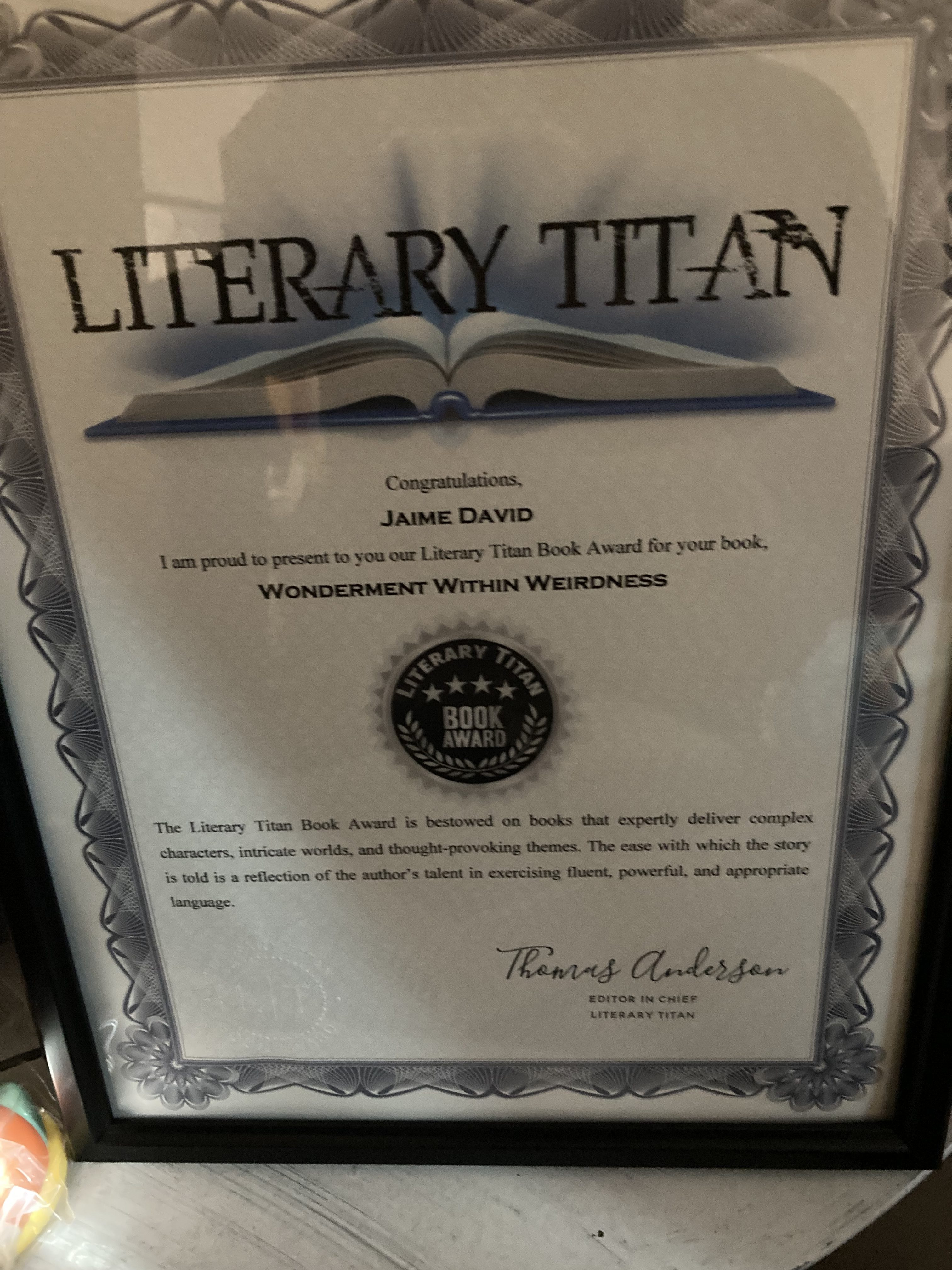
    There are moments in life that do not fully register at first. Moments where you stare at a screen, reread the same sentence multiple times, and wonder if what you are seeing is actually real. For me, one of those moments came when I found out that my debut book, Wonderment Within Weirdness, had received a 4-star silver award from the Literary Titan.

    Now, before anyone misunderstands what I am saying, no, the Literary Titan award is not the Pulitzer Prize. It is not one of those century-old literary institutions that immediately dominate headlines or get discussed endlessly in academic circles. I understand that. I am aware of the hierarchy that exists within the literary world. There are massive awards with generations of prestige behind them, and then there are smaller, newer awards trying to carve out their own identity in the publishing landscape. Literary Titan falls more into that latter category. But here is the thing people often overlook: recognition is still recognition. An award does not have to be the most famous literary honor on Earth in order to matter.

    And for a debut author, especially an independent one, receiving any kind of legitimate literary recognition can mean far more than outsiders realize.

    Because here is the reality that many people do not talk about enough: writing a book is hard. Finishing a book is even harder. Publishing one is another mountain entirely. Then comes the most brutal stage of all, getting anyone to notice it in a world overflowing with content. Every day, countless books are released onto the internet. Thousands upon thousands of stories, poetry collections, essays, memoirs, philosophical works, experimental projects, and novels appear online, all fighting for visibility. Most disappear almost instantly into the digital void. Some never receive reviews. Some never find an audience. Some barely get read outside of friends and family circles. That is simply the brutal reality of modern publishing.

    Which is why the Literary Titan award mattered to me.

    Not because it suddenly transformed me into a globally recognized literary icon overnight. Not because I now expect to be discussed alongside literary giants. But because it represented something important: external validation. It meant that someone outside of my immediate circle looked at my work and believed it deserved recognition. That matters. Especially for a first book.

    Debut books exist in a strange space. Established authors often have advantages that new writers simply do not possess. They may already have audiences built over years. They may have publishers backing them with marketing budgets. They may have editors, agents, industry connections, media exposure, or simply the power of name recognition. Readers approach established writers with preconceived expectations. There is already a built-in level of trust there.

    A debut author has none of that.

    When someone picks up a first book from a completely unknown writer, there is no guarantee attached to it. There is no proven track record. No legacy. No assurance that the work will even be coherent, let alone compelling. A debut writer has to earn every ounce of credibility from scratch. That is part of what makes literary recognition for a first book feel especially significant.

    And in my case, Wonderment Within Weirdness was not some hyper-calculated, market-tested project designed specifically to appeal to mainstream publishing trends. If anything, the book reflects many of the themes and ideas that define my broader creative identity. Weirdness. Wonder. Introspection. Emotion. Existential thought. Philosophical wandering. Experimental energy. It is deeply tied to my voice as a writer and thinker. In many ways, it represents me authentically rather than trying to imitate what the market supposedly wants.

    That can be risky.

    The internet often pushes creators toward conformity. Algorithms reward familiarity. Publishing industries sometimes reward predictability. There is pressure everywhere to fit neatly into categories, genres, aesthetics, and market expectations. But creative work that embraces weirdness and individuality can sometimes cut through precisely because it feels different. It feels human. It feels personal. And I think that is part of why the recognition meant something to me.

    Because it suggested that originality still has value.

    I also think there is something psychologically important about literary awards for independent authors that many people underestimate. When you are creating largely on your own, doubt becomes constant. Every writer experiences it to some degree, but independent creators especially know what it feels like to question themselves endlessly. Is the work good enough? Is anyone reading? Does any of this matter? Am I wasting my time? These thoughts can become relentless.

    So when an outside organization says, “We see merit here,” it can genuinely impact a creator’s confidence. Not in an egotistical way, but in a stabilizing way. It becomes proof that the work connected with someone beyond yourself. That is valuable fuel for continuing forward creatively.

    And honestly, the award also made me reflect on how strange and unpredictable artistic journeys can be.

    There are writers who spend decades producing work before receiving recognition. There are others who explode into visibility instantly. Some receive praise early and disappear later. Others struggle for years before eventually finding audiences. There is no universal roadmap for creativity. No guaranteed formula. No clear sequence that determines who succeeds and who does not. The literary world is chaotic. Sometimes brilliant books are ignored. Sometimes mediocre books become massive phenomena. Sometimes deeply personal projects unexpectedly resonate with readers and reviewers alike.

    That unpredictability is both terrifying and beautiful.

    I think part of why this award mattered so much to me is because it symbolized momentum. Not finality. Not completion. Momentum. It felt like confirmation that I am not simply shouting into the void entirely unnoticed. Even smaller recognitions can create psychological momentum for artists. They can reinforce the idea that continuing to create is worthwhile.

    And perhaps most importantly, it reminded me that the definition of success is more nuanced than people often make it out to be.

    Modern internet culture tends to frame success in extremes. Either you are world famous, or you are irrelevant. Either you win the biggest awards imaginable, or your accomplishments supposedly do not count. But reality is far more layered than that. There are countless levels of artistic success between obscurity and superstardom. A smaller literary award can still represent a meaningful achievement. Especially for a first-time author.

    I also think there is something fascinating about newer literary awards in general. Every prestigious institution that exists today had to begin somewhere. The Pulitzer Prize was once new. The Booker Prize was once unknown. Every literary tradition starts small before history determines whether it grows into something larger. Now, I am not claiming Literary Titan will become the next Pulitzer. Nobody can predict that. But I do think people sometimes dismiss newer awards too quickly simply because they lack decades of legacy.

    The reality is that literary culture is constantly evolving. Independent publishing itself has changed dramatically over the last twenty years. The barriers between traditional and independent authorship have blurred. Online platforms have allowed writers to build audiences without relying entirely on gatekeepers. Smaller awards and independent review organizations have emerged partly because the literary ecosystem itself has expanded beyond older institutional models.

    And frankly, independent authors often need these spaces.

    Because traditional literary systems can be incredibly difficult to penetrate. Many talented writers never receive attention from major publishers or prestigious literary organizations despite producing meaningful work. Smaller awards can provide visibility where mainstream institutions may overlook emerging voices. That does not make the recognition fake or meaningless. It simply means it exists within a different layer of the literary landscape.

    Another thing that struck me after receiving the award was how differently creators experience recognition compared to outsiders observing from a distance. Someone scrolling online might see “4-star Literary Titan award” and move on after two seconds. But for the creator behind the work, that recognition often represents years of thought, effort, doubt, rewriting, editing, emotional investment, and persistence condensed into a single moment.

    People see the outcome. They rarely see the process behind it.

    They do not see the nights spent questioning whether the project will ever come together properly. They do not see the anxiety involved in publishing something personal into public view. They do not see the fear of rejection. They do not see the vulnerability required to create sincerely in a culture that often rewards irony and detachment more than authenticity.

    And perhaps that is another reason why this award felt meaningful to me specifically. It validated authenticity.

    I have always been drawn toward ideas that sit outside rigid convention. Whether through my writing, my philosophical ideas surrounding anarcho-compassionism, my blog posts, or my broader creative identity, I tend to gravitate toward introspection, emotional honesty, nuance, existential exploration, and unconventional thinking. Wonderment Within Weirdness reflects that mindset heavily. It is not trying to be sterile or artificially polished into generic marketability. It embraces weirdness directly, even in its very title.

    And honestly, I think the title itself matters.

    “Wonderment Within Weirdness” captures something fundamental about how I view creativity and existence. There is wonder inside the strange. Beauty inside imperfection. Meaning hidden within chaos. Modern society often pressures people to suppress weirdness, flatten individuality, and conform to expectations. But creativity frequently thrives in the exact opposite direction. Some of the most memorable art emerges precisely because it dares to be unusual.

    That does not mean every unconventional work automatically becomes brilliant. But authenticity has power. Readers can often sense when something comes from a genuine place rather than existing solely as a calculated product.

    I also think there is something inspiring about the fact that a debut independent book can receive recognition at all in today’s environment. We live in an era where gatekeeping still exists, but it is no longer absolute. Independent creators have more opportunities than ever before to publish work, connect with audiences, and gain visibility. The internet has created overwhelming saturation, yes, but it has also democratized creativity in many ways.

    That democratization comes with contradictions. Visibility is harder because everyone is competing simultaneously. Yet opportunities also exist that previous generations of writers could barely imagine. A person can build a blog, publish books independently, create podcasts, interact directly with readers, and cultivate a creative ecosystem almost entirely outside traditional institutions.

    That is part of the journey I have been navigating myself through The Musings of Jaime David and my broader online presence.

    And perhaps that is another reason this award felt important. It represented not just one isolated accomplishment, but evidence that the broader creative path I have been pursuing might actually be leading somewhere meaningful.

    What made the experience even more surreal was seeing the recognition expand beyond the award announcement itself. Literary Titan did not simply hand out the award quietly and move on. There was an actual press release published about my book receiving the award, which made the accomplishment feel far more tangible and publicly documented. FinancialContent press release about the award

    That mattered to me because there is something psychologically different about seeing your work discussed publicly in a professional context. It transforms the experience from feeling purely internal into something externally recognized and archived. Suddenly, the book was not just existing within my own creative ecosystem. It was being discussed beyond it.

    Then there was the author interview that Literary Titan conducted with me, which honestly made the entire experience feel even more real. Literary Titan author interview with Jaime David The title alone, “It Started With a YouTube Comment,” captures something fascinating about modern creativity and internet culture. So many creative journeys now begin in strange, seemingly insignificant digital moments. A comment. A post. A random idea. A passing conversation online. Something tiny eventually snowballs into something much larger.

    That interview gave me the opportunity to reflect not just on the book itself, but on the broader creative process behind it. And honestly, interviews can sometimes feel even more vulnerable than the work itself because they require the creator to directly articulate thoughts, motivations, insecurities, and inspirations in their own voice. There is nowhere to hide behind fictional structure or poetic abstraction at that point. It becomes direct human reflection.

    And then there was the review itself from Literary Titan. Literary Titan review of Wonderment Within Weirdness Reviews are fascinating because they represent interpretation. Once creative work enters the world, readers begin forming their own relationships with it. They notice things the creator may not have fully realized themselves. They interpret themes differently. They emotionally connect to unexpected aspects of the work. That is part of what makes literature so interesting in the first place. Books stop belonging solely to the author once they are released publicly. They become shared experiences between creator and reader.

    Perhaps one of the strangest and coolest parts of all this, though, was the fact that there was even a podcast episode discussing my book. Literary Titan podcast episode about Wonderment Within Weirdness There is something surreal about hearing people talk about your creative work in audio form, almost like listening to your ideas echo back at you from outside yourself. It creates this bizarre sensation where the project suddenly feels alive beyond your own head.

    And honestly, when you step back and look at the full picture, it becomes clear that the experience extended beyond simply “winning an award.” There was the award itself, the review, the interview, the press release coverage, and even a podcast discussion. For a debut independent book, that is genuinely meaningful visibility.

    Will the Literary Titan award alone suddenly make me famous? Of course not. I am realistic about that. But creative careers are often built incrementally. Recognition accumulates piece by piece over time. One review leads to another. One award builds credibility. One reader recommends a book to someone else. Momentum compounds gradually rather than explosively for most writers.

    People often romanticize overnight success while ignoring how many creators build their audiences slowly over years. Persistence matters enormously in creative fields. So does consistency. So does continuing to create even when visibility feels limited.

    And honestly, I think the award reinforced something deeper psychologically for me: the importance of continuing despite uncertainty.

    Because uncertainty never fully disappears for artists. Even successful writers experience doubt constantly. There is no magical point where creators suddenly become immune to insecurity. Every project involves risk. Every piece of writing involves vulnerability. Every publication becomes an act of exposure in some way.

    But recognition can help counterbalance that uncertainty enough to keep moving forward.

    It can remind creators that their work has impact beyond their own internal world. That someone connected with it. That the effort mattered to another human being somewhere out there.

    And for me, as a debut author, that feeling carries enormous significance.

    Fediverse Reactions
  • To Every Writer, Author, and Reader Out There — I Want to Tell You About My Book

    To Every Writer, Author, and Reader Out There — I Want to Tell You About My Book

    I want to talk about my debut novel, “Wonderment Within Weirdness.” Not in a sales pitch kind of way, not with a rehearsed elevator pitch or a list of reasons you absolutely must buy it right now. I just want to talk about it honestly, the way I would if we were sitting somewhere having a real conversation. I have been thinking a lot lately about how to share this book with more people, particularly with the writing and reading communities that I genuinely respect and engage with, and I figured the most straightforward thing I could do is just tell you what the book is, what it is about underneath the surface, and why I think certain people would connect with it. So that is what this is. A conversation.

    The simplest way to describe “Wonderment Within Weirdness” is that it is a science fiction action-adventure novel about an ordinary person who gets pulled into a multiversal conflict far beyond anything he could have anticipated or prepared for. That is the skeleton of it. A regular guy, an enormous and strange situation, stakes that reach levels that most people would find completely absurd. And honestly, absurd is a fair word for a lot of what happens in this book. The story goes to some wild places. There are multiple timelines, unknown universes, demons, portal guns, a heist in hell, and a threat to existence itself. I am not going to pretend that sounds restrained or modest, because it is not. From the very beginning, I wanted this book to be grand in scope. I wanted it to be epic and layered and ambitious. That was always the intention, and I do not apologize for it.

    What I do want to be clear about, though, is that the size and the strangeness of the book are not the point. They are the vehicle. The actual point of the story is something much quieter and more personal, even if it rarely gets the chance to be quiet inside the book itself. The multiverse is not just a backdrop. It is a metaphor. It is a way of exploring uncertainty, and choice, and what happens to a person when the familiar rules of existence stop applying and get replaced by something vast and incomprehensible. I think most people have felt a version of that at some point in their lives. Not with portal guns involved, obviously, but that feeling of reality shifting beneath you, of suddenly not knowing the rules anymore, of being asked to navigate something you were never prepared for. That feeling is at the heart of everything I was trying to do with this story.

    One of the things I have reflected on a lot since publishing the book is how much of its meaning I did not fully understand while I was writing it. That sounds strange, maybe, but I think it is true of a lot of writing. You put something down on the page because it feels right, because it is the honest thing, and only later do you look back and see what you were actually doing. Looking back at “Wonderment Within Weirdness” now, I can see how richly thematic it is, how much it is really about conflict, resilience, morality, and the way individuals navigate chaos. I can see that it is, in some ways that I did not consciously plan, an anti-war novel. Not in a heavy-handed or preachy sense. But the weight of violence accumulates throughout the story. The cost of conflict is never abstract. It lands on the protagonist in ways that are personal and real, and I think that honesty about what conflict actually does to people is one of the things I am most proud of in the book.

    The protagonist himself is somebody I care about a great deal. He is not a hero in the conventional sense. He does not have a secret destiny or a hidden power that gets activated when things get bad enough. He is just a person who finds himself in circumstances that are completely beyond him, and he has to figure out how to keep going anyway. He is not defined by confidence or certainty. He is defined by his refusal to completely give up, even when giving up would be the reasonable response to everything happening around him. I wrote him that way deliberately, because I find that kind of resilience far more interesting and far more honest than the polished invincibility you often get from genre protagonists. His struggle is emotional as much as it is physical. His arc is as much about mental endurance as it is about the external conflict. Mental health as a theme is not something I grafted onto the story after the fact. It is woven into the fabric of who he is and how he moves through everything the book throws at him.

    I also want to say something about the length, because I know it comes up. The book is over 600 pages. For a debut novel, that is unusual, and I am aware of that. When people hear that number, there is often a moment of hesitation. But I want to be honest about why the book is that long, because it is not padding and it is not self-indulgence. It is because I had a genuinely enormous story to tell, with layers of plot and subplots and characters and ideas that could not be compressed without losing something essential. The story is dense and sprawling and chaotic in places, and that is intentional. It reflects the nature of the world I was building. The length is the length because the story demanded it, and I stand by that. I also think readers who commit to it find that the size of the book becomes part of the experience. There is a particular kind of satisfaction that comes from finishing something that took real investment, and I wanted to give readers that.

    There is also humor in the book, and I want to mention that because I think it sometimes gets overlooked in conversations about themes and meaning. “Wonderment Within Weirdness” is funny in places. Not in a way that undercuts the serious moments, but in a way that lives alongside them. I think absurdity and sincerity can coexist, and I think some of the most honest moments in any piece of fiction come from the collision of those two things. The book leans into its own strangeness with a certain amount of self-awareness, and I think that tonal balance is one of the things that makes it feel different from a lot of other science fiction I have read. It does not take itself so seriously that it forgets to be alive, but it does not use humor as a way to avoid saying something real either.

    Now I want to speak directly to the communities I genuinely respect and engage with, the writers and readers who spend time thinking carefully about storytelling and craft and the experience of creating and consuming fiction. If you watch channels like The Creative Penn, where Joanna Penn has spent years building an incredible resource around the craft and the business of being an indie author, then you already understand that independent publishing is not a lesser version of traditional publishing. It is just a different path, and the books that come from it deserve the same serious engagement. “Wonderment Within Weirdness” is a book I made on my own terms, through the independent route, and I am proud of that. I think the community that Joanna has built is exactly the kind of community that understands what that means.

    If you watch Brandon Sanderson’s lectures and channel, where he breaks down world-building and narrative structure with a generosity and clarity that I genuinely admire, you might find something interesting in the way I approached my own world-building. The multiverse in my book is not decorative. It is structural. The rules of how it works matter, and the way the protagonist interacts with those rules is the spine of the plot. I think readers who appreciate that kind of intentional construction in speculative fiction will have a lot to engage with here, even if my approach is messier and more chaotic than Sanderson’s famously rigorous systems.

    If you follow channels like Hello Future Me, where Timothy Hickson does incredibly thoughtful video essays about how storytelling builds meaning through its architecture, then the thematic layering in “Wonderment Within Weirdness” is something I would genuinely love you to dig into. The anti-war elements, the mental health themes, the use of the multiverse as metaphor rather than just spectacle — these are all things that are there to be found if you are reading with that kind of attention. I am not claiming the book is perfect. No debut novel is. But I am claiming that there is more going on beneath the surface than a casual glance might suggest, and that is exactly the kind of book that channels like Hello Future Me are built to celebrate.

    To everyone who watches Abbie Emmons talk about the psychology of storytelling and why certain narratives connect with readers on a level that goes beyond plot, I want you to know that the emotional core of my book was never an afterthought. I spent a lot of time thinking about what I wanted readers to feel and why, about how the protagonist’s internal experience should track against the external chaos of the story. The emotional resonance was the thing I cared about most, even when I was writing scenes that are, on the surface, completely bananas. If you watch Jenna Moreci’s channel and appreciate her honest, direct takes on what works and what does not in genre fiction, I think you would find “Wonderment Within Weirdness” to be a genuinely interesting case study. It does some things very well and it takes some risks that do not always land perfectly, and I am at peace with both of those things. That is what a debut novel is.

    For those who follow channels like Author Level Up with Michael La Ronn, where the focus is on what it actually means to build a body of work as an indie author and keep showing up for your craft, I want to say that “Wonderment Within Weirdness” was just the beginning for me. I also released a poetry compilation called “My Powerful Poems” and a short story collection called “Some Small Short Stories” in 2025, making three books in a little over a year. I am not saying that to brag. I am saying it because I think the writers in those communities understand what it means to commit to the work, to keep creating even when it is difficult, and “Wonderment Within Weirdness” is where that commitment started for me. It is the book that proved to me that I could actually do this.

    If you spend time reading blogs like The Creative Penn, where the conversation around indie publishing and the author journey is as rich and sustained as anywhere on the internet, I think the story behind my book is as interesting as the book itself. I am a writer and a scientist, and I came to this debut novel with curiosity and a refusal to simplify things, whether that means the plot, the themes, or the emotional experience of the protagonist. That approach is reflected on every page. It is also reflected in the blog I maintain at jaimedavid.blog, where I write about the book, about the themes, about what it means to be an indie author navigating all of this. If you read Jane Friedman’s blog and appreciate the honest, practical, thoughtful engagement with the realities of the publishing world that she consistently provides, then you know that independent authors are part of that conversation too, and I want to be part of it.

    The book is available in print and ebook through Lulu and various online platforms including Amazon. It is not a perfect book. I do not think first novels usually are, and I think there is something a little dishonest about pretending otherwise. But it is an honest book. It is a book that came from a genuine place, that was written with real ambition and real feeling, and that has more going on inside it than its genre surface might immediately suggest. If you are part of the writing and reading communities I have mentioned here, if you spend time thinking about craft and story and what fiction can do when it is willing to take risks, then I think “Wonderment Within Weirdness” is worth your time. Not because I am telling you to read it, but because I genuinely believe you would find something in it worth thinking about.

    That is really all I wanted to say. Go check it out if it sounds like your kind of thing. And if you do read it, I would genuinely love to know what you thought.

    Fediverse Reactions
  • When Fans and Fellow Authors Aren’t What They Seem: The New Wave of Indie Author Scams

    When Fans and Fellow Authors Aren’t What They Seem: The New Wave of Indie Author Scams

    If you’re an indie author long enough, you start to notice the odd messages trickling into your inbox. Some claim to be fans. Others present themselves as fellow authors who “just wanted to connect.” At first, it feels flattering. A fan who loves your work? A peer who wants to talk shop? What writer doesn’t want that? But scratch the surface, and the truth reveals itself: they aren’t fans, and they aren’t fellow authors. More often than not, they’re scammers — and increasingly, their messages read like they were churned out by ChatGPT or some other AI. The indie author world is a precarious balance between hope and hustle. Every new fan, every peer who reaches out, is a potential milestone, a small win in the lonely grind of self-publishing. Scammers know this, and they exploit it. They rely on the desire for validation, the natural instinct to respond to someone who seems interested, and the habit of answering polite questions. That’s the trap: the first message looks harmless, even flattering, and it lulls you into a sense of trust before the scam reveals itself.

    On the fan side, the scam typically starts with vague flattery. They’ll say they “just finished your book” or “can’t wait to read your next one.” Sometimes they awkwardly drop the title into the message to sound convincing. But here’s the first red flag: the numbers. Indie authors know our sales dashboards inside and out. If nobody bought the book, nobody read it. Any claim otherwise is a lie, and the more they emphasize it, the more desperate it feels to convince themselves — and you — that it’s true. These fake fans count on the hope and excitement of the author, hoping that you’ll ignore the glaring evidence in your own analytics.

    Then comes the link request. “Can you send me the Amazon link?” Motherfucker, if you actually read the book like you claim, you already had the link. That’s how you bought it. Asking for it proves they didn’t read anything. Sure, the link itself is harmless — anyone can Google it — but the act of asking is never about the link. It’s about engagement, a foothold into your attention. Once they know you’ll reply, the next stage of the con begins. Sometimes it’s a push for “marketing services” that are pure smoke and mirrors. Sometimes it’s a pay-to-play anthology, or a supposedly exclusive opportunity that costs money to access. Other times, they just want to grab your link to prop up a fake persona online, pointing to it as “proof” that they’re a real author or fan. The scam isn’t in the link — it’s in your interaction, your trust, and your attention.

    What makes this even creepier is the AI flavor. These emails don’t just look fake — they read fake. Awkward phrasing, stiff politeness, repeated sentence structures, generic praise that could apply to any book anywhere. They’re lifeless, as though a bot spat them out from a prompt like “write a flattering fan email to an indie author.” Real fans don’t sound like ChatGPT circa 2022 trying to sound human. Real authors don’t write “Dear Esteemed Writer, your literary contributions are deeply appreciated” as a first cold email. That robotic tone, the absence of nuance, the lack of specificity — it’s all screaming that no real human sat down and wrote this with genuine interest. Scammers leverage AI to churn these out en masse, meaning your inbox could be getting dozens of these false engagements without ever costing them anything.

    Then there’s the “fellow author” scam, which is deceptively tricky because author-to-author connections are normal. They start with generic compliments: “I love your style,” or “Your work really spoke to me.” Sometimes they try to appear established, or they even name-drop a well-known author identity to lend credibility. Then they pivot to questions about your process, your genre, or they request your book link. The mismatch is glaring. If they were truly a peer who had looked you up, they would know what genres you write. They would know about the multiple forms you’ve published in — poetry, short stories, and novels across different genres. Instead, they ask questions anyone could answer after five seconds of Googling. Big-name authors don’t cold-message indie writers out of nowhere, so when someone claims otherwise, alarm bells should ring. And if their phrasing is stiff, overly formal, or repetitive, it’s almost certainly AI-assisted.

    Big-name authors don’t cold-message unknown indie writers out of nowhere, period. They have agents, publicists, and entire teams managing their communications, fan interactions, and professional outreach. Every email, every social media message, every collaboration offer is filtered, scheduled, and deliberate. They’re focused on massive projects, brand strategy, tours, and managing their existing readership. The likelihood that a bestselling author, with thousands of readers and a packed schedule, would randomly stumble across an unknown indie author’s work and personally reach out is effectively zero. If someone claiming to be a “well-known author” lands in your inbox asking for your book link or details about your process, it’s almost certainly a scam. They can’t possibly be operating like that — it defies the entire infrastructure and workflow of how professional authors manage their careers. Scammers exploit the possibility that indie authors might hope for such a connection, dangling the idea of legitimacy, but the reality is clear: big names simply don’t do cold, random outreach to unknown writers.

    On top of that, big-name authors usually have traditional publishers, or if they’re indie, they’re so established they essentially run their own company. They have a brand, an image, and a carefully cultivated reputation. Doing anything suspicious — like cold-emailing unknown writers out of the blue — would risk all of that, and no professional author with something to protect is going to take that gamble. Their careers are built on trust, visibility, and credibility, and engaging in shady behavior would undermine years of work. And here’s the kicker: most big-name authors, whether traditionally published or self-published, include warnings on their official websites. If someone contacts you claiming to be them, there’s usually a statement clarifying that any outreach outside official channels is fraudulent. A quick check on their site can save you from falling for these impersonation scams. Reputation, branding, and clarity are everything for a major author, and that’s why these cold, unsolicited “friendly author” emails are almost never legitimate.

    Once you engage, the scam script evolves. Suddenly there’s a “can’t miss opportunity” or a “service” you need to pay for. Sometimes they’ll build just enough rapport to seem like a colleague, or like a fellow fan, before asking for money, favors, or information. They’re exploiting one of the most human tendencies indie authors have: the hunger for validation. We want someone, anyone, to read our work, to appreciate it, to recognize it. These scammers feed that desire just enough to lower your guard while keeping their intentions opaque.

    What’s particularly insidious is how these scams have evolved. They’re not the clumsy “Nigerian prince” type emails anymore. They’re subtle, flattering, and personalized in ways that can almost trick the mind. They come with AI-assisted prose that mimics politeness and excitement, dropping book titles or generic genre mentions to look credible. Some even try to appear socially savvy, referencing supposed fan communities or indie networks. It’s all surface-level sugar, with no substance behind it. The difference between a real fan or author and a scammer is the receipts. Real engagement comes with proof: a purchase, specific feedback about plot or character, awareness of your multiple works. Fake engagement comes with empty flattery and repetitive, robotic sentences.

    Indie authors are uniquely vulnerable because our world thrives on small wins. Every new email that hints at admiration can feel monumental. Scammers exploit this by creating messages that superficially look authentic. The AI aspect amplifies this: hundreds of messages can be generated cheaply and quickly, meaning the scammer’s operation scales without risk or investment. You, the author, are the variable they test repeatedly. You respond? Great, they continue. You ignore? They move on to the next target.

    The patterns are easy to spot once you know what to look for. Genuine fans don’t ask what genre you write — they already know. They don’t pretend to have read your book without proof, and they don’t ask for your link after claiming to have purchased it. Real fellow authors don’t send template-style praise. They reference details, stylistic choices, or community context. Big-name authors aren’t going to cold-DM indie writers. When something in your inbox reads like a mix of empty flattery, generic phrases, awkward syntax, and robotic politeness, it’s almost certainly a scam. And if you press for specifics, the silence that follows is the loudest confirmation you’ll ever need.

    It’s exhausting, but awareness is the best defense. Trust your numbers. Check your sales dashboards. Flattery without detail is manipulation, not admiration. Question every request for a link or a process explanation. And if anything seems off, don’t engage. Scammers feed on hope, politeness, and the desire for recognition. They rely on the fact that indie authors will give them the benefit of the doubt. Don’t.

    Because at the end of the day, scammers can pretend all they want, but they can’t fake the truth. We see the sales. We track the shares. We know when someone is lying. We know when a “fan” didn’t actually buy the book and when a “fellow author” is parroting generics instead of giving insight. And the more we call this out, the harder it gets for them to succeed.

    Never underestimate the power of your dashboard. Whatever platform you’re using — Amazon KDP, Lulu, IngramSpark, or another print-on-demand service — your sales numbers are your truth serum. They don’t lie, they don’t flinch, and they don’t play games. If no one bought your book, then no one actually read it. That simple fact is a litmus test for spotting fake fan messages or shallow “author peers.” Any claim otherwise should set off alarm bells. And yes, even if somehow these people actually read your work without buying it — pirated copies, PDFs floating around, or illegal downloads — that’s still a problem. They’re circumventing your rights as the creator, and that engagement is meaningless for your growth, royalties, or long-term success. Trust your dashboard. Let the numbers speak louder than flattery. In the world of indie publishing, your metrics are more than just numbers — they’re your reality check.

    Even if someone actually goes so far as to buy your book, that doesn’t automatically make them a genuine fan or trustworthy contact. Sure, a sale helps your numbers, but if the person is engaging in shady behavior — sending spammy, scammy, or suspicious messages — that purchased copy can be used for purposes you don’t intend. They might be trying to build credibility to manipulate you, impersonate you, or leverage your work in some way that benefits them, not you. A single sale doesn’t erase red flags; engagement, context, and intent matter far more than the click that shows up in your dashboard. In other words, even when they buy, stay vigilant — the numbers tell part of the story, but their behavior tells the rest.

    Next time someone asks for your link or says they “loved” your book without ever buying it, pause. Examine the language. Look for robotic phrasing. Compare it to your dashboard. Check for proof. Nine times out of ten, the person isn’t a fan or a peer — they’re a scammer wearing a mask, sometimes powered by AI, hoping to exploit your trust and desire for validation. Don’t give them your time. Don’t give them your energy. Reserve both for the readers and writers who genuinely care, the people who show up, without needing to fake it. The scams are real, but so is your awareness. The truth is always in the receipts. up, without needing to fake it.

  • The Harsh Realities and Hidden Rewards of Being a Self-Published Indie Author

    The Harsh Realities and Hidden Rewards of Being a Self-Published Indie Author

    My journey as a self-published indie author has been a winding, years-long labor of persistence, learning, and stubborn love for storytelling. My debut book, Wonderment Within Weirdness, took me seven years to write—a slow, sometimes grueling process of drafting, editing, and reimagining until it finally became the book I knew it needed to be. In February 2025, I achieved the milestone I had dreamed of for so long: holding the finished copy in my hands and seeing it available for readers to discover. That moment, however, was just the start of my self publishing adventure. A few months later, in June 2025, I pushed myself even further, releasing not one but two new works: my poetry compilation My Powerful Poems and my short story collection Some Small Short Stories. Publishing three books in the same year, especially as an indie author doing every step of the process myself, was as thrilling as it was exhausting. Each book brought its own set of challenges, lessons, and small victories, shaping my understanding of what it truly means to live the indie author life.

    Being a self-published indie author is a strange, stubborn kind of joy—one that looks effortless from the outside but, up close, reveals itself as a marathon of small, exacting tasks that never quite stop. The myth of instant freedom is seductive: write, upload, sell, celebrate. The reality is that self publishing is a series of technical gatekeepers, marketing skirmishes, and emotional trade-offs that test your patience in ways you never expected. For those of us living the indie author life, every victory has a receipt attached to it—sometimes literally—and every creative decision carries a follow-up set of logistical problems. You have the autonomy to publish, yes, but that autonomy quickly translates into responsibility for everything: the craft, the mechanics, the audience-building, and the often-unforgiving finances. This is the center of the indie author struggle, and it deserves to be described in full, messy detail.

    The first battleground is the upload: the moment you try to put your manuscript on a platform like Lulu publishing. If you haven’t wrestled with PDF conversions, bleed margins, spine measurements, and RGB-versus-CMYK nightmares, you haven’t yet felt the peculiar blend of frustration and quiet fury that comes with book formatting problems. That MS you wrote in a clean Word doc becomes a fragile construction once you add headers, page numbers, images, and a cover with precise trim size. Fonts can shift, tables can collapse, embedded images can pixelate. Lulu’s requirements—file compatibility, image resolution, bleed and gutter settings—are not arbitrary gatekeeping so much as technical realities of print production, but they still feel like a series of tiny, picky roadblocks you must clear alone. And clearing them isn’t free. You order a proof copy, a physical exemplar of your work, and you open it with a mix of pride and dread. You will find things. Maybe it’s a widow line, maybe a forgotten comma, maybe the cover color reads differently in print, maybe an image is too close to the gutter. You fix the files and order another proof copy. Repeat. The proof copy process becomes this repetitive, expensive loop that many indie authors don’t fully account for when budgeting their time and money.

    Then there’s the marketing—arguably the least romantic, most exhausting part of self publishing. Book marketing challenges are real, specific, and relentless. Writing the book is an act of creation; promoting it is an act of endurance. You learn to write social posts that don’t sound like sales pitches, to craft ads that don’t bleed your budget dry, to research keywords and categories so your book will at least be visible in searches. Promoting self published books requires not just time but an understanding of algorithms, SEO, and human behavior: when to post, which hashtags to use, what kind of author voice resonates on what platform. Social media book promotion feels like standing on a soapbox in Times Square while a marching band drowns you out—algorithms bury content, trends move fast, and reader attention is a scarce currency. You’ll spend hours in Facebook groups, on Twitter threads, Instagram reels, newsletter swaps, and blog posts, trying to coax a community into noticing your labor. Even then, traction is slow, and results rarely match the sweat invested. That’s what people mean when they talk about indie author struggles: it’s an emotional and financial grind that rarely has tidy, immediate payoffs.

    Compounding all of that is the fact that most self-published authors are simultaneously the writer, editor, proofreader, cover artist, formatter, publicist, and accountant. Doing everything yourself as an author is more than a badge of honor—it’s a survival strategy for many of us who can’t or won’t spend thousands on professional services. I edited my own manuscript, did the interior layout, created the cover artwork, and handled promo materials because the alternative would have been to delay publication or to accept a version of my book that didn’t match my vision. Learning each of those crafts takes time, and learning them while maintaining momentum on the writing itself is an exercise in extreme multitasking. You’ll learn to color-correct a cover file at 2 a.m., to rebuild a table of contents that keeps breaking during conversion, and to answer customer emails about shipping delays with a calm you don’t feel. All of these micro-skills are part of indie author life; they make you resourceful, but they also wear you thin.

    Yet despite all the sore spots—proof copy costs, formatting headaches, relentless promotion, and the mental load of being the entire production team—there are deep, abiding positives that make self publishing not just tolerable but exhilarating. Chief among them is creative control in self publishing. You get to publish the book you wrote, not the book someone else thinks you should write. You control content, cover art, pricing, edition updates, and distribution decisions. That creative latitude extends to the ways you engage readers: you can iterate with ease, release bonus material, or pivot your marketing to target the exact audience that’s resonating with your themes. There’s also the financial upside: self publishing royalties, while variable, are often much higher per unit than traditional deals, meaning that if you find a niche audience, your revenue per sale can be significant. And because you manage distribution and pricing, you can experiment—discount the ebook for a weekend, release a signed limited run through your site, or bundle titles in ways a traditional publisher might never permit.

    Another underrated advantage is the direct connection with readers. Without gatekeepers, you can respond to feedback, build a mailing list, cultivate a community, and see how your book lands in real time. That direct line means you can adjust, iterate, and even repair mistakes quickly—issue a corrected edition, release updates, or add bonus chapters. For many indie authors, the conversations with readers—the emails, the DMs, the reviews that say “this book helped me”—are the compensatory fuel that makes the long work worth it. On top of that, the indie ecosystem has resources: forums, critique groups, cross-promotional networks, and grassroots reviewers who support self-published voices. You’re not wholly alone, even if it sometimes feels that way.

    At the end of the day, self publishing is a complicated alchemy of craft, hustle, and stubborn conviction. It’s full of unavoidable pain—the proof copy process that eats your budget, the book formatting problems that test your tolerance for detail, the endless cycle of social media book promotion—but balanced by the unique rewards of ownership, creative freedom, closer reader relationships, and the possibility of meaningful royalties. For those of us who did everything ourselves—wrote, edited, designed, and marketed—we carry scars and trophies in equal measure. The path is not easy, but it is honest: the book that reaches your reader is the book you made, in every literal and figurative sense. If you’re considering this road, be prepared for long nights and repetitive revisions, budget for proof copies and promotion, and find the small pleasures—holding that final proof, that first sale email, that review that recalls a line you thought only you noticed. Those moments make the struggle worth its weight.