Episode 21 of The Jaime David Podcast is out now!
Tag: spotify podcast
-

The Jaime David Podcast – Episode 19: Death
The Jaime David Podcast – Episode 19: Death is now out.
Read the original post here:
Listen on Spotify:
Check out the transcript below:
Episode 19 — Death — The Jaime David Podcast
Intro:
Hey everyone, welcome back to The Jaime David Podcast. This is Jaime David here, and today’s episode is about something very real, very personal, and something all of us face — death.
I wrote a poem called “Death” a while ago that explores my thoughts and feelings about loss, grief, and what it means to live a meaningful life in the shadow of mortality. I wanted to share it with you because it’s one of those universal topics that touches every human being, and sometimes we don’t talk about it enough.
Background and Context:
Death is a topic that can feel heavy, even uncomfortable. For some, it brings fear or sadness. For others, it brings reflection or even acceptance. When I wrote this poem, I was trying to work through my own understanding of death — what it means to me personally, and how it shapes the way I live.
I don’t claim to have all the answers. Honestly, I don’t know if there’s an afterlife or what happens when we die. What I do know is that death reminds me to appreciate life — to value the moments we have with the people we care about, and to try to be a positive force in the world.
This poem was a way to express those feelings — the struggle with grief, the uncertainty about what’s next, and the determination to live with purpose despite it all.
Poem Reading:
Now, I’d like to read the poem “Death” for you:
Death is a part of life.
It causes us great strife.
It takes away our loved ones
And leaves us all alone.It affects us all differently,
For we have different ways that we grieve,
But I know that I personally believe
That death is the end; the end of everything.Once someone’s gone, they’re gone for good.
Maybe there’s a God and an afterlife. Who knows?
All I do know is that I will always try
To bring happiness and joy to the people in my life.I will try to make the world great in the best way that I can
By using the gifts and talents that make me who I am.
I may not be perfect; not in the slightest
But I strive to be a light; a light that shines brightest
When I’m surrounded by those who are caring and supportive.I don’t like to see people in pain,
Either physically or emotionally.
Their pain is something that I want to take away,
But I know I can’t do that,
For I’m not superhuman.I’m only a man; a man with a plan;
A plan to see this world be the best world that it can.
How it will be done, I honestly don’t know.
What I do know is that I’ll be a light that glows.I care about people; always have and always will.
That’ll never change; at least, I don’t think it will.
I strive to be better; to be different.
I want to learn from my own failures, shortcomings, and mistakes.I want to be someone that people would want to meet.
I want to be someone that people could appreciate.
Even though I don’t expect anything in return,
I will do anything I can to bring joy to this world,
So that if I die tomorrow, I’ll be proud of all I’ve done.I don’t know what will happen to me when I die.
All I know is, I’m going to appreciate life and just take things one day at a time.Reflection:
That poem reflects a lot of what I think about death and life. For me, death is the end — or at least, that’s my belief for now. But whether or not there’s something beyond, what really matters is how we live right now.
We all want to be remembered, to have made a positive impact on those around us. We want to shine a light, even in small ways, to make life better for others. And I think that striving for that light — to be kind, supportive, and to bring joy — is a worthy goal.
Grief is different for everyone, and there’s no right or wrong way to experience it. But what unites us is the chance to live fully despite knowing that death is inevitable.
So, to anyone listening who’s dealing with loss or just thinking about mortality — remember that you’re not alone. And if you can, try to be that light for yourself and others. Take life one day at a time, appreciate the small moments, and keep striving to be better.
Closing:
Thank you for listening to this episode of The Jaime David Podcast. If this poem or message resonated with you, I’d love to hear your thoughts — reach out anytime.
I’m Jaime David. Take care of yourself, and each other. We’ll talk again soon.
-

The Jaime David Podcast – Episode 18: The Dome
Episode 18 of The Jaime David Podcast is out now!
Read the original post here:
Listen to the episode on Spotify:
See the episode transcript below:
Intro:
Hey everyone, this is Jaime David, and welcome back to The Jaime David Podcast. Today we’re diving into one of my longer, more personal works — a poem called “The Dome.” This poem holds a special place for me because it was the very first poem I ever submitted to a contest. Even though it wasn’t accepted, the whole experience, and the story behind it, really meant a lot. So, I want to share that background with you before we jump into the poem and then have a deeper discussion about it.
Background Discussion:
So, about a month before I wrote this poem, I was just casually browsing YouTube when I came across a video by a channel called DarkDocs. The video was titled “Is America’s Own Chernobyl Sitting In The Middle of the Ocean.” It really opened my eyes to a hidden environmental disaster — the Runit Dome in the Marshall Islands. This dome is essentially a concrete vault that holds radioactive waste from nuclear tests done decades ago. The problem is, with sea levels rising due to climate change, this dome is leaking or at risk of leaking radiation into the ocean, threatening not only the Marshallese people but potentially the entire world’s oceans.
Then, I saw another related video in the suggestions by ABC News, which covered the ongoing impact of this dome on the Marshallese community. One of the people they featured was Kathy Jetnil-Kijiner, a poet from the Marshall Islands who read a moving poem at the UN Climate Summit back in 2014. Her work inspired me a lot, so I followed her social media and found out about a book project she was involved in — a collection of scientific articles and poems about climate relocation and climate crisis. That’s when I decided to submit my own poem for the contest.
Fast forward to today, the poem wasn’t accepted for the book, but the editors told me they appreciated my excerpt and had a huge number of submissions. Even though I didn’t make it into the book, I’m sharing the full poem here because the message is so important — about climate change, about human impact, about responsibility — and I hope it resonates with you as much as it does with me.
Poem Section (casual lead-in):
Now, the poem itself is one of my longer pieces. It’s raw, emotional, and full of urgency, and I think it captures the complex mix of hope, despair, and responsibility we all feel when we think about climate change and environmental disaster. Let’s dive in.
Bikini Atoll;
They were told
The US were protectors
Of hope
And of freedom.
Instead, they were relo-
-cated from their homes
While their atolls
Were bombarded with radiation,
Which had took a toll
On them and their souls,
And the remains of it all
Were buried underneath a dome
That is called “The Tomb.”
How ironic it’s name is, so,
Because the Runit Dome
Has the potential
To become their own tombs.
With sea level rising,
It’s becoming a crisis
That if the radiation finds its
Way out, it could
Completely poison
The entire Earth’s oceans,
And this is because of the
Changing Earth’s climate!
Is there any hope for us to survive this
Disastrous threat that could possibly annihilate us?
I’d say there is, but we need to realize this:
For us to survive it,
We all need to rise up and
Take a stand for what’s right, which
Is saving the entire planet
From total destruction.
It may sound bleak; it may sound alarmist,
But I believe we all can grow and thrive despite this!
That is why I, a mere man who writes this,
An artist with a creative mind that is
Concerned about the state of the world and this climactic climate crisis,
Had decided to sit down and take the time to write this.
I wrote this poem
Because I care about my home.
I care about the loved ones that I call my own.
I wrote this for my friends; my family, too!
I wrote this for their friends, and their families, too!
I wrote this for everyone; everyone that’s in the room;
The room that is so big and so round and so blue;
The room that has oceans that spans millions of miles;
The room that has a diversity of creatures both on land and in the sea;
The room that has been around for billions of years;
The room that houses a species that has accomplished many great feats, but has also caused a myriad of tragedies that led countless people to defeat;
The room that I’m proud to call planet Earth.
I was not asked to be born on this Earth,
But it is my place; the place of my birth.
It sorta just happened; one day I was conceived.
I grew to a fetus, then a baby, and then eventually an adult human being.
It was a slow process; just like humanity’s growth on this Earth for thousands of years.
We started out in caves, and eventually made great things.
Along the way, we also had created
Devastating weapons that can harm us and hurt us in many ways.
The same goes with climate change; it’s mostly man-made.
It is a mess that we ourselves had made.
The consequences are dire; the Earth is on fire.
But if we take a stand now, I believe we’ll survive this!
The Earth is our home; it is our dome.
It is the one thing that should come above all!
Just as the dome
Located in the Enewetak Atoll
Has the potential
To destroy us all,
We too have the potential;
The potential to be saviors
For not just the here and now,
But for future generations.
That is why I had wrote this poem.
So if you see this message, please heed the urgency
To do something about this climactic climate emergency
That could lead to insurgency
Of disastrous natural convergency
That could inadvertently lead
To extreme diathermancy
And create great divergency.
We must fight this looming threat, and we must do so with great fervency,
For it is this Earth that we love with great ardency!
We must stand up and fight, and must do so without errancy.
We must not treat this threat as a mere nonemergency.
We must respect this planet with great amounts of conservancy,
And clean up this world with great levels of detergency.
This our home; the home that we were grown.
This Earth is our dome, and this is its poem!
Post-Poem Analysis & Reflection:
Alright, so what can we unpack here? The poem starts with Bikini Atoll, which was the site of devastating U.S. nuclear tests. The people there were forcibly relocated with promises of protection and freedom, only to suffer radiation exposure and loss of their homeland — a literal human tragedy buried under what’s called the “Tomb” or the Runit Dome.
That dome, as the poem highlights, is now a ticking time bomb because climate change is raising sea levels and threatening to release radiation into the oceans. This isn’t just a local problem — it’s a global crisis. The oceans are the lifeblood of our planet, and poisoning them could lead to catastrophic consequences for ecosystems and humanity alike.
But the poem doesn’t just stop at describing the disaster. It’s a call to action — a plea for us all to rise up, to take responsibility, and to fight for the Earth, our only home. It reminds us that while the situation may sound bleak, there is hope if we come together and act with urgency and care.
I also love how the poem personalizes this — not just as a distant environmental issue, but as something that touches families, communities, all of us. The Earth isn’t just a place; it’s our home, a dome that shelters us all. And like the Runit Dome, what we do to it can either save us or destroy us.
This poem was my way of processing the climate crisis and expressing my deep concern — and I think that’s something we all need to do. Reflect on what’s happening, and then ask ourselves: What can we do? How can I be part of the solution?
So, thanks for joining me for this episode. If this poem speaks to you, I encourage you to learn more about climate change, share your thoughts, and get involved however you can. Until next time, I’m Jaime David, and this was The Jaime David Podcast. Stay aware, stay active, and take care of our home.
-
The Jaime David Podcast- Episode 18 is out now!
Episode 18 of The Jaime David Podcast is out now!
Check it out on Spotify:
-

The Jaime David Podcast – Episode 17: Subway Sunsets
Episode 17: “Subway Sunsets is out now.
Original Poem:
Listen on Spotify:
Transcript:
Intro:
Hey everyone — welcome back to The Jaime David Podcast. I’m your host, Jaime David, and this is Episode Seventeen.
Today, we’re looking at one of my shorter poems — but don’t let the length fool you. Sometimes a few lines are all it takes to set a whole mood. This one’s called “Subway Sunsets,” and it’s all about those quiet, still moments we sometimes catch in the middle of chaos.
Pre-Poem Discussion:
I remember writing this one after a long day, sitting on the subway, kind of lost in my own head. You know that moment when the train breaks above ground, and sunlight just hits differently? That in-between state — the commute, the twilight, the city buzzing but also somehow pausing just for you?
That’s what I tried to capture.
I think a lot of people associate the subway with stress, crowds, delays. But sometimes — not always, but sometimes — there’s beauty in that underground rhythm. Or, in this case, right above it.
Let me go ahead and bring in the poem now — again, it’s short, but it’s more about the feeling it leaves behind.
It’s the end of the day.
You’re on the subway.
It’s still twilight.
It’s not yet night.
Through the clear glass pane,
The setting sun is shining on your face.
Post-Poem Analysis & Reflection:
So that’s “Subway Sunsets.”
What I love about this piece is that it’s kind of a snapshot — like a Polaroid for the soul. It doesn’t try to over-explain or get too deep. It just says: here’s a moment. Here’s light hitting your face while the train rocks forward. That’s it. But that’s enough.
The phrase “It’s not yet night” really lingers for me. That liminal space — when the day’s ending but the night hasn’t fully taken over — can feel so reflective. You’re physically transitioning from one place to another, but emotionally, you might be stuck somewhere in between.
And then the last line — “The setting sun is shining on your face.” It’s simple. But in a way, it feels like a blessing. Like the universe saying: hey, before it gets dark, here’s a little warmth.
That’s what I wanted this poem to feel like. A pause. A breath. A reminder that even in transit — literally and figuratively — we can find beauty.
There’s also something quietly hopeful about it. The day might be done, but the light still touches you. You’re still present. Still here. And the moment still matters.
Anyway — thanks again for riding this one out with me. If you’ve ever had a small moment like that, where everything briefly slows down even in a busy space — I’d love to hear about it.
I’ll catch you next time on The Jaime David Podcast. Take care, and don’t forget to look for the light, even when you’re just riding home.
Fediverse Reactions
-
-
The Jaime David Podcast – Episode 16: Bridges And Walls
Episode 16 of The Jaime David Podcast is out now.
Check it out on Spotify:
Read the original poem here:
Here is the script for the episode:
Intro:
Welcome back to The Jaime David Podcast. I am your host, Jaime David. This is Episode Sixteen, and today we are diving into another one of my older poems, part of the ongoing journey of revisiting and reflecting on my past works.
This poem is called “Bridges and Walls” — and just by the title, you might already get a sense that it is about connection, division, and the ways we build or break barriers in our lives and in our societies.
Before I get into the poem, let me just set the stage a bit.
This piece was written during a time when I was thinking a lot about unity versus separation — not just in a political sense, but in a deeply human one. How we treat each other. Who we let in, and who we keep out. The structures we build between us, and whether they isolate or connect.
Alright. Let us go ahead and get into the poem.
Poem:
If you raise up a bridge, you build a wall.
If you tear down a wall, you create a bridge.
Why should we exclude some instead of include all?
Why should we divide ourselves and act cold like the fridge?
It is time we stop looking at each other like we’re not “the others”
And start realizing that we should start to love one another.
We’re all humans.
We are one family.
We’ve lived on this planet for many generations.
Sure, our ancestors may have caused much division;
Division that exists to this very day.
However, there is one vision; one vision I envision,
And that vision is an end to all division.
I believe it’s possible. It’s very feasible.
The first step to make it achievable is to simply care for other people.
That’s all you need to do to start bringing a positive impact to the world.
Post-Poem Discussion and Analysis:
So let us talk about that.
One of the lines that really stands out to me now is the opening paradox: “If you raise up a bridge, you build a wall. If you tear down a wall, you create a bridge.” It plays on the idea that intent and outcome are not always what we expect. Sometimes, what we think is a connection is actually a boundary. And vice versa — breaking something down can lead to new pathways.
Another piece of this poem that hits home for me is the line, “We’re all humans. We are one family.” It sounds simple, almost cliché, but in a world where identity is often weaponized and differences are emphasized, that line becomes radical. It reminds me of how easy it is to forget the basic truth that we all share this planet, and none of us is truly “the other.”
There is a tension in this poem between acknowledging historical divisions and envisioning a better future. “Sure, our ancestors may have caused much division,” I wrote. And that still feels true. But what matters is the choice we have now — to carry forward those divisions, or to be part of the healing process.
This poem might sound idealistic — “I believe it’s possible,” I said. But I still stand by that. Change does not always require grand gestures. The first step is simply to care for other people. Empathy, listening, reaching across — that is how walls become bridges.
So, yeah. That is “Bridges and Walls.” Let me know what you think, and if you are someone who is trying to break down a wall in your own life — emotional, relational, cultural — I hope this poem gives you a little push to keep going.
Thanks again for listening to The Jaime David Podcast. I will see you in the next episode.
Fediverse Reactions
-
-

The Jaime David Podcast Season 2 Returns!!! – Episode 16 out now!!!!
My podcast “The Jaime David Podcast” returns.
Episode 16 is out now!
Fediverse Reactions
-
-
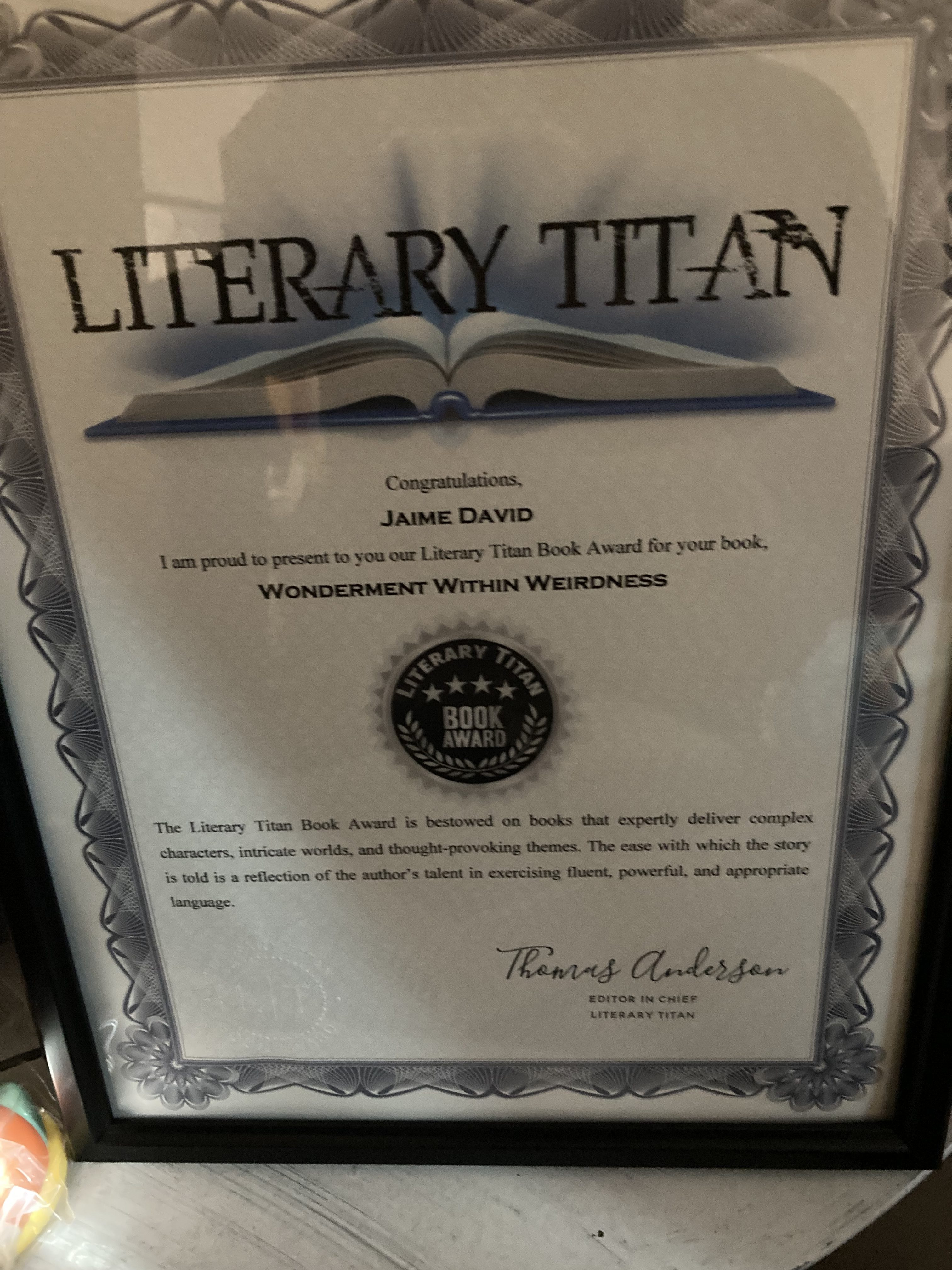
How My Debut Book “Wonderment Within Weirdness” Won a 4-Star Literary Titan Award
There are moments in life that do not fully register at first. Moments where you stare at a screen, reread the same sentence multiple times, and wonder if what you are seeing is actually real. For me, one of those moments came when I found out that my debut book, Wonderment Within Weirdness, had received a 4-star silver award from the Literary Titan.
Now, before anyone misunderstands what I am saying, no, the Literary Titan award is not the Pulitzer Prize. It is not one of those century-old literary institutions that immediately dominate headlines or get discussed endlessly in academic circles. I understand that. I am aware of the hierarchy that exists within the literary world. There are massive awards with generations of prestige behind them, and then there are smaller, newer awards trying to carve out their own identity in the publishing landscape. Literary Titan falls more into that latter category. But here is the thing people often overlook: recognition is still recognition. An award does not have to be the most famous literary honor on Earth in order to matter.
And for a debut author, especially an independent one, receiving any kind of legitimate literary recognition can mean far more than outsiders realize.
Because here is the reality that many people do not talk about enough: writing a book is hard. Finishing a book is even harder. Publishing one is another mountain entirely. Then comes the most brutal stage of all, getting anyone to notice it in a world overflowing with content. Every day, countless books are released onto the internet. Thousands upon thousands of stories, poetry collections, essays, memoirs, philosophical works, experimental projects, and novels appear online, all fighting for visibility. Most disappear almost instantly into the digital void. Some never receive reviews. Some never find an audience. Some barely get read outside of friends and family circles. That is simply the brutal reality of modern publishing.
Which is why the Literary Titan award mattered to me.
Not because it suddenly transformed me into a globally recognized literary icon overnight. Not because I now expect to be discussed alongside literary giants. But because it represented something important: external validation. It meant that someone outside of my immediate circle looked at my work and believed it deserved recognition. That matters. Especially for a first book.
Debut books exist in a strange space. Established authors often have advantages that new writers simply do not possess. They may already have audiences built over years. They may have publishers backing them with marketing budgets. They may have editors, agents, industry connections, media exposure, or simply the power of name recognition. Readers approach established writers with preconceived expectations. There is already a built-in level of trust there.
A debut author has none of that.
When someone picks up a first book from a completely unknown writer, there is no guarantee attached to it. There is no proven track record. No legacy. No assurance that the work will even be coherent, let alone compelling. A debut writer has to earn every ounce of credibility from scratch. That is part of what makes literary recognition for a first book feel especially significant.
And in my case, Wonderment Within Weirdness was not some hyper-calculated, market-tested project designed specifically to appeal to mainstream publishing trends. If anything, the book reflects many of the themes and ideas that define my broader creative identity. Weirdness. Wonder. Introspection. Emotion. Existential thought. Philosophical wandering. Experimental energy. It is deeply tied to my voice as a writer and thinker. In many ways, it represents me authentically rather than trying to imitate what the market supposedly wants.
That can be risky.
The internet often pushes creators toward conformity. Algorithms reward familiarity. Publishing industries sometimes reward predictability. There is pressure everywhere to fit neatly into categories, genres, aesthetics, and market expectations. But creative work that embraces weirdness and individuality can sometimes cut through precisely because it feels different. It feels human. It feels personal. And I think that is part of why the recognition meant something to me.
Because it suggested that originality still has value.
I also think there is something psychologically important about literary awards for independent authors that many people underestimate. When you are creating largely on your own, doubt becomes constant. Every writer experiences it to some degree, but independent creators especially know what it feels like to question themselves endlessly. Is the work good enough? Is anyone reading? Does any of this matter? Am I wasting my time? These thoughts can become relentless.
So when an outside organization says, “We see merit here,” it can genuinely impact a creator’s confidence. Not in an egotistical way, but in a stabilizing way. It becomes proof that the work connected with someone beyond yourself. That is valuable fuel for continuing forward creatively.
And honestly, the award also made me reflect on how strange and unpredictable artistic journeys can be.
There are writers who spend decades producing work before receiving recognition. There are others who explode into visibility instantly. Some receive praise early and disappear later. Others struggle for years before eventually finding audiences. There is no universal roadmap for creativity. No guaranteed formula. No clear sequence that determines who succeeds and who does not. The literary world is chaotic. Sometimes brilliant books are ignored. Sometimes mediocre books become massive phenomena. Sometimes deeply personal projects unexpectedly resonate with readers and reviewers alike.
That unpredictability is both terrifying and beautiful.
I think part of why this award mattered so much to me is because it symbolized momentum. Not finality. Not completion. Momentum. It felt like confirmation that I am not simply shouting into the void entirely unnoticed. Even smaller recognitions can create psychological momentum for artists. They can reinforce the idea that continuing to create is worthwhile.
And perhaps most importantly, it reminded me that the definition of success is more nuanced than people often make it out to be.
Modern internet culture tends to frame success in extremes. Either you are world famous, or you are irrelevant. Either you win the biggest awards imaginable, or your accomplishments supposedly do not count. But reality is far more layered than that. There are countless levels of artistic success between obscurity and superstardom. A smaller literary award can still represent a meaningful achievement. Especially for a first-time author.
I also think there is something fascinating about newer literary awards in general. Every prestigious institution that exists today had to begin somewhere. The Pulitzer Prize was once new. The Booker Prize was once unknown. Every literary tradition starts small before history determines whether it grows into something larger. Now, I am not claiming Literary Titan will become the next Pulitzer. Nobody can predict that. But I do think people sometimes dismiss newer awards too quickly simply because they lack decades of legacy.
The reality is that literary culture is constantly evolving. Independent publishing itself has changed dramatically over the last twenty years. The barriers between traditional and independent authorship have blurred. Online platforms have allowed writers to build audiences without relying entirely on gatekeepers. Smaller awards and independent review organizations have emerged partly because the literary ecosystem itself has expanded beyond older institutional models.
And frankly, independent authors often need these spaces.
Because traditional literary systems can be incredibly difficult to penetrate. Many talented writers never receive attention from major publishers or prestigious literary organizations despite producing meaningful work. Smaller awards can provide visibility where mainstream institutions may overlook emerging voices. That does not make the recognition fake or meaningless. It simply means it exists within a different layer of the literary landscape.
Another thing that struck me after receiving the award was how differently creators experience recognition compared to outsiders observing from a distance. Someone scrolling online might see “4-star Literary Titan award” and move on after two seconds. But for the creator behind the work, that recognition often represents years of thought, effort, doubt, rewriting, editing, emotional investment, and persistence condensed into a single moment.
People see the outcome. They rarely see the process behind it.
They do not see the nights spent questioning whether the project will ever come together properly. They do not see the anxiety involved in publishing something personal into public view. They do not see the fear of rejection. They do not see the vulnerability required to create sincerely in a culture that often rewards irony and detachment more than authenticity.
And perhaps that is another reason why this award felt meaningful to me specifically. It validated authenticity.
I have always been drawn toward ideas that sit outside rigid convention. Whether through my writing, my philosophical ideas surrounding anarcho-compassionism, my blog posts, or my broader creative identity, I tend to gravitate toward introspection, emotional honesty, nuance, existential exploration, and unconventional thinking. Wonderment Within Weirdness reflects that mindset heavily. It is not trying to be sterile or artificially polished into generic marketability. It embraces weirdness directly, even in its very title.
And honestly, I think the title itself matters.
“Wonderment Within Weirdness” captures something fundamental about how I view creativity and existence. There is wonder inside the strange. Beauty inside imperfection. Meaning hidden within chaos. Modern society often pressures people to suppress weirdness, flatten individuality, and conform to expectations. But creativity frequently thrives in the exact opposite direction. Some of the most memorable art emerges precisely because it dares to be unusual.
That does not mean every unconventional work automatically becomes brilliant. But authenticity has power. Readers can often sense when something comes from a genuine place rather than existing solely as a calculated product.
I also think there is something inspiring about the fact that a debut independent book can receive recognition at all in today’s environment. We live in an era where gatekeeping still exists, but it is no longer absolute. Independent creators have more opportunities than ever before to publish work, connect with audiences, and gain visibility. The internet has created overwhelming saturation, yes, but it has also democratized creativity in many ways.
That democratization comes with contradictions. Visibility is harder because everyone is competing simultaneously. Yet opportunities also exist that previous generations of writers could barely imagine. A person can build a blog, publish books independently, create podcasts, interact directly with readers, and cultivate a creative ecosystem almost entirely outside traditional institutions.
That is part of the journey I have been navigating myself through The Musings of Jaime David and my broader online presence.
And perhaps that is another reason this award felt important. It represented not just one isolated accomplishment, but evidence that the broader creative path I have been pursuing might actually be leading somewhere meaningful.
What made the experience even more surreal was seeing the recognition expand beyond the award announcement itself. Literary Titan did not simply hand out the award quietly and move on. There was an actual press release published about my book receiving the award, which made the accomplishment feel far more tangible and publicly documented. FinancialContent press release about the award
That mattered to me because there is something psychologically different about seeing your work discussed publicly in a professional context. It transforms the experience from feeling purely internal into something externally recognized and archived. Suddenly, the book was not just existing within my own creative ecosystem. It was being discussed beyond it.
Then there was the author interview that Literary Titan conducted with me, which honestly made the entire experience feel even more real. Literary Titan author interview with Jaime David The title alone, “It Started With a YouTube Comment,” captures something fascinating about modern creativity and internet culture. So many creative journeys now begin in strange, seemingly insignificant digital moments. A comment. A post. A random idea. A passing conversation online. Something tiny eventually snowballs into something much larger.
That interview gave me the opportunity to reflect not just on the book itself, but on the broader creative process behind it. And honestly, interviews can sometimes feel even more vulnerable than the work itself because they require the creator to directly articulate thoughts, motivations, insecurities, and inspirations in their own voice. There is nowhere to hide behind fictional structure or poetic abstraction at that point. It becomes direct human reflection.
And then there was the review itself from Literary Titan. Literary Titan review of Wonderment Within Weirdness Reviews are fascinating because they represent interpretation. Once creative work enters the world, readers begin forming their own relationships with it. They notice things the creator may not have fully realized themselves. They interpret themes differently. They emotionally connect to unexpected aspects of the work. That is part of what makes literature so interesting in the first place. Books stop belonging solely to the author once they are released publicly. They become shared experiences between creator and reader.
Perhaps one of the strangest and coolest parts of all this, though, was the fact that there was even a podcast episode discussing my book. Literary Titan podcast episode about Wonderment Within Weirdness There is something surreal about hearing people talk about your creative work in audio form, almost like listening to your ideas echo back at you from outside yourself. It creates this bizarre sensation where the project suddenly feels alive beyond your own head.
And honestly, when you step back and look at the full picture, it becomes clear that the experience extended beyond simply “winning an award.” There was the award itself, the review, the interview, the press release coverage, and even a podcast discussion. For a debut independent book, that is genuinely meaningful visibility.
Will the Literary Titan award alone suddenly make me famous? Of course not. I am realistic about that. But creative careers are often built incrementally. Recognition accumulates piece by piece over time. One review leads to another. One award builds credibility. One reader recommends a book to someone else. Momentum compounds gradually rather than explosively for most writers.
People often romanticize overnight success while ignoring how many creators build their audiences slowly over years. Persistence matters enormously in creative fields. So does consistency. So does continuing to create even when visibility feels limited.
And honestly, I think the award reinforced something deeper psychologically for me: the importance of continuing despite uncertainty.
Because uncertainty never fully disappears for artists. Even successful writers experience doubt constantly. There is no magical point where creators suddenly become immune to insecurity. Every project involves risk. Every piece of writing involves vulnerability. Every publication becomes an act of exposure in some way.
But recognition can help counterbalance that uncertainty enough to keep moving forward.
It can remind creators that their work has impact beyond their own internal world. That someone connected with it. That the effort mattered to another human being somewhere out there.
And for me, as a debut author, that feeling carries enormous significance.
Fediverse Reactions
-