Paste my profile into the search field of your favorite open social app or platform.
Your Profile
Or, if you know your own profile, we can start things that way! Why do I need to enter my profile?
This site is part of the ⁂ open social web, a network of interconnected social platforms (like Mastodon, Pixelfed, Friendica, and others). Unlike centralized social media, your account lives on a platform of your choice, and you can interact with people across different platforms.
By entering your profile, we can send you to your account where you can complete this action.
There’s a lot of media out there today that looks incredible on the surface. Big budgets. Huge stakes. Flashy action. Multiverse-level chaos. But for all the spectacle, something often feels… off. Empty, even. Like it’s all noise without meaning.
That’s where Wonderment Within Weirdness stands apart.
And no, this isn’t me gassing myself up. This is me recognizing something I didn’t fully see at first: beneath all the absurdity, the chaos, the wild set pieces, and the multiverse insanity, there is something grounding it all.
Heart.
Real, genuine heart.
At its core, this story isn’t just about saving the multiverse. It’s about people. Flawed people. Messy people. People who don’t always get along. People who make mistakes, who argue, who split apart and come back together. People who aren’t purely good or purely bad, but exist somewhere in between.
And that matters.
Because a lot of media today simplifies things. Clear heroes. Clear villains. Clean arcs. Easy resolutions. But life isn’t like that. Relationships aren’t like that. Growth isn’t like that. And Wonderment Within Weirdness doesn’t pretend otherwise.
Even in the middle of insane battles—whether it’s chaos unfolding across space and time, or conflicts happening in grounded, everyday places—what really drives the story is how the characters react to it all. Their fears. Their choices. Their bonds. Their disagreements.
The story allows characters to feel human, even in the most inhuman situations.
And that’s where the heart comes from.
It’s in the way characters don’t always stay united. In the way trust shifts. In the way alliances form and break. In the way people come and go. Nothing is static, and that fluidity makes everything feel alive.
It’s also in the themes that sit underneath the surface.
There’s an underlying resistance to the idea that perfection is necessary. A pushback against the notion that the world—or the multiverse—needs to be “cleansed” or made flawless. Instead, the story leans into something deeper: that imperfection is part of existence, and that flawed people still deserve to live, to try, to grow.
That message carries weight.
Because even when things get absurd—even when the story leans into humor, chaos, and over-the-top moments—it never loses sight of that core idea. The stakes aren’t just about winning or losing. They’re about what it means to fight for others. To stand up even when things are overwhelming. To keep going when giving up would be easier.
That’s heart.
And it’s something that can’t be faked.
You can have the biggest battles, the wildest concepts, the most creative worlds—but without heart, it all fades. It becomes forgettable. Interchangeable. Just another story.
Wonderment Within Weirdness doesn’t fall into that trap.
Because underneath everything—the weirdness, the wonder, the chaos—it cares.
Across decades of storytelling, One Piece has remained one of the most powerful and enduring narratives in anime and manga, not only because of its sprawling world, epic battles, and imaginative characters, but because of its profound exploration of friendship and the human heart. Beneath the layers of humor, adventure, and chaos, there is a deep emotional core that binds the series together. This emotional core is built on a single, unshakable truth: friendship is the force that drives the entire story, and it is a force that transcends labels, languages, boundaries, and backgrounds. At the center of this force stands Monkey D. Luffy, a young pirate whose simple dreams mask an extraordinary ability to break down walls—not only the physical ones he punches through, but the emotional and metaphorical barriers that people build around their hearts. Through his intentional simplicity, his unwavering loyalty, and his fearless compassion, Luffy becomes the kind of friend anyone would aspire to have, and more importantly, the kind of friend we aspire to be.
One of the defining elements of One Piece is that Oda doesn’t write friendship as a convenient narrative mechanic or a shallow theme meant to be repeated. Instead, friendship in One Piece is something that is lived, breathed, and fought for. It is something that takes different shapes depending on who is experiencing it, but it ultimately connects everyone through a shared sense of purpose, loyalty, and emotional truth. The world of One Piece is filled with trauma, oppression, discrimination, and suffering, but these dark forces never fully extinguish the light of connection that the Straw Hat crew brings with them. That light stands opposed to the labeling, categorizing, and divisive tendencies of the world. In the Grand Line, people are labeled by their race, their value, their allegiance, or the price on their head. But with Luffy, those labels mean nothing. He doesn’t see fishmen, giants, cyborgs, nobodies, monsters, or criminals. He sees people. He sees potential friends.
This is what makes Luffy such an unusual and endearing protagonist. His intelligence is often played off as comedic, yet he possesses the deepest emotional wisdom in the story: he understands that labels serve only to isolate and diminish; friendship serves to unite and uplift. From his earliest moments as a young pirate, we see him defy the conventions of what a pirate, a captain, or even a hero should be. He doesn’t recruit based on strength or skill. He never asks whether someone is useful. He simply asks whether someone is hurting, whether someone dreams, and whether someone needs a hand. This is most evident in how the Straw Hat crew comes together. Every member of his crew was someone living behind emotional walls—walls built to hide pain, fear, rejection, or shame. And every time, Luffy showed up, punched a hole straight through those walls, and reached inside with a hand full of warmth and sincerity.
One of the most iconic examples of this emotional demolition comes from Nami’s devastating moment in Arlong Park. Nami’s life had been defined by manipulation and exploitation. She bore her pain silently, believing herself unworthy of true friendship because her childhood trauma taught her that trust only leads to loss. When she finally collapses under the weight of her suffering, begging for help despite her deep shame, Luffy does not lecture her, question her motives, or analyze her past. He simply places his treasured straw hat—his dream itself—on her head and tells her he will handle it. When Luffy walks toward Arlong Park, tearing through physical barriers with every punch, he is also tearing apart the psychological prison Nami lived in. He is destroying the walls built around her heart so she can breathe again. And when he defeats Arlong, it symbolizes more than a victory in battle. It symbolizes the liberation of a friend who had been locked in suffering for years.
Another powerful moment comes from Robin’s story at Enies Lobby. Robin’s entire existence had been defined by the world’s labels: demon, monster, criminal, weapon. She accepted these titles because she believed that was all she was allowed to be. She lived in isolation and fear, believing she had no right to live, no right to dream, and no right to belong. Luffy’s fight to save her isn’t just about rescuing a crew member. It’s about demolishing the cruel labels the world forced upon her. When she finally cries out, “I want to live!”, she is breaking through her own emotional barriers, but she only has the courage to do so because Luffy and the others smashed the walls from the outside. Luffy literally orders his crew to burn down the flag symbolizing Robin’s oppression, proving that he doesn’t care about the world’s judgments, labels, or systems. He cares about the person behind them.
The theme of friendship running deeper than labels extends beyond the core crew. Luffy’s entire journey is marked by encounters with people who believed themselves unworthy of companionship or who were rejected by the world for reasons beyond their control. Sabo believed he had lost everything, only to rediscover the power of brotherhood. Law walked a path of revenge and trauma until Luffy gave him room to breathe and dream again. Jinbe, labeled as an enemy and a criminal by the world, found acceptance and brotherhood through Luffy’s straightforward trust. Even characters like Bon Clay, whose identity is fluid and who exists outside conventional definitions, are embraced by Luffy without question or hesitation. Luffy does not care about gender, appearance, species, origin, or stigma. He only cares about the heart.
This is what makes Luffy such a transformative force in the story. His ability to break down emotional and metaphorical walls is rooted in his refusal to treat people as anything other than equals. While many shonen protagonists fight for justice or peace, Luffy fights for freedom—the freedom to live, to dream, to choose, to be seen. And he does this not through sophisticated arguments or philosophical monologues, but through action, presence, and sincerity. He enters people’s lives like a storm of authenticity, shattering the false narratives they have internalized about themselves. He makes them believe they are worthy of love, loyalty, and a place in the world.
Friendship in One Piece is not passive. It is active, fierce, demanding, and transformative. It requires sacrifice, vulnerability, and courage. It pulls characters out of despair and guides them toward redemption. Through Luffy’s eyes, friendship is not an obligation or a token of convenience; it is a sacred bond. His repeated acts of risking his life for his friends are not born from a hero complex or a need for validation, but from an instinctive understanding that connection is the strongest force in the world. He will walk into hell if it means someone he cares about will find a way back to the light.
One of the most underrated aspects of One Piece is how it shows friendship as something that evolves. Luffy does not demand emotional transformation from his friends; he creates a space where transformation becomes possible. He doesn’t pressure Zoro to reveal his inner thoughts or force Sanji to talk about his past. Instead, he allows them to grow at their own pace, while providing unwavering support in the background. This kind of emotional patience is rare in protagonists. It illustrates that true friendship does not control or dictate. It nurtures and uplifts.
Luffy’s friendships also transcend the binary distinctions that dominate society. He doesn’t seek out friends because they fit neatly into categories. In fact, the mismatched nature of the Straw Hat crew—pirate hunter, thief, liar, cyborg, skeleton musician, reindeer doctor, archaeologist labeled a demon—shows that labels are meaningless in the face of genuine connection. The crew is a testament to what happens when people choose each other not based on status or similarity, but based on authenticity and mutual respect. This theme becomes even more powerful when considering the various races and species across the world: fishmen who are discriminated against, giants treated as weapons, minks forced into hiding. Luffy’s refusal to see anyone as less-than allows the story to illustrate a profound truth: labels are often constructed to divide, but friendship exists to unify.
In many ways, Luffy becomes a mirror for others. Through him, characters are forced to confront not only their potential but their fears, insecurities, and hidden wounds. His optimism challenges cynicism. His trust challenges doubt. His emotional honesty challenges denial. And his relentless pursuit of freedom challenges every system of oppression he encounters. Luffy’s journey is more than a pirate adventure. It is a revolution of the heart.
Another layer to the theme of deep friendship in One Piece is the way it embraces emotional vulnerability. Luffy is not a traditional stoic hero. He laughs loudly, cries openly, gets scared, gets angry, and expresses love without shame. His emotions are not weaknesses—they are strengths that inspire the people around him. His willingness to feel deeply encourages his friends to do the same. This emotional openness dismantles the toxic narratives in many heroic stories that equate strength with emotional suppression. Instead, One Piece teaches that true strength comes from emotional courage, the bravery to care deeply even when the world punishes you for it.
Throughout the series, emotional walls represent fear, shame, and conditioning. When Luffy breaks these walls—sometimes with his fists, sometimes with his heart—he is liberating people from the prisons built around them. Every island, every arc, every new ally serves as a testament to the idea that emotional freedom is just as vital as physical freedom. Luffy fights dragons, tyrants, government organizations, and world-shaking enemies, yet his greatest victories are the ones where he gives someone back their sense of self-worth and belonging.
And this is why Luffy is a friend to aspire to. He represents the best qualities of companionship: loyalty without condition, acceptance without judgment, courage without hesitation, and love without limitations. He embodies the ideal of being someone who believes in others so strongly that they begin to believe in themselves. He never abandons his friends, never belittles their dreams, never questions their value. Instead, he amplifies their strengths and shields their vulnerabilities. Being Luffy’s friend means being seen, understood, and valued for who you are, not who the world says you must be.
It is this combination of emotional bravery, unshakable loyalty, and boundless compassion that makes One Piece resonate so deeply with audiences across the world. It teaches that friendship is not a label you give someone. It is a bond forged through shared struggles, dreams, and moments of raw humanity. It teaches that labels have the power to divide, but friendship has the power to rebuild what is broken. And it teaches that sometimes, the greatest heroes are not the strongest or smartest, but the ones who show up, who care deeply, and who refuse to let anyone face their burdens alone.
In the end, One Piece is not merely a story about pirates searching for treasure. It is a story about people searching for acceptance, meaning, and connection in a world that often tries to strip those things away. It is a story where friendship becomes a form of rebellion, a force stronger than oppression, and a beacon that guides people through the darkest seas. Luffy’s journey reminds us that while the world may attempt to define us through labels, the bonds we create through genuine friendship have the power to redefine everything.
And that may be the deepest treasure One Piece has to offer: a reminder that walls—no matter how powerful or deeply rooted—can always be broken, especially when someone reaches for you with a heart that refuses to let go.
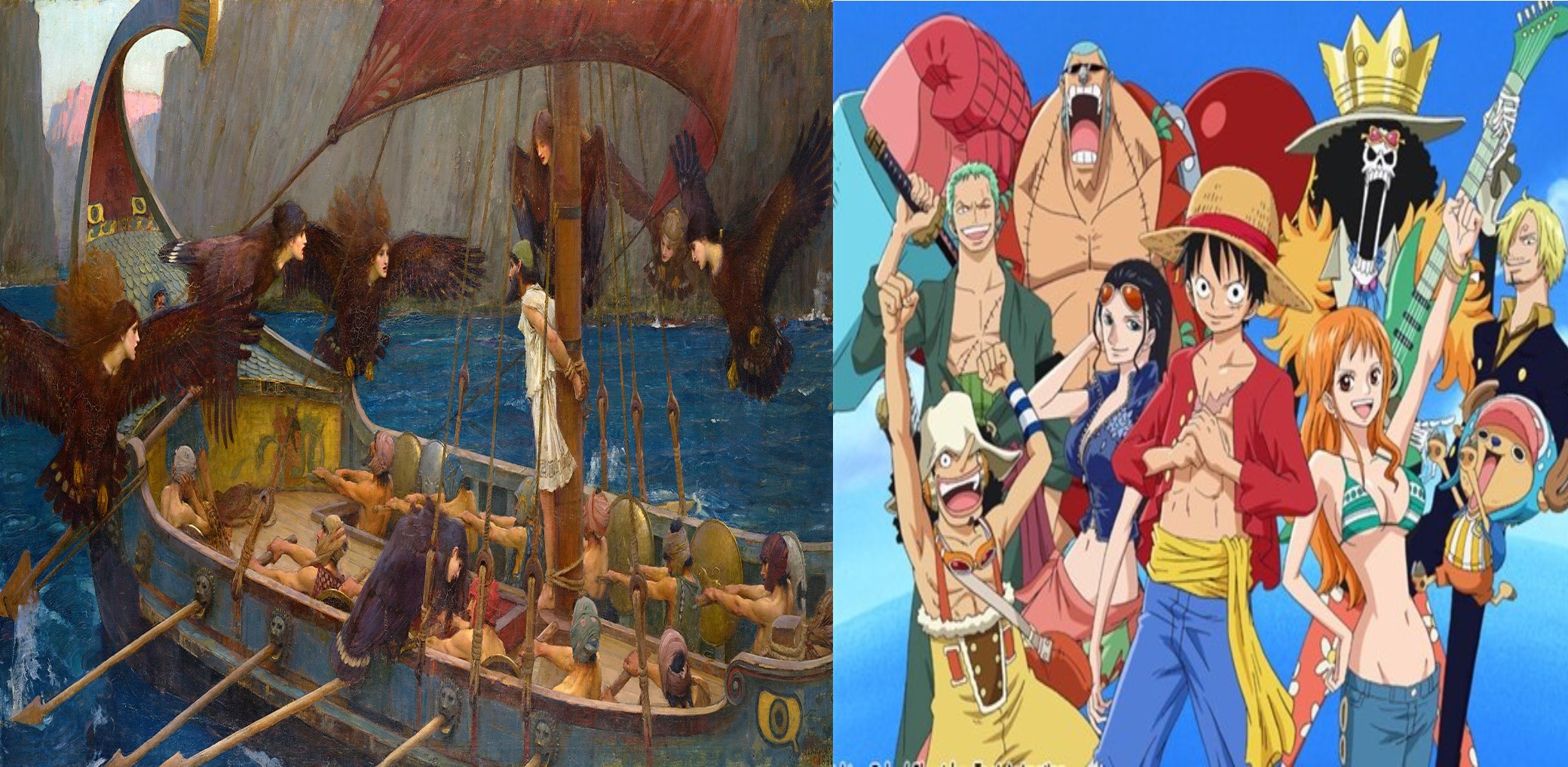
So, I don’t know if I’m the only one who thinks this, but One Piece is a modern-day Odyssey. Nani (for those of you who don’t know, “nani” is the Japanese word for “what”)???? Yes, you heard it right! The anime/manga series “One Piece” is a modern-day version of “The Odyssey!” You know; that epic from ancient Greece that you learn about in high school and whatnot (at least, I assume people learn about it in high school. I don’t know what the curriculum is like in other high schools. I went to a private school, and I know that I learned about “The Odyssey” in my school)? The one that’s written by a guy named Homer who’s last name is not Simpson (and who, as far as I’m aware, doesn’t even have a last name, because it was written during a period of time when last names weren’t a thing, or at the very least, weren’t very common)? Yes; that “Odyssey!” How so? Well, One Piece has a lot of similar themes, and a similar story structure, to The Odyssey! Let me show you what I mean! Now, before I begin, I’m going to point out that there are A LOT of themes in both The Odyssey and One Piece that I could make numerous blog posts about and whatnot, but I’ll save those for another time! For now, I just want to highlight some major themes and story structures that are similar in both works. Oh, and spoiler alert for those who haven’t read the Odyssey nor read/watched One Piece! With that out of the way, let’s begin!
Synopses
As with all comparative essays, one must start with synopses of the works that are being compared. I will do the same for this blog post!
The Odyssey:
“The Odyssey” focuses on Odysseus’ 10-year journey home to Ithaca after the Trojan War. Along the way, he sails the sea, explores different islands, faces many powerful enemies (such as gods and monsters), and meets many different people!
One Piece:
“One Piece” is about a boy named Luffy who sets off to sea at 17 to find the elusive treasure named “The One Piece.” Along the way, he gets together a crew, explores different islands, faces many powerful enemies (some with superhuman abilities, thanks to these fruits called “Devil Fruits,” and some without), and makes many new friends!
Similarities
Now that I’ve summarized the premises of “One Piece” and “The Odyssey,” I will now present to you the various similarities in both works!
Epic-style storytelling:
Right off the bat, one should note that both works have an epic-style storytelling. What is an epic? According to Merriam-Webster dictionary, an epic is defined as “a long narrative poem in elevated style recounting the deeds of a legendary or historical hero” (https://www.merriam-webster.com/dictionary/epic). Now, obviously “The Odyssey” fits this definition exactly. It was a long poem, written during ancient Greece, that narrates the journey of Odysseus as he makes his way home to Greece. Along the way, he accomplishes many feats that seem “legendary” and “heroic.” Odysseus embarks on the hero’s journey, and we see him grow and evolve as the narrative goes on. “The Odyssey” definitely fits the definition of what constitutes an epic. Does “One Piece” fit the definition, as well? I would say yes.
How does “One Piece” fit the definition of what it means to be an epic? Of course, it isn’t a poem. It is an anime/manga series! However, it is focused mainly on the journey of a central character (Luffy) as he travels the world in search of the mysterious “One Piece” and become Pirate King! Throughout the series, Luffy and his crew are seen accomplishing many feats that other characters thought were impossible to achieve! We (the audience) see Luffy and his crew grow and develop throughout the course of the series! Sure, “One Piece” may not be the standard form of an epic tale, however, it is still an epic tale, in my opinion! Luffy embarks on the hero’s journey at the very start of the series, and from there, we witness Luffy’s quest to reach “The One Piece!” Similarly, in “The Odyssey,” we (the audience) witness Odysseus’s quest to get back home!
Importance of the sea:
The sea plays a pivotal role in both “The Odyssey” and “One Piece.” In both works, the sea is used as a mode of transport to get from one destination to another. The characters use sea-faring ships to traverse the sea and go from island to island.
The sea is also a means of escape for the characters in both works. Odysseus uses the sea to escape Calypso’s island, and the Straw Hats use the sea to escape many perilous situations, such as escaping from Enies Lobby after their battle with CP9. The sea also evokes a sense of uncertainty and danger in both “The Odyssey” and “One Piece.” In “The Odyssey,” once Odysseus sets out to see after escaping the island of Calypso, he doesn’t know what lies ahead of him. All he does know is that for him to reach Greece, he has to traverse straight through the uncertainty that lies ahead. In “One Piece,” the end goal of the Straw Hats from the very beginning of the series is to reach Raftel and find the One Piece. To get there, they have to travel along the Grand Line, which has it’s own perils and dangers that many pirates may not expect.
The sea is also used as a means to world-build and character-build. Many interesting characters are met on the sea, many unique places are discovered while traveling on the sea, and many pivotal moments for the characters in both works take place on the sea!
Significance of the number “10”:
The number “10” is prevalent throughout both works. In “The Odyssey,” the number “10” is used to denote how many years have passed since the end of the Trojan War. The Trojan War itself had lasted for 10 years, which parallels how long it’s been since Odysseus has not returned home.
In “One Piece,” the number “10” is the number of crew members Luffy wants to gather before the end of the series (so far, he has nine, which leads fans to speculate who is, or will be, the 10th member of the Straw Hats). The number “10” is also the number of members are on Blackbeard’s crew (excluding Blackbeard himself, and excluding Doc Q’s horse). The 10 crew members on Blackbeard’s crew are nicknamed “The Ten Titanic Captains,” for they are captains of smaller divisions of the Blackbeard crew. Blackbeard and his crew are foreshadowed to be the antitheses for Luffy and his crew, for the are the opposite in almost every single way in terms of personality, but similar in every single way in terms of their capabilities and roles on their respective crews. The number “10” is also the number of years it was between Luffy meeting Shanks for the first time and receiving the Straw Hat at 7 years old to Luffy setting out to sea and beginning his adventure at 17. The number “10” is also the number of years it was between Shanks lost his arm to save Luffy from drowning and getting eaten from the giant Sea King and Luffy defeating the Sea King with one punch, which was a pivotal moment for Luffy and his character. When Luffy was 7, he was weak. He had just eaten the Gum-Gum fruit and received his rubber abilities, so he was not used to his powers and weaknesses (such as losing the ability to swim for the rest of his life). Because Luffy was weak, he could not defend himself from the bandits that kidnapped him, he could not swim to safety, and he could not fight against the Sea King that tried to eat him. Thus, he relied on Shanks, his hero, to save Luffy during those critical moments in his life. At the end of all of that, when Shanks and his crew were about to leave Foosha Village, Luffy tells Shanks that he wants to be just like him when he grows up, and that he’ll gather his own crew and become a pirate just like him. As a symbol of their bond, Luffy’s dreams, and the promise that Luffy makes to Shanks, Shanks gives Luffy the straw hat he was wearing, and tells Luffy to give it back to him when they meet again! Ten-years was also how old Luffy’s brother Sabo had set out to sea and “died.” It was after Sabo’s “death” that Luffy and his brother Ace made a promise to always protect each other, that they’d set out to sea at 17, and that no matter what crew they were on, they’d always be brothers at heart!
As you all can see, the number “10” is a significant number in both works! There are probably even more examples I could list about the significance of the number “10,” but I won’t because I don’t want to sound like a bore. However, it is something interesting to think about!
Larger-than-life villains:
Both works are filled TO THE BRIM with larger-than-life villains, both literally and figuratively! In “The Odyssey,” Odysseus fights against gods, giants, monsters, and creatures. In “One Piece,” Luffy and crew face off against giants, creatures, really big enemies that aren’t considered giants, and characters that are very powerful. In both works, these enemies are represented as larger-than-life, either physically (i.e. size) or figuratively (i.e. power). Significant size differences can make someone seem small. Luffy’s and Odysseus’s sizes are closest to the sizes of a real human, and seeing them face off against gigantic enemies can create a feeling of tension, and it can be very cathartic to see them overcome the enemies that are larger than them.
Obstacles:
In both works, there are TONS of obstacles throughout the worlds! In “The Odyssey,” Odysseus face monsters, giants, gods, and creatures, prevails through storms, whirlpools, and wreckage, treks through different islands, and deals with the wrath of numerous gods in order to get back home.
In One Piece, Luffy and crew come across various obstacles while traveling the seas, from pirate crews attacking them to Marines ambushing them. They also need to brave through storms, fight past sea monsters, and find their way past rocks, cliffs, and mountains that get in their way.
Theme of freedom:
Both works have a running theme of freedom. Odysseus and Luffy both long freedom. For Odysseus, he longs to be free of the curse that the gods put on him so he can get back home. When he is trapped on numerous islands, he wants to be free from his prison so he can get back home. Once Odysseus is home, he defeats all of the suitors so he can be free to be with his wife in private and live the rest of his life in peace and tranquility.
In One Piece, Luffy and crew desire freedom in their own way. They all want to be free to roam the seas without any Marines or pirates attacking them, and they want to be able to freely accomplish the dreams and goals that they have. When Luffy and crew are trapped by enemies, they long to return to the sea, because for them, the sea represents freedom. It is at the sea that they are truly free. On the sea, they can sail away to anywhere. When Luffy sees other people getting hurt, he wants to do everything that he can so that they can be free of the pain and suffering that they are enduring.
Theme of rebellion:
There is a lot of rebellion in both works. In “The Odyssey,” Odysseus rebels against the will of the gods. The gods want him to die, but Odysseus defies what they want. When he returns to Ithaca, he finds that suitors want his wife. Odysseus defies what the suitors want by slaying all of them.
In One Piece, Luffy and crew rebel against antagonistic forces on numerous occasions. When they face Crocodile on Alabasta, they rebel against him and his entire organization in order to save the people living in the kingdom. When they face Doflamingo on Dressrosa, they rebel against him and his crew, and create an uprising of pirates, Marines, citizens, and enslaved denizens so that they can save the island from the evil tyrant. There are so many more examples that I can list, but I won’t. I only listed notable examples from the series.
Theme of loyalty:
In both works, loyalty is a major theme. Both Odysseus and Luffy care about their respective crews and families. Odysseus cares about his crew and his wife a lot. He does all he can to try to bring his crew home, and he does all he can to try to get back to Ithaca to see his wife.
In One Piece, Luffy cares a lot about his crew, his friends, his brothers, his grandpa, anyone he meets along his journey whom he finds really nice, and anyone who is in suffering or is in pain. He does all he can to help people in need, and will go at great lengths for people he cares about, regardless of how long he’s known them. He’s even willing to go so far as to sacrifice himself for his crew. Luffy’s crew is also very loyal to him and one another. Whenever they are faced with difficult situations, they are willing to put themselves on the front line in order to save each other.
Theme of resilience:
The main protagonists in both works are very resilient. Odysseus faces so many foes, obstacles, and hardships to get back home, and even when he’s home, he faces so many enemies to get to his wife. For many, witnessing one’s own crew perish right in front of their own eyes would cause them to break, but not Odysseus. Instead, he stands tall and braves through it all. He braves through every obstacle that the gods throw at him so he can make it back home, even if he winds up returning home alone. It is his resilience, willpower, and bravery that allows him to get back home.
In One Piece, Luffy and crew are very resilient. No matter how tough the enemies may be, they use all of their strength, skills, and wit in order to defeat them. Even if they are almost on the verge of defeat, they manage to pull through and come out victorious.
Differences
Some vs none:
In “The Odyssey,” Odysseus starts out with a crew. Towards the end, he loses his crew, as well as all of the people that helped him get back home. In “One Piece,” Luffy starts his journey by himself. Over the course of the series, he gathered a crew and made allies along the way. Luffy’s journey is the reverse of Odysseus’s in terms of how it starts out. Luffy starts out with no one and eventually ends up with a crew and allies, while Odysseus starts out with a crew and allies, but ends up coming back home without them.
Individualism vs collectivism:
In both works, there are many examples of Odysseus and Luffy holding their own, as well as many examples of them relying on others. When comparing the two characters, however, Odysseus tends to rely on his crew and others a lot, while Luffy relies on himself most of the time. There are some cases, however, where Odysseus is forced to rely on himself (i.e. when his crew members perish in front of his eyes). As for Luffy, there are cases where he needs to rely on his crew (i.e. when there is an enemy that is too strong for any of them to handle individually).
Brains vs brawn:
When it comes to Luffy and Odysseus, there is a stark contrast when it comes to how they deal with enemies. For Odysseus, he is strategic. He plans his every move, and relies on his brains and wit in order to overcome difficult situations. For Luffy, on the other hand, he relies on strength and emotion. He uses his brawn to fight his way through most of his problems. This mentality has gotten Luffy and his crew into trouble on more than one occasion.
Maturity vs immaturity:
To build upon the previous point, relying on brains can be seen as an example of maturity, while relying on strength can be seen as an example of immaturity. When challenges arise in life, one needs to be logical and strategic. Relying on pure emotion gets one nowhere, because it clouds one’s judgment and prevents them from seeing other perspectives, outcomes, and solutions. This is especially true in survival situations. In order to have the best chances of success and making it out alive, one needs to be logical and strategic, for one mistake or mishap could prove fatal.
During the Punk Hazard arc, there is one scene where Zoro scolds Luffy for being too reckless, and that he needs to take things more seriously, otherwise he’d put him and the rest of the crew in serious danger.
Conclusion
So, as you can see, there are a lot of interesting similarities and parallels between “The Odyssey” and “One Piece.” There is a lot more comparisons and contrasts I could probably make, but I think I’ve said enough for now. If you want, check out this blog post from another One Piece fan who had also found interesting similarities between “One Piece” and “The Odyssey.” Give it a read!
This post is going to be something different. I’ve had the idea in my mind for a while. I’d like to discuss some the themes and symbols in my friend Daniela Elana’s book “Volatile,” and share my thoughts. Hope you enjoy. Oh and spoiler alert, if you have not read the book “Volatile,” there will be plot spoilers in this post, so be forewarned! Without further ado, let’s begin.
Theme of Betrayal
Betrayal is a pertinent theme that appears throughout Volatile. Maricel first gets betrayed by the guy she meets on the bus who turned out to be a creep. Later on, she feels betrayed by celebrities that she idolized and looked up to when one of them assaults her and later insults her. Later on in the novel, Maricel gets betrayed by her deadbeat dad who comes into her life out of the blue. The two start to develop a connection, until it was later revealed to Maricel that her dad only wanted to connect for her money. She felt betrayed by that. Towards the climax of the novel, Marciel gets betrayed by her lover Claudius, who was revealed to have lied about everything regarding who he was, including his name. Maricel is forced to work together with a few of the enslaved denizens in the secret society of Lemuria, only to be betrayed yet again by one of the allies that she had previously worked with once all of them were out of the fray. Betrayal is a prevalent theme in Volatile, and the lessons that can be learned can be applied to the real world. Sometimes, you don’t know who you can trust, because people whom you could know really well could have the worst of intentions. The only person you can trust is yourself, but even then, not fully, which was the case when Maricel took possession of the crystal skull. She had lost control of herself and became someone she was not; something she was not. Similarly, strong emotions, whether they are positive or negative, can make us act in ways that we wouldn’t normally act. Same thing with substances. We have the potential to act in ways we wouldn’t normally act. If one is not careful, it is possible to lose one’s self. It is possible to act irrational and become someone you’re not. It is possible to do things you would normally not do. In short, you have to be skeptical of people, and try not to act in ways that can hurt yourself or others. Don’t be too skeptical, though. By acting too skeptical of things, it is possible to turn away the people who care about the most, causing them to feel betrayed. This was the case when Maricel pushed her friends and family away after they warned her about who Claudius really was. By the time she found out for herself who he really was, it was too late. So, to summarize, be skeptical, but not too skeptical, be cautious, but not too cautious, be open to listen to people’s concerns, even if you may not believe it 100 percent, try to act in ways that don’t hurt yourself or others, and lastly, try not to push people away, because you might wind up pushing away the people who care about you the most.
Theme of Change
Throughout the novel, Maricel evolves as a character. She starts out as a country gal that no one really knew. As time goes on, she becomes a famous actress who everybody knows. By the end of the novel, she loses all of that fame and becomes a nobody once again. Not only that, but her character also changes in the way she acts. At the start of the novel, she’s passive about a lot of things. By the end of the novel, she becomes a strong and independent character who doesn’t take crap from anyone else. In a way, she goes from being a follower to becoming a leader.
Similarly, her relationship with Claudius changes. In the beginning, he starts off as an elusive character with a mysterious backstory. As Maricel finds out more about Claudius, their relationship changes. It goes from joyful to annoying to abusive to a full-blown nightmare. In the end, she is able to escape him, but at the cost of losing everything and everyone she loved.
Individualism vs Conformity
Throughout the novel, the themes of individuality and conformity clash in dynamic and ironic ways. Maricel’s character is the embodiment of individuality. She constantly makes her own choices, which a lot of the time go against what others expect of her. When her friends and family warned her of Claudius, she decided to stay with him despite what they said to her. When she was brought to Lemuria, she was expected to act like a queen, but she didn’t. She did what she wanted to do. Eventually, she turned on the order itself and found a way to escape. She had help, but ultimately, she made it out alone. From the beginning of the novel all the way to the end, Maricel did things her way.
Claudius embodies both conformity and individuality. He was imprisoned by God, but eventually made his way out. Once he did, he and a group of other angels turned on God and formed their own society. In this sense, they were individualists because they did things their own way. They didn’t go along with what God and the other angels expected of them. That is how Claudius embodies individuality. On the flipside, he also embodies conformity. Sometime after forming a secret society, Claudius became a tyrant and ruled over the society with an iron fist. He oppressed the citizens of Lemuria and forced them to conform with his vision. If they didn’t, there’d be dire consequences for them.
Symbolism of Fire
Fire is a major symbol for “Volatile,” and the rest of the “Through the Fire” series. The relationship of Claudius and Maricel is described as “volatile.” In chemistry, volatility relates to vapor pressures and boiling points for liquids or solids. If the vapor pressure is high, volatility is high. If the boiling point, volatility is low. This is because gases are the most unstable form of matter. Usually, a substance’s volatility is recorded at room temperature. If a substance evaporates (for liquids) or sublimates (for solids) at room temperature, that means that for that specific substance, room temperature was a very high temperature for it. In layman’s terms, room temperature is considered “hot” for volatile substances that evaporate or sublimate at room temperature.
Fire itself burns at high temperatures. It is a very destructive force. It can end lives, burn homes, and destroy ecosystems. If fire is not contained and controlled, it can quickly go out of control and burn everything in its path.
Love is usually compared to fire or flames. This is because love, just like fire, can burn uncontrollably if it is not contained or controlled. Similarly, other emotions, especially anger, are like fire as well. If they are not controlled or contained, they can go out of control like a wildfire.
Fire, for the most part, is bad. It is bad if it goes out of control. However, there are some good qualities about fire. Firstly, fire can be a light source. It can light up the darkness that surrounds. A person with a strong, positive personality can have a similar effect, as well. If there is sadness and negativity in a person’s life, a positive person could sometimes brighten up that person’s life, even if it is in a small or brief way. Positive people can also find a way to bring joy into the lives of those they meet, whether it’s friends, family, lovers, or even strangers. Just by being who they are as people, they are able to make people’s lives better.
Fire can also provide warmth for people. In the frigid, cold months, or in environments with extreme cold, fire can help provide some warmth for people. Heat is able to radiate out of the flames and can warm a person’s external and internal body temperature. Similarly, someone who is a loving individual can give people feelings of warmth and comfort in the ways they speak and act. They can show uplifting emotional support when needed, and are caring and affectionate individuals.
Lastly, fire has a rejuvenating effect. Once it destroys an ecosystem, it has the potential to allow new ecosystems to thrive. It provides new organisms with homes and shelter, it allows plants and seedlings to grow and thrive, and it enriches the soil by providing it with nutrients! Similarly, when love fails, it makes way for something new. It allows people to find out who they truly are, and it allows people to better themselves as individuals, and it gives them a chance to find a way to tame the flame that they have within them. It allows one to grow, learn, and thrive! It allows one to enrich their lives with whatever it is they enjoy the most and it allows people to figure out what it is they want from love. It allows people to figure out what they want and how they want to be. The ending of love is not an ending; it’s a beginning. It’s the beginning of something new; something better. It’s the beginning of something that is better than anything that came before! That is what love is, and that is how love can make us grow, even when it ends! Sure, love may be volatile, but it’s volatility can bring about change that is needed for people to grow!
Closing Thoughts
There are many more themes and symbols in “Volatile” that I could discuss, but for now, I think I’ve written enough. I don’t want this post to get too long, after all! I just wanted to highlight some themes and symbols that I found interesting! I hope you all enjoyed! While you’re at it, feel free to check out my friend Daniela Elana’s blog. It has a lot of great work on there! Take care, everyone! I plan on making more literary discussions like this, not only of my friend’s other books, but also other works that I find interesting, as well, whether it’s movies, TV shows, video games, books from other authors, YouTube videos, music, art, poems, short stories, etc. Anyways, that’s all for now!