The Musings of Jaime David
@jaimedavid.blog@jaimedavid.blog

The writings of some random dude on the internet

1,206 posts
1 follower

Tag: writing journey

  • When Literary Titan Put My Book on Their Podcast

    When Literary Titan Put My Book on Their Podcast

    There are certain moments in an author’s journey that stand out forever.

    Publishing a book is already a surreal experience. For years, a story exists only in your imagination. It lives inside your head. Then, eventually, you take that idea and turn it into something physical. You write the words, edit the manuscript, format the pages, create the cover, and finally release it into the world.

    But once a book is released, something else happens.

    You have to let go.

    The story that was once completely yours now belongs to readers. It belongs to reviewers. It belongs to anyone who decides to pick it up and experience it for themselves.

    As an independent author, those moments can feel especially meaningful because every milestone represents something you built yourself.

    Recently, I experienced another one of those moments.

    My debut novel, Wonderment Within Weirdness, was featured on the Literary Titan podcast, and that podcast episode was recently uploaded to YouTube.

    Seeing that happen was incredibly exciting because Literary Titan was already an important milestone in my journey as an author.

    They were one of the first major literary organizations to recognize my work.

    They reviewed my book.

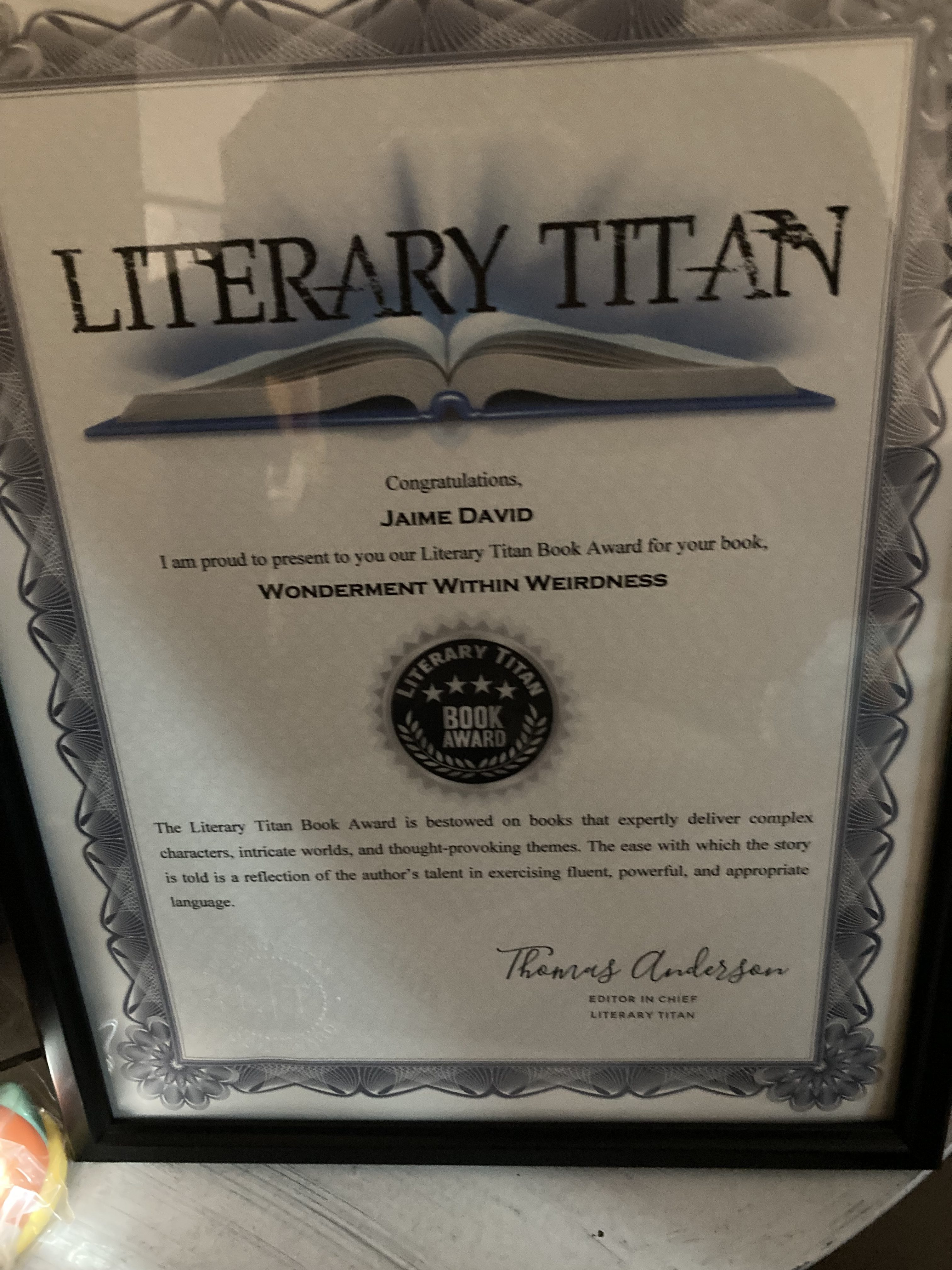
    They awarded it the Literary Titan Silver Book Award.

    And now, their discussion of my novel has reached an even wider audience through YouTube.

    For an indie author, moments like this are incredibly meaningful.

    When I first published Wonderment Within Weirdness, I knew I was creating something unusual.

    I knew it was not a typical science fiction story.

    I knew it was not going to fit neatly into one category.

    The book was a combination of science fiction, fantasy, satire, adventure, cosmic speculation, and my own personal ideas about life, existence, morality, and the universe.

    It was a story that I wanted to be big.

    I wanted it to feel like an epic journey.

    I wanted it to explore massive ideas while still being driven by personal emotions.

    And when Literary Titan reviewed it, they recognized many of those elements.

    Their podcast discussion focused on exactly what makes Wonderment Within Weirdness the type of story it is.

    The review begins with the basic premise.

    The story follows Matthew Tiberius, who dies and awakens in a strange and unexpected version of heaven.

    Instead of finding a simple, peaceful afterlife, Matthew discovers a bizarre world filled with politics, conflicts, strange systems, and mysteries.

    The heaven of Wonderment Within Weirdness is not just a place of eternal peace.

    It is a fully developed world.

    It has neighborhoods.

    It has organizations.

    It has conflicts.

    It has power struggles.

    It has systems that reflect many of the issues found in human society.

    That was one of the things Literary Titan highlighted.

    The idea of taking something traditionally viewed as perfect and exploring what happens when that environment becomes complicated.

    Because one of the biggest themes behind Wonderment Within Weirdness is questioning systems.

    Questioning authority.

    Questioning judgment.

    Questioning whether even supposedly perfect worlds can contain flaws.

    The podcast also highlighted the scale of the story.

    One thing I always wanted with this series was to create something massive.

    The first book is not just about one character discovering a strange afterlife.

    It expands into larger conflicts involving cosmic forces, different realities, and multiverse-level stakes.

    The goal was to create a feeling of exploration.

    A feeling that the universe was much bigger than the characters initially understood.

    That sense of wonder is something that has always attracted me to science fiction and fantasy.

    The idea that there are endless possibilities beyond what we know.

    The idea that existence itself can be questioned and explored.

    Literary Titan also discussed the tone of the novel.

    And this was something I found especially interesting.

    They described the writing style as bold, loud, messy, and intentionally excessive.

    And honestly, that description fits.

    Wonderment Within Weirdness was never meant to be a quiet story.

    It was never meant to be a small, simple adventure.

    The title itself says a lot.

    There is wonder.

    There is weirdness.

    There is imagination.

    There is chaos.

    The story embraces being unconventional.

    And that is something I have always valued as a creator.

    Not every story has to follow the same formula.

    Not every book has to feel like everything else already published.

    Sometimes the most interesting stories are the ones that take risks.

    Of course, a bold style is not going to appeal to every reader.

    Every creative choice has people who love it and people who do not connect with it.

    But as an author, I would rather create something that has a strong identity than something that feels like it was designed to be completely safe.

    Literary Titan also discussed the world-building.

    One of the biggest ideas behind the novel was imagining heaven as an actual functioning society.

    What would happen if the afterlife had infrastructure?

    What would happen if it had communities?

    What would happen if beings with immense power still had disagreements, conflicts, and different interpretations of existence?

    Those questions helped shape the world of Wonderment Within Weirdness.

    The afterlife in the story is not simply a destination.

    It is a place with history.

    A place with politics.

    A place with mysteries.

    A place where characters still have to confront questions about morality, identity, and purpose.

    Another major point from the review was the exploration of themes.

    At its core, Wonderment Within Weirdness is not just about action and adventure.

    It is also about bigger questions.

    What does it mean to be judged?

    Who gets to decide what is right and wrong?

    What happens when systems designed to create order become complicated?

    How do individuals find meaning in a universe that is larger than themselves?

    These are questions that have fascinated humanity for centuries.

    Science fiction and fantasy have always been powerful genres because they allow creators to explore those ideas through impossible scenarios.

    A spaceship.

    A magical world.

    An alternate reality.

    A strange version of heaven.

    The setting may be fictional, but the questions are often very real.

    That is what I have always loved about speculative fiction.

    It allows us to explore reality by imagining something beyond reality.

    The Literary Titan podcast also emphasized who might enjoy this type of story.

    They highlighted readers who enjoy unconventional indie science fiction and fantasy.

    Readers who enjoy mythological reinterpretations.

    Readers who enjoy stories that are not afraid to experiment.

    Readers who enjoy big ideas and unusual concepts.

    And that means a lot to me because that is exactly the audience I hoped would connect with the book.

    I never wanted Wonderment Within Weirdness to simply be another generic science fiction story.

    I wanted it to feel like something that could only come from my imagination.

    Something unique.

    Something strange.

    Something different.

    The fact that Literary Titan recognized those qualities is incredibly meaningful.

    Especially because independent authors often face a unique challenge.

    When you publish traditionally, there is usually an established system behind you.

    Editors.

    Publishers.

    Marketing teams.

    Distribution networks.

    When you publish independently, you are responsible for much more.

    You are the writer.

    You are the editor.

    You are the marketer.

    You are the person trying to convince the world that your story is worth discovering.

    So when an organization like Literary Titan recognizes your work, it feels like validation that all those hours mattered.

    Receiving the Literary Titan Silver Book Award was already an incredible honor.

    Having them discuss the book on their podcast was another amazing step.

    And now seeing that discussion uploaded to YouTube creates another opportunity.

    It means more people can discover the story.

    More people can learn what Wonderment Within Weirdness is about.

    More people can see what kind of journey I created.

    Looking back, it is still amazing to think about how far this book has traveled.

    It started as an idea.

    Then it became a manuscript.

    Then a published novel.

    Then an award-winning book.

    Then a podcast discussion.

    Then a YouTube video.

    Every step represents another person encountering something that began in my imagination.

    That is one of the most rewarding parts of being an author.

    Stories have a life beyond their creators.

    Once they are released, they can travel places the author never expected.

    They can reach people the author never meets.

    They can create conversations.

    They can inspire thoughts.

    They can become part of someone else’s experience.

    That is the dream every writer has.

    Not necessarily fame.

    Not necessarily becoming the biggest author in the world.

    But simply knowing that something you created reached another person.

    For me, Literary Titan’s recognition of Wonderment Within Weirdness represents exactly that.

    It represents someone else seeing the creativity, ambition, and imagination that went into the book.

    It represents a reminder that taking a chance on yourself can lead to unexpected opportunities.

    And it represents another chapter in my journey as Jaime David.

    When I first wrote Wonderment Within Weirdness, I did not know where it would go.

    I just knew I had a story I wanted to tell.

    Now, years later, that story has been recognized, reviewed, awarded, and discussed by others.

    And that is something I will always appreciate.

    Because every book has a journey.

    Every author has a journey.

    And this has been one of the most incredible parts of mine.

    Fediverse Reactions
  • The Time I Sent a YouTuber Fan Mail

    The Time I Sent a YouTuber Fan Mail

    There are certain moments in life that feel almost impossible to predict. They are the kinds of moments that, years earlier, would have sounded like unrealistic daydreams. You imagine them happening to someone else, not to you. Then, one day, life surprises you.

    Recently, I experienced one of those moments.

    For the first time in my life, I sent fan mail to a YouTuber.

    Not only that, but the package contained something far more personal than a letter or a piece of merchandise. Instead, I sent three books that I wrote and published under my pen name, Jaime David. A short time later, I watched that same YouTuber open the package live on his show, flip through my books, read part of the dedication from my debut novel, discover that I had thanked him in the acknowledgements, and genuinely express his appreciation.

    Even now, it still feels surreal.

    This is the story of how that happened, why I decided to do it, and why this became such a meaningful full-circle moment in my journey as a writer.

    For years, I have watched Dusty Smith on YouTube. Whether you know him from his political commentary, livestreams, or his long-running online presence, he has been one of those creators whose content I have consistently followed.

    Like many people, I do not agree with every single opinion he has or every single thing he says. But beyond that, there has always been something about his content that kept me coming back. I have appreciated his humor, his personality, his ability to build a community, and his willingness to create content that feels different from many other channels online.

    And that is an important part of this story.

    Because when I decided to send my books to Dusty, it was not something I wanted to do with just anyone.

    I did not simply think, “I wrote books, so I should send them to every YouTuber I watch.”

    That was never the point.

    There are thousands upon thousands of creators online. But I specifically chose Dusty because he was someone whose work genuinely mattered to me over the years.

    He was one of my favorite YouTubers.

    That mattered.

    I wanted the books to go to someone whose content I had actually watched, someone whose work had been part of my life for years, and someone who had influenced me creatively.

    There was also another important reason.

    My debut novel, Wonderment Within Weirdness, contains an acknowledgements section where I thank people and creators who helped influence me throughout my writing journey.

    Dusty Smith was included in those acknowledgements.

    That was something personal.

    Writing a book does not happen in a vacuum. Every author has influences. Every creative person has moments, stories, and people who inspire them.

    And in Dusty’s case, there was something especially interesting.

    Dusty was not only a YouTuber.

    He was also an author.

    Years ago, before his current online presence became what many people know him for today, Dusty wrote and published a book called Seven Deadly Sins under the pen name Michael Bishop. This was not the famous science fiction author Michael Bishop, but rather a pen name Dusty used for his own writing.

    While Dusty himself has since been critical of that book and has expressed that he does not necessarily consider it his best work, the fact remains that he was an author.

    He went through the process of writing a book.

    He went through the process of publishing a book.

    He put a creative work into the world.

    And that is something that always stood out to me.

    Because as someone who eventually became an author myself, I understand the significance of taking an idea that exists only in your head and turning it into something physical that other people can hold.

    Even if an author later looks back at an earlier work and thinks, “I could have done that differently,” there is still something meaningful about having created it in the first place.

    That part of Dusty’s story resonated with me.

    I remember when I was in college watching Dusty talk about his book and showcase it on one of his shows.

    At the time, I found it fascinating.

    Here was someone I followed online who had actually written a book.

    Someone who had taken the leap from simply consuming stories to creating one.

    That did not single-handedly inspire me to become an author. My journey came from many different places: science fiction, movies, television, anime, video games, other writers, personal experiences, and my own imagination.

    But that moment was one small piece of the larger puzzle.

    Sometimes inspiration does not come from one huge event.

    Sometimes it comes from small moments that stay with you.

    A creator talking about writing.

    A person sharing their creative process.

    A reminder that ordinary people can create something meaningful.

    So when I eventually became an author myself, it felt fitting that Dusty would be someone I thanked.

    And once I realized he had a P.O. Box for fan mail, I thought about it.

    If I had already written his name in the acknowledgements of my book, why not give him the chance to actually see it?

    That was really the reason I decided to send the books.

    I wanted him to know his work had an impact.

    I wanted him to have the opportunity to read the acknowledgement himself.

    I wanted him to have the chance to check out the books if he wanted.

    Whether he ever opened them, read them, or talked about them was completely his choice.

    There were no expectations.

    It was simply gratitude.

    A way of saying, “Thank you for being part of my journey.”

    I had never sent fan mail to a YouTuber before.

    This was a first.

    And honestly, that made the decision feel even more meaningful.

    Since my books are self-published through Lulu, the process of getting copies to Dusty was not as simple as grabbing books from a shelf.

    My books are produced through print-on-demand.

    For people unfamiliar with self-publishing, print-on-demand is a system where books are created after an order is placed rather than being mass-produced ahead of time.

    Traditional publishing often involves printing large quantities of books, storing them, and distributing them through retailers.

    With print-on-demand, the book is printed specifically for the person who orders it.

    The files are submitted, the book enters production, it is printed, bound, inspected, packaged, and shipped.

    The advantage is that independent authors do not need to spend thousands of dollars upfront printing massive quantities of books.

    There is no need for warehouses.

    There is no need for storing hundreds of copies.

    The book exists whenever someone wants a copy.

    The tradeoff is time.

    Because each copy has to be produced, there is a waiting period before shipping.

    So after placing the order, I waited.

    The books went through production.

    Then they were shipped.

    A few weeks passed.

    Then a few more weeks passed as the package traveled.

    Eventually, the books arrived.

    Seeing your own writing become a physical object never stops being special.

    These were not just books.

    They represented years of ideas, drafts, revisions, editing, formatting, publishing decisions, and perseverance.

    Inside the package were:

    Wonderment Within Weirdness.

    My Powerful Poems.

    Some Small Short Stories.

    I carefully packaged everything and sent them to Dusty’s P.O. Box.

    Then I waited.

    At that point, there was nothing else I could do.

    Maybe he would open it.

    Maybe he would not.

    Maybe he would mention it.

    Maybe he would simply keep the books privately.

    And honestly, any of those outcomes would have been okay.

    The important thing was that I had sent them.

    Last week, I saw that the package had been delivered.

    That alone made me happy.

    The books had reached him.

    Then, during the week of July 6, 2026, Dusty picked up the mail.

    I still had no idea what would happen.

    Creators receive countless packages from viewers. Some things are opened privately. Some things appear on streams. Some things are saved for later.

    There was no guarantee.

    Then came July 8, 2026.

    During Dusty’s livestream, he opened my package.

    And suddenly, there they were.

    My books.

    Watching that moment was difficult to describe.

    These books had once existed only as ideas in my head.

    Now they were sitting in front of someone whose own creative journey had helped inspire mine.

    He picked up My Powerful Poems first.

    He reacted to the size of the book and complimented the printing quality.

    Then he looked through Some Small Short Stories.

    Finally, he reached Wonderment Within Weirdness.

    That was the moment that truly hit me.

    He opened my debut novel.

    He read from the dedication.

    Then he reached the acknowledgements.

    And he saw that I had thanked him.

    Watching that happen was incredibly special.

    Not because a YouTuber noticed my books.

    But because the reason I sent them was recognized.

    He understood that this was someone reaching out with appreciation.

    He thanked me for thinking of him.

    He complimented the quality of the books.

    And he gave my work a moment of recognition.

    After the stream ended, I kept thinking about why this moment meant so much.

    Eventually, I realized it was because of the connection between the past and the present.

    Years ago, I was watching an author who happened to be a YouTuber.

    Now, that same person was watching my own journey as an author.

    A person who once put his own book into the world was now holding mine.

    That is the part that feels like the ultimate full-circle moment.

    It is a reminder that creativity connects people in ways we do not always expect.

    An author can inspire another author.

    A viewer can eventually become a creator.

    A person watching someone else’s dream can eventually create a dream of their own.

    And sometimes, years later, those paths cross.

    Sending these books was not about seeking attention.

    It was not about demanding recognition.

    It was about gratitude.

    It was about saying thank you to someone who, even indirectly, was part of my creative journey.

    And the fact that he opened them, read them, and appreciated them made the experience even more memorable.

    This was my first time ever sending fan mail to a YouTuber.

    And I think it was the perfect reason to do it.

    Because sometimes fan mail is not really about receiving something back.

    Sometimes it is about finally getting the chance to give something.

    A thank you.

    A memory.

    A reminder that someone’s work mattered.

    Years after watching Dusty talk about his own book, I got to experience the incredible feeling of seeing him hold one of mine.

    That is something I will never forget.

    You can find the segment of Dusty unboxing my books starting at 26:33.

    Fediverse Reactions
  • How My Debut Book “Wonderment Within Weirdness” Won a 4-Star Literary Titan Award

    How My Debut Book “Wonderment Within Weirdness” Won a 4-Star Literary Titan Award

    There are moments in life that do not fully register at first. Moments where you stare at a screen, reread the same sentence multiple times, and wonder if what you are seeing is actually real. For me, one of those moments came when I found out that my debut book, Wonderment Within Weirdness, had received a 4-star silver award from the Literary Titan.

    Now, before anyone misunderstands what I am saying, no, the Literary Titan award is not the Pulitzer Prize. It is not one of those century-old literary institutions that immediately dominate headlines or get discussed endlessly in academic circles. I understand that. I am aware of the hierarchy that exists within the literary world. There are massive awards with generations of prestige behind them, and then there are smaller, newer awards trying to carve out their own identity in the publishing landscape. Literary Titan falls more into that latter category. But here is the thing people often overlook: recognition is still recognition. An award does not have to be the most famous literary honor on Earth in order to matter.

    And for a debut author, especially an independent one, receiving any kind of legitimate literary recognition can mean far more than outsiders realize.

    Because here is the reality that many people do not talk about enough: writing a book is hard. Finishing a book is even harder. Publishing one is another mountain entirely. Then comes the most brutal stage of all, getting anyone to notice it in a world overflowing with content. Every day, countless books are released onto the internet. Thousands upon thousands of stories, poetry collections, essays, memoirs, philosophical works, experimental projects, and novels appear online, all fighting for visibility. Most disappear almost instantly into the digital void. Some never receive reviews. Some never find an audience. Some barely get read outside of friends and family circles. That is simply the brutal reality of modern publishing.

    Which is why the Literary Titan award mattered to me.

    Not because it suddenly transformed me into a globally recognized literary icon overnight. Not because I now expect to be discussed alongside literary giants. But because it represented something important: external validation. It meant that someone outside of my immediate circle looked at my work and believed it deserved recognition. That matters. Especially for a first book.

    Debut books exist in a strange space. Established authors often have advantages that new writers simply do not possess. They may already have audiences built over years. They may have publishers backing them with marketing budgets. They may have editors, agents, industry connections, media exposure, or simply the power of name recognition. Readers approach established writers with preconceived expectations. There is already a built-in level of trust there.

    A debut author has none of that.

    When someone picks up a first book from a completely unknown writer, there is no guarantee attached to it. There is no proven track record. No legacy. No assurance that the work will even be coherent, let alone compelling. A debut writer has to earn every ounce of credibility from scratch. That is part of what makes literary recognition for a first book feel especially significant.

    And in my case, Wonderment Within Weirdness was not some hyper-calculated, market-tested project designed specifically to appeal to mainstream publishing trends. If anything, the book reflects many of the themes and ideas that define my broader creative identity. Weirdness. Wonder. Introspection. Emotion. Existential thought. Philosophical wandering. Experimental energy. It is deeply tied to my voice as a writer and thinker. In many ways, it represents me authentically rather than trying to imitate what the market supposedly wants.

    That can be risky.

    The internet often pushes creators toward conformity. Algorithms reward familiarity. Publishing industries sometimes reward predictability. There is pressure everywhere to fit neatly into categories, genres, aesthetics, and market expectations. But creative work that embraces weirdness and individuality can sometimes cut through precisely because it feels different. It feels human. It feels personal. And I think that is part of why the recognition meant something to me.

    Because it suggested that originality still has value.

    I also think there is something psychologically important about literary awards for independent authors that many people underestimate. When you are creating largely on your own, doubt becomes constant. Every writer experiences it to some degree, but independent creators especially know what it feels like to question themselves endlessly. Is the work good enough? Is anyone reading? Does any of this matter? Am I wasting my time? These thoughts can become relentless.

    So when an outside organization says, “We see merit here,” it can genuinely impact a creator’s confidence. Not in an egotistical way, but in a stabilizing way. It becomes proof that the work connected with someone beyond yourself. That is valuable fuel for continuing forward creatively.

    And honestly, the award also made me reflect on how strange and unpredictable artistic journeys can be.

    There are writers who spend decades producing work before receiving recognition. There are others who explode into visibility instantly. Some receive praise early and disappear later. Others struggle for years before eventually finding audiences. There is no universal roadmap for creativity. No guaranteed formula. No clear sequence that determines who succeeds and who does not. The literary world is chaotic. Sometimes brilliant books are ignored. Sometimes mediocre books become massive phenomena. Sometimes deeply personal projects unexpectedly resonate with readers and reviewers alike.

    That unpredictability is both terrifying and beautiful.

    I think part of why this award mattered so much to me is because it symbolized momentum. Not finality. Not completion. Momentum. It felt like confirmation that I am not simply shouting into the void entirely unnoticed. Even smaller recognitions can create psychological momentum for artists. They can reinforce the idea that continuing to create is worthwhile.

    And perhaps most importantly, it reminded me that the definition of success is more nuanced than people often make it out to be.

    Modern internet culture tends to frame success in extremes. Either you are world famous, or you are irrelevant. Either you win the biggest awards imaginable, or your accomplishments supposedly do not count. But reality is far more layered than that. There are countless levels of artistic success between obscurity and superstardom. A smaller literary award can still represent a meaningful achievement. Especially for a first-time author.

    I also think there is something fascinating about newer literary awards in general. Every prestigious institution that exists today had to begin somewhere. The Pulitzer Prize was once new. The Booker Prize was once unknown. Every literary tradition starts small before history determines whether it grows into something larger. Now, I am not claiming Literary Titan will become the next Pulitzer. Nobody can predict that. But I do think people sometimes dismiss newer awards too quickly simply because they lack decades of legacy.

    The reality is that literary culture is constantly evolving. Independent publishing itself has changed dramatically over the last twenty years. The barriers between traditional and independent authorship have blurred. Online platforms have allowed writers to build audiences without relying entirely on gatekeepers. Smaller awards and independent review organizations have emerged partly because the literary ecosystem itself has expanded beyond older institutional models.

    And frankly, independent authors often need these spaces.

    Because traditional literary systems can be incredibly difficult to penetrate. Many talented writers never receive attention from major publishers or prestigious literary organizations despite producing meaningful work. Smaller awards can provide visibility where mainstream institutions may overlook emerging voices. That does not make the recognition fake or meaningless. It simply means it exists within a different layer of the literary landscape.

    Another thing that struck me after receiving the award was how differently creators experience recognition compared to outsiders observing from a distance. Someone scrolling online might see “4-star Literary Titan award” and move on after two seconds. But for the creator behind the work, that recognition often represents years of thought, effort, doubt, rewriting, editing, emotional investment, and persistence condensed into a single moment.

    People see the outcome. They rarely see the process behind it.

    They do not see the nights spent questioning whether the project will ever come together properly. They do not see the anxiety involved in publishing something personal into public view. They do not see the fear of rejection. They do not see the vulnerability required to create sincerely in a culture that often rewards irony and detachment more than authenticity.

    And perhaps that is another reason why this award felt meaningful to me specifically. It validated authenticity.

    I have always been drawn toward ideas that sit outside rigid convention. Whether through my writing, my philosophical ideas surrounding anarcho-compassionism, my blog posts, or my broader creative identity, I tend to gravitate toward introspection, emotional honesty, nuance, existential exploration, and unconventional thinking. Wonderment Within Weirdness reflects that mindset heavily. It is not trying to be sterile or artificially polished into generic marketability. It embraces weirdness directly, even in its very title.

    And honestly, I think the title itself matters.

    “Wonderment Within Weirdness” captures something fundamental about how I view creativity and existence. There is wonder inside the strange. Beauty inside imperfection. Meaning hidden within chaos. Modern society often pressures people to suppress weirdness, flatten individuality, and conform to expectations. But creativity frequently thrives in the exact opposite direction. Some of the most memorable art emerges precisely because it dares to be unusual.

    That does not mean every unconventional work automatically becomes brilliant. But authenticity has power. Readers can often sense when something comes from a genuine place rather than existing solely as a calculated product.

    I also think there is something inspiring about the fact that a debut independent book can receive recognition at all in today’s environment. We live in an era where gatekeeping still exists, but it is no longer absolute. Independent creators have more opportunities than ever before to publish work, connect with audiences, and gain visibility. The internet has created overwhelming saturation, yes, but it has also democratized creativity in many ways.

    That democratization comes with contradictions. Visibility is harder because everyone is competing simultaneously. Yet opportunities also exist that previous generations of writers could barely imagine. A person can build a blog, publish books independently, create podcasts, interact directly with readers, and cultivate a creative ecosystem almost entirely outside traditional institutions.

    That is part of the journey I have been navigating myself through The Musings of Jaime David and my broader online presence.

    And perhaps that is another reason this award felt important. It represented not just one isolated accomplishment, but evidence that the broader creative path I have been pursuing might actually be leading somewhere meaningful.

    What made the experience even more surreal was seeing the recognition expand beyond the award announcement itself. Literary Titan did not simply hand out the award quietly and move on. There was an actual press release published about my book receiving the award, which made the accomplishment feel far more tangible and publicly documented. FinancialContent press release about the award

    That mattered to me because there is something psychologically different about seeing your work discussed publicly in a professional context. It transforms the experience from feeling purely internal into something externally recognized and archived. Suddenly, the book was not just existing within my own creative ecosystem. It was being discussed beyond it.

    Then there was the author interview that Literary Titan conducted with me, which honestly made the entire experience feel even more real. Literary Titan author interview with Jaime David The title alone, “It Started With a YouTube Comment,” captures something fascinating about modern creativity and internet culture. So many creative journeys now begin in strange, seemingly insignificant digital moments. A comment. A post. A random idea. A passing conversation online. Something tiny eventually snowballs into something much larger.

    That interview gave me the opportunity to reflect not just on the book itself, but on the broader creative process behind it. And honestly, interviews can sometimes feel even more vulnerable than the work itself because they require the creator to directly articulate thoughts, motivations, insecurities, and inspirations in their own voice. There is nowhere to hide behind fictional structure or poetic abstraction at that point. It becomes direct human reflection.

    And then there was the review itself from Literary Titan. Literary Titan review of Wonderment Within Weirdness Reviews are fascinating because they represent interpretation. Once creative work enters the world, readers begin forming their own relationships with it. They notice things the creator may not have fully realized themselves. They interpret themes differently. They emotionally connect to unexpected aspects of the work. That is part of what makes literature so interesting in the first place. Books stop belonging solely to the author once they are released publicly. They become shared experiences between creator and reader.

    Perhaps one of the strangest and coolest parts of all this, though, was the fact that there was even a podcast episode discussing my book. Literary Titan podcast episode about Wonderment Within Weirdness There is something surreal about hearing people talk about your creative work in audio form, almost like listening to your ideas echo back at you from outside yourself. It creates this bizarre sensation where the project suddenly feels alive beyond your own head.

    And honestly, when you step back and look at the full picture, it becomes clear that the experience extended beyond simply “winning an award.” There was the award itself, the review, the interview, the press release coverage, and even a podcast discussion. For a debut independent book, that is genuinely meaningful visibility.

    Will the Literary Titan award alone suddenly make me famous? Of course not. I am realistic about that. But creative careers are often built incrementally. Recognition accumulates piece by piece over time. One review leads to another. One award builds credibility. One reader recommends a book to someone else. Momentum compounds gradually rather than explosively for most writers.

    People often romanticize overnight success while ignoring how many creators build their audiences slowly over years. Persistence matters enormously in creative fields. So does consistency. So does continuing to create even when visibility feels limited.

    And honestly, I think the award reinforced something deeper psychologically for me: the importance of continuing despite uncertainty.

    Because uncertainty never fully disappears for artists. Even successful writers experience doubt constantly. There is no magical point where creators suddenly become immune to insecurity. Every project involves risk. Every piece of writing involves vulnerability. Every publication becomes an act of exposure in some way.

    But recognition can help counterbalance that uncertainty enough to keep moving forward.

    It can remind creators that their work has impact beyond their own internal world. That someone connected with it. That the effort mattered to another human being somewhere out there.

    And for me, as a debut author, that feeling carries enormous significance.

    Fediverse Reactions
  • Subways of the Mind, Wonderment of the Weird: On a Song, a Mystery, and the Quiet Mirroring of a Writer’s Journey

    Subways of the Mind, Wonderment of the Weird: On a Song, a Mystery, and the Quiet Mirroring of a Writer’s Journey

    There are songs that you enjoy, songs that you remember, and then there are songs that feel as if they were quietly waiting for you long before you ever knew they existed. “Subways of Your Mind” by FEX belongs to that rare third category. It is not merely a track, not simply a pleasant or haunting piece of music, but a small universe of atmosphere, memory, mystery, and resonance. It is a song that feels like a corridor you wander into rather than a melody you press play on. And in a strange, almost uncanny way, its long disappearance and eventual rediscovery mirrors parts of my own path as a writer, as an author, and as a mind that has always felt like a moving underground network of thoughts, tunnels, echoes, and unmarked stations.

    This is, admittedly, a rare post for me on my main blog that centers so explicitly on music. After so many music posts living comfortably on my music blog, it might seem unusual to place this one here. But this song is not only about sound. It is about memory, time, patience, searching, identity, and the strange way art waits for us when we are not yet ready to meet it. It belongs here because it does not simply speak to my ears. It speaks to my writing life, to my inner landscape, and to a specific chapter of my journey that unfolded in parallel with its own.

    “Subways of Your Mind” is often known now by another name, the most mysterious song on the internet. For years it existed as a fragment, a ghost, a partially remembered broadcast captured from German radio in the 1980s, its artist unknown, its title unknown, its origin uncertain. Listeners speculated endlessly about who made it, where it came from, what its real lyrics were, what language it even belonged to. It circulated as a puzzle, as a whisper from another era that refused to identify itself. And yet, despite the mystery, or perhaps because of it, the song developed a cult following. People were not just trying to find a track. They were trying to recover a piece of time, a lost creative moment, a human voice that had gone unnamed for decades.

    There is something deeply moving about that kind of search. A song drifting through decades without a signature, surviving only because someone recorded it, someone shared it, someone refused to let it disappear. It reminds us that art does not always arrive with certainty, credit, or clarity. Sometimes it arrives as a question. Sometimes it arrives incomplete. Sometimes it arrives before the world is ready to understand or preserve it properly. And yet, it persists.

    When the song was finally identified and its creators revealed in 2024, it felt less like a reveal and more like a reunion. FEX, the band behind the track, emerged from obscurity into a world that had been quietly waiting for them without knowing it. The mystery ended not with a dramatic twist but with a gentle confirmation, a soft anchoring of a wandering artifact back to its human source. And when the song was officially released to the world in February 2025, it was as if time itself had folded inward, allowing the past and present to finally meet in a clean, audible moment.

    What struck me most was not only the beauty of the song itself, though it is undeniably a vibe, atmospheric, introspective, melancholic without despair, dreamy without vagueness. What struck me was the timing.

    Because 2024, the year the mystery was solved, was also the year I was nearing completion of my own long, quiet labor, my debut novel, Wonderment Within Weirdness. After years of writing, revising, doubting, rewriting, shaping, and reshaping, I was finally approaching the moment where the story would become something fixed in the world. And then in February 2025, when “Subways of Your Mind” was officially released, when it finally emerged from rumor into reality, that same month I published my first book.

    Two creative journeys, utterly unrelated in origin, separated by decades in one case and by personal circumstance in the other, arriving into public existence at almost the same moment.

    I do not believe in cosmic destiny in any mystical sense, but I do believe in resonance. And the resonance here felt undeniable.

    The song’s title alone feels like an accidental autobiography of my inner life. Subways of your mind. The phrase suggests motion beneath the surface, networks unseen, complex systems running quietly below the visible city of thought. It implies layers, intersections, detours, forgotten platforms, trains arriving late, thoughts switching tracks without warning. It implies that the mind is not a single road but a map, dense, confusing, alive, echoing.

    That has always been how my mind feels.

    My thinking has never been linear. It is associative, branching, recursive, layered with memory, imagination, analysis, emotion, philosophy, and narrative all moving at once. Ideas do not come in straight lines. They come as trains from different directions, sometimes colliding, sometimes missing each other, sometimes arriving at the same station from opposite ends of the map. Writing for me has always been less about inventing roads and more about learning how to navigate the tunnels that already exist inside me.

    Listening to “Subways of Your Mind,” I hear that internal geography made audible. The drifting synth lines feel like passing lights through tunnel windows. The restrained rhythm feels like rails humming beneath a city. The vocals feel distant but intimate, like hearing someone speak in the next car over, close enough to feel present, far enough to feel unreachable. The song does not demand attention. It invites wandering.

    That is how I write.

    When I was working on Wonderment Within Weirdness, much of the process felt subterranean. The story developed below conscious planning, in fragments, in images, in half-formed scenes that surfaced only after long incubation. I was not always sure where the narrative was going. I often trusted instinct more than outline. I let the trains run and watched where they arrived.

    And like the song, much of that work existed in obscurity for a long time. Not because it was lost, but because it was unfinished, unnamed, private. Drafts piled up like unmarked stations. Scenes changed titles. Characters evolved. Entire sections vanished and reappeared in new forms. The book existed, but it did not yet exist in the world.

    There is a particular loneliness to that phase of creation. You are working on something that matters deeply to you, but that no one else can yet see. You are convinced of its reality, but it has no public proof. You are both its only witness and its only advocate.

    In that sense, the mysterious song and my manuscript shared a quiet kinship. Both existed in limbo, known to a few, half-known to many, fully known to almost no one. Both waited for the moment when they would finally be named.

    When “Subways of Your Mind” was identified, I remember thinking about how fragile art can be. How easily it can disappear if no one preserves it, credits it, remembers it. How many songs, poems, stories, and paintings have vanished because the chain of memory broke at the wrong moment. The survival of this song was not guaranteed. It was an accident, a lucky recording, a stubborn community of listeners who refused to let the trail go cold.

    Publishing my book felt similar in spirit, if not in scale. It was an act of preservation. A way of saying, this story existed, this mind existed, this particular configuration of thought and feeling passed through the world and left a trace.

    That is, in the end, what all art is doing. It is leaving tunnels behind.

    The official release of the song in February 2025 felt strangely ceremonial to me. Not because I had anything to do with it, but because it symbolized the end of waiting. After decades of uncertainty, the track was finally whole. It had a name, an artist, a date, a place in history. It could now be listened to without a question mark hovering over it.

    That same month, my own long question mark resolved into a physical book.

    Holding Wonderment Within Weirdness for the first time felt like surfacing from underground. For years, the story had been entirely inside me. Now it existed independently, capable of being read by strangers, misread, loved, ignored, criticized, reinterpreted. It had left my subway system and entered someone else’s.

    Listening to “Subways of Your Mind” now, after knowing its story, after knowing my own, the song feels like a companion piece to that transition. It is about movement without spectacle, about introspection without isolation, about mystery without despair. It does not rush. It trusts time.

    There is also something deeply comforting in the idea that art can wait. That a song recorded in the 1980s can find its audience in the 2020s. That a story written in quiet isolation can find its readers years after its first sentence was typed. That creative work is not always bound to the moment of its creation, but to the moment of its recognition.

    As a writer, that idea matters to me more than almost anything.

    So much of the anxiety around publishing, around visibility, around success, comes from the pressure to be immediate. To be timely. To be viral. To matter now or not at all. But “Subways of Your Mind” is proof that relevance can be delayed without being diminished. That obscurity does not equal failure. That sometimes the world simply has not yet built the ears capable of hearing you.

    My own journey has never been fast. I published my first book after years of blogging, experimenting, doubting, refining, and redefining what I wanted to say and how I wanted to say it. I am still building my voice. Still discovering my rhythms. Still mapping my internal transit lines.

    And in that ongoing process, this song feels like a small affirmation. A reminder that creative timelines are strange, nonlinear, deeply personal things. A reminder that being lost for a while does not mean being gone forever.

    It also feels fitting that this post lives on my main blog rather than my music blog. Because this is not really about a song. It is about a mirror.

    It is about how art recognizes us even when we do not recognize ourselves yet. How a phrase written by strangers decades ago can suddenly feel like the most accurate description of your own mind. How discovery can happen in parallel across completely different lives, bound only by timing and resonance.

    “Subways of Your Mind” is a vibe, yes. It is atmospheric, moody, quietly hypnotic. But more than that, it is a map. Not of a city, but of an interior world. A world where thoughts travel in loops, where memory and imagination share tracks, where past and present meet at unmarked platforms.

    That is the world I write from.

    And perhaps that is why this song feels less like something I discovered and more like something that discovered me.

    In the end, the mystery of the song was solved. But the mystery of the mind never is. It keeps building new tunnels, new stations, new hidden routes. Writing is simply my way of riding those trains and describing what I see through the window.

    Sometimes, very rarely, a song rides with me.

    And when it does, I pay attention.

  • Why IndieReader’s New Era Matters for Authors — And Why I’m Proud to Recommend Them

    Why IndieReader’s New Era Matters for Authors — And Why I’m Proud to Recommend Them

    In a publishing landscape overflowing with voices, noise, and endless competition, indie authors often find themselves fighting twice as hard just to be seen. Yet even in the midst of that struggle, independent creators continue to rise, push boundaries, and redefine what storytelling can look like. That spirit — bold, determined, and undeniably creative — is exactly why IndieReader’s next chapter matters so much. And why I’m genuinely proud to talk about them today.

    Disclaimer: This post contains affiliate links. If you purchase a service through my link, I may earn a small commission at no extra cost to you. I only recommend services I believe in and find valuable for writers.

    From the beginning, IndieReader represented something rare: a platform built to uplift and legitimize self-published, hybrid, and small press authors. When Amy Edelman created IndieReader in 2009, her mission wasn’t just ambitious — it was revolutionary. She set out to level a playing field that had shut out countless writers simply because they dared to publish independently. Her vision helped turn IndieReader into a trusted home for professional book reviews, literary awards, and author-focused marketing support.

    Today, the indie world is bigger and more dynamic than ever before. Over 2.6 million self-published titles are released every single year. Indie authors are claiming spots on bestseller lists, winning major awards, and even seeing their stories adapted for film and television. The impact is undeniable. Yet with such a massive wave of content flooding the market, quality indie books can still struggle to find the visibility they genuinely deserve.

    And that is exactly why IndieReader’s new era feels both timely and transformative.

    Under the leadership of the founders of Wildbound Literary PR — experts who have dedicated their careers to uplifting authors and helping important stories find their audience — IndieReader is stepping into a role that goes beyond reviewing books. They are evolving into a vibrant literary hub with renewed energy, clearer purpose, and a commitment to redefining what it means to be indie today.

    Yes, IndieReader will continue offering everything it has always been respected for: professional reviews that carry weight, award programs with credibility, and marketing services built specifically for independent authors. But now, they’re also expanding into community-building spaces, strategic partnerships, and innovative new tools designed to connect standout indie titles with readers, reviewers, and industry insiders.

    Because being indie is no longer the “alternative.” It’s a force. An artistic movement. A valid, vital, and unstoppable part of modern publishing.

    And authors deserve platforms that recognize that power — platforms that amplify, uplift, and advocate for their work with intention. IndieReader, under its new leadership, is stepping confidently into that role.

    If you’re an indie author trying to rise above the noise, get your book into the right hands, or strengthen your credibility in a crowded marketplace, IndieReader remains one of the most valuable partners you can choose. Their new chapter is not just a continuation — it’s an upgrade. A renewed promise. A commitment to helping authors not only publish, but thrive.

    In a world where independent voices matter more than ever, IndieReader is here to make sure those voices are heard.

    https://www.awin1.com/awclick.php?gid=550110&mid=83237&awinaffid=2271895&linkid=4214884&clickref=

  • When Rejection Feels Personal

    When Rejection Feels Personal

    I’ve always believed that if you put your heart into something — really try — eventually, it will be seen.

    But lately, I’m not so sure.

    For months, I’ve been trying to get my websites approved for AdSense. Three sites, three different focuses, one consistent effort: to share my work, my voice, my perspective. And every time, I get rejected. Every time, the same message: “Low-quality content.”

    No explanation. No guidance. No human response. Just those cold words, repeated, over and over.


    It’s not the money that stings. It’s the feeling of being invisible. Of having your effort, your care, your heart poured into something — only to be told, vaguely, that it doesn’t matter.

    And sometimes, you can’t help but wonder if it’s about more than the content. If there’s something about who you are, or what your name sounds like, or the perspective you bring — and yes, my name is Hispanic — that quietly works against you.

    I want to believe it’s not true. I want to believe that a system that powers the world’s largest advertising platform treats everyone fairly. But when silence replaces answers, and automation replaces understanding, it’s hard not to feel like something deeper is at play.


    I wrote to Google. I asked for clarity, for feedback, for a human to look at my work. I explained how it felt to be repeatedly dismissed without explanation.

    No response.

    It’s not just a rejection. It’s a dismissal. And when your name or your identity might be part of the invisible reason, it cuts deeper than any automated message could.


    And yet, despite all that, I keep going.

    I write because I have to. I create because I have to. Not for validation, not for approval, but because this is who I am. My work — my words, my ideas, my perspectives — matter to me. And I hope they matter to others too.

    Maybe one day Google will see that. Maybe one day a human reviewer will look at my sites and recognize the care, the effort, and the heart behind them.

    But until then, I’ll keep sharing, keep writing, keep creating. Because no rejection, no algorithm, no automated judgment can erase what I put into the world.

    And even if it sometimes feels like the system is blind, or worse — biased — I refuse to let that stop me.

    Because heart and honesty can’t be rejected. They can only be ignored. And I refuse to be silent.

    Fediverse Reactions
  • Six Years Later: From Loss to Light

    Six Years Later: From Loss to Light

    2019 was a dark year for me. One of those years that changes you in quiet, irreversible ways. I lost my uncle and my cousin that year. Two people who meant a lot to me, gone within months of each other. The kind of loss that settles deep inside your chest, where words don’t quite reach. Everything felt heavier back then — the days, the air, the silence. I was trying to find some kind of outlet, some way to process everything I was feeling. I didn’t really know where to start or what to do with all the weight I was carrying.

    And then, one day in October 2019, a friend told me about WordPress. They told me about blogging — about how it could be a place to write, to share, to release. I didn’t know much about it, but something in me needed that — needed something. A spark. A direction. A place to put the words I couldn’t say out loud. So I decided to jump into it. I made an account, opened up a blank page, and started to write.

    That’s how The Musings of Jaime David was born.

    It started simple — just me, my thoughts, and a keyboard. I wasn’t thinking about audience or engagement or analytics. I wasn’t even thinking long-term. I just wanted to write something real. To take everything I’d been holding inside — the grief, the confusion, the flickers of hope — and put it somewhere safe. Somewhere outside of me. That first post, though small and uncertain, felt monumental. It was my way of saying, I’m still here. I’m still trying.

    Back then, I couldn’t have imagined what that small act of creation would become. I didn’t know that it would lead to six years of writing, expanding, and evolving. I didn’t know it would grow into multiple blogs, books, and even a podcast. I just knew that in that moment — in that year of loss — I needed something that would help me keep going. And WordPress became that lifeline.

    Now, here I am, in October 2025 — six years later. Looking back, it’s hard not to feel emotional. Because what began from grief and uncertainty turned into something bigger than I ever expected. Six years of words, ideas, reflection, and growth. Six years of navigating life’s chaos, both global and personal. Six years of learning to use creativity as a way to survive, heal, and connect.

    When I look at my journey, it still amazes me how far things have come. It started with one simple site — The Musings of Jaime David. Then, in 2020, I created The Interfaith Intrepid. That year was one of upheaval for everyone. The pandemic hit, the world shifted, and suddenly everything felt uncertain again. But writing remained a constant. The Interfaith Intrepid gave me a place to talk about society, politics, and the bigger questions that were weighing on so many of us. It became my outlet for understanding not just myself, but the world around me.

    From there, things began to branch out further. Over time, I realized that I wasn’t just one kind of writer. I had many sides, many interests, many voices that wanted to be heard. Earlier this year, in 2025, I created Let’s Be Different Together, my mental health blog — something that came from a deeply personal place. That blog wasn’t just about writing; it was about connection. It was about reminding others that they weren’t alone. It was about reminding myself that I wasn’t alone either.

    Not long after that, I created even more spaces — Jaime David Music, Jaime David Science, and Jaime David Gaming. Each one represented a different part of who I am. The musician and music lover. The scientist and thinker. The gamer and storyteller. Each blog gave me another way to explore the world, to express something unique.

    And then, just recently, I created two new blogs — Anime, Manga, and Comics and Oddities in Media. Those came from my love of storytelling, art, and the strange, fascinating corners of media that often go unnoticed. I wanted spaces where I could talk about the things that inspire me, that challenge me, that remind me why I fell in love with stories in the first place.

    It’s surreal when I pause and look at all of it together — eight blogs, each with its own tone, purpose, and identity. What started as one small corner of the internet has grown into an entire creative ecosystem. And through it all, I can trace a thread — a line that runs from that dark year in 2019, through every post, every project, every piece of growth.

    These six years haven’t been easy. I’ve lived through three presidencies, two elections, a pandemic, and countless global shifts. The rise of AI, the explosion of TikTok, wars in Ukraine and Gaza, floods, wildfires, shutdowns — the world has changed in ways we couldn’t have imagined. And personally, I’ve faced my own storms. More losses. More growing pains. Times of doubt, times of clarity, times of rediscovery. But through it all, the writing stayed. It was my anchor when things got too loud.

    And I think that’s the beauty of creative expression — it doesn’t erase pain, but it gives it shape. It turns it into something that can live outside of you, something that can even comfort others. In many ways, my writing has become a record not just of my growth, but of resilience — of the quiet persistence to keep going no matter what happens.

    This year, 2025, has been one of the most defining yet. Not just because of the new blogs, but because of everything else that came to life alongside them. This was the year I published my three books — Wonderment Within Weirdness, My Powerful Poems, and Some Small Short Stories. Seeing those books come to life felt like a culmination of years of work, reflection, and courage. My novel captured my imagination and my love for storytelling. My poetry book carried the raw emotion of years of introspection. And my short story collection held small pieces of humanity — fragments of observation and empathy that I’ve carried with me along the way.

    I also launched The Jaime David Podcast and my YouTube channel this year. The podcast has been especially meaningful — revisiting old poems, giving them voice, and reflecting on how far I’ve come since those early days of writing. There’s something powerful about hearing your own words aloud — about realizing how they’ve changed, how you’ve changed. The YouTube channel opened another door, one that allowed me to connect with others visually and emotionally. Both projects have been reminders that creativity is always evolving — that there’s always a new way to tell a story.

    When I think about these six years, I don’t just see accomplishments. I see survival. I see transformation. I see a journey that began in pain and found meaning through creation. Every blog post, every paragraph, every story — they all trace back to that moment in 2019 when I needed something to hold onto. And I found it in words.

    I’ve come to realize that writing, for me, isn’t just a passion — it’s a lifeline. It’s how I make sense of things. It’s how I process the world. And maybe, in some small way, it’s how I try to make the world a little softer. Because when I write, I’m not just talking to myself. I’m talking to anyone who’s ever felt lost, anyone who’s ever needed a reason to keep going.

    Of course, over these six years, there’s been growth — not just emotional or creative, but in reach as well. My main blog has surpassed 10,000 views. There are hundreds of subscribers and readers who have followed my work across different sites and platforms. That means a lot to me. But at the same time, I’ve never done this for the numbers. I’ve never written to chase likes or clicks. I write because it’s part of who I am. Because expression matters more than validation.

    That doesn’t mean I don’t appreciate it — I do, deeply. Every reader, every comment, every message — they all remind me that there’s connection in what I’m doing. But even if no one were to read, I would still write. Because writing has never been about popularity. It’s been about truth. About showing up as I am, flaws and all, and putting something honest into the world.

    If anything, these six years have taught me that authenticity matters more than anything else. In an age where so much feels curated, filtered, and performative, being genuine is an act of quiet rebellion. And that’s what I’ve always wanted my work to be — real. Whether it’s joyful or painful, hopeful or uncertain, I want it to feel human.

    When I look back on that younger version of myself in 2019 — the one struggling with loss, unsure of the future, typing words into a void — I want to tell him that it’s all going to matter. That the pain won’t disappear, but it will transform. That he’ll find meaning in unexpected places. That one small decision to write will set off a chain reaction of creation, healing, and growth.

    Because now, six years later, I can see it. I can see how far I’ve come. From grief to expression. From uncertainty to direction. From silence to voice.

    These six years haven’t just been about writing — they’ve been about becoming. Every site, every project, every piece of content is a part of that becoming. They tell the story of who I was, who I am, and who I’m still becoming.

    This anniversary feels different. More grounded. More real. Because I understand now that milestones aren’t just markers of achievement — they’re markers of endurance. They’re the quiet proof that you’ve kept going, even when it was hard.

    Six years ago, I was searching for something — maybe meaning, maybe purpose, maybe just a way to keep breathing through the hurt. And what I found was a voice. A space to grow. A way to turn pain into something that could be shared, something that could connect.

    I don’t know what the next six years will look like. Maybe more books, more blogs, new directions entirely. Maybe things I can’t even imagine yet. But I do know this: I’ll keep writing. I’ll keep creating. I’ll keep expressing. Because it’s not just what I do — it’s who I am.

    To everyone who has read my work, from the very beginning to now — thank you. Thank you for being part of this journey. Whether you’ve commented, shared, or quietly read along, you’ve made this experience richer. You’ve made me feel seen.

    Six years later, I’m still here — still writing, still growing, still learning. The losses of 2019 still live somewhere inside me, but they’ve evolved into something else now — something gentler. They’ve become part of the story. And maybe that’s what writing is really about — not escaping pain, but transforming it into meaning.

    So here’s to six years of The Musings of Jaime David, to every word that’s carried me forward, and to everyone who’s joined me along the way. Here’s to loss and healing, to creation and persistence, to everything that’s been and everything still to come.

    Thank you for reading. Thank you for being here.

  • The Many Faces of Jaime David: A Writer Among Other Notable Namesakes

    The Many Faces of Jaime David: A Writer Among Other Notable Namesakes

    There’s something oddly fascinating about sharing a name with other people, especially when it turns out that your name is tied to some truly remarkable individuals across different professions. You might be wondering, “Who exactly is Jaime David?” Well, it turns out that I’m not the only one with that name. In fact, I share it with several incredible women and one man, each making their own mark in a variety of fields. While my own journey as a writer is just beginning, the name Jaime David has traveled far beyond the literary world. In Rhode Island, there’s Jaime David, a dedicated principal who’s shaping the future of young minds. It’s incredible to think that we share not only a name but also a passion for making an impact, even though we’re in very different fields — her in education, me through storytelling. Then, there’s Jaime M. David, a fashion and lifestyle communications consultant based right here in New York City. It’s pretty wild to think that we’re both in the same city, both working hard in our respective industries. While fashion and lifestyle consulting may seem worlds away from writing, there’s something really cool about sharing a name with someone who’s helping brands tell their stories and connect with audiences. Jaime M. David is empowering others to express themselves through style and communication, and that’s something I can truly appreciate as a writer who also wants to inspire and connect with people. And then there’s Jaime David, an educator who specializes in Bernina machines, focusing on sergers and overlockers. As a creative person, I can’t help but admire the artistry involved in sewing and craftsmanship. This Jaime David is all about empowering others to bring their creative ideas to life with their hands, teaching them the skills to craft something beautiful. There’s a tangible artistry in sewing that parallels the way I create stories, so it’s inspiring to see my name associated with someone who helps people express their creativity in such a hands-on way. Finally, there’s Jaime David Martinez Martinez, a doctor in Miami, specializing in eye diseases at the Bascom Palmer Eye Institute. Medicine may seem worlds apart from writing, but there’s something incredibly powerful about knowing that my name is tied to someone doing important work in healthcare. It’s humbling to see how far the name Jaime David extends, with each person making a meaningful impact — from education and consulting to creative arts and healthcare. For me, Jaime David is more than just a pen name; it’s a reflection of my passion for storytelling and creative expression. While others may be shaping minds, consulting, or healing, I’m over here weaving stories that, hopefully, inspire in a different way. It’s fascinating to think about how names can shape us, how they hold meaning and history, and how they travel across different realms. Sharing this name with such diverse and impactful people only makes me feel more connected to the broader world. Every Jaime David has a story, and each one adds something valuable to the collective narrative. While my path as a writer is just one of many, it’s my own, and it’s shaped by my experiences, my voice, and my passion for creating stories that resonate with others. Who knows? Maybe one day, I’ll have the chance to meet one of these other Jaime Davids. Until then, I’m happy to be a part of this web of namesakes, each of us contributing something special to the world. And if you happen to know any other Jaime Davids out there, drop them in the comments — maybe we’ll start our own little club!