
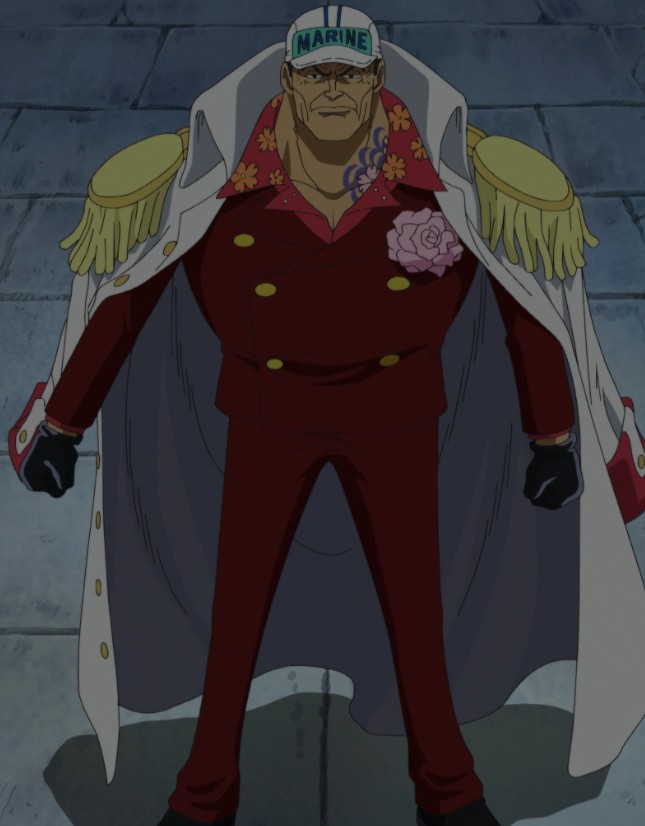
Akainu (Sakazuki) is one of the most polarizing figures in One Piece, known for his unwavering commitment to “Absolute Justice” and his role as the ruthless Fleet Admiral of the Marines. However, beyond his position as a villain, there exists an intriguing layer to his character—one that positions him as a unique figure capable of intersecting the roles of a D. bearer, Yin, and Yang. Few characters in One Piece can be interpreted in such a complex way, but Akainu stands as a rare example of a character whose ideology and actions span across these three distinct aspects.
Akainu has long been speculated as a potential D. bearer, which initially seems counterintuitive given the association of the Will of D. with freedom, rebellion, and chaos. However, Akainu’s embodiment of absolute control and his brutal commitment to order could actually align him with the D. lineage in a more unconventional manner. The D. doesn’t always have to represent the forces of chaos or freedom—what if it also represents a powerful disruptor of the status quo, but one whose methods are rooted in an authoritarian, oppressive form of change? Akainu disrupts the existing world order, but he does so through a rigid, oppressive lens. His extreme methods—his willingness to sacrifice freedom, innocence, and lives for the sake of law and order—show that his disruption doesn’t come with a goal of widespread freedom, but rather with the idea of creating a world governed by an uncompromising, hierarchical order. In this way, Akainu could be a D. bearer, not because he seeks to destroy corrupt systems for the sake of liberty, but because he represents a dark force aimed at disrupting the world through a rigid, totalitarian vision of order.
Akainu’s role as a Yin is another aspect of his complexity. Traditionally, Yin is associated with balance, control, and a passive yet controlling force. While it’s easy to view Yin as something softer or more subtle, Akainu’s take on it is far darker. For him, Yin represents the unyielding control that must be exerted over the world to restore balance. This balance, however, is one that comes at the expense of freedom. Akainu’s belief in Absolute Justice and his willingness to crush anyone who deviates from this ideal puts him firmly in the realm of Yin, albeit in a twisted, rigid form. He doesn’t see justice as something flexible or adaptable—his form of justice is fixed, black and white, where there is no room for mercy or understanding. Akainu’s version of balance isn’t about harmony but about the subjugation of chaos, where only one type of justice can exist. This makes his approach to balance far from peaceful, but rather a totalitarian force designed to suppress anything that might disturb the world order he wishes to create.
Yet, Akainu is also a powerful embodiment of Yang. Yang is the active, aggressive, and forceful counterpart to Yin, and Akainu’s approach to justice is a perfect example of this. His magma-based powers and his role as an enforcer of law show how he uses sheer force to impose his will on the world. As the head of the Marines, Akainu actively uses his position to exercise violence and domination over anyone who dares challenge his idea of justice. His brutality is a symbol of Yang energy—a destructive and overpowering force that aims to impose order through sheer violence. Akainu’s role in the Marineford War, where he killed Whitebeard, is a direct example of his Yang nature—he doesn’t just enforce order, he does so by crushing resistance with his own hands. His justice is not just a matter of law enforcement; it is a force that decimates anything that stands in his way.
Akainu’s intersection of the D., Yin, and Yang creates a multifaceted character whose motivations and actions challenge the usual understanding of these concepts. While the D. lineage has been primarily associated with rebellion and freedom, Akainu offers a different view: the D. could also be about disruption through authoritarianism and control. As a Yin, Akainu represents balance, but it’s a balance that requires absolute order at the cost of freedom. As a Yang, he is the living embodiment of force and power, using violence to achieve his goals and impose his vision of justice.
This complexity makes Akainu one of the few characters in One Piece who can be seen as embodying these three aspects. His brutal pursuit of order is both a reaction to and a reflection of the Will of D., but one that operates in a darker, more authoritarian vein. His character is a reminder that the Will of D. doesn’t always have to represent good or chaotic rebellion—it can also be about disrupting the status quo for the sake of something entirely different, in this case, absolute control. Akainu’s intersection of Yin and Yang makes him a complex antagonist in the story, embodying the tension between freedom and control, order and chaos, and ultimately serving as a symbol of the complex nature of power.
Akainu’s position as a D. bearer, Yin, and Yang forces fans to rethink what these categories mean and how they apply to the world of One Piece. His character is far more than just a simple villain or antagonist; he represents a deeper philosophical divide within the story—one that questions whether order, when taken to its extreme, is ultimately any better than chaos. As the series progresses, Akainu will continue to be a key player in the world’s ultimate struggle, and his ambiguous role in the narrative makes him one of the most fascinating and unpredictable characters in One Piece.
Leave a Reply