
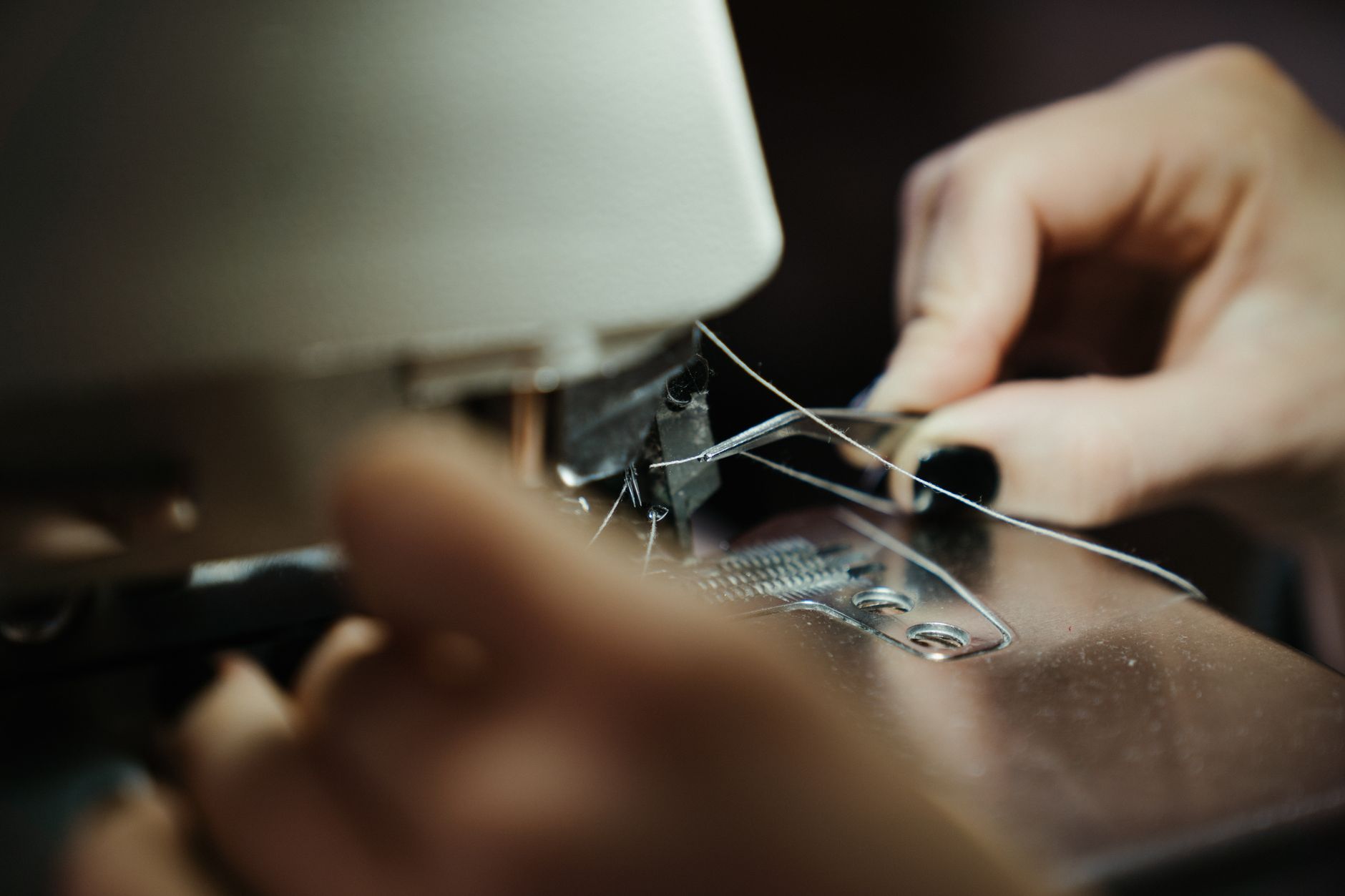
Apparently, the internet has decided that there can never be just one Jaime David.
At this point, I am starting to think I should stop being surprised.
First, I came across Jaime David Fernández Mirabal, the Dominican physician, psychiatrist, agronomist, politician, former vice president of the Dominican Republic, and member of the Mirabal family.
Then I found Jaime M. David, the fashion and lifestyle communications professional who has built an entire career around public relations, branding, communications, and creative strategy.
And now?
There is another Jaime David.
This one is a BERNINA educator.
And not just someone who happens to have the name.
She has written an extensive collection of sewing tutorials and articles, worked as a BERNINA of America educator, specializes in sergers and overlockers, has a background in interior architecture and fine arts, earned a Master of Fine Arts degree in textiles, and has had her textile work displayed in quilt shows and galleries.
At this point, I have to laugh.
Because apparently “Jaime David” is a name that keeps showing up in creative professions.
And considering what I do with the name, I find that incredibly interesting.
Meet the Other Jaime David
According to her author profile on WeAllSew, Jaime David is a BERNINA Educator whose focus is on sergers and overlockers. She combines skills from interior architecture and fine arts with her sewing practice, has written and edited patterns, and has exhibited textile work in quilt shows and galleries across the United States.
That is already a pretty fascinating combination.
Interior architecture.
Fine arts.
Textiles.
Sewing.
Education.
Machine technology.
Pattern design.
Gallery exhibitions.
It is the sort of creative career that reminds me how many different ways there are to make things.
And that is probably the part that interests me most.
Because when people hear “creative,” they often immediately think about the obvious categories.
Writing.
Painting.
Music.
Film.
Photography.
But creativity is much bigger than that.
Some people create with words.
Some create with sound.
Some create with cameras.
Some create with computers.
Some create with fabric.
Some create with thread.
Some create with sewing machines.
Some create entire environments.
And this Jaime David has made an entire creative life around materials that I honestly know very little about.
Which makes her work all the more interesting to me.
She Has a Completely Different Medium
This is where I love the weirdness of the name coincidence.
I write.
She sews.
I make music.
She makes textiles.
I record podcasts.
She teaches people how to use sewing machines and overlockers.
I spend time thinking about essays and blog posts.
She spends time thinking about stitches, fabrics, patterns, garments, and construction.
We are not exactly competing for the same audience.
And that’s a good thing.
Because it makes the coincidence more interesting.
There isn’t much reason for our paths to cross professionally.
Yet here we are.
Two people with the same name who have both turned that name into part of a public creative identity.
That’s what keeps catching my attention about all of these other Jaime Davids.
It’s not merely that the name exists.
It’s that these people are actually doing things with it.
They have careers.
They have projects.
They have websites.
They have bodies of work.
They have audiences.
They have stories.
And now, apparently, there is a whole little collection of Jaime Davids scattered across different corners of the internet.
Her Story Is Especially Interesting Because of How Many Creative Worlds She Combines
One of the things that immediately stood out to me about this Jaime David is her educational background.
Before becoming a BERNINA educator, she worked as a kitchen designer, using a bachelor’s degree in Interior Architecture.
She then pursued a Master of Fine Arts degree in Textiles.
And before joining BERNINA’s education team, she spent seven years working at a local BERNINA dealership.
She eventually became a full-time BERNINA of America educator and Overlocker/Serger Specialist.
I love that progression.
Because it is not a straight line.
It is a collection of skills that eventually converge.
Architecture.
Design.
Textiles.
Sewing.
Education.
Technology.
That sounds familiar.
Not because my career is anything like hers.
It isn’t.
But because I also find myself combining seemingly unrelated interests.
I have a scientific and technical background.
I write.
I make music.
I podcast.
I publish books.
I work with digital platforms.
I am interested in technology.
I am interested in art.
I am interested in history.
I am interested in politics.
I am interested in storytelling.
And sometimes those things overlap in ways that probably make absolutely no sense to anyone else.
But I have stopped worrying about that.
Maybe creativity is supposed to be a little messy.
Her Studio Story Really Caught My Attention
One of the most interesting things I found was an older WeAllSew feature from 2017 called “Studio Tour with BERNINA Educator, Jaime David.”
In it, she introduces herself and describes her work, her studio, and her creative process. She explained that she was one of ten BERNINA of America educators at the time and that she had taken the position of Overlocker/Serger Specialist two years earlier. She described the position as essentially her dream job.
But what really caught my attention was her description of the studio itself.
She had a dedicated space for sewing and artwork in Kansas City.
She described the studio as serving multiple functions: office, library, ironing area, art room, sewing space, and workspace.
There was a huge four-by-eight-foot working surface.
There were machines.
Fabric.
Books.
Patterns.
Projects.
A design wall.
A photography corner.
A library.
Works in progress.
And, naturally, a whole lot of sewing-related stuff.
Reading that, I had one immediate thought:
This is what a creative life looks like.
Not necessarily glamorous.
Not necessarily perfectly organized.
Not necessarily Instagram-perfect.
Just a room filled with things you are working on.
A place where ideas become physical objects.
A place where unfinished projects can sit around waiting for you to come back to them.
A place where you can experiment.
That is something I understand.
My materials just happen to be different.
My Studio Is the Internet
Her studio is a physical space.
Mine is increasingly digital.
That might be one of the biggest differences between us.
She has fabric.
I have files.
She has sewing machines.
I have audio software.
She has cutting tables.
I have keyboards.
She has thread.
I have words.
She has patterns.
I have drafts.
She makes physical objects.
I make things that often exist primarily as digital objects.
But there is a common idea underneath all of that.
You need somewhere to make things.
You need a space where experimentation is allowed.
You need a place where things can be unfinished.
And you need to be comfortable with the fact that the creative process is often messy.
That last part is particularly important.
Because the finished product can make creativity look easy.
A finished quilt looks finished.
A finished garment looks finished.
A finished song sounds finished.
A finished book looks finished.
A finished blog post looks finished.
But none of those things tell you how many failed attempts came before them.
They don’t show the scraps.
They don’t show the discarded versions.
They don’t show the mistakes.
They don’t show the hours spent wondering whether something is working.
They only show you the final object.
And She Has Made a Lot of Things
Her WeAllSew author archive is extensive.
She has written about overlockers, sergers, jeans, buttonholes, rivets, hardware, embroidery, French seams, binding, stretch stitches, coverstitch techniques, sewing with vinyl, custom garments, pillows, ties, laundry bags, baby items, and plenty more.
There is even an entire series of jeans-related tutorials.
In one of those posts, she explains that after getting interested in making jeans around the time of the Ginger Jeans pattern craze, she eventually developed her skills to the point where she was making roughly two pairs of jeans a year. She also talks about how different denim fabrics can be and how much the small details matter.
That is dedication.
Because making your own jeans is not exactly the same thing as buying a pair at a store.
You have to understand the material.
You have to understand the pattern.
You have to understand fit.
You have to understand stitching.
You have to understand construction.
You have to deal with hardware.
And then, presumably, you have to accept that the first attempt may not be perfect.
That is the same basic philosophy behind almost every creative discipline.
You learn by doing.
You make something.
You screw something up.
You figure out why.
You try again.
Eventually, you get better.
That’s Something I Can Relate To
I have been doing that with music.
When I started making music, I did not suddenly know what I was doing.
I experimented.
I recorded things.
I messed around with sounds.
I used Audacity.
I played instruments.
I tried different arrangements.
I tried different genres.
I made things that worked.
I made things that absolutely did not work.
And then I made more things.
Eventually, those experiments became songs.
The songs became albums.
And the albums became part of a larger creative identity.
That process is not fundamentally different from learning how to sew.
The tools are different.
The technical knowledge is different.
The end product is different.
But the philosophy is remarkably similar.
You learn the tools.
You experiment.
You make mistakes.
You improve.
You create something.
Then you create something else.
The BERNINA Connection Is Also Interesting
Jaime David’s relationship with BERNINA is not just about using sewing machines.
She became part of the company’s education team.
In her 2017 introduction, she described being one of ten BERNINA of America educators and working as an Overlocker/Serger Specialist.
That means her creative knowledge became something she could teach to other people.
And I think there is something really cool about that.
Creating something yourself is one thing.
Teaching someone else how to create it is another.
You have to understand your own process well enough to explain it.
You have to anticipate where someone else might get confused.
You have to break complicated things into understandable steps.
You have to communicate.
And that brings us right back to the other Jaime Davids I have already written about.
The communications professional.
The politician and physician.
And now the sewing educator.
Different careers.
Different worlds.
But all of them involve communication in one way or another.
There Is a Pattern Emerging Here
Maybe I am overthinking this.
Probably.
But I find it funny that every time I discover another Jaime David, there is some kind of interesting connection to what I do.
Not a literal connection.
A conceptual one.
Jaime David Fernández Mirabal has a life centered around medicine, public service, politics, and history.
Jaime M. David has a career centered around communications, branding, and storytelling.
This Jaime David has a career centered around art, textiles, sewing, education, and creative craftsmanship.
And I am over here writing blog posts, making music, producing podcasts, publishing books, and apparently writing essays about other people named Jaime David.
At some point, the universe is just trolling me.
But There Is Something More Meaningful Here
The more of these people I find, the more I think about what it actually means to build a creative identity.
A name by itself isn’t enough.
You have to put something behind it.
You have to do something.
You have to make something.
You have to develop skills.
You have to create a body of work.
That is what I find most interesting about this Jaime David.
Her name appears on dozens of sewing tutorials.
Her name is attached to educational material.
Her name is attached to textile work.
Her name is attached to BERNINA.
Her name is attached to a studio.
Her name is attached to a career.
The name isn’t the interesting part by itself.
The interesting part is what she has done with it.
And that is exactly how I want to think about my own name.
“Jaime David” Should Mean Something Because I Made It Mean Something
I don’t want my name to be famous simply for the sake of being famous.
I don’t even necessarily care about being famous.
What I care about is having created something.
I want there to be things attached to the name.
Words.
Songs.
Books.
Episodes.
Ideas.
Projects.
Essays.
Maybe some things people love.
Maybe some things people hate.
Maybe some things that make people laugh.
Maybe some things that make people think.
Maybe some things that nobody notices at all.
That’s okay.
The point is that I made them.
That is what I think about when I see someone like this Jaime David.
She didn’t just have the name.
She built a career.
She developed expertise.
She taught people.
She made things.
She documented what she knew.
She shared it with an audience.
That’s a legacy of its own.
And I Love That Her Creativity Is Physical
There is something especially fascinating to me about textile art because of how tangible it is.
Writing is intangible.
Music is largely intangible.
A podcast is intangible.
A digital blog post is intangible.
You can save them to a hard drive.
You can stream them.
You can read them.
But you cannot hold a blog post in your hands.
Textile art is different.
You can touch it.
You can feel the fabric.
You can see the stitches.
You can see how materials have been assembled.
You can see evidence of the human hand.
And that makes it a very different kind of storytelling.
A piece of textile art can communicate something without saying a single word.
A garment can communicate identity.
A quilt can communicate memory.
A handmade object can communicate care.
A pattern can communicate technique.
A repaired pair of jeans can communicate sustainability and history.
That is storytelling too.
Just without paragraphs.
She Also Has That Wonderful “Make It Yourself” Philosophy
One of the things that stands out from her work is how often she takes ordinary things and turns them into opportunities to create.
Jeans.
Pillows.
Ties.
Laundry bags.
Baby items.
Clothing.
Swimwear.
Decorative objects.
Instead of simply buying something, she often asks a different question:
What if I made this?
I love that question.
Because “What if I made this?” is basically the foundation of almost everything I do.
What if I wrote this?
What if I recorded this?
What if I turned this poem into a song?
What if I made an album?
What if I started a podcast?
What if I wrote a book?
What if I made another blog?
What if I tried another genre?
What if I just made the thing and saw what happened?
That mentality is powerful.
It turns you from a passive consumer into an active creator.
That’s What Makes Her a Fitting Jaime David to Write About
If I am going to keep discovering other people named Jaime David, I think this is exactly the kind of person I want to find.
Someone who makes things.
Someone who teaches.
Someone who experiments.
Someone who combines disciplines.
Someone who has built a career around creativity.
Someone who has turned knowledge into something useful for other people.
That is far more interesting to me than simply discovering another person with the same name.
The name gets my attention.
The work makes me stay.
And There Is Something Wonderful About the Fact That We Are So Different
I think that is the best part.
If every Jaime David I discovered were doing exactly what I do, this would get boring very quickly.
But we’re not.
One is a Dominican political figure.
One works in fashion and lifestyle communications.
One is a textile artist and sewing educator.
And then there is me.
A writer and musician who somehow decided that all of these things should coexist under one name.
That’s diversity.
And it is a reminder that there is no single way to live under a name.
There is no official Jaime David personality.
There is no predetermined Jaime David career.
There is no destiny attached to the words.
There are simply people.
And each person gets to decide what those words mean in their own life.
So, Hello, Another Jaime David
I don’t know this Jaime David personally.
I have never met her.
I have never taken one of her sewing classes.
I have never visited her Kansas City studio.
I don’t know what she is doing today.
But I found her work through the internet, and I found the coincidence too amusing not to write about.
Because here is another person who has taken the same name I use and built something completely different with it.
She has spent years working with textiles.
She has taught people how to use sewing machines.
She has created patterns.
She has worked with BERNINA.
She has exhibited artwork.
She has filled studios with fabric, machines, books, patterns, and works in progress.
And she has left a substantial collection of knowledge online for other people to use.
That’s pretty damn cool.
And if nothing else, she gives me another reminder of something I think about constantly:
Create.
Don’t wait until everything is perfect.
Don’t wait until you have every answer.
Don’t wait until you know exactly what the finished product is supposed to look like.
Start with what you have.
Learn.
Experiment.
Make mistakes.
Try again.
Then make something else.
Because eventually, those individual things start adding up.
A tutorial becomes a collection of tutorials.
A project becomes a body of work.
A skill becomes a career.
A hobby becomes an art form.
And a name becomes associated with everything you built underneath it.
That’s the part that matters.
Not that there is another Jaime David.
There are plenty.
What matters is what each of us does with the name.
This Jaime David built a world around sewing, textiles, education, design, and craftsmanship.
Another Jaime David built a career around communications and branding.
Another built a life around medicine and public service.
And I am building mine around words, music, stories, ideas, and whatever strange creative project comes next.
Same name.
Different lives.
Different mediums.
Different stories.
And honestly?
I wouldn’t have it any other way.
Because the more Jaime Davids I find, the more I appreciate being my own.
Not because I am the only one.
But because I am not.
There are other people carrying these same two words.
They are doing their own things.
They are creating their own histories.
They are making their own marks.
And so am I.
So, to the BERNINA educator Jaime David:
Keep sewing.
Keep teaching.
Keep making things.
Keep filling the world with textiles and ideas.
And somewhere in New York, another Jaime David will keep writing, recording, creating, experimenting, and occasionally searching the internet to discover yet another person who shares his name.
Apparently, this is my life now.
And honestly?
I’m kind of enjoying it.
