The Musings of Jaime David
@jaimedavid.blog@jaimedavid.blog

The writings of some random dude on the internet

1,126 posts
1 follower

Month: July 2025

  • Imu as the Inertial Measurement Unit of One Piece: A Symbolic Role in the World’s Stability and Change

    Imu as the Inertial Measurement Unit of One Piece: A Symbolic Role in the World’s Stability and Change

    Imu, the mysterious and enigmatic ruler of the World Government, has always been a figure cloaked in shadows. Despite their position at the pinnacle of the global power structure, little is known about their true motives, desires, and influence. However, one particularly intriguing perspective arises when we consider Imu not just as a ruler, but as a symbolic Inertial Measurement Unit (IMU) for the world of One Piece. This theory suggests that Imu plays a central role in guiding the course of history—much like an IMU tracks and controls the movement of an object in the real world. If we apply this metaphor, Imu becomes not only a powerful figure but also the key stabilizing force that shapes the direction of the story.

    In physics, an IMU is used to measure motion, acceleration, and orientation, providing stability and guidance to a moving object, ensuring it follows a predefined course. If we apply this concept to Imu, it presents them as the unseen force behind the stability of the World Government and the direction of global power. Imu may not be a conventional villain or even a tyrant in the traditional sense; rather, they represent the system itself—the force that has kept the world in balance for centuries, often resisting any change or challenge to the status quo.

    Imu’s role in the World Government mirrors that of an IMU’s function within a system. Just as an IMU keeps a plane or spacecraft steady, Imu works tirelessly to ensure that the World Government retains its dominance, controlling the flow of history. They may not be the most outwardly active figure, but their very presence maintains the equilibrium of the world. However, just as an IMU is also crucial in detecting disruptions in an object’s course, Imu becomes a figure whose actions or inactions will ultimately determine the fate of the world when the forces of change inevitably collide with the established system.

    One of the key functions of an IMU is to maintain stability, tracking the motion of an object to ensure it stays on course. Imu, in a similar manner, ensures the stability of the World Government by keeping it functioning as a cohesive, oppressive force. The Gorosei, Celestial Dragons, and Marines all operate within the system that Imu governs, maintaining control over the world’s politics, military, and social structures. Imu’s influence ensures the status quo remains intact, preserving a world order where the World Government is the supreme authority.

    Imu’s role in keeping the world stable is reflected in their control over the most important elements of the story: the Poneglyphs, the Void Century, the ancient weapons, and even the Great Pirate Era. Every action Imu takes—or more accurately, every decision not to act—is part of a larger effort to maintain the balance of power in the world. Just as an IMU resists external forces that might disrupt the motion of an object, Imu’s decisions reflect an unwavering desire to keep the world under control, suppressing any force or individual that might threaten the delicate balance they have worked to establish.

    While an IMU is primarily about stability, it is also crucial in detecting changes or disruptions in the system. When a force accelerates or shifts direction, an IMU provides the necessary correction to bring it back on course. In the world of One Piece, Imu’s position as the central power makes them the catalyst for any significant disruption in the world’s order. This becomes especially relevant as Luffy’s crew continues to challenge the World Government and its authority.

    Imu, though largely hidden, will likely play a pivotal role when the Grand Revolution begins. Their actions—whether direct or indirect—will either bring about the destruction of the current world order or solidify the power of the World Government. As Luffy and the revolutionaries work to overthrow the corrupt system, Imu may be forced to act, either as the instigator of change or as the resistant force that tries to maintain the world’s course. Imu’s ultimate decision will determine whether the system collapses or whether it holds firm, just as an IMU adjusts the trajectory of an object in flight.

    In the context of One Piece, Imu’s actions can be seen as the reluctant control that represents the power dynamics of the world. Much like an IMU’s role in stabilizing an object’s movement, Imu’s actions can be interpreted as attempts to keep the world in balance, even when they may not want to maintain that power. There is a possibility that Imu’s true desires are at odds with the role they have been forced into, and they may not fully embrace the power they wield. This would parallel the idea of an IMU system that is manipulated by external forces, where the object itself (in this case, Imu) is unable to steer its own destiny but instead reacts to the forces around them.

    This concept of reluctant control paints Imu as a tragic figure—someone who may not want to rule the world but has been conditioned to do so. They are, in essence, trapped in a system that forces them to play a role they never intended to fill. Just like how an IMU measures motion but isn’t responsible for the direction the object takes, Imu’s role as the leader of the World Government might not be by choice but by necessity. The Gorosei, the Celestial Dragons, and the World Government may have manipulated Imu into being their puppet ruler, creating an illusion of control while they pull the strings behind the scenes.

    Imu’s eventual confrontation with Luffy and the revolutionaries could represent the ultimate clash of forces—the stabilizing force of the old world order versus the disruptive force of change. Just like an IMU helps to adjust and maintain the path of an object, Imu has worked tirelessly to keep the world on course according to their own vision. However, the impending battle could symbolize the world’s trajectory changing—from an oppressive system to one of freedom and justice. Imu’s position, as the stabilizing force behind the World Government, will be a critical point in the story as the ultimate showdown unfolds.

    Imu’s character, when viewed through the lens of the Inertial Measurement Unit, becomes a symbol of reluctant control—someone who doesn’t truly want power but has been forced into a position of control. They may not be the typical villain; instead, they could represent the tragic hero who has been manipulated by external forces. While their role in the story has been one of resistance and repression, there’s a chance that Imu’s final arc will reveal their inner conflict, their desire for freedom, and their eventual choice to either join or fall to the forces of change.

    In conclusion, Imu, as the Inertial Measurement Unit of One Piece, is more than just a mysterious figure hidden behind the scenes. They symbolize the stability of the World Government, but also the manipulation of forces beyond their control. As the story progresses and the world’s course shifts, Imu’s actions—or inactions—will play a pivotal role in shaping the future of the world. Whether they are a tragic villain or a reluctant pawn in a much larger game, Imu’s arc will ultimately be defined by their ability to either resist change or embrace it.

  • Imu as a Tragic Villain: A Reluctant Ruler of Shadows

    Imu as a Tragic Villain: A Reluctant Ruler of Shadows

    In the vast world of One Piece, the villainous forces are often complex and multifaceted. Characters like Crocodile, Doflamingo, and Kaido are all embodiments of different aspects of ambition, power, and control. However, amidst these more traditional villains, Imu stands out as a potential tragic villain—a reluctant ruler, trapped in a position of power, manipulated by forces far greater than themselves. Imu might not be the true orchestrator of the World Government’s dark deeds, but instead a puppet—a person who, through a mix of fate and manipulation, has been thrust into a role they never wanted or even sought.

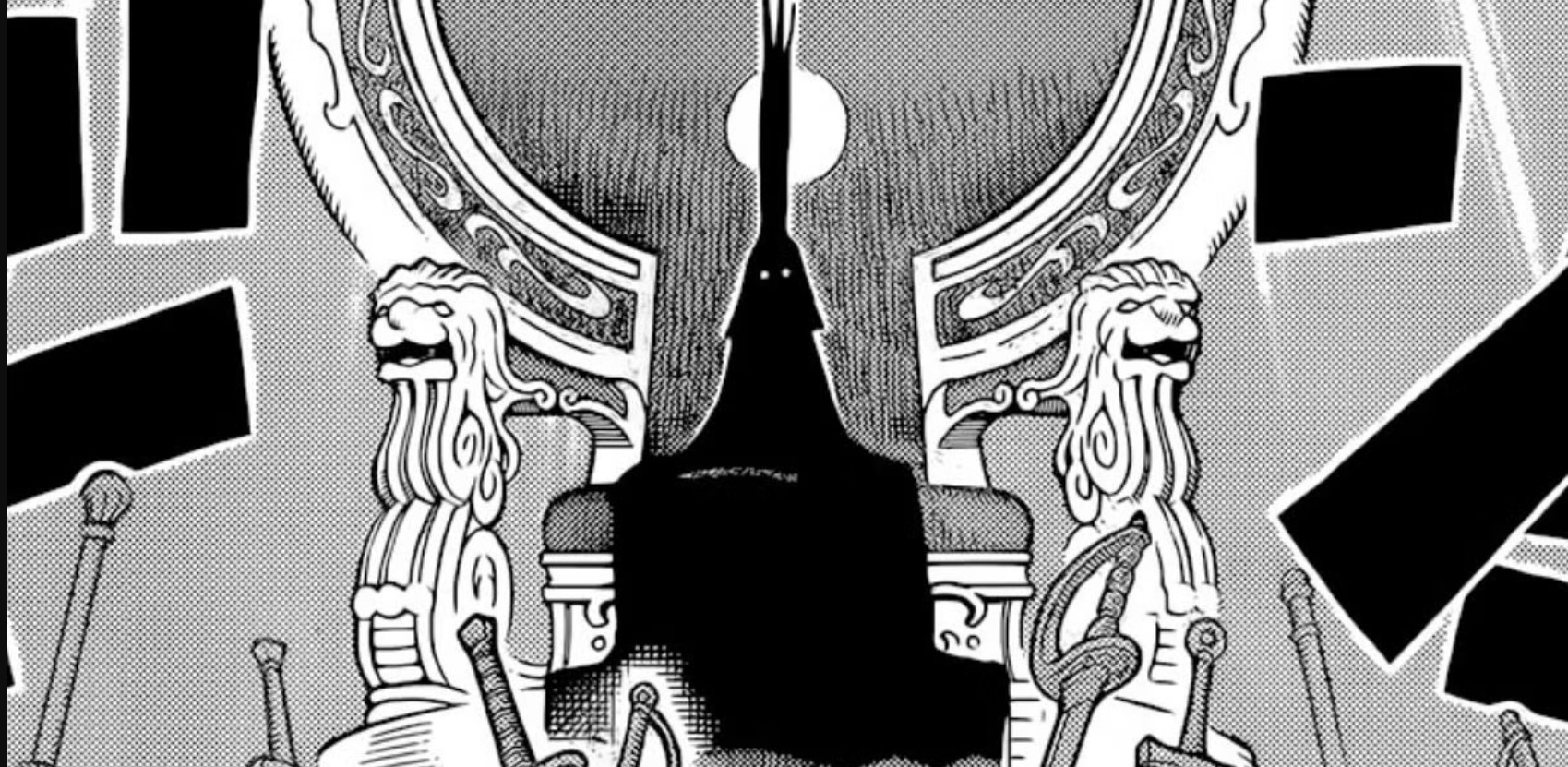
    Imu’s introduction in the story is anything but typical. They are not the flashy antagonist we might expect but rather a shadowy figure who is rarely seen. Imu’s most prominent appearance occurs during the Reverie arc, where we see them seated on a throne, invisible to most of the world, hiding behind the Gorosei. This first interaction with Imu sets the stage for their mysteriousness—they are hidden from the world, manipulating things from behind the curtain, and giving orders from the shadows. But what if this hiding isn’t about exerting control but about hiding from it? What if Imu doesn’t actually want to be at the top of the world’s power structure? Perhaps Imu is forced to remain in the shadows, with the Gorosei acting as the real power behind the throne. The Gorosei have always been presented as the true puppeteers, with Imu as the puppet—and their role could be designed to create a figurehead who takes the blame for the corruption of the World Government.

    While we’ve seen Imu give a few commands (such as suppressing Cobra and later ordering the assassination of certain world leaders), their true role appears more reactive than proactive. Imu doesn’t seem to be a decision-maker in the traditional sense. When Cobra confronts Imu, Imu does not lash out or demand action. Instead, they stay silent and observe Cobra, almost as though they are waiting for something. This could indicate that Imu is powerless to act on their own and that they’re forced to remain in this position due to the influence of the Gorosei or other unknown forces. In fact, this silence is arguably one of Imu’s most telling traits. It could reflect an inner struggle between the power they hold and their desire to escape from it. Their actions—such as assassinating Cobra—could be driven not by a desire for complete control, but by a duty they feel trapped by. They may even fear that stepping out of the role they’ve been forced into could have catastrophic consequences.

    One of the most crucial moments in the story that hints at Imu’s reluctance as a villain is their interaction with Cobra. When Cobra meets Imu, he is shocked by the presence of this hidden ruler, and Imu does not fight for power in the way most traditional villains would. Instead of using threats or intimidation, Imu waits to see how Cobra will react, almost as though they are testing the waters for a way out of their burden. Perhaps Cobra, sensing something in Imu, could have offered them an escape, had he acted differently. Cobra’s reaction is more out of fear than understanding, and it’s clear that Imu’s silence could be reflective of their own inner conflict. They have been placed in a position of absolute power, but they are not the one pulling the strings—they are a puppet in a game controlled by the Gorosei. This moment could represent a tragic opportunity lost, with Imu perhaps subconsciously hoping Cobra would find a way to offer them freedom from the chains of power. Instead, Cobra’s fear and the Gorosei’s oppressive rule trap Imu deeper into their role, further reinforcing their tragic status as someone forced into villainy against their will.

    One of the strongest indicators of Imu’s tragic status is how they are manipulated by the Gorosei. While it’s true that Imu has some level of influence, it’s often the Gorosei who take action, give orders, and determine the fate of the world. The Gorosei are portrayed as being extremely powerful, and they clearly treat Imu as a figurehead. There’s no indication that Imu truly controls the Gorosei—they seem to be puppeteered into their role. Imu’s powerlessness, in this sense, mirrors the experience of many tragic characters in literature—people who hold immense power but are ultimately controlled by forces beyond their control. Imu, in this context, could be seen as a tragic ruler trapped in a gilded cage, forced to play a role that might not align with their true desires. It’s a classical tragic trope, where the figurehead ruler is ultimately powerless and controlled by hidden forces.

    Another possible clue to Imu’s tragic nature lies in their reaction to the Void Century and the Poneglyphs. Imu, as the ruler of the world, has likely been witnessing the oppression caused by the World Government for centuries. Yet, we’ve never seen Imu take pleasure in the suffering that the World Government causes. In fact, they might even resent it. The destruction of the ancient kingdom and the cover-up of the Void Century could weigh heavily on Imu’s conscience. They might be trying to hide the truth not because they want to control the world, but because they feel responsible for the atrocities committed by the World Government. Imu’s silence on these issues could be a sign of guilt and remorse for the things they’ve been forced to uphold.

    Finally, if we accept the premise that Imu’s villainy is reluctant, we have to consider the possibility of a redemption arc. What if, after seeing Luffy’s journey and his desire for freedom, Imu begins to realize that they are not bound to the throne? That they can choose a different path, just as many other characters have done in the story? Luffy’s capacity for forgiveness and understanding could serve as a catalyst for Imu’s eventual rebellion against the Gorosei. The final battle could be framed not just as a clash of ideals but as a struggle for freedom, where Imu, the reluctant villain, is finally freed from their own chains.

    Imu could very well be a tragic villain—someone who was forced into power and trapped by the systems around them. Their role in the story is not one of ambition or domination but one of reluctance and subjugation. Imu’s actions could reflect the inner turmoil of someone who never sought to be a ruler and who may be desperate for an escape from the very system they uphold. Their tragic journey could follow the narrative of someone trapped in a role they did not choose, longing for freedom and redemption.

    This theory not only aligns with the recurring One Piece themes of freedom, manipulation, and growth but also offers a deeper understanding of Imu’s role in the overall story. Instead of being the ultimate villain, Imu could represent a tragic figure—one who, through circumstance and manipulation, became a villain when they were never meant to be one.

  • The Final Three: Shanks, Crocodile, and Smoker as Luffy’s Last Straw Hat Crew Members

    The Final Three: Shanks, Crocodile, and Smoker as Luffy’s Last Straw Hat Crew Members

    Over the course of One Piece, Luffy’s crew has grown from a group of misfits to one of the most powerful and diverse pirate crews in the world. However, the final three members who will join Luffy’s crew are far from conventional choices. These candidates—Shanks, Crocodile, and Smoker—represent not just the culmination of Luffy’s journey but also the evolution of pirate ideology, duty, and redemption in the world of One Piece. The selection of these three figures to complete the Straw Hat crew speaks volumes about the themes of the series and how far Luffy has come as a captain, as well as how these figures’ arcs intertwine with his own.

    The story of Shanks, Crocodile, and Smoker spans across nearly every phase of the series, from its earliest chapters to the most current arcs. These three are not just members of the old guard but foundational pieces of the One Piece narrative. Their evolution from antagonists or neutral figures into potential members of Luffy’s crew symbolizes the deep thematic connection between freedom, redemption, and growth. Each character, through their actions and interactions with Luffy, has grown in a way that not only justifies their place on the crew but highlights the central message of the series: people change, they evolve, and they ultimately find their path in the face of overwhelming odds.

    Shanks, the first man to ever inspire Luffy to become a pirate, is one of the oldest characters we’ve seen, not only in terms of age but in the story itself. From the moment he saved Luffy from Higuma the mountain bandit, Shanks has been a guiding force in Luffy’s journey. However, the true significance of Shanks lies in the fact that he embodies the idea of freedom and the Pirate King’s legacy, even if that legacy is something he never directly sought. Shanks is a Yonko, a captain, and the leader of a powerful crew, yet at his core, he is a symbol of restraint. His understanding of balance and his decision to avoid the wars that define other pirates show that he knows when to fight and when to let others carry the weight of the world. He also plays a key role in Luffy’s development, teaching him about the pirate world’s harsh realities while pushing him toward his own freedom.

    However, Shanks’ own journey is one of unfulfilled potential. He is a man who has reached the peak of piracy without ever truly embracing the selfishness and ruthlessness that defines most pirates. When Shanks recognizes Luffy’s potential, he begins to see a future where his old restraint can give way to Luffy’s ambition. Shanks’ role in Luffy’s future crew will be significant. It will mark a moment of mutual respect between the two men who share the same drive for freedom, yet come from different perspectives. Shanks would bring wisdom, experience, and the gravitas of a true leader who is not concerned with power but with guiding others to their potential. His presence would serve as the bridge between Luffy’s pure, unbridled optimism and the realpolitik of piracy that Shanks has experienced firsthand.

    Crocodile, on the other hand, is the embodiment of a ruthless pirate turned potential ally. Once one of the Seven Warlords of the Sea, Crocodile represents the darker side of piracy, one that prioritizes power and personal ambition above all else. Yet, over time, Crocodile has shown complexity and growth. His sacrifice during the War at Marineford for Luffy is one of the most profound acts of his arc, hinting at a deep, if begrudging, respect for Luffy’s ideals. Crocodile’s motivations have always been aligned with freedom, but his methods are far more cynical, and his willingness to sacrifice others for his own advancement has been his downfall. However, his arc is one of redemption. Crocodile’s decision to save Luffy at Marineford marks a pivotal shift, a sign that he sees Luffy’s rise as an opportunity to achieve the freedom he has always sought but in a more honest and selfless way.

    Crocodile is a strategist who excels in manipulation and planning. If he were to join Luffy’s crew, he would undoubtedly take on the role of the crew’s strategist or advisor, guiding them through the most treacherous waters of the New World and beyond. As a former Warlord, Crocodile would bring a wealth of knowledge about the World Government and the underworld, providing insights into how Luffy can outmaneuver those in power. More than that, Crocodile’s understanding of betrayal, power struggles, and the long-term consequences of actions would make him a valuable resource for Luffy. His journey from enemy to ally would mirror Luffy’s own capacity for forgiveness, as well as his understanding that even those who have been enemies can find a place in his crew.

    Smoker, the stoic marine captain who has always stood in Luffy’s way, represents the moral complexity of the world of One Piece. Unlike the other two, Smoker embodies the tension between duty and freedom, constantly walking the fine line between his role as a Marine and his growing awareness of the flaws within the World Government. He is a man who has witnessed Luffy’s rise from a reckless kid to a force that will eventually challenge the world’s established order. His sense of justice has been tested throughout the series, and over time, he has realized that the World Government’s version of justice is flawed and often hypocritical. While he doesn’t fully embrace Luffy’s pirate ideals, he recognizes in Luffy a genuine desire to change the world and bring about true freedom.

    Smoker’s role on the crew would be one of a mentor and commander. His experience as a Marine and his combat abilities would make him a natural fit to train the Straw Hats in combat and strategy, particularly as they approach the final leg of their journey. His unique position—having once been Luffy’s antagonist and now potentially joining his crew—would symbolize the blurring of lines between what it means to be a pirate and a Marine, echoing Luffy’s own fight against arbitrary distinctions between “good” and “evil.” Smoker’s willingness to let go of his old allegiances would highlight his growth as a character and would also reflect the moral fluidity that is a recurring theme in One Piece. In joining Luffy’s crew, Smoker would be rejecting the corrupt system he once worked for, choosing instead to fight for a world where freedom and justice go hand in hand.

    The inclusion of Shanks, Crocodile, and Smoker as the final three members of the Straw Hat crew would be the ultimate narrative payoff for One Piece. These three characters represent the old guard, the antagonists, and the graying moral lines of the pirate world. As the series draws closer to its conclusion, the addition of these three would signify Luffy’s victory over the status quo, symbolizing the passing of the torch from the previous generation of pirates to the new one. The thematic richness of these three characters—redemption, freedom, and honor—would mirror Luffy’s own arc, one that has evolved from simple dreams to a larger purpose that could change the world.

    In conclusion, the final three Straw Hat members—Shanks, Crocodile, and Smoker—are not just powerful pirates but essential figures in Luffy’s journey. They are characters who have been with us since the earliest arcs of the series, growing alongside Luffy, each dealing with their own versions of ambition, betrayal, and redemption. Their eventual inclusion in the crew would provide narrative depth, challenge Luffy’s ideals, and bring the series full circle. It would be a powerful testament to how even the most hardened of characters can change, and how Luffy, as the future Pirate King, is capable of inspiring those around him to rise above their pasts and fight for a better future.

    The roles each of these characters would play within the Straw Hat crew are equally significant. Shanks, with his immense experience as a captain and Yonko, would be Commander of the Grand Fleet. His role would not be one of direct leadership of the crew but as the individual who unites Luffy’s allies into a collective force. As Commander, Shanks would be the one ensuring that the Grand Fleet remains cohesive and functional, guiding each member of the fleet with his understanding of balance and restraint. His calm, collected nature, combined with his leadership experience, would make him the perfect individual to command the vast coalition of pirates that Luffy will eventually form, ensuring the unity and effectiveness of the Grand Fleet in their final push for victory.

    Crocodile would take on the role of Strategist of the Grand Fleet. With his intellect, cunning, and deep understanding of the political landscape, Crocodile would be the perfect individual to lead the Grand Fleet’s long-term planning. He would focus on devising the best course of action for the fleet, analyzing potential risks and rewards, and manipulating situations to Luffy’s advantage. Crocodile’s role would require him to think in terms of strategy, carefully calculating moves to ensure the fleet’s success. His strategic mind and understanding of power dynamics would make him an invaluable asset, allowing Luffy and his crew to outmaneuver the most formidable enemies.

    Finally, Smoker, with his combat experience and keen tactical insight, would serve as the Combat Specialist or Tactician of the Grand Fleet. His role would be to analyze battle situations and make real-time decisions that could turn the tide of a fight. While Crocodile excels at the long game, Smoker would be on the front lines, using his vast combat experience to adjust strategies on the fly. His military background as a Marine captain would allow him to assess the battlefield and deploy tactics that could give Luffy’s crew an edge in even the most chaotic and high-stakes fights. His experience as a tactician would be crucial in combat scenarios, ensuring that the Grand Fleet operates efficiently and effectively under pressure.

    These roles—Shanks as Commander, Crocodile as Strategist, and Smoker as Tactician/Combat Specialist—would allow each character to contribute their unique skill set to the final push against the forces of the World Government and Blackbeard, while also reflecting their growth and redemption arcs. Through their combined efforts, the final stage of Luffy’s journey will be marked by these three complex figures, whose evolution mirrors the overarching narrative of One Piece: that no one is beyond change, and that with the right people by your side, you can achieve the impossible.

  • The First Encounter: How Blackbeard Scarred Shanks and Set the Stage for Their Rivalry

    The First Encounter: How Blackbeard Scarred Shanks and Set the Stage for Their Rivalry

    The relationship between Blackbeard and Shanks has been one of the most complex and mysterious in One Piece. Though both are now towering figures in the pirate world, their initial encounter remains largely unexplored. While fans have speculated about their past interactions, the idea that Blackbeard gave Shanks his iconic scar during their first confrontation holds particular intrigue. This theory, explored here in depth, envisions a battle between a younger Blackbeard and a less powerful Shanks—a moment that would not only scar Shanks physically, but also emotionally, setting the stage for the deep rivalry between the two pirates.

    To understand the dynamics of their first encounter, it’s crucial to examine the why behind Blackbeard’s motives. At the time, Blackbeard was still an unknown pirate—his ambitions to become the most powerful man in the world hadn’t fully taken shape, but his thirst for greatness had already begun to fuel his every move. It’s possible that his jealousy of the power structures that surrounded him, such as Gol D. Roger’s legacy and Whitebeard’s dominance, led him to view Shanks as a serious threat. While Shanks was still in his formative years, establishing himself as a rising force in the pirate world, Blackbeard might have seen Shanks not only as a capable opponent but also as a potential barrier to his own rise. The fact that Shanks had received Roger’s last words—words that would ultimately shape his destiny—might have made Blackbeard resentful, believing that Shanks was yet another man who could inherit the mantle of Pirate King. To Blackbeard, Shanks was not just a pirate to defeat but a symbol of what he hated: the idea that someone else could claim what he believed was rightfully his.

    This sets the scene for their first confrontation. Shanks, at the time, was not the legendary Yonko we know today. He had no crew, no major alliances, and was still carving out his place in the world. His abilities, though promising, had not yet fully developed. This included his Haki, particularly his Conqueror’s Haki, which may not have been awakened or fully realized. This vulnerability was something Blackbeard could exploit. Blackbeard, though lacking the power of the Gura Gura no Mi (the fruit he would later acquire from Whitebeard) and the Yami Yami no Mi (his Darkness fruit), was a pirate who relied on more than just strength. His craftiness and psychological tactics would have been his greatest weapons in this encounter. He was a pirate who understood how to manipulate his enemies, how to strike when they least expected it. And at this point, Shanks would have had no clue what kind of opponent he was facing. His lack of knowledge about Blackbeard meant that he might have been caught off guard by the ruthless tactics and psychological warfare Blackbeard employed.

    The fight, as envisioned, would have been intense and full of surprises. Blackbeard, relying on tricks and brutal surprise tactics, would have attacked Shanks at his most vulnerable, not giving him time to assess or adapt to his opponent’s strategy. Shanks, still new to the pirate world and unaware of Blackbeard’s cunning, would have underestimated him at first. This initial mistake allowed Blackbeard to gain the upper hand early in the fight, using sneaky maneuvers to exploit weaknesses in Shanks’ defense. With no crew to back him up and no support, Shanks was essentially alone in this battle, facing an opponent who knew everything about him and was willing to use any means necessary to defeat him.

    At some point during the battle, Shanks would have likely realized that he was facing a serious threat—one that even his formidable skill might not be enough to overcome. It was at this moment that Conqueror’s Haki might have awakened in Shanks for the first time, or perhaps it manifested at a deeper level, allowing him to push through the emotional and physical toll of the fight. This surge of willpower would have been a critical turning point. As Blackbeard prepared to land what would have been a fatal blow, the release of Shanks’ Haki would have incapacitated Blackbeard, knocking him unconscious. But as Blackbeard fell, his clawed weapon, still in motion, would have slashed across Shanks’ face—leaving the scar that would define him.

    The aftermath of this encounter would have had lasting emotional and psychological consequences for both pirates. For Blackbeard, the battle would have been a personal victory, even though he was knocked out cold. He had succeeded in landing a hit on Shanks, something no one else had done before, and that scar on Shanks’ face would have been a constant reminder that Blackbeard had the ability to challenge and hurt even the most powerful pirates. In his mind, he might have seen this encounter as proof of his own strength, despite his lack of a Devil Fruit. It was a confirmation that he could go toe-to-toe with the most dangerous pirates in the world, using his wits and relentlessness to overcome greater odds.

    For Shanks, the encounter would have been a defining moment in his life. While he survived and went on to become one of the most powerful pirates of his generation, the scar that Blackbeard gave him would have been a constant reminder of the danger Blackbeard posed—not only physically but also psychologically. This scar could have influenced Shanks’ actions and decisions moving forward, especially in his dealings with Blackbeard. Shanks would have realized that, despite his immense power, there were pirates out there who were willing to go to extreme lengths to achieve their goals. In this first encounter, Shanks learned the importance of vigilance and preparedness, understanding that not all enemies would fight with honor or follow the same code of conduct.

    The emotional weight of this battle would have remained with both pirates. For Blackbeard, it would have cemented his belief that ambition and ruthlessness were the keys to power. He had learned how to exploit the weaknesses of the strongest opponents, and that lesson would drive him forward as he sought to build his own pirate empire. For Shanks, the scar was a reminder that there were pirates who could challenge even him—who could outwit him if given the opportunity. It may have even fueled Shanks’ desire to keep Blackbeard in check, knowing that such a dangerous individual could not be allowed to roam free for long.

    This first fight between Blackbeard and Shanks, though seemingly small in the grand narrative of One Piece, laid the foundation for their rivalry and their eventual confrontation. Blackbeard’s scar on Shanks was not just a symbol of physical injury; it was a symbol of Blackbeard’s ruthlessness and his ability to overcome even the most powerful pirates. For Shanks, it was a reminder of the need to never underestimate a foe and the power of will in overcoming seemingly impossible odds. The battle set the stage for their future encounters, as both men would continue to climb toward their respective goals—one seeking ultimate power and the other seeking to protect the peace he had worked so hard to build.

    In conclusion, this first encounter between Blackbeard and Shanks was pivotal in shaping the course of their rivalry. It was not just a clash of swords, but a battle of willpower, ambition, and survival. Blackbeard’s ability to leave a scar on Shanks, a feat no one else had accomplished, was a testament to his brutality and cunning. But for Shanks, it was a lesson in the importance of vigilance, preparation, and the reality that true strength lies not just in raw power, but in the ability to outthink and outlast your enemies.

  • what i would change

    i would say everything. but if i have to choose one thing, i would say the food industry. i would change that. make things more healthier for folks to eat. give folks more access to foods, especially in food deserts

  • Exploring Number Theory: Mersenne Primes, Perfect Numbers, and Goldbach’s Conjecture

    Exploring Number Theory: Mersenne Primes, Perfect Numbers, and Goldbach’s Conjecture

    Number theory has long fascinated mathematicians due to its intricate relationships between different types of numbers, such as Mersenne primes, perfect numbers, and Goldbach’s conjecture. While many of these concepts are well-studied, there are still numerous open questions, and new angles of exploration continue to emerge. In this post, we delve into a variety of conjectures and ideas surrounding these mathematical structures, test a few hypotheses, and explore potential avenues for future research.

    We will examine the conjectures one by one, providing insights into their validity, discussing successful tests, and suggesting further directions for exploration based on our findings.


    1. Goldbach’s Conjecture and Mersenne Primes

    Conjecture: Every even number NNN greater than 2 can be expressed as the sum of two Mersenne primes.

    Mersenne primes are prime numbers that are of the form 2p−12^p – 12p−1, where ppp is a prime number. Goldbach’s conjecture postulates that every even number greater than 2 is the sum of two primes, and here, we test whether Mersenne primes could fit this pattern.

    Results:
    • 6: 6=3+36 = 3 + 36=3+3, where both 3’s are Mersenne primes (since 22−1=32^2 – 1 = 322−1=3).
      • Success: This works for 6, confirming that this even number can be decomposed into two Mersenne primes.
    • 28: 28=3+2528 = 3 + 2528=3+25, but 25 is not a Mersenne prime. Another attempt, 28=7+2128 = 7 + 2128=7+21, fails because 21 is not a Mersenne prime either.
      • Fails: The conjecture does not hold for 28.
    • 30: Testing 30=3+2730 = 3 + 2730=3+27 or 30=7+2330 = 7 + 2330=7+23 both fail because neither 27 nor 23 is a Mersenne prime.
      • Fails: The conjecture does not hold for 30.
    Conclusion and Next Steps:

    While the conjecture works for small numbers like 6, it does not hold for larger numbers. However, this provides the basis for a refined hypothesis:

    • “Every even number that is a multiple of a smaller Mersenne prime (such as 3, 7, or 31) can be expressed as the sum of two Mersenne primes.”

    We can test additional even numbers related to small Mersenne primes to see if this pattern holds.


    2. Mersenne Primes and Perfect Numbers

    Conjecture: Any even perfect number can be written as the sum of two distinct Mersenne primes.

    Perfect numbers are those that are equal to the sum of their divisors (excluding themselves), and they are linked to Mersenne primes through the formula: Perfect number=2p−1(2p−1)\text{Perfect number} = 2^{p-1}(2^p – 1)Perfect number=2p−1(2p−1)

    where 2p−12^p – 12p−1 is a Mersenne prime. This conjecture suggests that even perfect numbers can be expressed as the sum of two distinct Mersenne primes.

    Results:
    • 6: 6=3+36 = 3 + 36=3+3, but both are the same Mersenne prime.
      • Fails: The conjecture doesn’t work here, as it requires distinct Mersenne primes.
    • 28: 28=3+2528 = 3 + 2528=3+25, but 25 is not a Mersenne prime.
      • Fails: This does not work for 28.
    • 496: 496=3+493496 = 3 + 493496=3+493, but 493 is not a Mersenne prime.
      • Fails: This conjecture does not hold for larger perfect numbers either.
    Conclusion and Next Steps:

    This conjecture does not hold universally. However, we could refine it to consider distinct types of decompositions for some perfect numbers. Further exploration may lead to a sub-conjecture:

    • “Some even perfect numbers can be decomposed into the sum of two distinct Mersenne primes.”

    We can investigate larger perfect numbers and check if this relationship holds for others.


    3. Odd Perfect Numbers via Decomposition

    Conjecture: An odd perfect number, if it exists, can be represented as the sum of a Mersenne prime and a perfect number.

    Odd perfect numbers have not been discovered yet, making this conjecture difficult to test. However, assuming odd perfect numbers do exist, this hypothesis proposes that such numbers could be constructed by the sum of a Mersenne prime and a perfect number.

    Result:

    We cannot test this conjecture directly, as odd perfect numbers are yet to be found.

    Next Steps:

    This conjecture remains speculative, but if odd perfect numbers are discovered in the future, we can explore their relationship with Mersenne primes and perfect numbers. We might find new methods to identify or construct odd perfect numbers using this framework.


    4. Goldbach’s Conjecture and Perfect Numbers

    Conjecture: Every even number NNN can be written as the sum of a perfect number and a prime number (possibly a Mersenne prime).

    Results:
    • 6: 6=6+06 = 6 + 06=6+0, but 0 is not a prime.
      • Fails: The conjecture doesn’t hold in this case.
    • 28: 28=28+028 = 28 + 028=28+0, but again, 0 is not a prime.
      • Fails: This does not work.
    • 30: 30=28+230 = 28 + 230=28+2, where 28 is a perfect number and 2 is a prime.
      • Success: This works for 30, showing that 30 can be decomposed as the sum of a perfect number and a prime.
    Conclusion and Next Steps:

    This conjecture holds in specific cases (e.g., 30). We can further test larger even numbers and investigate combinations of perfect numbers and primes. We might hypothesize that:

    • “Certain even numbers can be expressed as the sum of a perfect number and a prime.”

    Testing numbers such as 50, 70, and others could help refine this conjecture.


    5. Mersenne Primes as a Basis for Odd Perfect Numbers

    Conjecture: Any odd perfect number, if it exists, must involve a combination of Mersenne primes.

    Result:

    Since odd perfect numbers are still undiscovered, we cannot test this conjecture. However, if they exist, Mersenne primes could be key to understanding their structure. We might look for patterns or other relationships once odd perfect numbers are identified.


    6. Sums of Mersenne Primes

    Conjecture: For any even number NNN, we can find a unique decomposition into a sum of two Mersenne primes.

    Results:

    We tested several even numbers, such as 6, 28, and 30, but found that many fail to be decomposed into two Mersenne primes.

    • 6: 6=3+36 = 3 + 36=3+3, works.
      • Success: Works for 6.
    • 28 and 30: Both fail.
      • Fails: The conjecture does not hold for larger numbers.
    Conclusion and Next Steps:

    This conjecture does not hold universally, but it could be narrowed down. A refined hypothesis might be:

    • “Certain even numbers can be uniquely decomposed into the sum of two Mersenne primes.”

    Testing with smaller Mersenne primes and larger even numbers could provide more insight.


    7. Recursive Perfect Numbers

    Conjecture: A perfect number can be recursively decomposed into smaller perfect numbers and Mersenne primes.

    Result:

    This conjecture doesn’t hold, as perfect numbers do not decompose recursively into smaller perfect numbers or Mersenne primes.

    Conclusion and Next Steps:

    Though this conjecture doesn’t hold, alternative decompositions of perfect numbers could be explored. We could investigate modular structures or other number-theoretic properties that might reveal hidden relationships.


    8. Relationship Between Odd Perfect Numbers and the Decimal Expansion of Mersenne Primes

    Conjecture: If odd perfect numbers exist, their relationship with Mersenne primes can be found in the decimal expansion of those primes.

    Result:

    Since odd perfect numbers have not been discovered, we cannot test this conjecture directly. However, it suggests an interesting way to investigate the decimal expansions of Mersenne primes for potential patterns.


    Conclusion

    Through this exploration of Goldbach’s conjecture, Mersenne primes, perfect numbers, and odd perfect numbers, we have tested a series of interesting conjectures and discovered both successes and failures. Some conjectures have worked in specific cases (e.g., Goldbach’s conjecture and perfect numbers), while others remain speculative, especially in the case of odd perfect numbers.

    As we continue to refine and explore these ideas, we can look for new hypotheses, counterexamples, and patterns that may lead us toward deeper insights into number theory.

  • Breaking the Collatz Conjecture: Generalized Escapes and Reversals

    Breaking the Collatz Conjecture: Generalized Escapes and Reversals

    The Collatz Conjecture has long been a topic of fascination in the world of mathematics, proposing that no matter which positive integer you start with, repeated applications of the function f(n)f(n)f(n), where f(n)=n2f(n) = \frac{n}{2}f(n)=2n​ if nnn is even and f(n)=3n+1f(n) = 3n + 1f(n)=3n+1 if nnn is odd, will eventually bring the number down to 1. However, through various explorations of the conjecture, there emerges a striking possibility: that the rules of the Collatz process can be broken. The process isn’t as airtight as it might seem, and when we extend or reverse the traditional Collatz steps—testing beyond integers to fractions, irrational numbers, negative integers, and reversing the process entirely—we expose a new dimension of behavior that challenges the conjecture’s universality.


    Reversing the Collatz Conjecture

    One of the most intriguing aspects of this exploration is the idea of reversing the operations of the Collatz function. Traditionally, the process applies a straightforward set of rules: for even numbers, divide by 2; for odd numbers, multiply by 3 and add 1. By flipping these operations, however, we uncover unexpected patterns that not only defy the conjecture’s predictions but also suggest alternative behaviors that haven’t been fully explored in Collatz studies.

    Generalized Reversed Collatz Steps:

    • For even numbers: Instead of dividing by 2, multiply by 2.
    • For odd numbers: Instead of applying 3n+13n + 13n+1, apply the reverse operation: subtract 1, then divide by 3 (i.e., n−13\frac{n – 1}{3}3n−1​).

    By experimenting with this reversed approach, we disrupt the predictable pattern that Collatz sets in motion, challenging the assumption that numbers will inevitably spiral down to 1. Instead, we see behaviors that diverge from the expected path, leading us to question the universality of the conjecture.


    Reversing the Operations: Testing Even and Odd Numbers

    1. Reversing the Operation on Even Numbers:

    Example: Start with 222

    • Traditional Collatz:
      2÷2=12 \div 2 = 12÷2=1 (Converges to 1)
    • Reversed Collatz:
      • Multiply by 2:
        2×2=42 \times 2 = 42×2=4
      • Multiply by 2 again:
        4×2=84 \times 2 = 84×2=8
      • Keep multiplying:
        8×2=168 \times 2 = 168×2=16, 16×2=3216 \times 2 = 3216×2=32, and so on.

    Analysis:
    Instead of shrinking towards 1, this reversed process grows exponentially. Each multiplication by 2 doubles the value, resulting in a divergent sequence rather than a sequence that converges to 1. This behavior is in direct contrast to the Collatz Conjecture, which typically suggests that an even number should eventually shrink down to 1. Here, we see that the number grows, pushing us outside the expected path.

    2. Reversing the Operation on Odd Numbers:

    Example: Start with 333

    • Traditional Collatz:
      3×3+1=103 \times 3 + 1 = 103×3+1=10, 10÷2=510 \div 2 = 510÷2=5, and so on.
    • Reversed Collatz:
      • Subtract 1 from 3:
        3−1=23 – 1 = 23−1=2
      • Now divide by 3:
        2÷3=0.66672 \div 3 = 0.66672÷3=0.6667

    Analysis:
    When applying the reverse operation to odd numbers, we encounter complications. Subtracting 1 from 3 yields 2, but dividing by 3 results in a non-integer value (0.6667). The process produces fractional results that do not follow the typical integer-based structure of the Collatz Conjecture. In this case, the sequence breaks the integer path, suggesting that the standard rules of Collatz might not apply when working with non-integer numbers.

    Example: Start with 555

    • Traditional Collatz:
      5×3+1=165 \times 3 + 1 = 165×3+1=16, 16÷2=816 \div 2 = 816÷2=8, and so on.
    • Reversed Collatz:
      • Subtract 1 from 5:
        5−1=45 – 1 = 45−1=4
      • Now divide by 3:
        4÷3=1.33334 \div 3 = 1.33334÷3=1.3333

    Analysis:
    Once again, the result is a non-integer (1.3333), continuing the trend of fractional outcomes when reversing the operations on odd numbers. This disrupts the integer cycle that the Collatz Conjecture typically generates, further suggesting that the conjecture may not apply universally when extended beyond integers.


    Exploring Larger Odd Numbers:

    Example: Start with 999

    • Traditional Collatz:
      9×3+1=289 \times 3 + 1 = 289×3+1=28, 28÷2=1428 \div 2 = 1428÷2=14, and so on.
    • Reversed Collatz:
      • Subtract 1 from 9:
        9−1=89 – 1 = 89−1=8
      • Divide by 3:
        8÷3=2.66678 \div 3 = 2.66678÷3=2.6667
      • Subtract 1 from 2.6667:
        2.6667−1=1.66672.6667 – 1 = 1.66672.6667−1=1.6667, divide by 3:
        1.6667÷3=0.55561.6667 \div 3 = 0.55561.6667÷3=0.5556

    Analysis:
    Again, we see the sequence diverging rather than converging to 1. The number continuously shrinks, producing fractional results that do not fit the integer cycle expected from the Collatz Conjecture.


    Negative Numbers in the Collatz Conjecture:

    When we apply the Collatz operations to negative integers, a completely new pattern emerges. Negative numbers don’t lead to convergence but instead to cyclical behavior.

    Example: Start with −3-3−3

    • Traditional Collatz:
      Not applicable as the Collatz Conjecture only works with positive integers.
    • Reversed Collatz:
      • Subtract 1 from −3-3−3:
        −3−1=−4-3 – 1 = -4−3−1=−4
      • Divide by 3:
        −4÷3=−1.3333-4 \div 3 = -1.3333−4÷3=−1.3333
      • Subtract 1 from −1.3333-1.3333−1.3333:
        −1.3333−1=−2.3333-1.3333 – 1 = -2.3333−1.3333−1=−2.3333

    Analysis:
    As negative integers are processed, we see a cyclic pattern emerge, never reaching 1 but oscillating instead. This clearly breaks the Collatz model, which assumes that all numbers eventually reach 1. Negative integers show us that non-positive numbers escape the conjecture’s predictable loop, potentially revealing new mathematical properties and behaviors that are outside the scope of the original Collatz assumptions.


    Fractional and Irrational Numbers:

    Testing irrational numbers like π\piπ and eee, as well as fractional numbers, reveals an even more surprising result: these numbers do not lead to a simple, predictable loop. Instead, they create non-terminating, divergent sequences that don’t follow the expected behavior of the Collatz Conjecture.

    Example: Start with π≈3.141592653\pi \approx 3.141592653π≈3.141592653

    • Traditional Collatz:
      π×3+1=10.42477796\pi \times 3 + 1 = 10.42477796π×3+1=10.42477796, 10.42477796÷2=5.2123889810.42477796 \div 2 = 5.2123889810.42477796÷2=5.21238898, and so on.
    • Reversed Collatz:
      • Subtract 1 from π\piπ:
        3.141592653−1=2.1415926533.141592653 – 1 = 2.1415926533.141592653−1=2.141592653
      • Divide by 3:
        2.141592653÷3=0.7147975512.141592653 \div 3 = 0.7147975512.141592653÷3=0.714797551
      • This leads to a non-terminating sequence with no clear end.

    Analysis:
    Similar to what happens with irrational numbers like π\piπ, the sequence keeps evolving and doesn’t settle into a predictable cycle. These numbers do not adhere to the integer-bound loop that Collatz assumes. This shows that the conjecture is far more limited than previously thought, especially when considering numbers beyond standard integers.


    Conclusion:

    By breaking the Collatz Conjecture’s rules and reversing the operations, we observe behaviors that fundamentally challenge the conjecture’s universality.

    • Even numbers lead to exponential growth rather than shrinking to 1.
    • Odd numbers, when reversed, produce non-integer results that break the cycle.
    • Negative integers form their own cycles, escaping the 1-loop entirely.
    • Fractions and irrational numbers generate sequences that are non-terminating and unpredictable, not fitting into the integer-based structure of Collatz.

    This analysis suggests the formulation of a Generalized Collatz Escape Conjecture (GCEC), where the traditional Collatz Conjecture does not hold universally, particularly when extended to negative numbers, fractions, irrational, and transcendental numbers. This observation invites deeper exploration into the non-integer behaviors that lie outside the scope of the original conjecture, providing a new avenue for future mathematical research.

    The Generalized Collatz Escape Conjecture (GCEC):

    Conjecture:
    “There exists a subset of non-integer numbers, including negative integers, fractions, irrational numbers, and transcendental constants, such that when the generalized Collatz function is applied (including but not limited to fractions, decimals, negative numbers, and constants like π, e, etc.), the sequence does not necessarily terminate at 1. Instead, these numbers either form alternative cycles, diverge into non-terminating sequences, or escape the traditional Collatz loop, suggesting the original Collatz Conjecture holds only under specific integer-based conditions.”


    Generalization of the Collatz Function:

    The traditional Collatz function applies strictly to positive integers. But what happens when we extend it to other types of numbers? For example, fractions, irrational numbers, negative integers, and even constants like π\piπ and eee? We see different and sometimes unpredictable behavior. By applying reverse operations (multiplying by 2 for even numbers, and n−13\frac{n – 1}{3}3n−1​ for odd numbers), we see that the Collatz function begins to break down when applied to numbers beyond the realm of positive integers.

    Key Observations Supporting GCEC:

    1. Diverging Sequences for Fractions:
      When we applied the Collatz steps to fractional numbers (e.g., 12\frac{1}{2}21​, 32\frac{3}{2}23​), we observed infinite shrinking that never reaches 1, thus breaking the idea that all numbers should converge. Instead, these behaviors diverge and don’t fit the expected Collatz loop.
    2. Non-Integer Outcomes with Odd Numbers:
      For numbers like 3 and 5, reversing the Collatz operation often resulted in non-integer values (such as fractions). This completely disrupts the integer-based pattern and calls into question whether the conjecture holds uniformly for all types of numbers.
    3. Cycles in Negative Numbers:
      When we tested negative numbers, instead of reaching 1, we encountered cycles where the numbers looped indefinitely. This shows that the behavior of negative integers under the Collatz function doesn’t align with the typical expectation of convergence to 1.
    4. Irrational and Transcendental Numbers:
      Plugging numbers like π or e into the formula revealed that the sequences they produce don’t stabilize or follow the expected Collatz behavior. These numbers either grow exponentially or wander unpredictably, further suggesting that Collatz doesn’t apply uniformly to all real numbers.

    Implications of the GCEC:

    The Generalized Collatz Escape Conjecture (GCEC) proposes that non-integer numbers and negative integers do not necessarily follow the loop expected by the original Collatz conjecture. While the original Collatz conjecture is true for positive integers, GCEC suggests that its rules may not apply to numbers outside the realm of positive integers.

    This conjecture challenges the universality of the Collatz hypothesis and invites more rigorous testing of numbers that have traditionally been excluded — those existing outside of the standard positive integer domain. This could change the way we think about convergence and cyclic behavior in number theory, urging mathematicians to reconsider the boundaries of the conjecture.


    How the GCEC Changes the Landscape:

    The Generalized Collatz Escape Conjecture introduces the idea that when we break the traditional boundaries of the Collatz function, such as by using fractions, irrational numbers, or negative integers, the results may no longer conform to the expected outcomes. Instead of converging to 1, numbers may:

    • Grow exponentially (as with even numbers multiplied by 2),
    • Follow cycles (as with negative integers that loop),
    • Produce non-integer values (as with odd numbers when reversed), or
    • Escape the loop entirely (as seen with irrational numbers like π and e).

    These new behaviors suggest that the Collatz Conjecture may not be as universally applicable as previously believed, leading to new avenues of exploration in mathematical behavior, divergence theory, and number theory.


    Conclusion:

    The tests conducted on non-integer numbers, negative integers, and irrational numbers show that the Collatz conjecture, as traditionally defined, doesn’t apply universally. Instead, divergent sequences, cycles, and non-integer behaviors arise when extending the conjecture to a broader range of numbers.

    The Generalized Collatz Escape Conjecture (GCEC) offers a more nuanced view of number theory, suggesting that the original conjecture may only hold in specific cases involving positive integers. This expansion of the rules opens up new directions for mathematical inquiry and invites deeper exploration into the complex behaviors of numbers beyond the standard Collatz framework.

  • Musing Mondays #11: Why Do We Say “Sleep Like a Baby” When Babies Don’t?

    Musing Mondays #11: Why Do We Say “Sleep Like a Baby” When Babies Don’t?

    You ever think about the phrase “sleep like a baby”? Because honestly, babies wake up crying every couple of hours, no matter how much they sleep. So why do we use it to mean deep, peaceful rest?

    Maybe it’s nostalgia—or just the idea of innocence and vulnerability we associate with babies. But the phrase ignores the brutal reality: babies don’t get good sleep. They get interrupted, chaotic sleep. And adults who get those same night wake-ups? They’re tired, frustrated, desperate for normalcy.

    So maybe “sleep like a baby” is less about how babies actually sleep, and more about our wish for a kind of reset—something pure and unburdened. A reminder that language often glosses over complexity to create comforting myths.

  • Applying Occam’s Razor to Unsolved Cryptograms: A Simplified Approach to Cracking Codes

    Applying Occam’s Razor to Unsolved Cryptograms: A Simplified Approach to Cracking Codes

    Cryptography is a field that often thrives on complexity. From the basic Caesar cipher to the historically mysterious Zodiac cipher, these encrypted messages challenge the solver to think critically, analyze patterns, and decode information. However, in many cases, applying Occam’s Razor—the principle that the simplest solution is often the best—could help strip away the unnecessary complexity and bring us closer to solutions. Let’s explore how Occam’s Razor could apply to some unsolved cryptograms and ciphers, simplifying the cracking process and offering a new lens through which to view these puzzles.

    1. Caesar Cipher (Shift Cipher)

    The Caesar cipher is a classic substitution cipher, where each letter in the plaintext is shifted by a certain number. This cipher seems simple, but brute-forcing every shift can be tedious, especially with large shifts.

    Traditional Approach:
    This cipher is typically solved through brute force, trying every possible shift and checking the results. While this method works, it is time-consuming.

    Occam’s Razor Approach:
    Instead of brute-forcing all the shifts, we can simplify the process by assuming that the most common letter in the English language—”E”—corresponds to the most frequent letter in the cryptogram. This approach reduces the number of shifts needed to crack the cipher and is a much simpler solution.


    2. Vigenère Cipher

    The Vigenère cipher uses a keyword to determine the shift pattern for each letter in the plaintext. While the cipher itself is more complex, it still follows a structured system that can be cracked with the right approach.

    Traditional Approach:
    To crack the Vigenère cipher, cryptanalysts typically use frequency analysis and advanced algorithms, such as Kasiski examination or the Friedman test, to determine the length of the key.

    Occam’s Razor Approach:
    A simpler approach would be to focus on common words such as “the” or “and.” By looking for these patterns in the cipher, we can narrow down the key length and shift pattern. With this, we eliminate the need for complex frequency analysis and instead leverage simple linguistic patterns to find the key.


    3. Atbash Cipher

    The Atbash cipher is a simple substitution cipher in which the alphabet is reversed. “A” becomes “Z,” “B” becomes “Y,” and so on.

    Traditional Approach:
    Solving the Atbash cipher is straightforward, as it just involves reversing the alphabet and substituting each letter back.

    Occam’s Razor Approach:
    Rather than performing this process manually, we can simply accept that the cipher is a mirror image of the alphabet. Once we match a few letters, the rest of the message will likely reveal itself. There’s no need for overcomplication when the solution is right in front of us.


    4. Substitution Ciphers

    Substitution ciphers involve replacing each letter with another letter or symbol. The key to solving this cipher lies in letter-frequency matching, but many times, cryptanalysts overcomplicate the process.

    Traditional Approach:
    Frequency analysis compares the letters in the cryptogram to the frequency of letters in the English language to solve substitution ciphers.

    Occam’s Razor Approach:
    Rather than getting lost in mathematical frequency analysis, we could focus on high-frequency short words, like “the,” “and,” or “of.” By guessing these words early, we can quickly decode parts of the message, revealing more letters and ultimately solving the cipher.


    5. One-Time Pad (OTP)

    The one-time pad is often hailed as a perfectly secure encryption system, but it is nearly impossible to break because it uses a random key as long as the message itself.

    Traditional Approach:
    There’s no way to break the one-time pad without the key, and traditional cryptanalysis methods—like frequency analysis or brute force—are ineffective due to the randomness of the key.

    Occam’s Razor Approach:
    In this case, the simplest approach is to accept that the ciphertext cannot be decrypted without the key. Instead of overcomplicating the problem by searching for patterns, we focus on finding the key itself. If we can locate flaws in the key generation or distribution process, we might be able to decrypt the message with relative ease.


    6. Rail Fence Cipher

    The Rail Fence cipher involves writing the message in a zigzag pattern across multiple rows and then reading off the rows to form the ciphertext.

    Traditional Approach:
    Solving the Rail Fence cipher typically involves determining the number of rails and reconstructing the message accordingly.

    Occam’s Razor Approach:
    Rather than brute-forcing the number of rails, we can assume that the ciphertext has a recognizable pattern. By focusing on partial words or common word structures, we can deduce the rail pattern and crack the code quickly. The simpler approach is to look for familiar word structures that fit the expected pattern.


    7. Enigma Machine Cipher

    The Enigma machine, famously used during WWII, employed a complex rotor system that created a polyalphabetic substitution cipher. Breaking this cipher was one of the most significant achievements in cryptography.

    Traditional Approach:
    Breaking the Enigma cipher required advanced cryptanalysis, including the use of early computing machines like the Bombe, as well as knowledge of known plaintext and rotor settings.

    Occam’s Razor Approach:
    Instead of relying on vast computational power or trial-and-error, we simplify by focusing on known patterns in the messages, such as repeated phrases or high-frequency words. By analyzing the message structure and rotor settings, we can crack the cipher more efficiently without overcomplicating the process.


    8. Cryptic Crosswords (Cryptograms in Puzzle Form)

    Cryptic crosswords contain ciphers in the form of wordplay, homophones, hidden meanings, and clues. Decoding them can feel like cracking a cryptogram with additional layers of complexity.

    Traditional Approach:
    These require knowledge of cryptic crossword formats and strategies, along with an understanding of obscure wordplay.

    Occam’s Razor Approach:
    Rather than obsessing over every hidden clue, we simplify by focusing on the most common crossword-solving strategies. By relying on word definitions, abbreviations, and anagram hints, we can decode the puzzle step by step, rather than trying to figure out every cryptic detail.


    9. The Zodiac Cipher

    The Zodiac cipher, a series of cryptic messages sent by the Zodiac Killer, uses symbols and numbers to represent letters or entire words. Solving it requires deep analysis of the cipher’s structure and patterns.

    Traditional Approach:
    Cryptanalysts typically apply frequency analysis and complex pattern recognition, but the unique symbols complicate the decryption process.

    Occam’s Razor Approach:
    The simplest solution might be to focus on the most straightforward element of the cipher: symbol-to-letter associations. Rather than diving into complex theories, we can start with common cryptographic rules like substitution or homophonic substitution. By focusing on repeated symbols and looking for familiar letter patterns, we can begin to crack the cipher.


    10. The “Beale Ciphers”

    The Beale Ciphers, which allegedly contain the location of hidden treasure, have remained unsolved for centuries. Despite attempts to apply various decryption methods, the cipher’s true solution remains elusive.

    Traditional Approach:
    Cryptanalysts often use frequency analysis and attempt to match the cipher to different cipher types like substitution or Vigenère.

    Occam’s Razor Approach:
    We simplify by assuming that the cipher’s key might be something quite obvious, like a commonly used cipher or historical reference tied to the Beale treasure. Instead of diving deep into complex number-letter mappings, we can focus on historical context or other clues that might have been overlooked. The simplest solution may lie outside the cipher itself, waiting for us to recognize it.


    Conclusion

    By applying Occam’s Razor to cryptograms and ciphers, we take a more straightforward approach to decryption. Instead of overcomplicating the problem with unnecessary complexity, we focus on simpler, more practical solutions. By narrowing down possibilities, focusing on common patterns, and eliminating excessive assumptions, we might just find that the key to unlocking these puzzles was simpler than we thought. The principle of simplicity can be incredibly powerful, even in the world of cryptography.

  • Applying Occam’s Razor to Unsolved Problems Across Fields

    Applying Occam’s Razor to Unsolved Problems Across Fields

    Occam’s Razor is a principle that suggests the simplest explanation is often the best one. When dealing with complex and unsolved problems in various fields, it’s easy to get lost in the intricacies of theories, conjectures, and debates. But what if the simplest approach, rather than the most complicated, is the answer? Let’s take Occam’s Razor and apply it to some of the most challenging unsolved problems across disciplines like mathematics, chemistry, physics, biology, literature, and philosophy. By stripping away the excess and focusing on what is most likely and practical, we may uncover fresh perspectives on long-standing conundrums.


    Mathematics:

    1. Riemann Hypothesis
    The Riemann Hypothesis delves into prime number distribution and is essential for understanding the behavior of primes. The complex versions of this problem require intricate mathematical theory and advanced analysis. But applying Occam’s Razor, we can simplify it by focusing on the basics: prime numbers follow a pattern, and the hypothesis suggests they do so in a predictable way. If the hypothesis is true, we don’t need to dive deep into convoluted reasoning. Just let primes be what they are — mysterious but real, without needing an elaborate framework.

    2. Collatz Conjecture
    The Collatz Conjecture involves recursive operations that, for most numbers, eventually reach 1. The process is simple but leads to complex possibilities. Rather than complicating the matter with infinite pathways or advanced mathematical operations, Occam’s Razor suggests that the simplest way to view it is: some numbers will eventually loop or reduce to 1. If we don’t need a universal proof, we can focus on whether the conjecture holds true across numbers without getting caught up in its infinite possibilities.

    3. Goldbach Conjecture
    Goldbach’s conjecture proposes that every even number greater than 2 can be written as the sum of two primes. While the conjecture has yet to be proven, we can apply Occam’s Razor by trusting the pattern we’ve observed so far. If the conjecture holds true for every even number tested, perhaps the answer lies in the simplest approach — testing more numbers and assuming the pattern holds.


    Chemistry:

    1. Origin of Life (Abiogenesis)
    The question of how life emerged from non-living matter is one of chemistry’s greatest unsolved problems. Theories often dive into complicated biochemical processes and molecular evolution. But applying Occam’s Razor, we might simplify it by proposing that life arose when the right ingredients mixed under the right conditions. There’s no need for elaborate or fantastical hypotheses when the simplest explanation might be that life is just a product of basic chemistry, evolving in a primordial soup.

    2. Dark Matter and Dark Energy
    Dark matter and dark energy remain theoretical concepts that attempt to explain the behavior of the universe. We’ve yet to observe these forces directly, and physicists continue to speculate about their exact nature. Instead of postulating exotic particles or forces, we can apply Occam’s Razor and assume that the universe behaves as it does because we simply don’t yet fully understand gravity and its role. Sometimes, the absence of an explanation is itself an explanation.

    3. Protein Folding
    Proteins fold into specific shapes that are critical for their function. The mechanism behind protein folding remains an unsolved problem in biology. Rather than complicating it with speculative models, Occam’s Razor would suggest that the folding process might be governed by simple physical laws we don’t yet fully understand. The solution likely lies in uncovering the fundamental forces behind folding, rather than imagining wildly complex biological processes.


    Physics:

    1. Quantum Gravity
    Quantum gravity seeks to reconcile quantum mechanics with general relativity. Theories like string theory and loop quantum gravity propose complex and abstract models. However, Occam’s Razor suggests that we should consider the possibility that these two frameworks are just approximations for a deeper, unified law that we have yet to discover. Instead of relying on highly complex models, we might want to strip down the problem and simply ask: is gravity fundamentally quantum, or is it an emergent property of something else?

    2. The Uncertainty Principle
    The uncertainty principle introduces limits to our ability to measure certain pairs of physical properties, like position and momentum. Rather than complicating things with the philosophical implications of this principle, we can apply Occam’s Razor by accepting that the uncertainty principle is simply the reality of the universe at small scales. It’s not a deep paradox; it’s just how things work at a microscopic level.

    3. The Measurement Problem (Wave Function Collapse)
    The measurement problem in quantum mechanics, where the wave function collapses upon observation, leads to various interpretations. The debate between the Copenhagen interpretation and many-worlds is full of intricate philosophical and theoretical complexities. But the simplest solution might just be that the wave function is a tool for predicting probabilities, and measurement results in a definite outcome. No need for metaphysical baggage; it’s simply the way quantum mechanics works.


    Biology:

    1. The Nature vs. Nurture Debate
    The nature vs. nurture debate has been ongoing for decades, with genetic and environmental factors both contributing to who we are. Instead of taking an all-or-nothing approach, Occam’s Razor suggests the simplest explanation: it’s both. Traits arise from a combination of genetic predispositions and environmental influences. There’s no need to choose one over the other — the truth lies in the balance.

    2. The Aging Process
    Aging is often viewed as a complex biological process involving telomeres, mitochondrial dysfunction, and genetic expression. However, applying Occam’s Razor, we might simplify aging to the basic concept of accumulated damage over time. Aging doesn’t require a mysterious, grand explanation; it’s just the result of cells, systems, and environments interacting and deteriorating over time.

    3. Consciousness
    The problem of consciousness remains one of the greatest unsolved mysteries in biology. Rather than overcomplicating it with metaphysical theories, Occam’s Razor suggests that consciousness is a product of neural patterns in the brain. The simplest approach is to accept that the brain produces thoughts, and those thoughts produce consciousness, without invoking layers of unnecessary complexity.


    English/Literature:

    1. The Meaning of Metaphor
    Metaphors are central to human communication, yet their full cognitive and psychological nature remains elusive. Applying Occam’s Razor, we can reduce metaphors to their simplest form: tools for linking familiar concepts with unfamiliar ones. They don’t need to be anything more than that. The simplest explanation is that metaphors enrich language by facilitating understanding and connection.

    2. Authorship of Shakespeare’s Works
    The authorship of Shakespeare’s works has long been debated, with some questioning whether Shakespeare wrote all of his plays. Instead of entertaining complex theories about alternative authors, we can apply Occam’s Razor and trust the historical records. Shakespeare likely wrote the plays, and the simplest solution is to accept that historical facts, even if imperfect, are our best guide.

    3. The “Untranslatable” Word
    Some argue that certain words can’t be translated into other languages without losing their essence. Occam’s Razor would suggest that the apparent untranslatability lies in cultural differences, not inherent linguistic limitations. The simplest explanation is that any word can be explained through context or analogies, and that’s enough.


    Philosophy:

    1. The Problem of Other Minds
    Philosophers often debate how we can be certain that other people have minds similar to our own. Occam’s Razor suggests that the simplest explanation is to assume that other people are conscious and sentient, based on their behavior and interactions. We don’t need to overthink the problem; just assume that other minds exist, and proceed as if they do.

    2. Free Will vs. Determinism
    The debate over free will versus determinism often leads to philosophical and metaphysical entanglements. Occam’s Razor cuts through this by suggesting that we probably have some degree of free will, but it’s influenced by a mix of biological, environmental, and random factors. The issue isn’t all or nothing; it’s a balance of influences.

    3. The Nature of Reality
    Debates about whether reality is subjective, objective, or an illusion have persisted for centuries. Occam’s Razor suggests that the simplest explanation is to treat reality as something we can observe and interact with. Whether it’s an illusion or objective truth is beside the point — reality exists as we experience it, and that’s enough to live by.


    Conclusion

    Occam’s Razor offers a valuable tool for tackling unsolved problems across various fields. By simplifying complex issues and removing unnecessary assumptions, we often find that the answer lies not in convoluted theories but in a more direct and intuitive approach. In a world full of uncertainties and complexities, sometimes the simplest answer is the most insightful, and it’s often hidden in plain sight.